Sunday Night Anxiety: Why Sundays Feel Heavy and What Helps
That heavy feeling on Sunday evening has a name: anticipatory anxiety. Here is why it happens, the signs to watch, and a five-step reset that makes Monday feel lighter.
- Written by
- Health Daily Advice
- Published
- Reading time
- 8 minutes
- Sources
- 8 cited

In this guide
Sunday night anxiety — often called the Sunday scaries — is a wave of dread or low mood that arrives as the weekend ends and the working week approaches. It is anticipatory anxiety, not a diagnosis, and it is extremely common. A few small, practical steps on Sunday evening can make Monday feel much easier.
What Sunday night anxiety is
Sunday night anxiety is the unease many people feel on Sunday afternoon or evening as they start thinking about Monday: the emails, the meetings, the deadlines and the demands of the week ahead. Psychologists at the Cleveland Clinic describe it as a form of anticipatory anxiety — worry about something that has not happened yet. The feeling is real, even though the week it predicts usually turns out to be far more ordinary than feared.
It is not a medical diagnosis, and it does not mean you have an anxiety disorder. But it is widespread. An often-cited LinkedIn survey found that 80% of professionals experience the Sunday scaries, with younger workers reporting the most worry. If your stomach tightens every Sunday evening, you are far from alone.
Why does Sunday night feel harder?
Several things stack up on a Sunday evening. Understanding them makes the feeling less mysterious — and easier to tackle.
1. Anticipatory anxiety
The main driver is anticipation. Your mind starts rehearsing Monday before it arrives: the difficult conversation, the full inbox, the project that is behind schedule. Because the week has not happened yet, your imagination fills the gaps, and it rarely fills them kindly. As Cleveland Clinic psychologist Dr Kia-Rai Prewitt explains, work is something people get anxious about because they do not control so much of it — and that fuels negative thoughts about what lies ahead. Noticing that the dread is about a prediction, not a fact, is itself a useful first step.
2. Unfinished business and blurred boundaries
Research from the University of Exeter, carried out with Channel 4 and Investors in People, found that weekend emails and unfinished tasks from the week before both feed the Sunday night blues. Interviews with employees also pointed to self-imposed pressure to perform as a trigger — and, strikingly, people who love their jobs experience the blues too.
The researchers also found that the boundaries between home and work life have blurred since the pandemic, which has intensified the problem. When a work message can land on your phone at any hour, Sunday never fully feels like a day off. The Exeter team surveyed 656 people across three Sundays and Mondays and found that people experience energy dips on Sunday evenings, followed by a rise in energy on Monday mornings — a pattern the researchers believe contributes to the blues.
3. Your body clock has shifted
Weekends often mean later nights and longer lie-ins, and that shift has a real effect. Researchers call it social jet lag: when your sleep schedule swings sharply between weekdays and weekends, your body clock struggles to switch back. A guide from the University of Melbourne notes that a three-hour change in sleep-wake timing can feel as disruptive as the jet lag from flying across time zones. So on Sunday night, your body may simply not feel sleepy at your usual bedtime — and lying awake gives worries more room to grow.
The same guide suggests keeping weekend wake times within about an hour of your weekday time and getting around 20 minutes of morning sunlight. Most adults need seven to nine hours of sleep, and a steady rhythm matters as much as the total.
Signs and symptoms
Sunday night anxiety can show up in the mind, the body and behaviour. The NHS lists these as common anxiety symptoms, and many are exactly what people describe on a Sunday evening:
- A racing or more noticeable heartbeat, sweating, shaking or feeling hot
- Breathlessness, light-headedness or dizziness
- Headaches, stomach cramps, nausea or a churning stomach
- Feeling tense, nervous or unable to relax
- Worrying about the future, or fearing the worst will happen
- Trouble falling asleep, or sleep that feels shallow and broken
- Difficulty concentrating, or a mind that keeps circling back to Monday
- Not being able to enjoy your leisure time, or avoiding things that trigger the worry
For some people the anxiety spikes into a panic attack — sudden, intense fear with a racing heartbeat, shortness of breath, trembling and a feeling of losing control. The NHS notes that a panic attack usually lasts 5 to 20 minutes. Panic attacks can be frightening, but they are not dangerous and should not harm you.
What helps tonight: the Sunday Night Reset
You do not need to fix your whole working life on a Sunday evening. A short, repeatable routine that parks the worries, calms the body and protects your sleep is enough. Try these five steps.
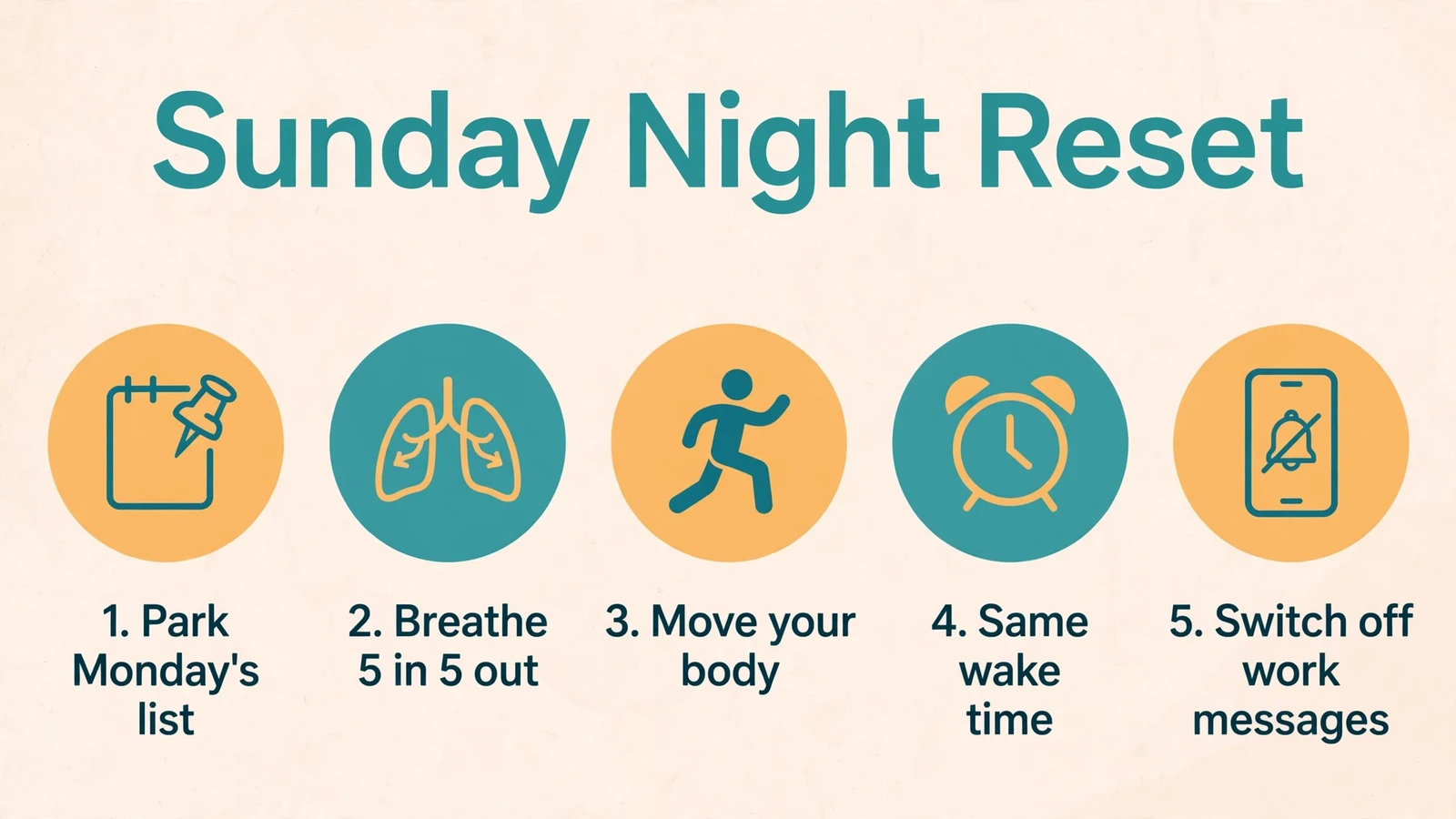
1. Park Monday’s list — on paper, not in your head
Take ten minutes to write down everything that is circling in your mind about the week ahead, then pick the three things that matter most for Monday and write them as a short list. The Cleveland Clinic’s advice is to jot down a to-do list for Monday — and then keep the list out of your head once it is written. Put the list somewhere you will see it in the morning, then close the notebook. The NHS Every Mind Matters programme suggests a similar idea: set a daily “worry time” at a fixed hour, so worries stop taking over the whole evening.
2. Breathe slowly: five in, five out
When anxiety rises, breathing becomes fast and shallow, which worsens the physical symptoms. The NHS breathing exercise for stress, anxiety and panic is simple and takes only a few minutes:
- Get comfortable, sitting or lying down, and let your breath flow as deep into your belly as is comfortable, without forcing it.
- Breathe in gently through your nose.
- Count steadily from 1 to 5 as you breathe in — you may not reach 5 at first, and that is fine.
- Let the breath flow out gently through your mouth, counting from 1 to 5 again.
- Repeat for at least 5 minutes.
The NHS says you get the most benefit from doing this regularly, as part of your daily routine.
3. Move your body
Regular exercise is one of the most reliable ways to ease anxiety — the NHS lists running, walking, swimming and yoga as activities that can help you relax. On a Sunday evening you do not need a workout; a brisk 20-minute walk or a gentle stretch is enough. Cleveland Clinic psychologists point out that exercise releases feel-good endorphins that can brighten your mood and give you the strength to take on Monday.
4. Keep a steady wake time — even at weekends
The single most effective sleep fix is boring but powerful: get up at roughly the same time every day, weekends included. The University of Melbourne guide suggests keeping weekend wake times within about an hour of your weekday time, and getting outside for morning light. If you want more weekend sleep, go to bed earlier on Friday rather than sleeping in late on Saturday — you get the same rest with far less clock shift.
5. Switch off work messages
Give yourself a clear cut-off: no work email, messages or apps after 6pm on Sunday. Turn off notifications or move the apps off your home screen for the evening. The Exeter research found weekend emails were a key trigger for the Sunday night blues, and the Cleveland Clinic’s advice is the same: if possible, avoid doing work over the weekend so you can fully separate from your job. That email can wait until Monday.
Make Sunday — and Monday — something to look forward to
Two small pleasures can soften the whole transition. First, plan something enjoyable for Sunday evening itself: a favourite meal, a film, a walk with a friend, a long bath. Second, give Monday a small treat of its own — a coffee from your favourite café or a good podcast for the commute. Cleveland Clinic psychologists call this making Mondays easier: easing back in with simpler tasks instead of scheduling the hardest meeting first thing.
When it is more than the Sunday scaries
Occasional Sunday night nerves are normal. But the pattern deserves a closer look if:
- The dread starts much earlier — on Saturday, or even Friday — and never really lifts
- It happens every single week and leaves you exhausted by Tuesday
- You feel anxious most days, not just on Sundays
- You are regularly unable to sleep, or you dread work so much that you feel tearful, sick or panicky
- You have started avoiding work, calling in sick, or drinking or using other substances to cope
- The anxiety is affecting your relationships, your appetite or your ability to enjoy anything
These signs do not mean something is seriously wrong with you — but they do suggest the problem is bigger than a Sunday evening routine can fix. Anxiety that is frequent, intense or long-lasting can be a sign of an anxiety condition, and effective help exists. The NHS advises not to self-diagnose: speak to a GP if you are worried about how you are feeling. You can also read our guide to getting help now for support options and what to expect.
When to see a doctor
See a GP if you are struggling to cope with anxiety, fear or panic, if the things you are trying yourself are not helping, or if you would like a referral to an NHS talking therapies service. If you are 18 or over, you can also refer yourself directly to an NHS talking therapies service without speaking to a GP first. Talking therapies such as cognitive behavioural therapy (CBT) can help with worry and the anticipation that drives Sunday night anxiety.
Get help sooner if anxiety stops you working, sleeping or looking after yourself, or if panic attacks keep coming back. If you cannot tell whether shortness of breath or chest pain is from anxiety, see a GP promptly — do not assume it is anxiety.
If you feel unable to cope or keep yourself safe, get support right away. You can call Samaritans free, day or night, on 116 123, or visit our get help now page for more options.
In an emergency call 911 (US), 999 (UK) or 112 (EU)
Sunday night anxiety is common, understandable and — for most people — very manageable. A short evening routine, a steadier sleep rhythm and a firm boundary around work messages can take the weight out of Sundays. If the feeling keeps coming back, that is a sign to get a little extra support.
Frequently asked questions
What is Sunday night anxiety?
Sunday night anxiety, often called the Sunday scaries, is a wave of dread, restlessness or low mood that arrives as the weekend ends and the working week approaches. Psychologists describe it as anticipatory anxiety — worry about something that has not happened yet. It is not a diagnosis, and it is very common: a LinkedIn survey found 80% of professionals experience it.
Why do I feel anxious every Sunday night?
Several things stack up: your mind rehearses Monday before it arrives, unfinished tasks and weekend work messages keep your brain switched on, and late nights and lie-ins shift your body clock, making sleep harder. Research from the University of Exeter also found energy dips on Sunday evenings. The sharper the contrast between your weekend and your working week, the heavier Sunday can feel.
What helps Sunday night anxiety tonight?
Try a five-step reset: write Monday's worries on paper and pick three priorities, then close the notebook; breathe slowly, in for 5 and out for 5, for at least 5 minutes; move your body with a walk or stretch; keep a steady wake time; and switch off work messages after a set time. Adding something enjoyable to Sunday evening and a small treat for Monday morning also helps.
Is Sunday night anxiety a sign of an anxiety disorder?
Not usually. Occasional Sunday nerves are normal and very common. It may be more than the Sunday scaries if the dread starts earlier in the weekend and never lifts, you feel anxious most days, you regularly cannot sleep, or anxiety is affecting your work, relationships or appetite. The NHS advises not to self-diagnose — speak to a GP if you are worried about how you are feeling.
How can I sleep better on a Sunday night?
Keep your wake time steady — within about an hour of your weekday time — even at weekends, and get morning sunlight to anchor your body clock. If you want more weekend sleep, go to bed earlier on Friday instead of sleeping in late. Avoid work messages in the evening, wind down with something relaxing, and try the NHS breathing exercise: in through your nose, out through your mouth, counting to 5 each way for at least 5 minutes.
When should I see a doctor about Sunday night anxiety?
See a GP if you are struggling to cope with anxiety, if the things you are trying yourself are not helping, or if you would like a referral to an NHS talking therapies service. Adults can also self-refer to NHS talking therapies. Get help sooner if anxiety stops you working, sleeping or looking after yourself, or if you have panic attacks that keep coming back.
Sources
- Cleveland Clinic: How To Fight Off the Sunday Scaries health.clevelandclinic.org
- NHS: Get help with anxiety, fear or panic www.nhs.uk
- NHS: Breathing exercises for stress www.nhs.uk
- NHS Every Mind Matters: Anxiety www.nhs.uk
- University of Exeter: Sunday Night Blues caused by weekend emails and blurred boundaries news.exeter.ac.uk
- University of Melbourne: How to maintain a consistent sleep-wake schedule psychologicalsciences.unimelb.edu.au

Try the tool
How have you felt over the last 2 weeks?
The PHQ-9 and GAD-7 that GPs use. Private, about 3 minutes.
Start the self-check