What Is TMS Therapy? How Magnetic Stimulation Treats Depression
Magnetic pulses, no surgery, no anaesthetic: how TMS therapy treats depression that hasn't responded to medication, what a course involves, and how well it works.
- Written by
- Health Daily Advice
- Published
- Reading time
- 8 minutes
- Sources
- 13 cited
In this guide
Transcranial magnetic stimulation (TMS) is a non-invasive treatment for depression that uses magnetic pulses to stimulate nerve cells in the brain. A coil held against the scalp targets the area that regulates mood. It is mainly used when antidepressants and talking therapy have not helped enough, and it is given in daily sessions over several weeks.
A magnet on your head sounds like science fiction, yet TMS has been used in clinics for years and is recommended by NICE for depression — and searches for TMS therapy have surged this week.
What is TMS therapy?
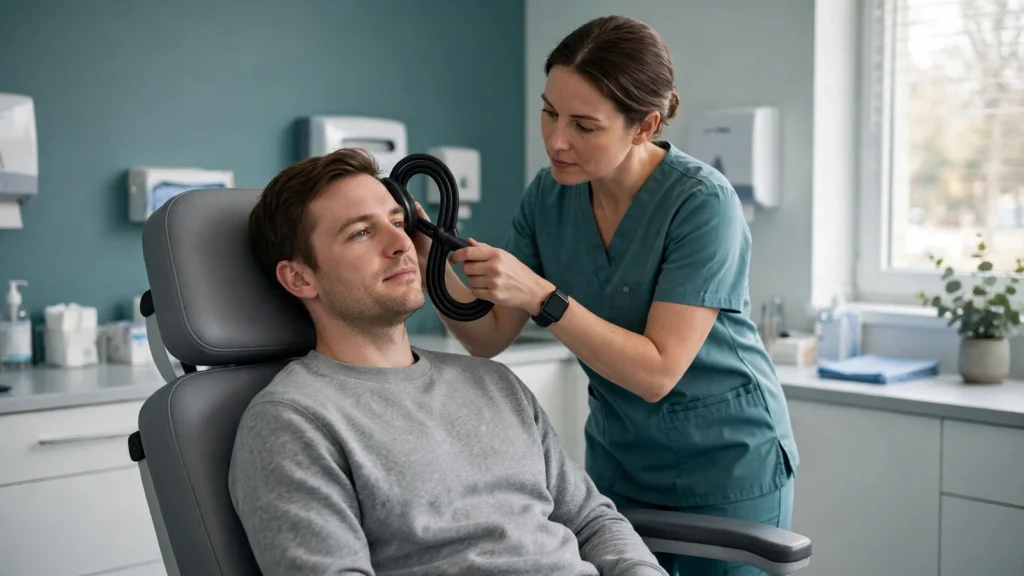
TMS stands for transcranial magnetic stimulation — “transcranial” simply means across the skull. An electromagnetic coil is placed against your scalp and sends brief magnetic pulses through the skull, creating tiny electrical signals in the nerve cells underneath. The Mayo Clinic describes it as non-invasive because it involves no surgery and no cutting of the skin.
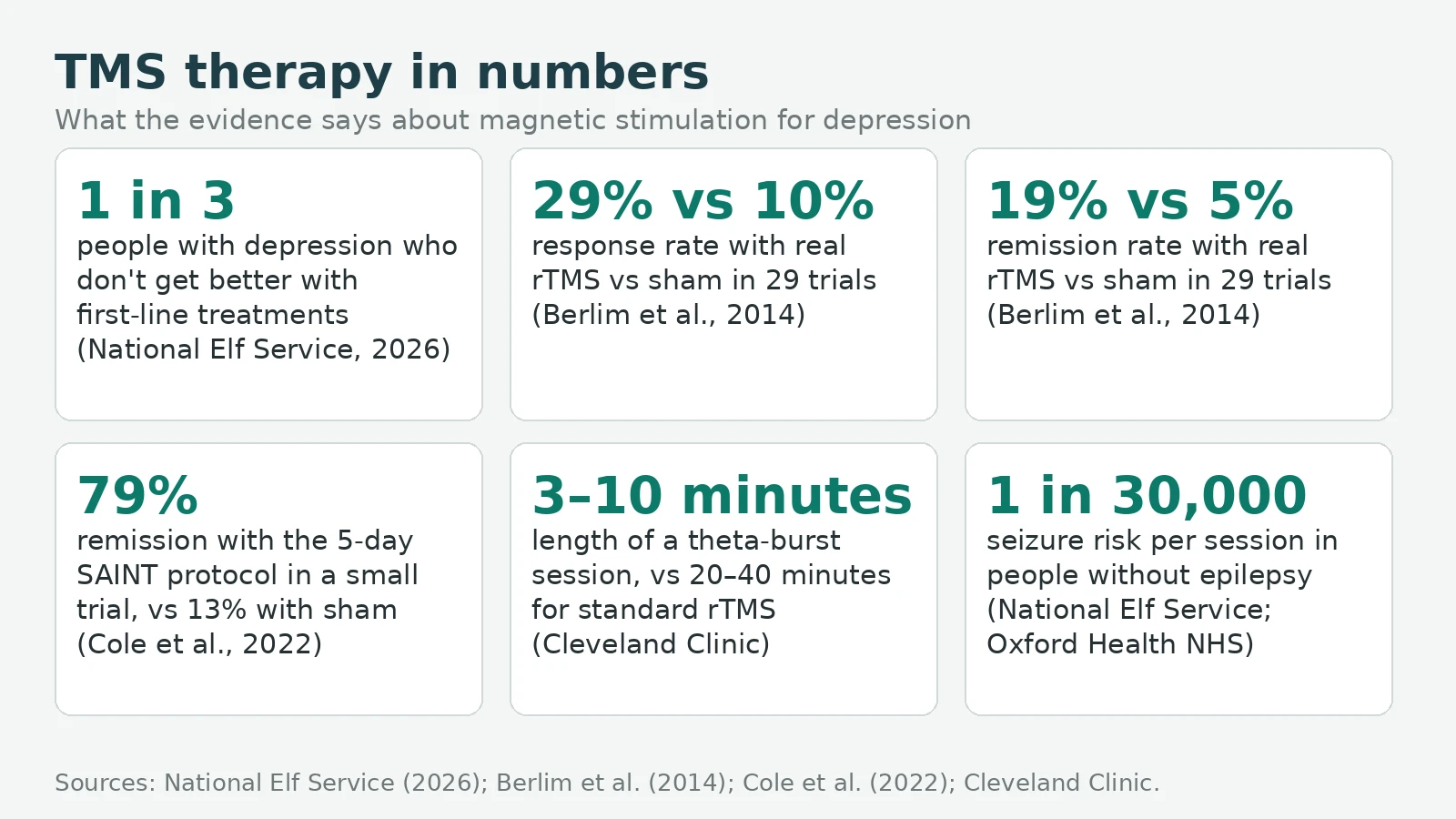
When the pulses are delivered repeatedly, the treatment is called repetitive TMS, or rTMS — the form used for depression. Variations include standard rTMS (sessions of 20 to 40 minutes), theta-burst stimulation (iTBS, 3 to 10 minutes), deep TMS (a helmet-like coil reaching deeper circuits), and accelerated TMS (several brief sessions a day). You stay awake throughout, with no anaesthetic (called anesthesia in the US) and no hospital stay.
How does TMS work for depression?
Depression is linked to underactive areas of the brain involved in mood control. In TMS for depression, the coil sits over the left dorsolateral prefrontal cortex — the part of the frontal lobe that helps regulate mood, planning and decision-making. The pulses are thought to wake up that underactive region and strengthen its connections with deeper brain areas involved in mood.
The Oxford Health NHS patient leaflet puts it plainly: rTMS stimulates the brain and promotes neuroplasticity, the brain’s ability to mend and build connections between nerve cells. The full biology is not yet fully understood, but the effect builds over repeated sessions — which is why TMS is given as a course, not a one-off.
Who is TMS therapy for?
TMS is mainly offered to people with depression that has not improved enough with standard treatment — what clinicians call treatment-resistant depression. It is far from rare: about one in three people with depression do not get better with first-line treatments such as antidepressants or talking therapies, according to the National Elf Service.
In practice, that usually means you will have tried at least one or two antidepressants first. In the US, insurers typically require two to four different antidepressants to have been tried before they will pay for TMS, Harvard Health reports. In the UK you need a psychiatrist’s referral and stay under your usual mental health team; TMS can also be combined with medication and talking therapy.
What happens during a course of TMS?
A course starts with a longer first appointment. The team works out your “motor threshold” — the smallest amount of magnetic energy needed to make your thumb twitch — which sets a personal dose. They then position the coil over the mood-regulating area, usually a few inches above the left temple.
Standard rTMS is one session a day, five days a week, for about six weeks — around 30 sessions of about 30 minutes each. Theta-burst sessions take only 3 to 10 minutes each. The accelerated theta-burst protocol packs three 9-minute sessions a day into two weeks — 30 sessions of 1,800 pulses each, with 50-minute breaks between them.
During a session you sit in a large adjustable chair, a bit like a dentist’s chair, wearing earplugs — the coil makes a loud clicking sound with every pulse. You feel a tapping sensation on your head and your scalp muscles may twitch. Oxford Health advises not driving on the first day, but you can usually drive after later sessions. Some people notice a change within a couple of weeks; others respond only later in the course.
What is the SAINT protocol?
The newest development is the accelerated approach developed at Stanford University, known as SAINT — Stanford Accelerated Intelligent Neuromodulation Therapy, now also called Stanford Neuromodulation Therapy. It compresses a whole course into five days: ten short sessions a day, each guided by the patient’s own MRI scan to target the precise spot in the left prefrontal cortex most strongly connected to a deep brain area overactive in depression.
In a small double-blind trial of 29 people with treatment-resistant depression, published in the American Journal of Psychiatry in 2022, 78.6% of those who received SAINT were in remission after five days, compared with 13.3% of those who received a placebo procedure. The FDA cleared the SAINT system in 2022. The trial was small and single-centre, so larger studies are needed — but it is a large part of why TMS is suddenly in the headlines.
How well does TMS work for depression?
It helps a meaningful share of people, but not everyone — and the figures depend on how you count. In controlled trials, a 2014 meta-analysis of 29 randomised trials involving 1,371 people found that 29.3% of those given high-frequency rTMS responded — meaning their symptoms fell by at least half — compared with 10.4% of those given a sham treatment. Remission, where symptoms fall below the threshold for diagnosis, was 18.6% with real rTMS versus 5% with sham.
Results in everyday clinic practice look better, probably because clinics treat people for longer and combine TMS with other care. Harvard Health reports that about 50% to 70% of people show a response after TMS, and about 30% to 40% reach remission. Reviews summarised by the National Elf Service conclude that real TMS roughly doubles the chance of response and remission compared with sham treatment.
Follow-up studies suggest that for people who reach remission after TMS, it usually lasts at least a year. A large UK trial found that people who benefited could expect to stay well for at least six months, though some needed a top-up course. Staying on antidepressant medication after TMS can also help prevent depression returning — discuss it with your doctor.
What are the side effects of TMS?
TMS is generally well tolerated. Its side effects are milder and more localised than those of many antidepressants, because the stimulation only affects the targeted area of the brain and the scalp over it. A 2022 review of 53 sham-controlled trials found scalp pain (24% vs 5% with sham), headache (23% vs 16%) and scalp discomfort (11% vs 5%) were the only side effects more common with real treatment. They tend to ease as sessions continue, and ordinary painkillers usually help.
Some people feel tired afterwards; fainting is rare, mostly early in a course. The most serious risk is a seizure: Oxford Health puts the risk at less than 1 in 30,000 to 50,000 treatments. It is higher in people with epilepsy — about 2 to 3% over a whole course — and can be raised by brain injury, alcohol use, sleep deprivation and some medicines. TMS does not cause memory loss or problems with thinking, according to the Cleveland Clinic.
Who cannot have TMS therapy?
Because TMS uses strong magnetic fields, you usually cannot have it if you have any metal in or near your head, apart from dental braces or fillings — including aneurysm clips or coils, stents in the neck or brain, deep brain stimulators, cochlear implants, metal shards or shrapnel, facial tattoos with metallic ink, and cardiac pacemakers.
People with epilepsy are not usually treated, because of the risk of triggering a seizure. Metal elsewhere in the body, such as a hip or knee replacement, is usually fine. Tell your clinic about any implants, head injuries, seizures or medicines before starting.
TMS vs ECT: what is the difference?
TMS is often mentioned alongside electroconvulsive therapy (ECT), another brain stimulation treatment for severe depression. TMS needs no anaesthetic — you stay awake — while ECT is given under general anaesthetic and deliberately causes a brief seizure, usually lasting less than a minute. TMS does not cause memory loss; after ECT, confusion and memory problems can follow, and driving is usually avoided for one to two weeks after the last treatment. TMS is given daily for about six weeks; ECT is usually given 2 to 3 times a week for 3 to 4 weeks, 6 to 12 treatments in total.
ECT is generally reserved for very severe depression, including situations where a fast response is needed. A 2025 review of 16 trials in treatment-resistant depression ranked theta-burst TMS first out of 25 treatments for remission — ahead of ECT. But the two suit different situations, and the choice is one to make with a psychiatrist.
Is TMS available on the NHS, and how much does it cost?
Access is the awkward part. NICE recommended rTMS for depression in 2015, finding no major safety concerns and adequate short-term evidence of benefit. Yet it is only available in about 1 in 7 mental health trusts at present, according to the National Elf Service — so whether you can get it on the NHS depends heavily on where you live. It is more widely available privately.
Where it is offered on the NHS, it is free. Privately, prices vary: Oxford Health charges £265 for an initial psychiatric assessment, £125 for a follow-up review, and £2,200 for a 30-session accelerated theta-burst course. In the US, the Mayo Clinic has put a six-week course at around $10,000, though insurance often covers it once a set number of antidepressants have been tried. In the UK, the route is usually through your GP to a psychiatrist, who can refer you to a neuromodulation service where one exists.
When to see a doctor
Talk to your GP or psychiatrist if your depression has not improved with antidepressants or talking therapy, or if you are interested in TMS. They can explain the treatments available in your area, refer you for assessment, and help you weigh the benefits and risks.
Get urgent help straight away if you feel you might act on thoughts of harming yourself, or if someone near you is in immediate danger. In an emergency call 911 (US), 999 (UK) or 112 (EU). If you need support now, you can also visit our get help now page for crisis helplines and resources.
TMS is not a quick fix, and it does not work for everyone. But for people whose depression has resisted medication and therapy, it offers something genuinely different: a treatment that targets the brain circuits involved in mood directly, without surgery or anaesthesia.
Frequently asked questions
What is TMS therapy for depression?
TMS (transcranial magnetic stimulation) is a non-invasive treatment that uses magnetic pulses to stimulate nerve cells in the brain. A coil held against the scalp targets the left prefrontal cortex, the area that regulates mood. It is mainly used when antidepressants and talking therapy have not helped enough, and it is given in daily sessions over several weeks.
How long does a course of TMS take?
A standard course is about 30 sessions, one a day, five days a week, for around six weeks. Each session lasts about 30 minutes, or only 3 to 10 minutes with theta-burst stimulation. Faster protocols pack the same number of sessions into two weeks, or even five days with the Stanford SAINT protocol. Your clinic will explain which schedule suits you.
How effective is TMS for depression?
In a meta-analysis of 29 trials, 29% of people given real rTMS responded, compared with 10% given a sham treatment, and 19% reached remission versus 5%. In everyday clinic practice the figures are higher: about 50% to 70% respond and 30% to 40% reach remission. It does not work for everyone, and remission usually lasts at least a year.
Is TMS therapy safe?
TMS is generally well tolerated. The most common side effects are scalp discomfort and headache, which usually ease as sessions continue. The most serious risk is a seizure, at less than 1 in 30,000 sessions in people without epilepsy. It does not cause memory loss, and no anaesthetic or surgery is involved. People with metal implants in or near the head usually cannot have it.
Can I get TMS therapy on the NHS?
It depends on where you live. NICE recommended rTMS for depression in 2015, but it is only available in about 1 in 7 mental health trusts in England, and some local health bodies do not fund it. Where it is offered on the NHS, it is free. It is more widely available privately: Oxford Health charges £2,200 for a 30-session accelerated course.
Sources
- Oxford Health NHS Foundation Trust: Repetitive Transcranial Magnetic Stimulation (rTMS) patient leaflet oxfordhealth.nhs.uk
- Mayo Clinic: Transcranial magnetic stimulation www.mayoclinic.org
- Cleveland Clinic: TMS (Transcranial Magnetic Stimulation): What It Is my.clevelandclinic.org
- NICE: Repetitive transcranial magnetic stimulation for depression (IPG542) www.nice.org.uk
- National Elf Service: Transcranial magnetic stimulation for difficult-to-treat depression: the evidence so far www.nationalelfservice.net
- Harvard Health Publishing: TMS treatment may succeed when depression drugs fail www.health.harvard.edu
- Stanford Medicine: Experimental depression treatment is nearly 80% effective in controlled study med.stanford.edu
- Berlim MT et al. Response, remission and drop-out rates following high-frequency rTMS for major depression. Psychological Medicine, 2014 pubmed.ncbi.nlm.nih.gov

Try the tool
How have you felt over the last 2 weeks?
The PHQ-9 and GAD-7 that GPs use. Private, about 3 minutes.
Start the self-check