Why Are My Periods Irregular? Common Causes Explained
Periods that arrive too early, too late or not at all usually have an explainable cause. Here is how doctors define an irregular cycle, the most common reasons behind it, and when to book a GP appointment.
- Written by
- Health Daily Advice
- Published
- Reading time
- 3 minutes
- Sources
- 8 cited

In this guide
Your periods are irregular if the gap between them is usually less than 21 days or more than 35 days. Common causes include stress, weight changes, too much exercise, hormonal contraception, PCOS, thyroid disorders and perimenopause. Most irregular periods are harmless, but see a GP if the pattern changes or worries you.
What counts as an irregular period?
The average gap between periods starting (the menstrual cycle) is around 28 days, and it can be a little shorter or longer than that. According to the NHS, your periods are irregular if the gap between them is less than 21 days or more than 35 days. Day 1 of your cycle is the first day of your period, and the last day of your cycle is the day before your next one.
Irregular periods can affect anyone who has periods. They are more likely when periods first start during puberty and when you are nearing the menopause. Tracking your cycle in an app or diary can help you see whether it is irregular.
A single late or early period is rarely a cause for concern. Skipping one or two periods is not ideal but is not usually alarming — lifestyle changes such as stress, a new workout routine, weight change or a new contraceptive method can all shift your cycle. The Cleveland Clinic advises calling your healthcare provider if you miss three or more periods in a row.
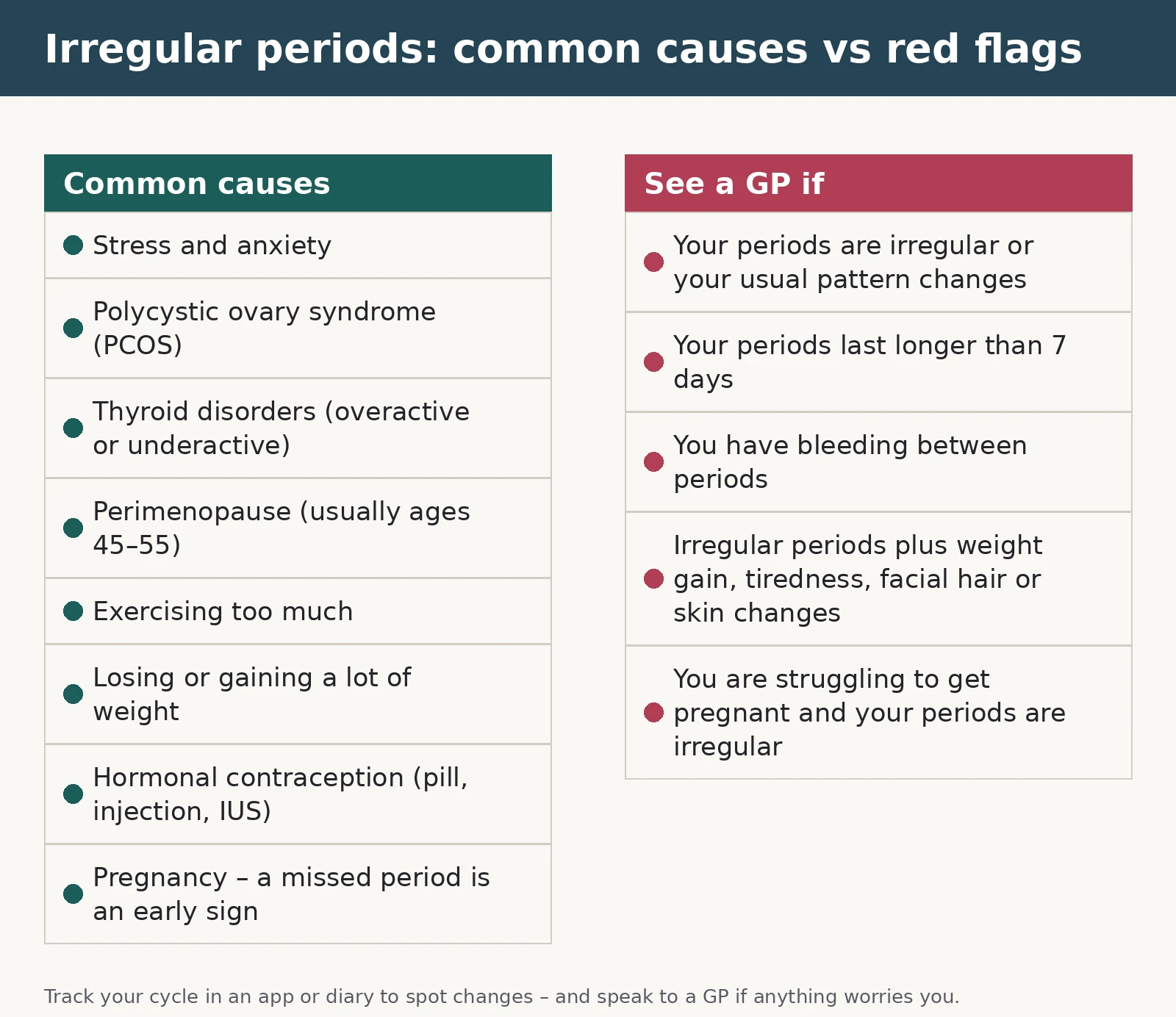
The most common causes of irregular periods
Stress and anxiety
Stress is one of the most common disruptors of the menstrual cycle. The brain region that controls your period is sensitive to cortisol, the stress hormone, so short-term stress can delay ovulation while chronic stress can suppress the hormones that drive the cycle altogether. The Women’s Health Network notes that ongoing high cortisol can influence progesterone and oestrogen levels enough to disturb menstruation.
Polycystic ovary syndrome (PCOS)
PCOS is a hormonal condition in which the body produces more androgens (sometimes called “male” hormones) than usual. This can stop ovulation from happening regularly, leading to infrequent or unpredictable periods. Insulin resistance is a common underlying feature. Mayo Clinic lists PCOS among the medical conditions to check when irregular periods cannot be explained by lifestyle factors alone.
Thyroid disorders
The thyroid gland helps regulate the hormones that control your cycle. Both an underactive thyroid (hypothyroidism) and an overactive thyroid (hyperthyroidism) can make periods irregular, heavier, lighter or less predictable. Mayo Clinic advises that thyroid disorders are one of the first medical causes your doctor will investigate.
Perimenopause
The years leading up to the menopause — usually between the ages of 45 and 55, according to the NHS — bring fluctuating oestrogen and progesterone levels that can make cycles longer, shorter, heavier or lighter. These hormonal shifts can begin years before your last period, so irregular bleeding in your 40s does not necessarily signal a problem, though it is still worth discussing with your GP.
Exercising too much and weight changes
Intense exercise, significant weight loss or rapid weight gain can all disrupt ovulation. Very low body fat or an eating disorder can even stop periods altogether. If your routine has changed recently — a new training plan, a strict diet or a noticeable shift in weight — that may be all that is behind the change.
Hormonal contraception
The progestogen-only pill, the contraceptive injection and the intrauterine system (IUS, sometimes called the hormonal coil) commonly cause irregular bleeding, lighter periods or no periods at all. Switching methods or starting and stopping contraception can also cause temporary irregularity. If bleeding worries you, talk to a doctor or pharmacist rather than stopping your method without advice.
Pregnancy
A missed period is often an early sign of pregnancy. Even if your cycles are irregular, you may still be ovulating, so Mayo Clinic recommends ruling pregnancy out first with a test before investigating other causes.
When to see a doctor
Irregular periods are not usually a sign of a problem. But speak to a GP if:
- your periods are irregular or your usual pattern changes
- your periods last longer than 7 days
- you have bleeding between periods
- you have irregular periods plus other symptoms such as weight gain, tiredness, hair growth on your face, or dry or oily skin
- your periods are irregular and you are struggling to get pregnant
Your GP may refer you to a gynaecologist for tests, and any treatment will depend on the underlying cause — for example, treating a thyroid problem or adjusting contraception. If you are trying to conceive, unpredictable ovulation can make pregnancy harder, so seek advice early.
In an emergency call 911 (US), 999 (UK) or 112 (EU)
Frequently asked questions
Can stress make my period late?
Yes. Stress raises cortisol, the stress hormone, which can interfere with the brain signals that trigger ovulation. Short-term stress may delay your period by a few days, while chronic stress can suppress ovulation for longer. If nothing else explains a late period and life has been difficult, stress is a likely culprit. Keep a cycle diary so you can show your GP the pattern.
What is considered an irregular period?
The NHS defines periods as irregular when the gap between them is less than 21 days or more than 35 days. The average cycle is around 28 days. A single early or late period is rarely a worry; irregularity means the pattern keeps changing over several cycles, which is easier to spot if you track your start dates in an app or diary.
Can birth control make my periods irregular?
Yes. The progestogen-only pill, the contraceptive injection and the intrauterine system (IUS) commonly cause irregular bleeding, lighter periods or no periods at all. Starting, stopping or switching methods can also cause temporary irregularity. Do not stop your method without advice — talk to a doctor or pharmacist if the bleeding worries you.
Is it normal to miss a period for three months?
Skipping one or two periods is not ideal but usually nothing to worry about, especially after a change in stress, exercise, weight or contraception. However, the Cleveland Clinic advises calling your healthcare provider if you miss three or more periods in a row, as that pattern deserves investigation once pregnancy is ruled out.
Can PCOS cause irregular periods?
Yes. Polycystic ovary syndrome is one of the most common medical causes of irregular periods. The extra androgens it produces can prevent ovulation, so periods arrive infrequently or unpredictably. Other possible clues include weight gain, tiredness, facial hair growth and skin changes — a combination the NHS says should prompt a GP visit.
When should I see a GP about irregular periods?
See a GP if your periods are irregular or your usual pattern changes, if bleeding lasts longer than seven days, if you bleed between periods, if irregular periods come with weight gain, tiredness, facial hair or skin changes, or if irregular periods are making it hard to get pregnant. These are the signs the NHS lists for booking an appointment.
Sources
- NHS: Irregular periods www.nhs.uk
- Mayo Clinic News Network: Many Possible Causes of Irregular Periods newsnetwork.mayoclinic.org
- Cleveland Clinic: Irregular Periods (Abnormal Menstruation) dev.mycc.clevelandclinic.org
- AAFP/ACOG: Guidelines on Abnormal Uterine Bleeding with Ovulatory Dysfunction www.aafp.org
- Women's Health Network: Causes of Irregular Periods www.womenshealthnetwork.com

Try the tool
When is your next period and fertile window?
Six cycles ahead from your last period date.
Open the calculator

