Low Libido in Women: Common Causes and What Helps
A lasting drop in desire that bothers you is common and often has several overlapping causes. Here is what drives it and what helps, cause by cause.
- Written by
- Health Daily Advice
- Published
- Reading time
- 5 minutes
- Sources
- 8 cited

In this guide
Low libido in women means a lasting drop in sexual desire that bothers you. It is often caused by a mix of stress, tiredness, relationship difficulties, hormone changes in pregnancy, breastfeeding or menopause, low mood, long-term health conditions, and some medicines. Finding the cause matters, because treatment depends on it, and help is available.
What low libido means — and what it does not mean
Desire naturally rises and falls through life. Mayo Clinic states that women’s sexual desire changes over the years, that highs and lows commonly coincide with the start or end of a relationship or major life changes such as pregnancy, menopause or illness, and that there is “no magic number” to define low sex drive — it varies (Mayo Clinic).
Mayo Clinic lists symptoms as having less or no interest in any type of sexual activity, never or only seldom having sexual fantasies or thoughts, and being sad or concerned about the lack of sexual activity or fantasies. Importantly, Mayo Clinic also notes that sexual dysfunction is a problem only if it bothers the person — if it does not bother her, she does not need treatment (Mayo Clinic). A lower level of desire than you once had does not automatically mean something is wrong; it becomes worth addressing when it persists, causes distress, or strains a relationship.
Common causes at a glance
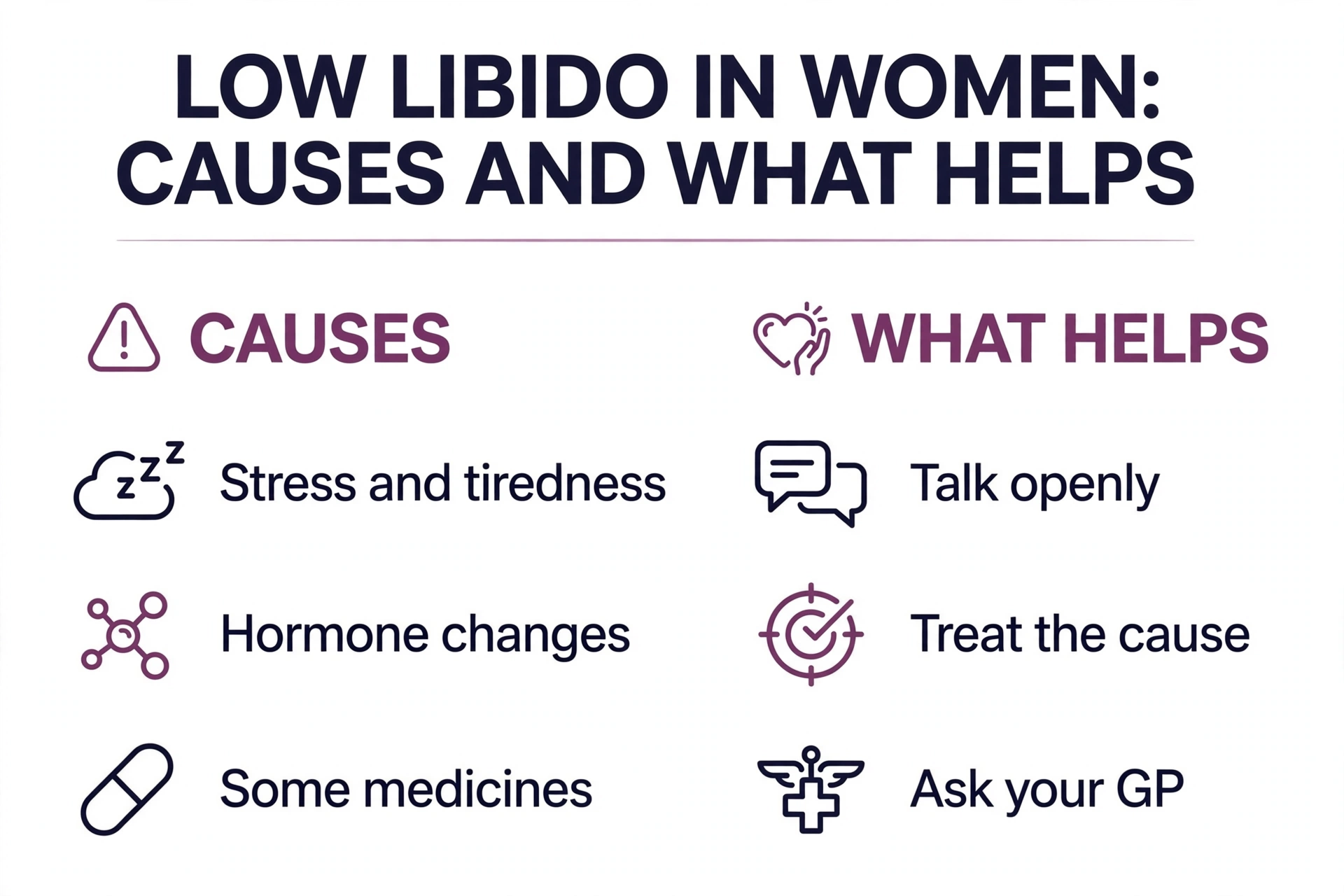
Low libido is usually multifactorial: several causes overlap rather than a single one acting alone. The main groups are stress and tiredness, low mood, relationship difficulties, hormone changes, medicines, and long-term health conditions.
Stress, tiredness and mental health
Mayo Clinic lists psychological causes including anxiety or depression, stress tied to finances, relationships or work, poor body image, low self-esteem, a history of physical, emotional or sexual abuse, and past negative sexual experiences (Mayo Clinic). It also lists fatigue separately, including exhaustion from caring for young children or ageing parents, and fatigue from illness or surgery. NHS Wales likewise lists relationship problems, stress, anxiety or depression, and drinking too much alcohol among the main causes of low sex drive (NHS Wales).
Relationship factors
For many people, emotional closeness is key to sexual intimacy. Mayo Clinic lists lack of connection, unresolved conflicts, poor communication of sexual needs and desires, trust issues, concern over a partner’s ability to have sex, and not enough privacy (Mayo Clinic). NHS Wales lists relationship problems first among main causes, and relationship counselling as a possible treatment where relationship problems are the cause (NHS Wales).
Hormone changes: pregnancy, breastfeeding and menopause
Mayo Clinic states that oestrogen levels drop during menopause, which can make a woman less interested in sex and cause vaginal dryness, leading to painful or uncomfortable sex, while also noting that many women still have satisfying sex during menopause and beyond (Mayo Clinic). Pregnancy and breastfeeding are other turning points, when hormone changes, fatigue and changes in body image can dampen sex drive. NHS Wales lists pregnancy and having a baby — hormone changes plus the stress and tiredness of looking after a baby — and lower hormone levels as women get older, particularly during the menopause (NHS Wales).
Medicines: SSRIs and hormonal contraception
Mayo Clinic states that some prescription medicines lower sex drive, “especially depression medicines called selective serotonin reuptake inhibitors (SSRIs)” (Mayo Clinic). NHS Wales lists taking certain medicines, such as medicine for high blood pressure or antidepressants, and using hormonal contraception like the pill, patch or implant, among main causes, and advises seeing a GP if a medicine or hormonal contraception may be affecting sex drive (NHS Wales). Never stop a prescribed medicine on your own: a clinician-led review may involve changing to a different medicine or type of contraception, or treating another cause entirely. Depression itself can also lower desire, so the picture is rarely simple.
Health conditions and pain during sex
Mayo Clinic lists diseases that can affect sex drive, including cancer, diabetes, high blood pressure, coronary artery disease and neurological diseases, and sexual conditions such as pain during sex or being unable to orgasm (Mayo Clinic). NHS Wales lists long-term conditions including heart disease, diabetes, an underactive thyroid and cancer (NHS Wales). Pain or dryness during sex can itself lower desire, so treating dryness or pain is often part of the answer rather than a separate problem.
When low desire becomes HSDD
An American College of Obstetricians and Gynecologists guideline summary defines hypoactive sexual desire disorder (HSDD) as a persistent or recurrent deficiency or absence of sexual desire or receptivity to sexual activity, and states that sexual dysfunction in women should be diagnosed when symptoms cause distress or interpersonal problems (AAFP / ACOG guideline summary). The same summary gives an older estimate that HSDD affects between 5.4 and 13.6 percent of women, peaking in women aged 40 to 60 and in those who have undergone surgical menopause. You do not have to meet a medical definition to seek help, and a GP can assess whether your symptoms fit a treatable pattern.
What helps
NHS Wales says treatment depends on the cause, and that a GP can advise on help and treatments including relationship counselling, medicines for problems such as vaginal dryness, HRT for menopause, antidepressants or cognitive behavioural therapy (CBT) for mental-health problems, and changing a medicine or contraception type (NHS Wales). Mayo Clinic lists non-medical options including talking openly with a partner, living healthily by limiting alcohol and being physically active, learning ways to lower stress, seeking counselling or therapy, using a lubricant for vaginal dryness or pain, using a vaginal moisturiser, and staying sexually active (Mayo Clinic).
For menopause-related low sexual desire, NICE guideline NG23 recommends considering testosterone supplementation if HRT alone is not effective, noting this was an off-label use (NICE NG23). That is a clinician-led decision after assessment, not something to try on your own. Mayo Clinic notes that a mix of treatments addressing medical, relationship and emotional issues most often works best. Be wary of unproven quick fixes marketed for libido: talk to a doctor or pharmacist before trying any product, and never stop a prescribed medicine without advice.
When to see a doctor
See your GP if low desire distresses you, strains your relationship, started after a new medicine, came on suddenly or is worsening, does not return after pregnancy, or comes with fatigue, low mood, pain during sex, vaginal dryness or a long-term condition. Talk to a doctor or pharmacist about any medicines or products rather than starting or stopping treatment on your own.
In an emergency call 911 (US), 999 (UK) or 112 (EU).
Frequently asked questions
Is low libido normal?
Yes, in the sense that desire naturally rises and falls through life. Mayo Clinic says there is no magic number for low sex drive and that it varies between women. A lower level than you once had does not automatically mean something is wrong. It becomes worth addressing when it persists, causes you distress, or strains your relationship.
Can antidepressants lower libido?
Yes, they can. Mayo Clinic singles out SSRIs — a common type of antidepressant — as medicines that can lower sex drive, and NHS Wales lists antidepressants among medicines that may affect it. Depression itself can also lower desire, so the picture is rarely simple. Speak to your GP about a review rather than stopping a prescribed medicine on your own.
Does the menopause cause low libido?
It can contribute. Mayo Clinic explains that falling oestrogen in menopause can reduce interest in sex and cause vaginal dryness, making sex painful or uncomfortable. NICE lists low sexual desire among menopause-associated sexual difficulties. Many women still enjoy satisfying sex after menopause, and treating dryness, mood or other menopause symptoms can help.
Can hormonal contraception affect sex drive?
NHS Wales lists hormonal contraception — the pill, patch or implant — among the main causes of low sex drive, and advises seeing a GP if you think it may be affecting you. The effect varies from person to person. A GP can discuss whether a different type of contraception, or another cause entirely, better explains the change.
Can low libido be improved?
Often, yes — but it depends on the cause. NHS Wales says treating the cause should help increase sex drive. That may mean better sleep and stress management, relationship counselling, treating an underlying condition, reviewing a medicine, or addressing vaginal dryness or menopause symptoms. Mayo Clinic notes that a mix of medical, relationship and emotional approaches most often works best.
Sources
- NHS Wales: Loss of libido 111.wales.nhs.uk
- Mayo Clinic: Low sex drive in women — symptoms and causes www.mayoclinic.org
- Mayo Clinic: Female sexual dysfunction — diagnosis and treatment www.mayoclinic.org
- NICE NG23: Menopause — identification and management www.nice.org.uk
- AAFP / ACOG guideline summary: Sexual dysfunction in women www.aafp.org

Try the tool
When is your next period and fertile window?
Six cycles ahead from your last period date.
Open the calculator

