Why Do I Feel Anxious for No Reason? Causes and What Helps
Anxiety with no obvious trigger is common and usually has a cause — hidden stress, hormones, caffeine or a health condition. Here is why it happens and what helps.
- Written by
- Health Daily Advice
- Published
- Reading time
- 7 minutes
- Sources
- 7 cited

In this guide
Feeling anxious when nothing is wrong is more common than people realise, and it does not mean you are imagining it. Anxiety can be set off by hidden stress, hormones, caffeine, poor sleep or a health problem — and sometimes the brain’s alarm system fires with no clear trigger. The feeling is real, and there are ways to calm it.
What “anxious for no reason” usually means
Anxiety is the body’s alarm system. When you sense danger, your brain releases hormones that speed up your heart, tighten your muscles and sharpen your senses so you can react quickly. That response is useful when a real threat exists — but it can also switch on when nothing is happening. The hormones are still released, and because there is nothing to fight or run from, you feel the surge as a racing heart, a tight chest, restlessness or a sense of dread.
The NHS puts it simply: anxiety is sometimes triggered by nothing obvious, and not knowing the cause can itself be upsetting. That is a normal experience, not a personal failure. The job is not to find a single dramatic reason, but to understand which of the quieter causes might be at work — and what you can do about them.
Why anxiety can appear out of nowhere
There is rarely one cause. Anxiety usually builds from a mix of background pressures, biology and habits. These are the reasons reputable health sources point to most often.
Hidden stress and subconscious triggers
Stress does not have to be dramatic to matter. A slow build-up of smaller pressures — money worries, work strain, relationship tension, a health concern you keep pushing aside — can leave your nervous system on edge for weeks. Then a small cue, like a place, a smell or a news story, can set off anxiety without you noticing the connection. The NHS suggests keeping a diary of what you were doing and how you felt at different times, because patterns often only show up once they are written down.
Brain chemistry and family history
Some people are simply wired to be more anxious. The NHS lists overactivity in the brain areas involved in emotion and behaviour, along with imbalances in the chemical messengers serotonin and noradrenaline, as factors behind generalised anxiety. Mayo Clinic adds that inherited traits play a part, and that personality type can make some people more prone to anxiety. The NHS estimates that you are five times more likely to develop generalised anxiety disorder if a close relative has it — so if anxiety runs in your family, you are starting from a higher baseline.
Past trauma and long-term stress
Difficult experiences leave a mark even years later. Mayo Clinic lists childhood abuse or trauma, witnessing traumatic events, and the slow build-up of smaller stressful situations such as bereavement, work stress or money worries as risk factors. The NHS also lists stressful or traumatic experiences such as domestic violence, child abuse or bullying, and painful long-term health conditions such as arthritis, as factors that raise the chances of anxiety.
Hormones
Hormones can turn the volume of anxiety up and down. Cleveland Clinic calls thyroid problems among the most common medical causes of anxiety, whether the gland is overactive or underactive, and notes that oestrogen can prompt anxiety when levels fluctuate during the menstrual cycle and during menopause. Mayo Clinic also lists thyroid problems, diabetes and heart disease among medical conditions linked to anxiety. If your anxiety appeared alongside other changes — feeling hot, a racing pulse, weight changes, or a change in your periods — a hormone check is worth discussing with your GP.
Health conditions you may not know about
Anxiety can be a symptom of a physical problem rather than a mental health problem on its own. Cleveland Clinic’s doctors list tumours that release excess adrenaline, infections such as Lyme disease, vitamin B12 deficiency, head injury, chronic pain and electrolyte disturbances among the medical causes they consider. Mayo Clinic adds respiratory disorders such as COPD and asthma, chronic pain and irritable bowel syndrome. Cleveland Clinic advises suspecting a medical cause when anxiety appears for the first time in adulthood, comes on suddenly, fluctuates a lot, or follows a recent change in medication.
Caffeine, alcohol and medicines
What you drink and take matters more than most people expect. Cleveland Clinic warns that excess caffeine can make many adults and children anxious, and flags energy drinks and “boosters” in particular. The NHS advises against drinking lots of coffee, tea, cola or energy drinks, because caffeine can disturb sleep and make anxiety harder to control. Alcohol, drug misuse and withdrawal from alcohol or anti-anxiety medicines can also cause or worsen anxiety, according to Mayo Clinic — and Mind notes that certain medications can cause anxiety as a side effect. If your anxiety started soon after a new medicine, tell the doctor who prescribed it rather than stopping it on your own.
Poor sleep
Anxiety and sleep feed each other. Anxiety disrupts sleep, and a bad night leaves the nervous system more reactive the next day — so the same small worry feels bigger. The NHS lists trouble sleeping as a core symptom of anxiety and recommends getting enough sleep because it gives you the energy to cope with difficult feelings. Breaking that loop, even a little, is one of the most practical things you can do.
How common is it?
Very common. The Anxiety & Depression Association of America, using US National Institute of Mental Health data, reports that an estimated 19.1% of US adults had an anxiety disorder in the past year, and 31.1% experience one at some time in their lives. The Anxiety & Depression Association of America reports that generalised anxiety disorder affects 6.8 million US adults — about 3.1% of the population — yet only 43.2% are receiving treatment. In England, Mind reports that one in five adults had a common mental health condition in the 2023/24 Adult Psychiatric Morbidity Survey, with generalised anxiety disorder the most common at 7.5%. Women are affected more often than men, but anxiety touches every age group and background.
Everyday anxiety or an anxiety disorder?
Occasional anxiety is a normal part of life, according to Mayo Clinic. The question is whether it is starting to run your life. This comparison can help you judge:
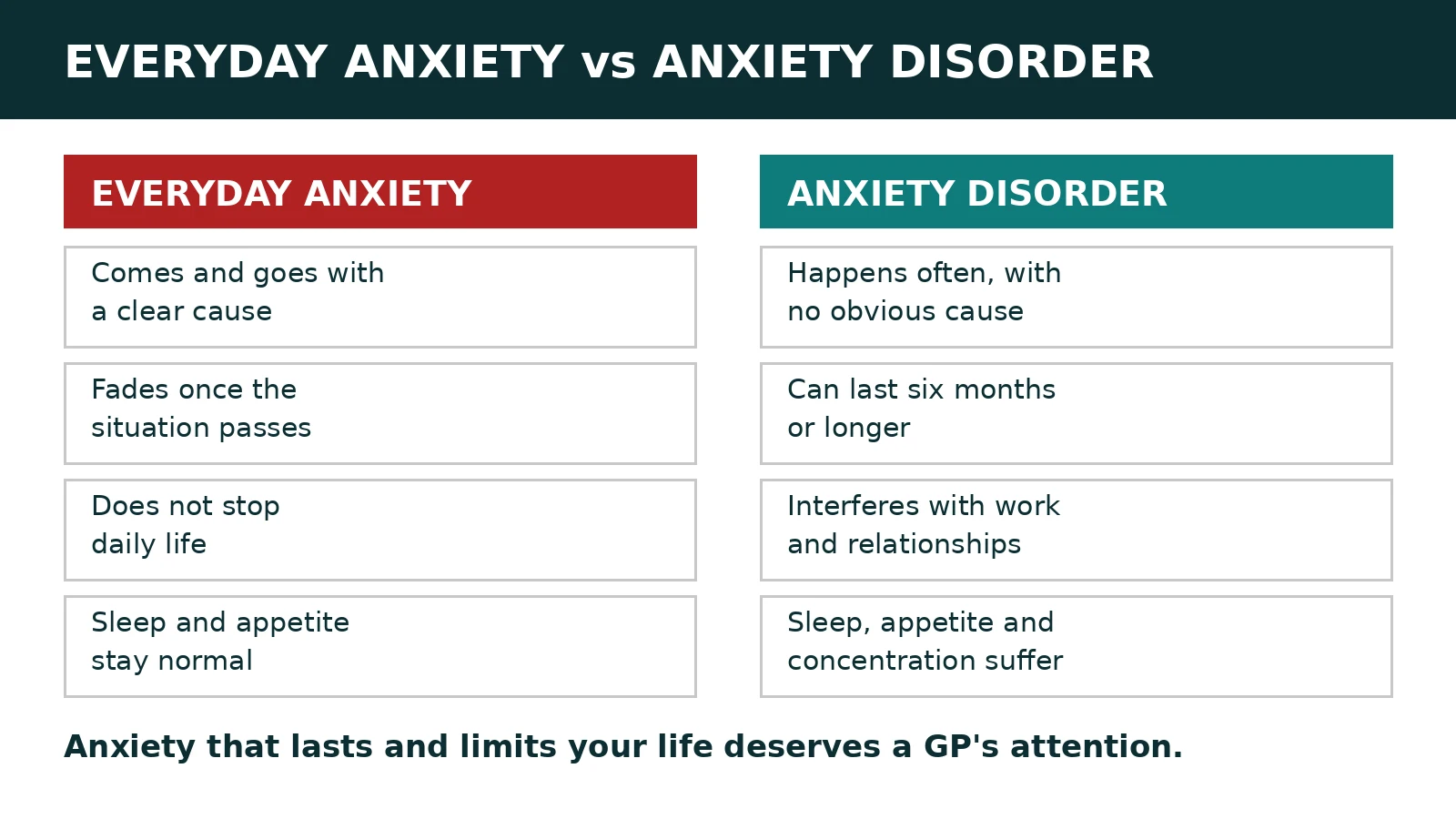
A GP may diagnose generalised anxiety disorder if you have felt anxious a lot of the time for at least six months and it affects your daily life. Panic attacks are a related pattern: the NHS says a panic attack can come on very quickly and for no apparent reason, and most panic attacks last between 5 and 20 minutes. If your anxiety comes with dizziness, you may find our guide to whether anxiety can cause dizziness useful.
What helps in the moment
When anxiety surges for no clear reason, small physical steps work better than arguing with the feeling:
- Slow your breathing. Breathe in slowly through your nose and out slowly through your mouth. The NHS recommends calming breathing exercises, and during a panic attack it advises staying where you are, breathing slowly and deeply, and reminding yourself that the attack will pass.
- Ground yourself. Name five things you can see, four you can touch, three you can hear, two you can smell and one you can taste. It pulls attention back to the present moment.
- Set a worry time. The NHS suggests giving worries a fixed slot in the day, so they do not take over the whole day. When a worry pops up outside that slot, note it down and return to it later.
- Move. Even a short walk can burn off some of the tension hormones behind the surge. The NHS recommends regular exercise such as running, walking, swimming or yoga.
- Write it down. A quick note of what you were doing and how you felt can reveal hidden triggers over a week or two.
Longer-term steps that lower anxiety
Calming the nervous system is a daily practice, not a one-off fix. The steps the NHS and Mayo Clinic recommend most are:
- Talk about it. Share how you feel with a friend, family member or counsellor. In England, adults can refer themselves directly to an NHS talking therapies service without a GP referral.
- Try self-help CBT. Cognitive behavioural therapy techniques — including self-help books and online courses based on CBT — help you spot and challenge the thought patterns that feed anxiety. A GP can recommend one.
- Face fears gradually. Avoiding situations that make you anxious, or relying on safety habits, can make anxiety worse over time. Facing fears in small, manageable steps is one of the most effective approaches the NHS recommends.
- Sleep, eat and move regularly. Enough sleep, regular meals, a healthy diet and regular exercise all give you more capacity to cope with difficult feelings.
- Cut back on caffeine and alcohol. Both can disturb sleep and make anxiety harder to control.
- Get help early. Mayo Clinic stresses that anxiety is harder to treat if you wait, so do not put off asking for support.
Professional treatment, if a GP recommends it, usually means talking therapy — usually CBT, alone or in a group — or, if needed, a medicine such as an SSRI antidepressant. The NHS usually advises trying talking therapies before prescribing medicine.
When to see a doctor
See a GP if worrying too much is interfering with work, relationships or other parts of your life; if fear, worry or anxiety feels upsetting and difficult to control; if treatments you have tried are not helping; or if you think your anxiety could be linked to a physical health problem — especially if it started suddenly in adulthood with no obvious trigger. Mayo Clinic also advises seeing a doctor if you feel depressed, have trouble with alcohol or drug use, or have other mental health concerns alongside anxiety.
If you feel you cannot cope, or you have thoughts of harming yourself, reach out straight away. In the UK, call Samaritans on 116 123, or visit our get help now page. In the US, call or text 988.
In an emergency call 911 (US), 999 (UK) or 112 (EU).
Frequently asked questions
Why do I feel anxious for no reason?
Anxiety does not always need an obvious trigger. The NHS says there is sometimes no clear cause, and the feeling can come from background stress, subconscious triggers, brain chemistry, family history, hormones or a medical condition. Mind explains that the fight-or-flight response can switch on even when nothing is happening right now, producing real physical symptoms.
Is it normal to feel anxious for no reason?
Yes — occasional anxiety is a normal part of life, according to Mayo Clinic. It becomes a problem when it is intense, hard to control, goes on for months, or interferes with daily life, work or relationships. That pattern may point to an anxiety disorder such as generalised anxiety disorder, which a GP can assess.
Can anxiety be caused by a physical health problem?
Yes. Mayo Clinic and Cleveland Clinic both list medical causes, including thyroid problems, heart disease, diabetes, respiratory disorders, vitamin B12 deficiency and certain medicines. Cleveland Clinic advises a medical check especially when anxiety appears for the first time in adulthood or starts suddenly with no obvious trigger.
Can caffeine make anxiety worse?
Yes. Cleveland Clinic says excess caffeine can make many adults and children anxious and warns about energy drinks, and the NHS advises cutting back on coffee, tea, cola and energy drinks because caffeine can disturb sleep and make anxiety harder to control. Cutting back gradually is usually easier than stopping all at once.
When should I see a doctor about anxiety?
See a GP if worrying too much interferes with work or relationships, feels uncontrollable, has lasted six months or more, or you think a physical cause may be involved. Mayo Clinic stresses getting help early, before anxiety gets worse. In England, adults can also refer themselves directly to an NHS talking therapies service.
Sources
- NHS: Anxiety (Every Mind Matters) www.nhs.uk
- NHS: Generalised anxiety disorder (GAD) www.nhs.uk
- NHS: Panic disorder www.nhs.uk
- Mayo Clinic: Anxiety disorders — symptoms and causes www.mayoclinic.org
- Cleveland Clinic: Is a Hidden Medical Condition Causing Your Anxiety? health.clevelandclinic.org
- Mind: About anxiety www.mind.org.uk
- Anxiety & Depression Association of America: Facts & Statistics adaa.org

Try the tool
How have you felt over the last 2 weeks?
The PHQ-9 and GAD-7 that GPs use. Private, about 3 minutes.
Start the self-check