Hormone Therapy for Menopause: Benefits, Risks and Who It Helps
Hormone therapy is the most effective treatment for hot flushes and night sweats. This guide explains the types, benefits and risks, and who should — and should not — take HRT.
- Written by
- Health Daily Advice
- Published
- Reading time
- 7 minutes
- Sources
- 8 cited

In this guide
Hormone therapy replaces the oestrogen and progesterone that fall as periods stop, and it remains the most effective treatment for hot flushes and night sweats. For most healthy women under 60 who start within ten years of menopause, the benefits usually outweigh the risks, although the right type, route and length of treatment need a careful discussion with a GP.
What is hormone therapy for menopause?
Menopause is when periods stop because hormone levels have fallen, usually between the ages of 45 and 55, although it can happen earlier. Hormone therapy, often shortened to HRT, replaces the hormones the ovaries no longer make in the same amounts, mainly oestrogen and progesterone.
Timing matters. The Mayo Clinic explains the benefits are most likely to outweigh the risks when treatment starts before 60 or within ten years of menopause; starting later increases the risk of serious complications. The British Menopause Society agrees that healthy women under 60 should not be concerned about the safety profile of HRT.
What symptoms does HRT help with?
Hot flushes and night sweats are the symptoms HRT treats best. The Mayo Clinic calls systemic oestrogen the most effective treatment for them, and NICE recommends HRT as the first-line treatment in its guideline NG23. The NHS says HRT relieves most menopause symptoms, including hot flushes, night sweats, sleep problems, anxiety and low mood, and vaginal dryness, usually within a few days or weeks.
Oestrogen can also ease vaginal dryness, itching, burning and pain during sex. These symptoms are common: NICE records that among women aged 40 to 65 in England, 2,068,919 — about 21.1 per cent — experience hot flushes and night sweats, and 699,001 of them, or 53.9 per cent, received HRT in 2022/23.
What are the types of HRT?
The first choice is between oestrogen-only HRT, usually for women who have had their womb removed, and combined HRT, needed if the womb is still present: oestrogen alone can thicken the womb lining and raise the risk of womb cancer, while the progestogen protects against this.
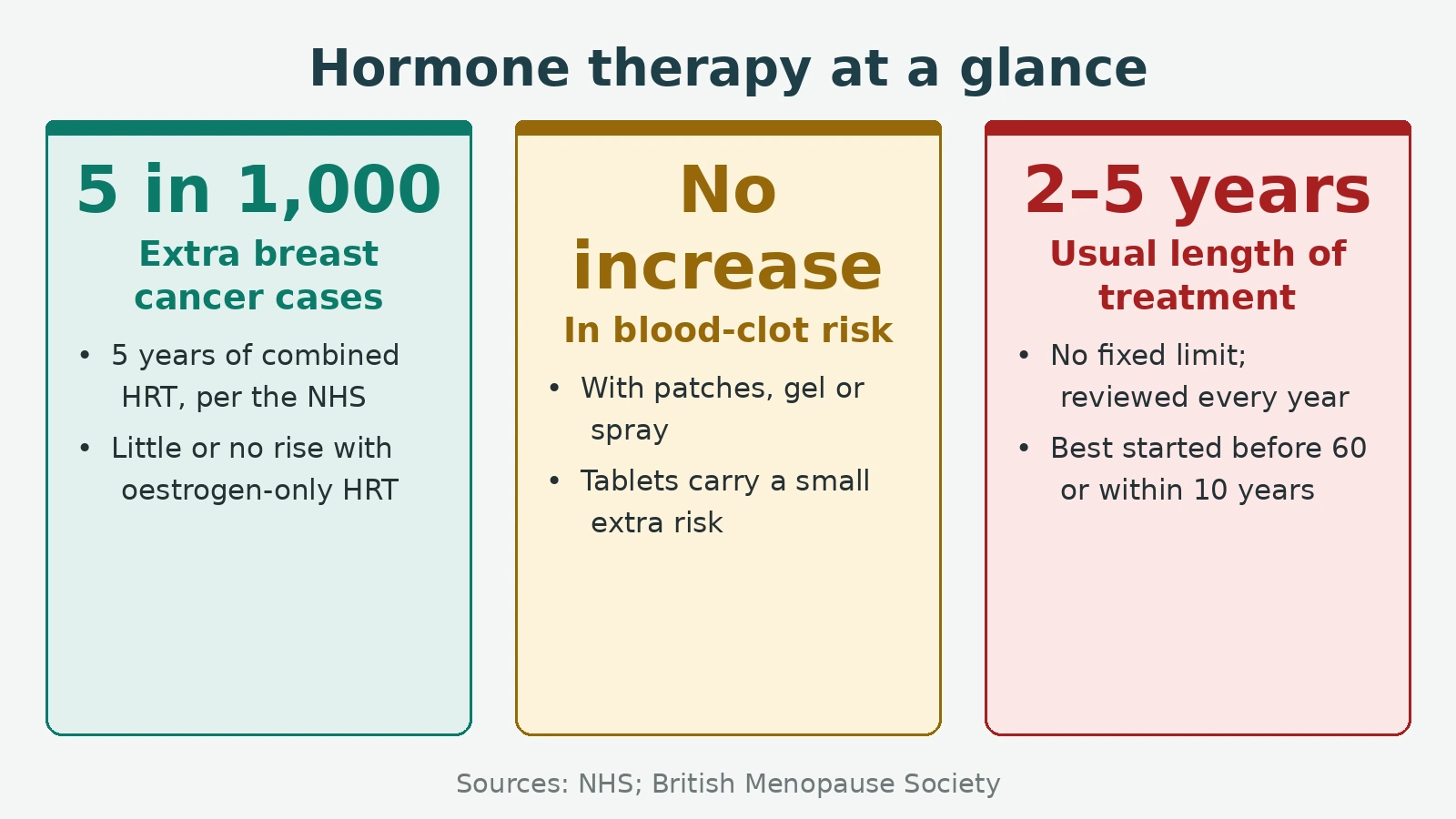
Combined HRT is sequential, used while periods are still happening, with a progestogen added for part of each cycle, followed by a bleed; or continuous, used once there has been no period for a year, with both hormones taken every day. Tablets are taken by mouth, patches are changed every few days, and gel and spray go on the skin. Patches, gel and spray do not increase blood-clot risk; tablets carry a small extra risk.
Vaginal oestrogen treats vaginal symptoms only, as a cream, gel, tablet, pessary or ring. The NHS notes it does not carry the usual risks of HRT or increase breast cancer risk, and it needs no progestogen even if the womb is present. An intrauterine system can supply the progestogen part of combined HRT, can stay in place for up to five years and doubles as contraception. HRT itself is not a contraceptive.
Testosterone is not currently licensed to treat menopause symptoms, but a specialist may prescribe it as a gel when sex drive is low and HRT alone has not helped. UK clinicians use “body-identical” for regulated, licensed products whose hormones match the body’s own; compounded “bioidentical” preparations are unregulated and not available on the NHS.
What are the benefits of HRT beyond symptom relief?
Bone health is the clearest benefit beyond symptom relief. Oestrogen is needed for healthy bones, and after the menopause, when oestrogen falls, bones thin — osteoporosis — which makes fractures more likely. The NHS explains HRT helps prevent osteoporosis by increasing oestrogen levels, and the British Menopause Society lists maintenance of bone mineral density and a reduced risk of osteoporotic fractures among the proven benefits. Possible further benefits are unproven, and NICE does not recommend HRT to prevent heart disease or dementia.
What are the risks of HRT?
The NHS says the benefits of HRT usually outweigh the risks, and the risks of serious side effects are very low. The risks depend on the type of HRT, how long it is taken and a woman’s own health risks.
Breast cancer
Combined HRT slightly increases breast cancer risk, and the risk grows the longer it is taken and the older a woman is, then falls again after stopping. The NHS gives the figure as around five extra cases in every 1,000 women who take combined HRT for five years. The British Menopause Society gives a similar figure of three to four extra cases per 1,000 women after at least five years of combined HRT over 50, and notes the risk with oestrogen alone is very much less. Women who have had breast cancer are usually advised not to take HRT.
Blood clots
The route of HRT is decisive. HRT tablets can increase the risk of blood clots, but the risk is still very low, according to the NHS. Patches, sprays and gels do not increase the risk. The British Menopause Society gives the background risk as 1.7 clots per 1,000 women over 50, highest in the first year, with no increase in risk from HRT given through the skin. Women at risk of clots are usually advised to use patches, spray or gel rather than tablets.
Stroke and heart disease
HRT tablets, but not patches, gel or spray, slightly increase the risk of stroke, the NHS says, although the risk is still very low, particularly for women under 60. The British Menopause Society adds that stroke risk increases when oral HRT is started in older women, over 60.
Womb cancer
Womb cancer is the reason the progestogen part of combined HRT exists. Taking oestrogen without a progestogen can thicken the womb lining, which can increase the risk of endometrial cancer, as the Mayo Clinic explains. The British Menopause Society notes the risk is reduced by adding progestogen, and that continuous progestogen protects better long-term than cyclical progestogen. That is why oestrogen-only HRT is for women who have had their womb removed.
Who should not take HRT?
HRT may not be suitable for everyone. The NHS lists the main situations: a history of breast, ovarian or womb cancer; a history of blood clots, although patches or gels may still be an option; untreated high blood pressure, which must be controlled first; liver disease; and pregnancy. The Mayo Clinic adds that hormone therapy generally is not an option for women with breast cancer, other hormonally driven cancers or blood-clot problems.
Early and premature menopause are the exception: if periods stop before 40, or before 45, HRT is particularly important, usually until at least 51, because replacing oestrogen young protects bone health.
How long do you take HRT for?
There is no fixed limit. The NHS says most women usually need HRT for two to five years, but it can be longer, and it is best taken only while the benefits outweigh the risks. After 60 the risks may start to outweigh the benefits, and a GP may suggest patches or gel rather than tablets. The British Menopause Society agrees there are no arbitrary limits while benefits outweigh risks.
When a woman decides to stop, she can stop suddenly, but the NHS says it is usually recommended to reduce the amount gradually over three to six months. Symptoms may return on stopping, and HRT can then be continued if the benefits still outweigh the risks.
What are the side effects of HRT?
Side effects are not the same as serious risks, and most are mild and short-lived. The NHS lists the common effects of oestrogen as headaches, breast pain, unexpected vaginal bleeding or spotting, feeling sick, mood changes, leg cramps, a mild rash, diarrhoea and hair loss. Progestogen can cause period changes, headaches, breast pain, feeling sick, diarrhoea, tiredness, mood changes, itchy skin and acne. These often go away after a few weeks. Speak to a GP if side effects are severe or last longer than three months.
What are the alternatives to HRT?
Some women cannot take HRT, and others decide not to. The NHS lists lifestyle changes, other medicines and herbal remedies, and the Mayo Clinic names weight loss, cognitive behavioural therapy and clinical hypnosis, alongside non-hormone prescription medicines, for hot flushes. NICE recommends considering menopause-specific CBT alongside HRT, or when HRT is not suitable, and fezolinetant for moderate to severe hot flushes when HRT is unsuitable.
The British Menopause Society’s June 2024 consensus statement lists non-hormonal therapies tested in trials and shown effective, but notes no treatment is as effective as oestrogen. None should be presented as equivalent to HRT.
Why is HRT in the news in 2026?
Searches for hormone therapy for menopause have been climbing, and a United States labelling change in early 2026 added to the discussion. On 12 February 2026, the US Food and Drug Administration approved labelling changes to six menopausal hormone therapy products, removing risk statements about cardiovascular disease, breast cancer and probable dementia from the boxed warning. The boxed warning about endometrial cancer remains on systemic oestrogen-alone products, and heart-disease and breast-cancer risks are still described elsewhere in the labels.
For UK readers, the key point is that this is a US labelling change: it does not change UK guidance from NICE or the NHS, and it does not mean HRT is risk-free.
When to see a doctor
Speak to a GP if you are thinking about starting HRT or are already taking it and are worried about any risks, if you are over 45 with menopause symptoms and considering HRT, or if you are under 45 with symptoms, which may point to early or premature menopause. Bleeding deserves attention: seek specialist review if it increases in heaviness or duration, becomes irregular, continues beyond six months on continuous combined HRT, or occurs after a spell without periods.
In an emergency call 911 (US), 999 (UK) or 112 (EU).
Frequently asked questions
Does HRT cause breast cancer?
Combined HRT slightly raises breast cancer risk: the NHS cites around five extra cases per 1,000 women who take it for five years, with the risk rising the longer it is taken and falling after stopping. Oestrogen-only HRT carries little or no extra risk. The risk is small for most women, but women who have had breast cancer are usually advised not to take HRT.
Does HRT cause blood clots?
Tablets can slightly increase the risk of blood clots, although the NHS stresses the risk is still very low. Patches, gel and spray do not increase the risk, because oestrogen absorbed through the skin behaves differently. The British Menopause Society gives the background risk as 1.7 clots per 1,000 women over 50, highest in the first year. Women at risk are usually offered a skin route instead of tablets.
Do patches carry the same risks as tablets?
No. Patches, gel and spray do not increase the risk of blood clots, while tablets carry a small extra risk, and tablets slightly increase stroke risk while skin routes do not, according to the NHS. That is why women at risk of clots, or with migraine or variable blood pressure, are often offered a patch, gel or spray. The breast cancer risk, however, applies to combined HRT in either form.
How long can I take HRT?
There is no fixed limit. The NHS says most women take HRT for two to five years, but it can be longer when the benefits still outweigh the risks. Treatment is usually reviewed three months after starting or changing type, then once a year. After 60, the risks may start to outweigh the benefits, so a GP may suggest patches or gel rather than tablets.
Is HRT a contraceptive?
No. HRT does not prevent pregnancy, and the NHS advises using contraception until two years after the last period if you are under 50, or for one year after the age of 50. An intrauterine system used as the progestogen part of combined HRT is the exception, because it also acts as a contraceptive. If pregnancy is possible, talk to a GP about contraception alongside HRT.
Can I take HRT after 60?
Yes, sometimes, but the balance changes with age. Starting HRT at 60 or older, or more than ten years after menopause, increases the risk of serious complications, according to the Mayo Clinic. A GP may still consider it, often suggesting patches or gel rather than tablets. The decision depends on your symptoms, health history and risk factors, and it needs an individual discussion.
Sources
- NHS: About hormone replacement therapy (HRT) www.nhs.uk
- NHS: Types of hormone replacement therapy (HRT) www.nhs.uk
- NHS: Benefits and risks of hormone replacement therapy (HRT) www.nhs.uk
- NHS: Side effects of hormone replacement therapy (HRT) www.nhs.uk
- NHS: When to take hormone replacement therapy (HRT) www.nhs.uk
- Mayo Clinic: Hormone therapy: Is it right for you? www.mayoclinic.org
- British Menopause Society: HRT Guide (Feb 2026) thebms.org.uk
- FDA: FDA Approves Labeling Changes to Menopausal Hormone Therapy Products www.fda.gov

Try the tool
How have you felt over the last 2 weeks?
The PHQ-9 and GAD-7 that GPs use. Private, about 3 minutes.
Start the self-check