Men’s Health Checks in Your 30s: What to Book and When
High blood pressure, high cholesterol and type 2 diabetes often start silently in your 30s. Which checks to book now, how to check your testicles, and what the NHS offers at 40, 50 and 65.
- Written by
- Health Daily Advice
- Published
- Reading time
- 5 minutes
- Sources
- 4 cited

In this guide
Your 30s are when high blood pressure, high cholesterol and type 2 diabetes often start developing silently, with no symptoms at all. A handful of simple checks can catch them years before they cause harm, and most take minutes. Today is International Men’s Day — a good moment to book the ones you have been putting off.
Why men’s health needs a nudge
Men are famously late to the doctor. Movember, the men’s health campaign that runs every November, focuses on prostate cancer, testicular cancer, and mental health and suicide prevention precisely because men so often wait until something is wrong. The numbers explain the urgency: around 1 in 8 men in the UK will be diagnosed with prostate cancer in their lifetime, and for Black men the figure is 1 in 4, according to Prostate Cancer UK. And three in four suicides in England and Wales in 2023 were men, according to Mind, using official ONS data. A check-up is not vanity — it is the cheapest form of prevention there is.
The checks that matter in your 30s
There is no single “men’s MOT” on the NHS in your 30s, but the checks worth having are straightforward, and your GP can arrange most of them.
Blood pressure: know your numbers
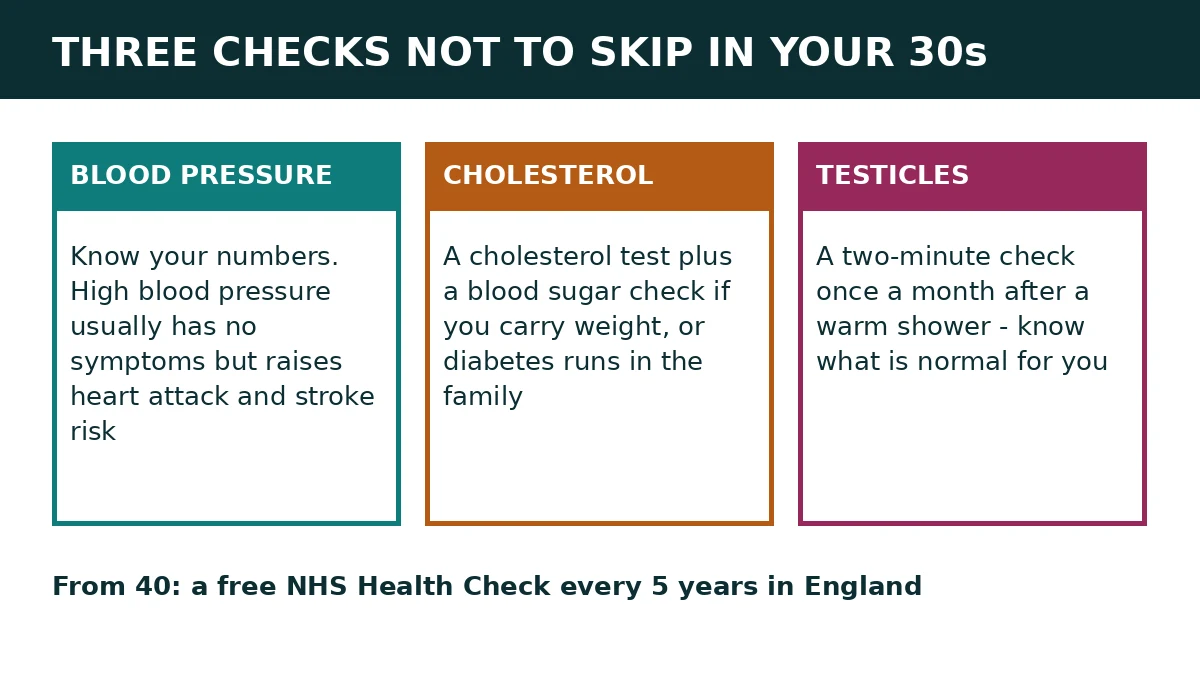
High blood pressure usually has no symptoms, yet it is one of the biggest risk factors for heart attack and stroke. Many of the warning signs for heart and circulation problems, such as high blood pressure and high cholesterol, do not have symptoms, which is exactly why the NHS offers free health checks from age 40. In your 30s, ask for a blood pressure reading at any GP visit, or use a pharmacy machine, and keep a note of the result so you can see whether it is creeping up over the years.
Cholesterol and blood sugar
A cholesterol test gives a picture of your cardiovascular risk, and it matters most if heart disease runs in your family or you carry weight around your middle. A blood sugar test (HbA1c) screens for prediabetes and type 2 diabetes, and is particularly relevant if you are overweight, have a family history of diabetes, or have noticed unusual tiredness or thirst. Your GP can arrange both, and will weigh up whether you need them now or at 40.
Weight and waist
Body mass index only tells part of the story. A waist measurement over 94cm in men is a warning sign for cardiovascular risk in its own right, even when BMI looks reasonable. It is a two-minute check you can do at home with a tape measure.
Testicles: the two-minute monthly check
Testicular cancer is most common in men aged 15 to 49, and it is one of the most treatable cancers when it is found early. The NHS advises checking your testicles regularly so you know what is normal for you. Once a month, ideally after a warm bath or shower, gently roll each testicle between your thumb and fingers and feel for lumps, swelling or changes. See a GP about a lump or swelling, a testicle getting bigger, an ache or pain, or a scrotum that feels heavy, firm or hard. Most lumps turn out not to be cancer, but they should always be checked.
Sexual health and vaccinations
STI screening matters if you have a new partner or more than one partner, and many clinics offer free, confidential testing. Keep vaccinations up to date too — your GP can tell you what you are due.
Mental health counts as health
Depression and anxiety often peak in young adulthood, and men are less likely to talk about how they feel. Low mood, constant worry, poor sleep or losing interest in things you used to enjoy are all valid reasons to book a GP appointment. If you are struggling, you can call Samaritans free on 116 123 at any time, day or night. You can also find support at healthdailyadvice.com/get-help-now.
What comes later: 40, 50 and 65
Knowing what is ahead makes the 30s checks feel less random. In England, adults aged 40 to 74 without certain existing conditions are invited to a free NHS Health Check every five years. It takes about 20 to 30 minutes and usually includes height, weight and waist measurements, a blood pressure test, a cholesterol test and possibly a blood sugar test, and you are given a cardiovascular risk score showing your chance of developing a heart or circulation problem over the next 10 years.
From 50 to 74, bowel cancer screening arrives as a home test kit every two years. From 50 you can also ask your GP about a PSA blood test for prostate problems — from 45 if you are Black or have a family history of prostate cancer. There is no routine national prostate screening programme in the UK, because the PSA test can miss cancers and can also be raised for reasons other than cancer, so the decision is made with a clinician. In May 2026, the UK National Screening Committee recommended targeted PSA screening every two years for men aged 45 to 61 with a BRCA2 gene change and a relevant family history. At 65, men are invited for a one-off ultrasound scan to check for an abdominal aortic aneurysm.
Symptoms men should never ignore
Screening is for people without symptoms. See your GP promptly if you notice a lump or swelling in a testicle, blood in your urine or stools, a lasting change in bowel habit, needing to pass urine more often (especially at night) or a weak flow, unexplained weight loss, persistent tiredness, or erection problems — which can be an early sign of heart disease or diabetes. If you notice symptoms of low testosterone such as low energy, low sex drive and loss of muscle, or urinary symptoms that could point to an enlarged prostate, a GP can check what is going on rather than leaving you to guess.
When to see a doctor
Book a GP appointment if any check comes back abnormal, if you notice any of the symptoms above, or if you simply have not had a check-up in years and want a baseline. Get emergency help for chest pain that is severe or does not settle, sudden severe testicular pain, or thoughts of harming yourself. In an emergency call 911 (US), 999 (UK) or 112 (EU). In the UK you can also call NHS 111 for urgent advice, or Samaritans on 116 123 for mental health support at any hour.
Frequently asked questions
What health checks should a man have in his 30s?
Know your blood pressure, ask about a cholesterol test and a blood sugar test if you have risk factors, check your testicles once a month, keep STI screening and vaccinations up to date, and talk to your GP about your mental health. The free NHS Health Check starts at 40.
How do I check my testicles?
Once a month, ideally after a warm bath or shower, gently roll each testicle between your thumb and fingers and feel for lumps, swelling or changes. Learn what is normal for you. See a GP about any lump, swelling, heaviness or ache, even if it does not hurt.
What is the NHS Health Check?
A free 20 to 30 minute check for adults aged 40 to 74 in England without certain existing conditions, offered every five years. It measures height, weight, waist, blood pressure and cholesterol, possibly blood sugar, and gives you a 10-year cardiovascular risk score.
Should men have a PSA test?
There is no routine prostate screening programme in the UK. Men aged 50 and over can ask their GP about a PSA blood test after discussing its benefits and drawbacks. Black men and men with a family history of prostate cancer may be advised to consider it from 45.
When should a man see a doctor urgently?
Get emergency help for severe chest pain, sudden severe testicular pain, or thoughts of harming yourself. See a GP promptly for a testicle lump, blood in urine or stools, a lasting change in bowel habit, unexplained weight loss, or erection problems.
Sources
- NHS: NHS Health Check www.nhs.uk
- NHS 111 Wales: Cancer of the testicle 111.wales.nhs.uk
- Ready Health: Men's Health Screening: Checks by Age, PSA and More readyhealth.co.uk
- U-Test: Men's Health Checks by Age: What to Check and When u-test.co.uk

Try the tool
Not sure if it can wait?
Common causes and warning signs for 16 everyday symptoms.
Open the symptom guide