Are Energy Drinks Bad for Your Heart? What the New Evidence Says
A new analysis of FDA safety reports links energy drinks and stimulant supplements to serious heart events in young adults. Here is what the study found, what it does not prove, and how much caffeine is safe.
- Written by
- Health Daily Advice
- Published
- Reading time
- 5 minutes
- Sources
- 5 cited

In this guide
Energy drinks are fine as an occasional pick-me-up for most healthy adults, but new research suggests regular use carries a heart risk. In an analysis of more than 28,000 reports to the Food and Drug Administration, cardiac arrest was mentioned about 11 times more often in reports involving energy drinks and stimulant supplements than in reports about products without stimulants.
What did the new study actually find?
Researchers from the University of Virginia School of Medicine reviewed adverse-event reports sent to the FDA between 2017 and 2025, and presented their findings at the American Heart Association’s Scientific Sessions 2026 in Chicago. Of the 28,345 reports, 854 involved caffeinated energy drinks or stimulant supplements, and the rest involved foods and supplements without caffeine or other stimulants.
Compared with the non-stimulant reports, the ones involving energy drinks and stimulant products mentioned serious heart problems far more often:
- Cardiac arrest was reported about 11 times more often.
- Heart attacks were reported about 4.5 times more often.
- Ventricular arrhythmias (abnormal rhythms in the heart’s lower chambers) and palpitations were reported about four times more often.
- Elevated heart rate was reported nearly three times more often, chest pain 2.71 times more often, and fainting about twice as often.
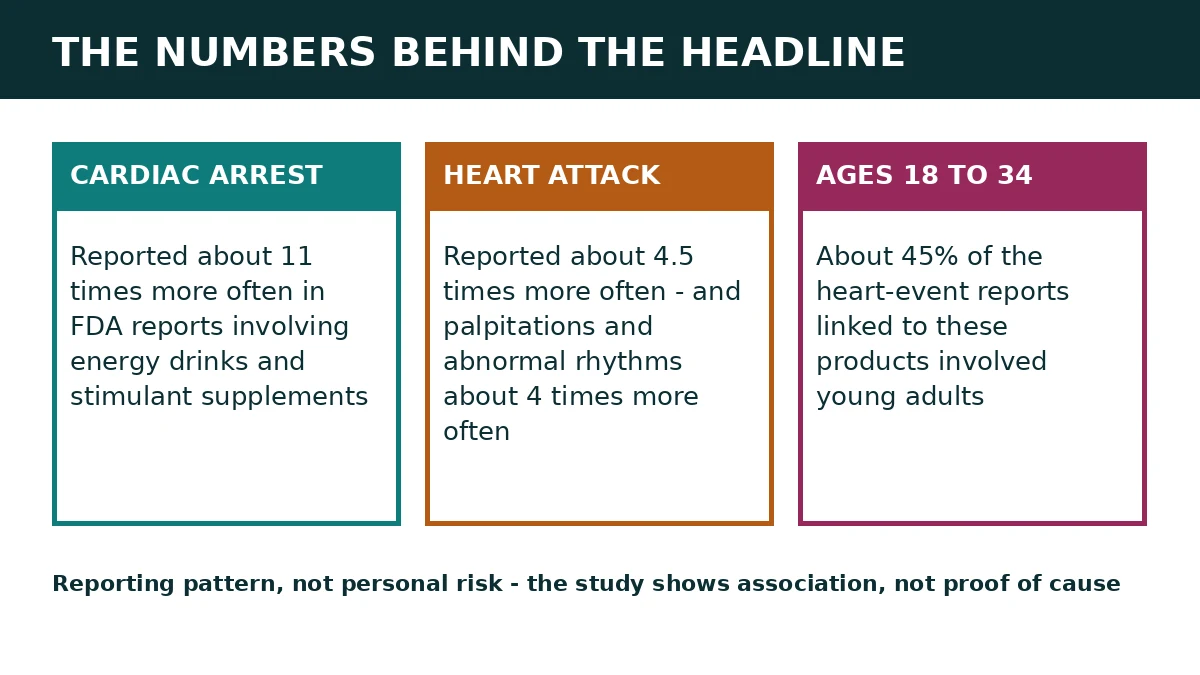
It is important to read these numbers the right way. They describe reporting patterns, not personal risk. As the study’s critics point out, the figures do not mean a daily energy drink makes you 11 times more likely to have a cardiac arrest. What they show is a strong safety signal that deserves attention — and more research.
Why are young adults the focus?
Nearly 45% of the reports linking caffeine and stimulant products to heart events involved adults aged 18 to 34, a group not usually thought of as being at risk of heart problems. The pattern was similar for men and women.
Researchers do not fully understand why the signal is so strong in young adults. It may partly reflect how often younger people drink these products, and how they use them — before intense exercise, or mixed with alcohol. Some may also have an undiagnosed heart condition that a heavy stimulant load brings to light. Doctors have described cases of arrhythmias and sudden cardiac death in young people with no known heart disease who had consumed these products.
Sales help explain the scale of the habit: sales of caffeinated energy drinks have more than doubled over the past decade, reaching over $20 billion in 2024, according to the American Heart Association.
What is actually in an energy drink?
The main active ingredient is caffeine, but the dose is far higher than in a normal coffee. According to the American Heart Association, some energy drinks contain as much as three times more caffeine per fluid ounce as brewed coffee, and some pre-workout supplements contain more than 12 times as much. A single can can contain anywhere from 80 to 300 milligrams of caffeine, depending on the product and size.
Many drinks also contain extra stimulants that can add to caffeine’s effect on the heart, including guarana, taurine, yerba mate, theobromine, synephrine and yohimbine. Caffeine raises heart rate and blood pressure by increasing activity in the sympathetic nervous system, and these extra ingredients can push blood pressure and stress hormones higher still. A 2025 review also found that heavy energy drink use can prolong the heart’s QTc interval — a measure of the heart’s electrical recovery between beats — beyond the effect of caffeine alone.
How much caffeine is safe?
The American Heart Association’s 2026 scientific statement on caffeine and cardiovascular disease says that consuming up to 400 milligrams of caffeine a day — roughly five 8-ounce cups of regular black coffee — is generally safe for most adults. The catch is how quickly energy drinks can eat into that allowance: two large cans can take you most of the way to 400 milligrams before you count any tea, coffee or pre-workout powder.
Limits are lower for some people. The NHS advises that pregnant women should have no more than 200 milligrams of caffeine a day, and notes that a 250ml can of energy drink contains about 80 milligrams. Children and teenagers are more sensitive to caffeine, and energy drinks are not recommended for them.
Who should be extra careful?
Talk to a doctor or pharmacist before using energy drinks or stimulant supplements if you:
- have a heart condition, high blood pressure or an irregular heartbeat;
- have a personal or family history of heart disease or sudden cardiac death;
- have ever had palpitations, chest pain or fainting after caffeine or exercise;
- are pregnant or breastfeeding;
- take medicines that affect heart rhythm or blood pressure.
Cardiologists also warn against combining energy drinks with strenuous exercise or alcohol, and against using them to push through exhaustion. Warning signs of too much stimulant include heart palpitations, chest pain and lightheadedness.
The picture in the UK
Britain is moving to restrict access for children. The government confirmed in July 2026 that it will ban the sale of high-caffeine energy drinks — those with more than 150 milligrams of caffeine per litre, other than tea or coffee — to under-16s in England. The ban is intended to come into force in April 2027, subject to Parliamentary approval, and will apply in shops, vending machines and online. Businesses that break the law face fines of up to £2,500. Many UK supermarkets already refuse to sell energy drinks to under-16s voluntarily.
How to cut back without the crash
If energy drinks have become a daily habit, stopping suddenly can bring on headaches and tiredness for a few days, so a gradual cut-down is usually easier. Try swapping one can a day for water or a lower-caffeine drink, and keep a rough count of all your caffeine — coffee, tea, energy drinks and pre-workout products together — for a week. Reading the label helps: check the total caffeine per can, not just per 100ml, and look for added stimulants such as guarana and synephrine. If you rely on energy drinks to get through the day, it is worth asking your GP whether poor sleep, low mood or another health issue is the real problem.
When to see a doctor
See a doctor promptly if you notice palpitations, chest pain, breathlessness or fainting, especially if they happen after drinking an energy drink or exercising. Get emergency help straight away for chest pain that does not settle, severe breathlessness, or collapsing — these can be signs of a heart attack or a dangerous heart rhythm. In an emergency call 911 (US), 999 (UK) or 112 (EU). If you have a heart condition and are unsure about caffeine, ask your doctor or pharmacist what limit, if any, makes sense for you.
Frequently asked questions
Are energy drinks bad for your heart?
They can be, especially with regular heavy use. A 2026 analysis of FDA reports found cardiac arrest mentioned about 11 times more often and heart attacks 4.5 times more often in reports involving energy drinks and stimulant supplements. The study shows an association, not proof of cause, and occasional use is probably low risk for most healthy adults.
How many energy drinks a day is safe?
There is no official safe number for energy drinks, but the American Heart Association says up to 400mg of caffeine a day is generally safe for most adults. A single can can hold 80 to 300mg, so one or two large cans can use up the whole day's allowance before any coffee or tea.
Can energy drinks cause a heart attack in a young person?
The new research found heart attacks reported 4.5 times more often in FDA reports involving energy drinks and stimulant supplements, with about 45% of heart-event reports involving adults aged 18 to 34. Doctors have also described arrhythmias and sudden cardiac death in young people with no known heart disease after using these products.
What are the warning signs of too much caffeine?
Heart palpitations, chest pain and lightheadedness are the main warning signs cardiologists name. Seek emergency help for chest pain that does not settle, severe breathlessness or fainting. If you have a heart condition, an irregular heartbeat or a family history of heart disease, ask your doctor about caffeine before using energy drinks.
Are energy drinks being banned in the UK?
Sales to under-16s will be banned in England from April 2027, subject to Parliamentary approval. The ban covers drinks with more than 150mg of caffeine per litre, other than tea or coffee, in shops, vending machines and online. Many UK supermarkets already refuse to sell energy drinks to under-16s voluntarily.
Sources
- American Heart Association: Energy drinks, stimulant products linked to cardiac arrest, heart attack in young adults newsroom.heart.org
- Healthline: Energy Drinks May Quadruple Risk in Adults Under 35 www.healthline.com
- Medical Xpress: Energy drinks, stimulant products linked to cardiac arrest, heart attack in young adults medicalxpress.com
- NHS: Foods to avoid in pregnancy (caffeine) www.nhs.uk
- GOV.UK: Children's health further protected with energy drinks ban www.gov.uk

Try the tool
Not sure if it can wait?
Common causes and warning signs for 16 everyday symptoms.
Open the symptom guide