US Loses Measles Elimination Status After 26 Years
The US has lost a public health milestone it held for 26 years. What elimination status means, why measles surged, and how to check your protection.
- Written by
- Health Daily Advice
- Published
- Reading time
- 6 minutes
- Sources
- 4 cited
In this guide
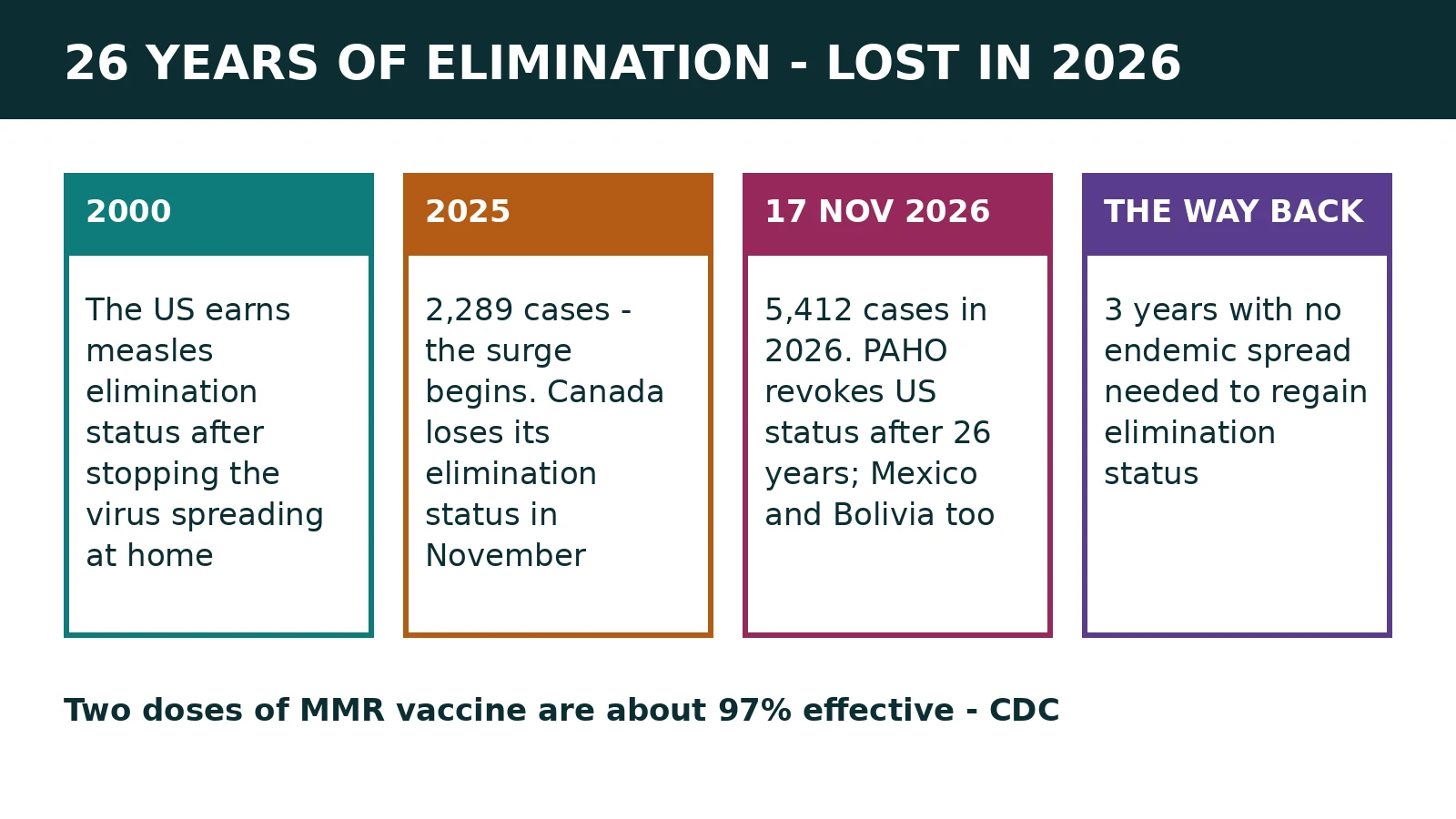
On 17 November 2026, the Pan American Health Organization announced that the United States has lost its measles elimination status, held for 26 years. The decision follows a year of uninterrupted transmission and a surge to 5,412 cases in 2026, the highest total in 35 years. Mexico and Bolivia lost their status the same day.
What does losing measles elimination status mean?
Elimination status does not mean a country has zero measles cases. It means the country has stopped measles spreading continuously within its own borders: imported cases may still arrive, but they do not start chains of transmission that last. Under PAHO’s rules, a country loses the status when the same measles virus genotype and lineage circulate uninterrupted for 12 months or more. That is what happened in the United States, where transmission that began in January 2025 was still going a year later.
The United States first earned elimination status in 2000. Canada lost its status in November 2025, and the region of the Americas as a whole lost its regional elimination status the same month. The region had regained that status only in 2024, after interrupting transmission in Venezuela and Brazil. PAHO Director Dr Jarbas Barbosa called the loss “much more than losing a public health designation”, saying it means “the virus has circulated for a prolonged period, putting families and communities at risk of preventable illness, hospitalization and death”.
Getting the status back will take years. Once the current outbreak ends, the United States will need three years in a row without endemic transmission to re-establish elimination status. Canada, by contrast, has interrupted the chain of transmission behind its own loss of status and is working to regain it.
The numbers behind the decision
The scale of the resurgence is stark. As of 12 November 2026, the CDC had recorded 5,412 confirmed measles cases in the United States in 2026, about 2.4 times the 2,289 cases reported in all of 2025, and the highest total since 1991. Cases were reported by 47 jurisdictions, with 18 more among international visitors. About 96% of this year’s cases were in people who were unvaccinated or whose vaccination status was unknown, and there were more than 590 hospitalisations.
The human cost has risen sharply. There have been 13 reported measles-associated deaths in the United States in the last two years, compared with three in the previous 25 years. Pennsylvania alone has recorded 1,589 confirmed cases and eight deaths in 2026, with a hospitalisation rate of nearly 20% among reported cases.
Across the Americas, PAHO recorded 58,213 confirmed measles cases and 82 deaths by 13 November 2026, more than four times the 12,806 cases logged in the same period in 2025. Globally, the WHO estimates that about 95,000 people died of measles in 2024, mostly unvaccinated children under five, even though a safe and cheap vaccine has existed for about 60 years.
Why did measles come back?
Measles is one of the most contagious diseases in the world: one infected person can pass it to as many as 18 people who are not immune, and the virus can stay active in the air for up to two hours after an infected person has left the room. Stopping it needs very high vaccination coverage, and PAHO says at least 95% coverage with both doses of the measles vaccine in every community is essential.
That coverage has slipped. In the United States, MMR vaccination coverage among kindergartners fell from 95.2% in the 2019-20 school year to 92.7% in 2023-24, and a 2025 study found coverage had declined in 78% of the 2,066 counties studied across 33 states. The CDC says COVID-era disruption interrupted routine childhood vaccination, and that national averages can hide pockets of low coverage where outbreaks take hold. PAHO points to the same pattern across the region: gaps concentrated in particular communities, missed vaccinations, barriers to health services, misinformation and vaccine hesitancy.
Measles vaccination has prevented an estimated 59 million deaths worldwide between 2000 and 2024, according to the WHO. Two doses of the MMR vaccine are about 97% effective at preventing measles, the CDC says.
What measles does to the body
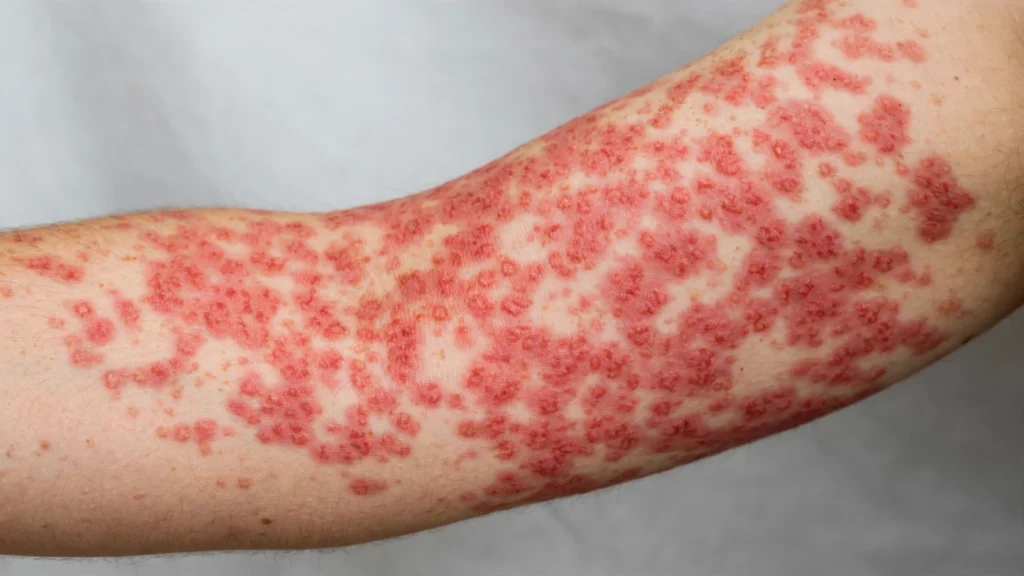
Measles usually starts with cold-like symptoms about 10 days after infection: a high temperature, a runny or blocked nose, sneezing, a cough and red, sore, watery eyes. Small white spots may appear inside the cheeks, and a rash follows a few days later, starting on the face and behind the ears before spreading over the body. Most people start to feel better in about a week.
But measles is not always mild. The NHS says about one in 15 people with measles develops complications, including ear infections, pneumonia, diarrhoea and brain inflammation (encephalitis), which affects about one in 1,000 to 2,000 cases and can cause permanent brain damage. Measles can also cause blindness and seizures, and it weakens the immune system for months afterwards, leaving the body less able to fight other infections. Complications are most common in children under five, adults over 30, pregnant women and people with weakened immune systems. Catching measles in pregnancy can cause miscarriage, stillbirth or premature birth.
How to check your protection
Two doses of the MMR vaccine, which also protects against mumps and rubella, give lifelong protection for most people. In the UK the vaccine is offered to children at 12 months and again at around 3 years and 4 months, and adults who missed it can ask their GP, who can vaccinate for free on the NHS. In the United States, the CDC recommends the same two-dose schedule and has said it will keep recommending MMR vaccination as the most effective way to prevent measles.
If you are not sure whether you or your child have had both doses, check your vaccination record or ask your GP or health department. It is unlikely to be measles if you have had both doses or have had measles before, the NHS says. If you think you or your child may have measles, call your GP or NHS 111 before going in, so you can be kept away from other patients. Stay off nursery, school or work for at least four days from when the rash first appears, and avoid close contact with babies, pregnant women and anyone with a weakened immune system.
What happens next
The CDC and its public health partners have set out a plan to stop the outbreaks and regain elimination status, built on encouraging MMR vaccination, expanding access to vaccines and closing protection gaps. Since August, the CDC has provided about $100 million in additional funding to state and local health departments for prevention and outbreak response, and CDC teams have been deployed to help states including Texas, South Carolina, Virginia, Kansas, New Mexico, Wisconsin, Pennsylvania and New York.
PAHO’s message is that the setback is reversible. “We know how to prevent measles, and we know how to stop its transmission,” Dr Barbosa said. “With sustained commitment to vaccination, strong surveillance and effective outbreak response, the Americas can eliminate measles transmission once again.” For readers, the practical step is the same one health officials keep repeating: check your vaccination status, and if you or your children are not fully protected, talk to your GP or local health department about catching up.
When to see a doctor
Ask for an urgent GP appointment or call NHS 111 if you think you or your child may have measles, if your child is under one year old and has been in contact with someone with measles, or if you are pregnant or have a weakened immune system and have been in close contact with a case. Also seek help if a high temperature does not come down after paracetamol or ibuprofen, if there is difficulty breathing, or if you feel very unwell.
In an emergency call 911 (US), 999 (UK) or 112 (EU). Call 999 or go to A&E if someone with measles has a seizure, severe difficulty breathing, cannot stay awake, suddenly becomes confused, or has a rash that does not fade when you press a glass against it.
Frequently asked questions
What does losing measles elimination status mean?
It means measles has spread continuously in the US for over 12 months, so the virus is considered endemic again. It does not mean everyone is at risk: people with two MMR doses are about 97% protected. The status can be regained after three years without endemic transmission.
Why did the US lose its measles elimination status?
Vaccination coverage slipped below the 95% needed to stop spread. MMR coverage among kindergartners fell from 95.2% in 2019-20 to 92.7% in 2023-24, and COVID-era disruption left gaps that outbreaks exploited.
How many measles cases has the US had in 2026?
The CDC recorded 5,412 confirmed cases as of 12 November 2026, the highest total since 1991 and about 2.4 times the 2,289 cases in all of 2025. About 96% were in people unvaccinated or with unknown vaccination status.
How can I check if I am protected against measles?
Check your vaccination record or ask your GP or local health department. Two doses of the MMR vaccine give lifelong protection for most people. Adults who missed vaccination can usually catch up free on the NHS or through their health department.
What should I do if I think I have measles?
Call your GP or NHS 111 before going in, so you can be kept away from other patients. Stay off school, nursery or work for at least four days from when the rash appears, and avoid babies, pregnant women and people with weakened immune systems.
Sources
- PAHO: PAHO urges countries to step up efforts to stop measles outbreaks www.paho.org
- CDC: Joint statement: Loss of U.S. measles elimination status www.cdc.gov
- NHS: Measles www.nhs.uk
- WHO: Measles fact sheet www.who.int

Try the tool
Not sure if it can wait?
Common causes and warning signs for 16 everyday symptoms.
Open the symptom guide