Blood Pressure Medication Recalled: Propranolol Lot Check
One lot of a common blood pressure pill has been recalled across the US over possible metal contamination. How to check your bottle, and why you need a same-day replacement — not just to stop.
- Written by
- Health Daily Advice
- Published
- Reading time
- 5 minutes
- Sources
- 7 cited

In this guide
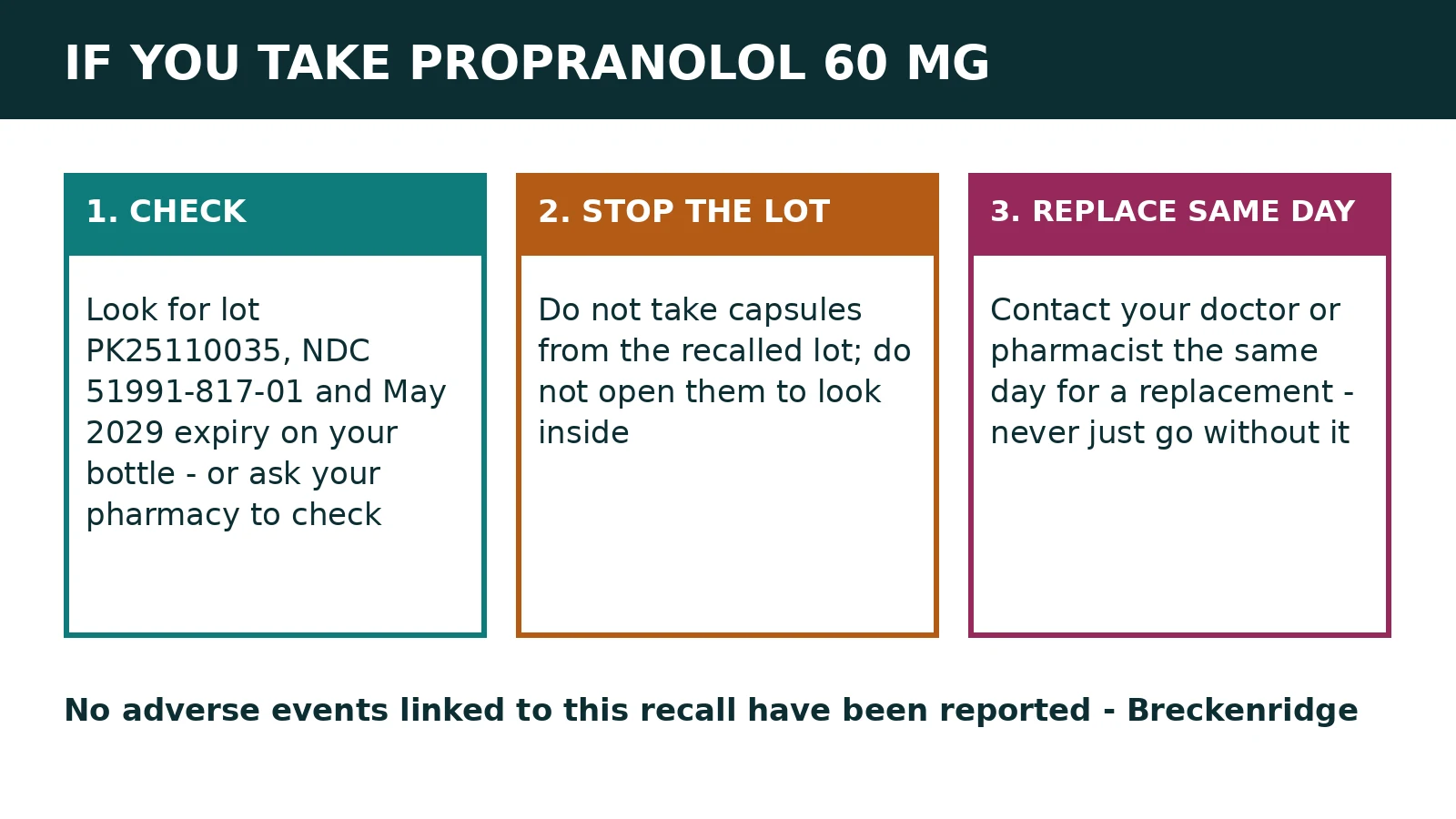
One lot of propranolol, a common blood pressure medicine, has been recalled across the United States because the capsules may contain metal fragments. If you take the 60 mg extended-release capsules, check your bottle for lot PK25110035 — and if it matches, contact your doctor or pharmacist the same day for a replacement.
What was recalled
Breckenridge Pharmaceutical announced the voluntary nationwide recall on Monday 16 November 2026. It covers a single lot of propranolol hydrochloride extended-release capsules, 60 mg, sold in 100-count bottles. The recall goes down to consumer level, meaning it reaches patients, not just wholesalers and pharmacies.
| Detail | What to look for |
|---|---|
| Drug | Propranolol hydrochloride extended-release capsules, 60 mg |
| Lot number | PK25110035 |
| NDC number | 51991-817-01 |
| Expiry date | May 2029 |
| Pack size | 100-count bottles |
| Manufacturer | Adare Pharma Solutions |
| Distributed | Nationwide in the US, 26 October to 4 November 2026 |
Only this one lot is affected. Other strengths of propranolol, other lots, and brand-name versions such as Inderal LA are not part of the recall. The total number of bottles in the lot has not been published, so do not be reassured by a small number — or alarmed by a large one. If your bottle matches the lot number, it is recalled whatever the size of the lot.
Why was it recalled?
The capsules may contain pieces of metal. The problem was traced to an intermediate manufacturing material shared with a separate lot that was never released to the market — metal was found in that unreleased lot, and this lot is being recalled as a precaution because it used the same material. Breckenridge has not named the metal involved or the size of any fragments.
Swallowing a contaminated capsule could cause cuts to soft tissue in the mouth, oesophagus, stomach or intestine, Breckenridge said. The company also said it was not aware of any adverse events linked to the recall when it announced it. The recall is being carried out with the knowledge of the US Food and Drug Administration (FDA).
How to check your bottle in 60 seconds
Pick up your bottle and look at the label for the lot number, the NDC number 51991-817-01 and the May 2029 expiry date. All three should match before you worry — the lot number is the key one. The capsules themselves are white, marked “60” on the cap and “RD203” on the body.
If your pharmacy repackaged the capsules into its own container and the lot number is not on the label, call the pharmacy and ask it to check its records — it will know which lot it dispensed. Do not split, chew, crush or open the capsules to look inside: that changes how the extended-release medicine works and will not tell you whether metal is present anyway.
If your bottle is from a different lot or a different strength, you can carry on as normal. The recall affects one lot only.
Should you stop taking it?
This is the part that needs care, because two pieces of advice point in different directions. Breckenridge says to stop taking capsules from the recalled lot immediately and contact a doctor for advice and replacement instructions. But propranolol must not be stopped suddenly in general use: stopping a beta-blocker abruptly can cause high blood pressure, chest pain, anxiety, a racing heartbeat and even a heart attack, especially after larger doses or at least six weeks of use.
The safe way through is to do both things on the same day. Stop taking capsules from the recalled lot, and contact your doctor or pharmacist the same day for a replacement from an unaffected lot or another manufacturer. Do not simply go without the medicine while you wait, and do not take a capsule from the recalled lot “just until” you get through — the replacement is the point. If you have already taken a capsule from the lot, watch for mouth pain or bleeding, trouble or pain swallowing, chest or stomach pain, vomiting blood, or black or bloody stools, and get prompt care if any of those appear. Also watch for rebound signs after stopping, such as a pounding or racing heartbeat, chest pain, or a sharp rise in your home blood pressure readings.
For questions about the recall itself, Breckenridge’s recall service provider Qualanex can be reached on 1-855-736-0807 or recall@qualanex.com, Monday to Friday, 9 a.m. to 5 p.m. Eastern. Side effects or quality problems can be reported to the FDA through MedWatch, online or on 1-800-332-1088.
What is propranolol?
Propranolol is a beta-blocker: it slows the heart rate and makes it easier for the heart to pump blood around the body. The NHS lists its uses as high blood pressure, irregular heartbeat such as atrial fibrillation, preventing chest pain from angina and future heart attacks and strokes, easing the physical symptoms of anxiety such as sweating and shaking, preventing migraine, and reducing the symptoms of an overactive thyroid.
It is a widely used medicine. About 10.3 million propranolol prescriptions were filled in the United States in 2024, for around 2.9 million patients. The recalled lot is a tiny fraction of that — but because the lot was distributed nationwide to wholesalers and pharmacies between 26 October and 4 November, anyone who filled a 60 mg extended-release prescription in early November could be holding an affected bottle.
Other recent blood pressure recalls
This is not the only blood pressure medicine recalled this autumn. Advagen Pharma recalled 3,684 bottles of metoprolol tartrate 50 mg tablets — another beta-blocker — after foreign tablets were found in bottles; the FDA classified that recall as Class II on 10 November 2026. Earlier in November, a combination blood pressure pill was recalled because the tablets did not dissolve properly, and chlorthalidone tablets were recalled for the same reason. Recalls are usually voluntary: the company removes the defective medicine and the FDA oversees the process, checks the plan is adequate and assigns a class. The FDA had not yet published a class for this propranolol recall at the time of writing.
When to see a doctor
Contact your doctor or pharmacist the same day if your bottle is from lot PK25110035, even if you feel fine — you need a replacement, not just reassurance. See a doctor promptly if you have taken a capsule from the lot and develop mouth pain or bleeding, difficulty swallowing, chest or stomach pain, or black or bloody stools.
In an emergency call 911 (US), 999 (UK) or 112 (EU). Call for emergency help if you vomit blood, have severe chest pain, heavy bleeding, or a racing heartbeat with chest pain after stopping propranolol suddenly.
Frequently asked questions
Which propranolol is recalled — is all propranolol affected?
No. Only one lot is recalled: propranolol hydrochloride extended-release capsules, 60 mg, lot PK25110035, in 100-count bottles with a May 2029 expiry. Other strengths, other lots and brand-name versions such as Inderal LA are not affected.
How do I check if my capsules are from lot PK25110035?
Look at your bottle label for the lot number, the NDC number 51991-817-01 and the May 2029 expiry date. If your pharmacy repackaged the capsules and the lot number is not visible, call the pharmacy and ask it to check its records. Do not open the capsules to look inside.
Should I stop taking propranolol if my bottle is from the recalled lot?
Yes, stop taking capsules from that lot — but contact your doctor or pharmacist the same day for a replacement from an unaffected lot or another manufacturer. Do not simply go without the medicine, and do not take a capsule from the recalled lot while you wait.
Why is it dangerous to stop propranolol suddenly?
Stopping a beta-blocker abruptly can cause high blood pressure, chest pain, anxiety, a racing heartbeat and even a heart attack, especially after larger doses or at least six weeks of use. A prescriber normally plans a gradual dose reduction, which is why a same-day replacement matters.
What should I do if I have already taken a capsule from the recalled lot?
Watch for mouth pain or bleeding, trouble or pain swallowing, chest or stomach pain, vomiting blood, or black or bloody stools, and get prompt care if any appear. Also watch for rebound signs after stopping, such as a pounding heartbeat or a sharp rise in blood pressure.
How do I report a problem, and who do I contact about the recall?
For recall questions, contact Qualanex on 1-855-736-0807 or recall@qualanex.com, Monday to Friday, 9 a.m. to 5 p.m. Eastern. Report side effects or quality problems to the FDA through MedWatch, online or on 1-800-332-1088.
Sources
- Breckenridge Pharmaceutical: Voluntary nationwide recall of one lot of propranolol hydrochloride extended-release capsules 60 mg (PR Newswire) www.prnewswire.com
- AARP: Propranolol blood pressure medication recall, November 2026 www.aarp.org
- Medical Daily: Breckenridge propranolol recall — metal contamination www.medicaldaily.com
- NHS: Propranolol — about propranolol www.nhs.uk
- FDA: Understanding drug recalls — what to know and what to do www.fda.gov
- GoodRx: Dangerous medications to stop abruptly www.goodrx.com

Try the tool
Not sure if it can wait?
Common causes and warning signs for 16 everyday symptoms.
Open the symptom guide