Salmonella Outbreaks 2026: Romaine Lettuce, Symptoms and Safety
The FDA's final summaries name romaine lettuce in one 2026 Salmonella outbreak — and leave two bigger ones unsolved. Here is what happened, the symptoms to know and how to stay safe.
- Written by
- Health Daily Advice
- Published
- Reading time
- 8 minutes
- Sources
- 10 cited
In this guide
In November 2026 the FDA closed three Salmonella outbreaks that sickened 261 people and put 47 in hospital. Romaine lettuce was confirmed as the cause of the smallest outbreak, 43 cases, but the foods behind the two larger outbreaks were never named. Most people recover within a week, though young children and older adults face higher risk.
What happened in the three 2026 outbreaks
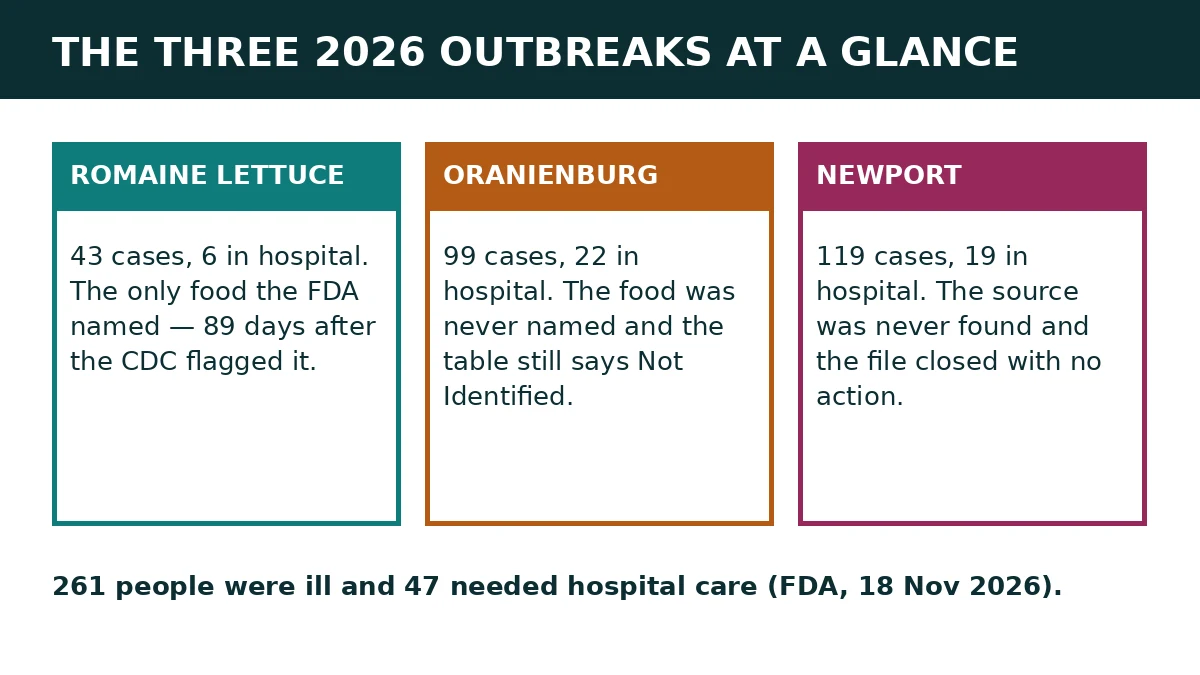
On 18 November 2026, the US Food and Drug Administration (FDA) published its final summaries for three Salmonella outbreaks it had closed on 4 November. Together they sickened 261 people and sent 47 to hospital, and no deaths were reported in any of them. The picture is uneven: one outbreak has a named food, and two do not.
| Outbreak | Cases | Hospitalisations | Food named? |
|---|---|---|---|
| Salmonella I 4,[5],12:i:- | 43 | 6 | Yes — romaine lettuce |
| Salmonella Oranienburg | 99 | 22 | No |
| Salmonella Newport | 119 | 19 | No |
The totals — 261 illnesses and 47 hospitalisations — come from the FDA summaries published on 18 November, as reported by food safety lawyer Bill Marler and Food Safety News.
Romaine lettuce: the outbreak we know about
The smallest of the three outbreaks is the only one with a confirmed food. It was caused by a strain called Salmonella I 4,[5],12:i:-, and it sickened 43 people, with six needing hospital care and no deaths, according to Food Safety News.
What makes this outbreak stand out is the timing. The Centers for Disease Control and Prevention (CDC) first flagged the cluster to the FDA on 4 August, and on 7 August the CDC named romaine lettuce as the leading vehicle of interest. Yet when the FDA posted the outbreak on its public investigation table on 12 August, the product was listed as “Not Yet Identified” — and it stayed that way for 84 days. The public was only told it was romaine when the investigation closed on 4 November, 89 days after the CDC had named it.
Behind the scenes, investigators had moved faster than the public record suggested. They traced 12 people who had eaten romaine in meals bought at four different points of sale between 7 and 20 July, and all four lines of inquiry converged on a single supplier and processor of prepackaged, shredded romaine lettuce. On 18 August, inspectors began a full preventive-controls inspection at that firm, taking 110 environmental swabs, all of which tested negative for Salmonella. No finished product could be tested because the lettuce was already past its shelf life. The inspection closed on 1 September with a Form 483 — the FDA’s list of observed problems — covering the firm’s sanitation controls, its corrective actions and its verification procedures.
The FDA concluded that this firm’s romaine was the confirmed outbreak vehicle. The firm’s name is redacted in the summary, as are the states where patients lived. No recall was issued in any of the three outbreaks, because the romaine was past its shelf life and no longer for sale by the time the food was confirmed.
The two larger outbreaks: no food ever named
The other two outbreaks were bigger, and their foods were never identified — not even at closure.
The Salmonella Oranienburg outbreak sickened 99 people and put 22 in hospital. Investigators traced 13 people who had eaten at six points of sale, and every line of inquiry led to one packinghouse whose growers share fields. Twelve lots were implicated, harvested between 28 April and 17 May, and lots from different harvest days had been mixed together in outgoing shipments. An inspection closed on 28 August with a produce-farm observations form noting several sanitation issues, but the commodity itself is redacted even in the title of the FDA’s summary, and the public table still reads “Not Identified”.
The Salmonella Newport outbreak was the largest of the three, with 119 cases and 19 hospitalisations. The CDC notified the FDA on 7 August, and on 20 August it named a suspect produce item. The traceback covered 15 people across eight points of service but did not converge on a single source, and two produce samples tested negative. No inspection was carried out. The file closed with the source undetermined and no action taken — and the public record still does not say what those 119 people ate.
One detail runs through all three files: no sample in any of them matched an outbreak strain. The conclusions rest on epidemiology and traceback — the pattern of who ate what, where — rather than on a laboratory match.
What is Salmonella?
Salmonella is a group of bacteria that live in the intestines of animals and people and are shed in stool. People most often become infected by eating food or drinking water contaminated with the bacteria, as the Mayo Clinic explains. It can also spread through contact with animals or their environment, and from one person to another when hands are not washed properly.
It is far from rare. The CDC estimates that Salmonella causes about 1.35 million infections in the United States every year, making it one of the most common causes of food poisoning. Most of those infections never become part of an outbreak investigation — only a small fraction are ever diagnosed and linked to a source.
What are the symptoms of Salmonella?
Most people develop watery diarrhoea, which may contain blood or mucus, along with stomach cramps that can be severe and a fever. Some also get a headache, nausea, vomiting and a loss of appetite, according to the CDC. A few people have no symptoms at all.
Symptoms usually start between 6 hours and 6 days after infection, and most often within 8 to 72 hours, the Mayo Clinic notes. For most healthy adults the illness feels like a bad stomach bug: unpleasant, draining, but manageable at home with fluids and rest.
How long does Salmonella last?
For most people, symptoms last 4 to 7 days and then clear on their own without specific treatment. That is the CDC’s usual course, and the Mayo Clinic agrees that most healthy people recover within a few days.
Recovery is not always that tidy. Some people have diarrhoea for several months after the infection. In a small number of cases the bacteria spread beyond the gut — into the blood, bones, joints or the lining of the brain — and a few people develop reactive arthritis, painful joints that can last for months or years. The CDC notes that reactive arthritis after Salmonella is most common in people aged 15 to 35. And because the bacteria can linger in stool for weeks after symptoms stop, careful handwashing matters well beyond the worst days.
Who is most at risk?
Anyone can catch Salmonella, but some groups are more likely to become seriously ill. The CDC names children under 5 — especially babies under 1 — adults aged 65 and over, adults aged 50 and over with underlying medical problems such as heart disease, and people with weakened immune systems. These are the people most likely to need hospital care, as the 47 hospitalisations across these three outbreaks show.
That is also why outbreaks linked to foods eaten raw, like salad leaves, worry public health officials. There is no cooking step to kill the bacteria, so the safety of the food depends entirely on how it was grown, washed and handled before it reached the plate.
How to lower your risk: clean, separate, cook, chill
No single habit guarantees safety, but the US government’s FoodSafety.gov guidance boils food safety at home down to four steps: clean, separate, cook and chill.
Clean
- Wash your hands with plain soap and water for at least 20 seconds before, during and after preparing food, and after touching raw meat, poultry, seafood or eggs.
- Rinse fruit and vegetables under running water, even if you plan to peel them. Do not use soap, bleach or commercial produce washes.
- Do not wash raw meat, poultry, eggs or seafood: it splashes germs around the kitchen rather than removing them.
- Wash cutting boards, dishes, utensils and worktops with hot, soapy water after they have touched raw food.
Separate
- Use one cutting board for fresh produce and foods that will not be cooked, and another for raw meat, poultry and seafood.
- Keep raw meat, poultry, seafood and eggs away from other foods in the shopping trolley, in bags and in the fridge.
Cook
- Cook food to a temperature high enough to kill germs, and check it with a food thermometer rather than guessing by colour.
- Keep cooked food hot, at 140°F (60°C) or above, until it is served.
Chill
- Refrigerate perishable food within 2 hours of cooking or buying it. Bacteria that cause food poisoning multiply fastest between 40°F (4°C) and 140°F (60°C).
- Keep the fridge at 40°F (4°C) or below and the freezer at 0°F (-18°C) or below.
And if you do fall ill, stay away from work, school or nursery until you have been free of diarrhoea or vomiting for at least 48 hours, as the NHS advises, and do not prepare food for other people while you are still unwell.
What to do if you think you have Salmonella
Most cases settle with rest and plenty of fluids. Sip water regularly and take small amounts often if your stomach is unsettled; oral rehydration salts, available from a pharmacy, can help replace the fluid and salts lost through diarrhoea and vomiting. Eat lightly when you feel able, and avoid preparing food for others until you have recovered.
Do not try to diagnose yourself from an article. If you are unsure what is causing your symptoms, or they are not improving, talk to a doctor or pharmacist, who can advise whether any testing or treatment is needed for you.
When to see a doctor
Most Salmonella infections clear up on their own, but some need medical care. The CDC says to call your doctor if you have any of these:
- Diarrhoea or vomiting lasting more than 2 days
- Bloody stool or bloody urine
- A fever higher than 102°F (38.9°C)
- Signs of dehydration: little or no urination, very dark urine, being very thirsty, a dry mouth or throat, feeling dizzy or lightheaded, or crying without tears
Get help sooner — the same day — if the person who is ill is a baby under 3 months old, a young child, an older adult, or someone with a weakened immune system, or if symptoms are severe or getting worse rather than better. Dehydration can develop quickly in young children, so do not wait it out.
In an emergency call 911 (US), 999 (UK) or 112 (EU)
The bottom line
These three outbreaks are over. The FDA says the romaine at the centre of the smallest one was past its shelf life and no longer for sale, and no recall was needed. But the summaries are a reminder of how foodborne illness works: the food that made people ill was identified in only one of three outbreaks, and even then the public learned about it months after the fact. The habits that protect you — washing your hands, rinsing salad leaves, keeping raw meat away from ready-to-eat food, and refrigerating food promptly — are the same whether or not an outbreak is in the news.
Frequently asked questions
What food caused the 2026 Salmonella outbreaks?
Romaine lettuce was confirmed as the vehicle in the smallest outbreak, which sickened 43 people, after CDC investigators traced it to prepackaged, shredded romaine. The foods behind the two larger outbreaks — Salmonella Oranienburg with 99 cases and Salmonella Newport with 119 — were never publicly named, and the FDA closed both files with the sources unidentified.
How long does Salmonella last?
Symptoms usually start 6 hours to 6 days after infection and last 4 to 7 days, according to the CDC. Most healthy adults recover at home with fluids and rest. A small number of people have diarrhoea for months, or develop joint pain that lingers, so see a doctor if symptoms drag on or keep getting worse.
What are the first symptoms of Salmonella?
The usual first signs are watery diarrhoea, stomach cramps and a fever, often with headache, nausea or vomiting and a loss of appetite. They typically begin 6 hours to 6 days after eating contaminated food, most often within 8 to 72 hours. A few people have no symptoms at all.
When should I see a doctor for Salmonella?
Call your doctor if diarrhoea or vomiting lasts more than 2 days, if there is blood in your stool or urine, if your fever is higher than 102°F, or if you show signs of dehydration such as very dark urine, intense thirst or dizziness. Get help the same day for a baby, an older adult, or anyone with a weakened immune system.
Can you get Salmonella from lettuce?
Yes. Leafy greens can carry Salmonella if they are contaminated during growing, harvesting or processing, and because salad leaves are eaten raw there is no cooking step to kill the germs. Rinse leaves under running water, keep them away from raw meat in the kitchen, and wash your hands before preparing food.
Is the romaine lettuce from the 2026 outbreak still in shops?
No. The FDA said the implicated romaine was past its shelf life and no longer available for sale by the time investigators confirmed it as the source, so no recall was issued. The outbreak was closed on 4 November 2026, and the agency says there is no ongoing risk to consumers from it.
Sources
- Food Safety News: FDA report on romaine outbreak has much information redacted www.foodsafetynews.com
- LexBlog (Bill Marler): FDA's final reports on three Salmonella outbreaks that sickened 261 www.lexblog.com
- CDC: Symptoms of Salmonella Infection www.cdc.gov
- CDC: About Salmonella Infection www.cdc.gov
- Mayo Clinic: Salmonella infection — Symptoms and causes www.mayoclinic.org
- FoodSafety.gov: 4 Steps to Food Safety www.foodsafety.gov
- NHS: Food poisoning www.nhs.uk

Try the tool
Not sure if it can wait?
Common causes and warning signs for 16 everyday symptoms.
Open the symptom guide