Radon Gas in Your Home: Health Risks and How to Test
Health Canada has warned that some radon detectors sold online give wrong readings. Here is what radon is, why it causes lung cancer, and how to test your home properly.
- Written by
- Health Daily Advice
- Published
- Reading time
- 8 minutes
- Sources
- 7 cited
In this guide
Radon is a colourless, odourless radioactive gas that seeps into homes from the soil below, and breathing it in over many years raises the risk of lung cancer. You cannot see, smell or taste it, so testing is the only way to know your level. A test over three months gives a reliable result, and high levels can be fixed.
Why radon is in the news now
On 16 November 2026, Health Canada issued a public advisory warning that some electronic radon detectors sold online give inaccurate readings. Several devices had already been recalled or flagged after testing showed they measured radon levels wrongly, including the InkBird WiFi Radon Detector (model RD-2) and detectors sold under the Life Basis, Hanchen and Spolehli names. The danger is a false sense of security: a faulty monitor can report a low number while the real level in the home is high, leaving people exposed without knowing they need to act.
Health Canada’s advice is to use only monitors that have passed performance testing through the Canadian National Radon Proficiency Program (C-NRPP), and to rely on a long-term test lasting at least three months for the most accurate picture of a home’s average radon level. The warning landed during Radon Action Month, at the start of the winter testing season, when homes are sealed tight and radon levels are often at their highest.
What is radon?
Radon forms naturally when uranium, which is present in small amounts in all rocks and soils, breaks down. The gas escapes from the ground into the air, where it quickly dilutes outdoors to very low concentrations. Indoors, though, it can build up. The World Health Organization (WHO) notes that radon levels in buildings can range from 10 becquerels per cubic metre (Bq/m³) to more than 10,000 Bq/m³, while outdoor air typically sits between 5 and 15 Bq/m³.
Radon slips into a house through cracks in floors and where floors meet walls, through gaps around pipes and cables, through small pores in hollow-block walls, and through sumps and drains. Levels are usually highest in basements, cellars and ground-floor rooms, but the WHO points out that considerable concentrations can also be found above the ground floor. Two neighbouring homes can have very different readings, because the result depends on the geology underneath, the way the house was built and how well it is ventilated.
How radon harms your lungs
As radon decays it produces tiny radioactive particles. When you breathe them in, they settle on the cells lining your airways, where they can damage DNA and, over time, lead to lung cancer. Radon is the second leading cause of lung cancer after smoking, and the leading cause among people who have never smoked.
The scale of the risk is striking. The US Environmental Protection Agency (EPA) estimates that radon is responsible for about 21,000 lung cancer deaths every year in the United States, including around 2,900 among people who have never smoked. In the UK, UKradon puts the toll at more than 1,100 lung cancer deaths a year. The WHO estimates that radon causes between 3% and 14% of all lung cancers in a country, depending on average radon levels and how many people smoke.
Risk rises steadily with exposure. According to the WHO, the risk of lung cancer increases by about 16% for every 100 Bq/m³ rise in long-term average radon concentration, and the relationship is linear, so there is no level at which the risk suddenly drops to zero. Smoking makes the danger far worse: the WHO estimates that smokers are about 25 times more at risk from radon than non-smokers. At the EPA’s action level, the agency estimates that about 7 in 1,000 people who never smoked, and about 62 in 1,000 smokers, could develop lung cancer from a lifetime of exposure.
One reassuring point is that radon does not cause symptoms you can feel. There is no cough, headache or warning sign that tells you levels are high, which is exactly why testing matters more than waiting for clues.
How much radon is too much?
There is no level of radon exposure that carries zero risk, but every country sets a reference or action level above which homes should be fixed. The figures differ, so check the guidance where you live.
| Authority | Level | What it means |
|---|---|---|
| WHO | 100 Bq/m³ | Reference level; should not exceed 300 Bq/m³ where 100 cannot be reached |
| UK (UKHSA) | 200 Bq/m³ | Action level as an annual average; target level after fixing is 100 Bq/m³ |
| Canada (Health Canada) | 200 Bq/m³ | Guideline level; test and reduce levels above this |
| US (EPA) | 4 pCi/L (150 Bq/m³) | Fix the home at or above this; consider fixing between 2 and 4 pCi/L |
For scale, the average indoor level in American homes is about 1.3 pCi/L (50 Bq/m³), against an outdoor average of about 0.4 pCi/L, according to the EPA. The average UK home sits at around 20 Bq/m³, well below the action level, but that average hides wide variation: homes in granite areas such as Cornwall and Devon, and in parts of Wales, Derbyshire and the Peak District, are far more likely to exceed it.
How to test your home for radon
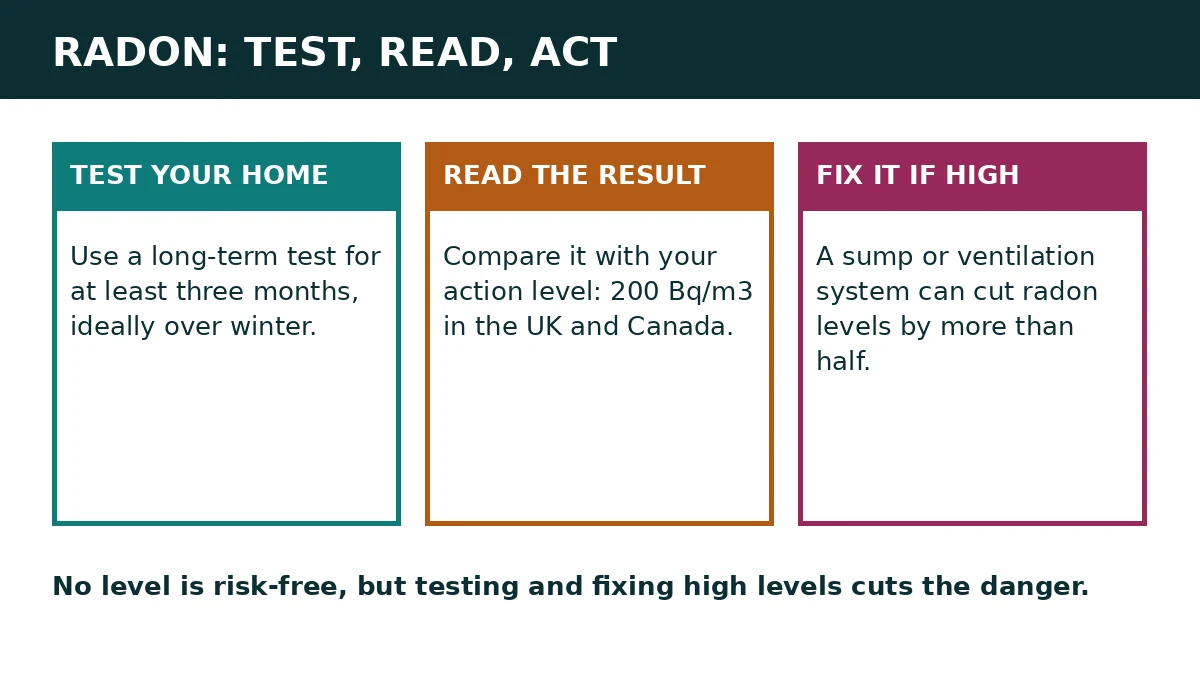
Testing is cheap and straightforward, and it is the only reliable way to find out your level. The most accurate approach is a long-term test: small passive detectors left in place for at least three months, which smooths out the day-to-day and seasonal swings in radon. The WHO recommends measuring for at least three months to estimate the annual average, and Health Canada and UKHSA give the same advice.
A few practical points make the result more trustworthy:
- Test the lowest lived-in level. Put the detector in a room you use regularly, such as a living room or bedroom, not in a kitchen or bathroom, and keep it away from draughts, radiators and outside walls.
- Test in winter if you can. Health Canada calls winter the best time to test, because homes are more tightly sealed and radon levels are often higher. In the UK, the standard three-month test is usually run over the winter months for the same reason.
- Use an approved device. In Canada, choose a monitor that has passed C-NRPP performance testing. In the UK, order a home measurement pack from UKHSA or another validated laboratory. In the US, use a kit from your state radon programme or a tester listed with the National Radon Proficiency Program or the National Radon Safety Board.
- Follow a high result with a second test. A short screening test of a few days can be a useful first check, but if it comes back high, confirm it with a long-term test or a second short test before deciding what to do.
Whatever you buy, check that the device is properly certified rather than trusting a cheap listing online. The Health Canada warning is a reminder that a bargain monitor can be worse than no monitor at all if it tells you the air is safe when it is not.
What to do if your result is high
A high result is not a reason to panic, and it does not mean you should move out. Well-tested methods exist to bring radon down, and they work in most homes. The WHO lists increasing under-floor ventilation, installing a radon sump system in the basement or under a solid floor, sealing floors and walls, and improving the building’s ventilation. Passive systems can cut indoor radon levels by more than half, and adding a ventilation fan can bring them down further still.
The usual route is to talk to a qualified radon professional, who can confirm the reading, work out where the gas is getting in and recommend the right fix for your type of home. After the work is done, test again to check the level has fallen below the action level, and ideally down towards the target level. Sealing cracks on its own is rarely enough, so it is worth getting professional advice rather than relying on DIY fixes.
If you rent, tell your landlord about the result in writing and ask what they plan to do. If you are buying a home, a radon test is worth arranging before you commit, particularly in an area known for high radon.
Who should test?
Everyone, really. Radon is found in homes of all kinds, old and new, and the EPA’s advice is that every home should be tested, because high levels turn up even in areas where the average is low. A neighbour’s low reading says nothing about your house, and a home that tested fine years ago may need retesting after building work, a new extension or a change in how the lower floors are used.
It is especially worth testing if you live in a known radon area, if your home has a basement or ground-floor bedrooms, if you spend a lot of time working from home, or if anyone in the household smokes or used to smoke, since smoking multiplies the risk from radon. Schools and workplaces in radon-prone areas should be tested too.
When to see a doctor
Radon exposure does not cause symptoms, so there is no set of warning signs to watch for in the short term. The health risk builds silently over years of breathing in raised levels, which is why testing your home matters more than looking for symptoms.
Still, talk to a doctor if you develop a cough that does not go away, cough up blood, feel breathless, have chest pain, or lose weight without trying, especially if you smoke or have lived for years in a home with high radon. These symptoms have many possible causes, and only a doctor can work out what is behind them, so do not try to diagnose yourself.
If you smoke, quitting is the single most powerful step you can take, because it cuts your radon-related lung cancer risk far more than any other single change. Your doctor or a stop-smoking service can help you plan it.
In an emergency call 911 (US), 999 (UK) or 112 (EU)
Frequently asked questions
What is radon gas in a home?
Radon is a colourless, odourless radioactive gas produced when uranium in rocks and soil breaks down. It seeps into homes through cracks in floors, gaps around pipes and drains, and can build up indoors to levels far above outdoor air. You cannot see, smell or taste it, so testing is the only way to know whether your home has a problem.
How dangerous is radon in your house?
Radon is the second leading cause of lung cancer after smoking, and the leading cause among people who have never smoked. The EPA estimates about 21,000 lung cancer deaths a year in the US from radon, and UKradon puts the UK figure at over 1,100 a year. Risk rises with the level and the length of exposure, and smoking multiplies it.
How do I test my home for radon?
Use a long-term test left in place for at least three months, ideally over winter when the house is sealed. Place the detector in the lowest lived-in level, in a room you use often, away from draughts and radiators. In Canada use a C-NRPP performance-tested device, and in the UK order a pack from UKHSA or another validated laboratory.
What radon level is safe?
No level carries zero risk, but every country sets a level above which homes should be fixed. The UK action level is 200 Bq/m3 as an annual average, with a target of 100 Bq/m3. The US EPA recommends fixing homes at 4 pCi/L (150 Bq/m3) or more, and the WHO reference level is 100 Bq/m3, not to exceed 300 Bq/m3.
Can radon in a home be fixed?
Yes. Proven methods include installing a radon sump system under the floor, increasing under-floor ventilation, sealing floors and walls, and improving ventilation. The WHO says passive systems can cut indoor radon levels by more than half, and adding a fan can bring them down further. Ask a qualified radon professional, then retest to confirm the level has fallen.
Why did Health Canada warn about radon detectors?
On 16 November 2026 Health Canada warned that some electronic radon detectors sold online give inaccurate readings, after several models were recalled or flagged. A faulty monitor can report a low reading while the real level is high, giving a false sense of security. Health Canada advises using only monitors that have passed C-NRPP performance testing.
Sources
- WHO: Radon and health www.who.int
- Health Canada: Health Canada warns of inaccurate radon detectors sold online recalls-rappels.canada.ca
- US EPA: Health Risk of Radon www.epa.gov
- US EPA: What is EPA's Action Level for Radon and What Does it Mean? www.epa.gov
- UKradon: Radon Action Level and Target Level www.ukradon.org
- UKradon: The risks to your health from radon www.ukradon.org

Try the tool
Not sure if it can wait?
Common causes and warning signs for 16 everyday symptoms.
Open the symptom guide