What Is Magnesium Glycinate? Benefits, Sleep and Side Effects
Magnesium glycinate is the gentle, well-absorbed magnesium form everyone is searching for. Here is what it is, what the evidence actually supports for sleep, anxiety and cramps, and who should be careful.
- Written by
- Health Daily Advice
- Published
- Reading time
- 7 minutes
- Sources
- 8 cited

In this guide
Magnesium glycinate is a supplement that pairs magnesium with glycine, an amino acid found in protein-rich foods. It is one of the best-absorbed forms of magnesium and is usually gentle on the stomach, which is why it is often chosen for sleep and relaxation. The evidence behind those uses, though, is thinner than the hype suggests.
What is magnesium glycinate?
Magnesium is a mineral your body uses in more than 300 chemical processes, from keeping muscles and nerves working to steadying blood pressure and blood sugar, according to the Cleveland Clinic. You get most of it from food, but when a supplement is needed, the form matters. Magnesium glycinate is magnesium bound to glycine, an amino acid found naturally in foods such as fish, dairy and meat.
What sets it apart is how well the body takes it in. Healthline describes it as highly bioavailable, meaning the magnesium is easily absorbed through the small intestine. The Cleveland Clinic adds that it tends to be easy to absorb and gentle on the stomach, which is one reason it has become the form people reach for when they want calm rather than a laxative effect.
Glycine may add something of its own. A 2017 review cited by the Cleveland Clinic found that glycine can improve sleep, reduce inflammation and help manage metabolic disorders such as diabetes. That double appeal — magnesium plus a calming amino acid — helps explain why searches for magnesium glycinate, and for glycinate gummies in particular, have climbed sharply over the past year.
How does magnesium glycinate compare with other forms?
Supplement shelves are crowded with magnesium compounds, and each behaves a little differently. The table below sums up the main ones, based on the Cleveland Clinic’s guides to magnesium and magnesium for sleep.
| Form | What it is known for | What to know |
|---|---|---|
| Magnesium glycinate | Sleep and relaxation | Well absorbed and gentle on the stomach |
| Magnesium citrate | Often used as a laxative | Well absorbed, but can loosen the bowels and upset the stomach before bed |
| Magnesium oxide | Antacid and constipation relief | Not absorbed as well as other forms; can cause diarrhoea |
| Magnesium L-threonate | Brain function research | Designed to reach the brain more easily; sleep evidence is still early |
One practical point applies to every form: the number on the front of the pack is not always the amount of magnesium you actually get. Healthline advises checking the label for the amount of elemental magnesium, which is the figure that counts. And because the US Food and Drug Administration does not review supplements for safety or effectiveness, the Cleveland Clinic suggests looking for products that have been tested by an independent body such as the United States Pharmacopeia (USP).
Does magnesium glycinate help you sleep?
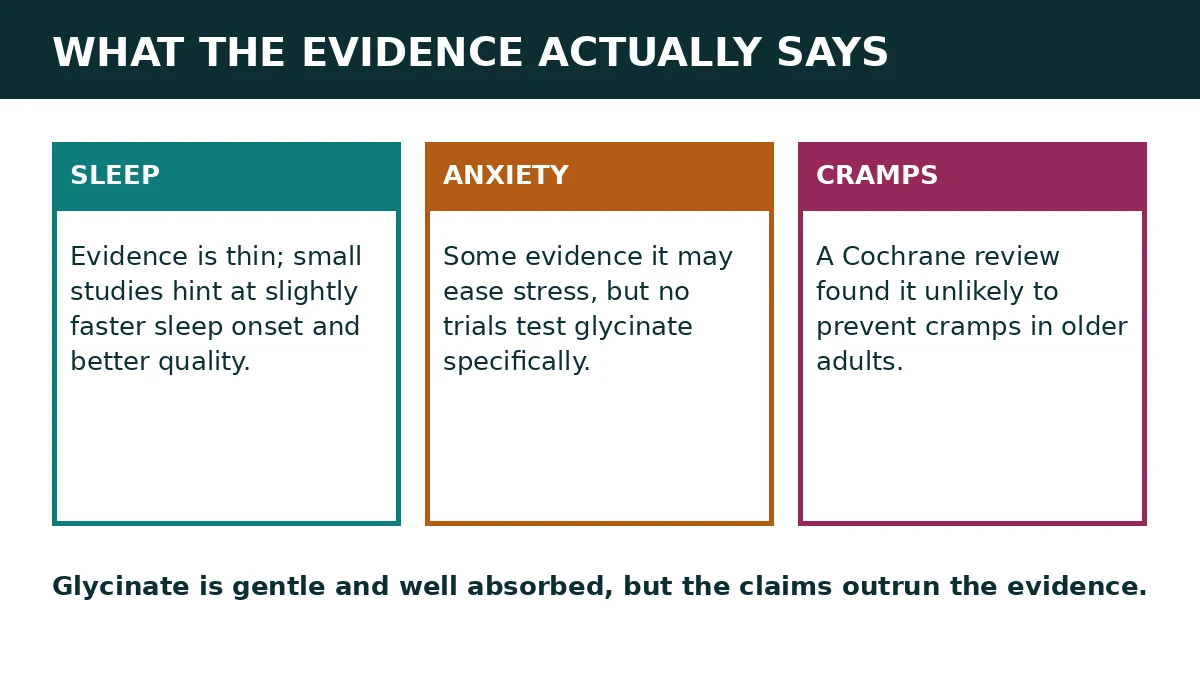
This is the claim that sells the most bottles, and it is also the one with the weakest backing. Dr Naoki Umeda, an integrative medicine specialist at the Cleveland Clinic, puts it plainly: the research behind magnesium as a sleep aid is still thin, though some people do find it helps. Most of the studies are small, and more research is needed before it can be routinely recommended for sleep problems.
What the early studies do suggest is modest. Preliminary research points to a slightly shorter time to fall asleep, better overall sleep quality, and some easing of mild, stress-related sleep disturbance. Magnesium seems to work by supporting the chemical messengers involved in sleep and relaxation, including GABA, the brain’s main calming signal. Glycine itself may also help, with early research linking it to better sleep quality and less daytime tiredness.
That is a long way from a sleeping pill. If sleep is a regular struggle, the Cleveland Clinic’s advice is to start with the measures that have real evidence behind them: a consistent sleep schedule, less caffeine and alcohol, a cool dark bedroom, no screens before bed, and cognitive behavioural therapy for insomnia (CBT-I) if the problem persists. A supplement is not the first step, and anyone thinking of trying one should talk to a doctor or pharmacist first.
What about anxiety and stress?
The picture for anxiety is similar: promising, but far from settled. The Cleveland Clinic’s psychiatrist Dr Joseph Austerman says there is some evidence that magnesium can be beneficial for managing anxiety and stress, though more research is needed. The proposed mechanisms make sense on paper. Magnesium appears to help level out cortisol, the stress hormone that can worsen anxiety when it stays high, and to keep the brain’s excitatory and calming signals in balance by dampening glutamate and supporting GABA.
There is an important gap, though. As Dr Austerman notes, no research has yet looked at how well specific magnesium compounds work for treating anxiety — so the calming reputation of glycinate in particular rests on reasoning about its absorption and its glycine partner, not on trials of glycinate itself. And magnesium is not a substitute for professional care. Anxiety that is persistent, intense or getting in the way of daily life needs a proper assessment, because talking therapy and other treatments are usually more effective than any supplement.
Does it help muscle cramps?
Here the evidence is clearer, and it is not what most people expect. A 2020 Cochrane review of magnesium for skeletal muscle cramps concluded that it is unlikely to provide clinically meaningful cramp prevention for older adults. The finding is summarised in a review of the evidence on supplements for cramps, which notes that an earlier version of the same review reached the same conclusion. For cramps in pregnancy the picture is more mixed, with conflicting results and a need for further research.
This surprises people because severe magnesium deficiency can itself cause muscle cramps, along with numbness, tingling and weakness, according to the NIH Office of Dietary Supplements. But most people with ordinary night cramps have normal magnesium levels, and topping up a mineral you are not short of does not reliably stop them. What does have support is simpler: stretching the cramping muscle, regular calf stretches before bed, and, in a 2026 three-arm trial, daily compression stockings, which reduced cramp frequency, pain and night wakings.
What magnesium glycinate does not prove
It helps to be blunt about the limits. Magnesium glycinate is not a proven treatment for insomnia, it is not a cure for anxiety, and it does not reliably prevent muscle cramps. It is a way of topping up magnesium intake in a form the body absorbs well — nothing more, and nothing less.
Nor can a blood test settle whether you need it. Less than 1% of the body’s magnesium sits in the bloodstream, with more than 99% stored in cells and bones, so a normal blood result does not give a full picture of your magnesium status, the Cleveland Clinic explains. That is why a doctor or pharmacist is the right person to judge whether a supplement makes sense for you, rather than a home test or a social media trend.
Side effects and who should be careful
For most healthy adults, magnesium supplements are generally safe when taken in sensible amounts. Problems usually start when the amount creeps up. The NIH sets 350 mg a day as the upper limit for magnesium from supplements and medicines for adults — a limit that does not apply to magnesium in food. Above that level, diarrhoea, nausea and stomach cramps are common. Very high intakes can cause low blood pressure, muscle weakness, a slow heart rate, irregular heartbeat and trouble breathing, and in extreme cases can lead to cardiac arrest.
Some people need extra caution. The kidneys clear excess magnesium from the body, so anyone with kidney disease should talk to a doctor first, because magnesium can build up to dangerous levels. Magnesium can also interfere with medicines, including some antibiotics, osteoporosis drugs such as bisphosphonates, diuretics and long-term acid reflux treatments. If you take prescription medicines, ask a doctor or pharmacist how a magnesium supplement might interact with them, and whether it should be taken at a different time of day.
It is also worth knowing that a supplement label can be misleading. The amount that counts is the elemental magnesium, and products vary widely. Buying from a reputable source and checking for independent testing is a sensible precaution, since supplements are not checked by regulators in the same way medicines are.
Getting magnesium from food first
Food is the simplest source, and for most people it is enough. The NIH puts the recommended daily amount at 400–420 mg for adult men and 310–320 mg for adult women, and notes that many people’s diets in the United States provide less than the recommended amounts. Good sources include leafy green vegetables such as spinach, nuts and seeds, beans and lentils, whole grains, and milk and yoghurt.
A varied diet of those foods usually covers daily needs without any supplement at all. People more likely to run low include older adults, people with type 2 diabetes, those with gut conditions such as Crohn’s disease or coeliac disease, and people who drink heavily over the long term. If you fall into one of those groups, or you have symptoms such as persistent tiredness, loss of appetite or muscle twitching, a doctor can advise whether testing or a supplement is warranted.
When to see a doctor
See a doctor or pharmacist before starting magnesium glycinate if you have kidney disease, heart problems, or take prescription medicines — especially antibiotics, osteoporosis drugs or diuretics. Get medical advice promptly if you notice muscle weakness, numbness or tingling, an irregular heartbeat, or persistent nausea and vomiting after starting a supplement.
Also seek help if the symptoms that led you to magnesium are not improving. Anxiety that will not lift, sleep problems that go on for weeks, or cramps that keep coming back, spread or come with weakness or dark urine all deserve a proper check rather than a different supplement. If you have been taking magnesium for about a month with no difference, it is time to look at something else.
In an emergency call 911 (US), 999 (UK) or 112 (EU)
Frequently asked questions
What is magnesium glycinate good for?
It is mainly used to top up magnesium intake in a form the body absorbs well and that is gentle on the stomach. It is popular for sleep and relaxation, and some evidence links magnesium to lower anxiety and better sleep quality. It is not a proven treatment for insomnia, anxiety or muscle cramps, and the evidence for glycinate specifically is thinner than for magnesium in general.
Does magnesium glycinate help you sleep?
It may help some people, but the evidence is thin. The Cleveland Clinic says most studies on magnesium and sleep are small, and more research is needed before it can be routinely recommended. Preliminary studies suggest slightly faster sleep onset, better sleep quality and some easing of mild stress-related sleep problems. Sleep hygiene and CBT-I have stronger evidence behind them.
Is magnesium glycinate better than magnesium citrate?
It depends on what you want it for. Glycinate is well absorbed and gentle on the stomach, so it is the form usually chosen for sleep and relaxation. Citrate is also well absorbed but has a laxative effect, which is why it is often used for constipation and can disturb sleep if taken at night. Magnesium oxide is the least well absorbed of the three.
What are the side effects of magnesium glycinate?
It is usually well tolerated, but taking more than the NIH upper limit of 350 mg a day from supplements can cause diarrhoea, nausea and stomach cramps. Very high intakes can lead to low blood pressure, muscle weakness, a slow or irregular heartbeat and trouble breathing. It can also interact with some antibiotics, osteoporosis drugs and diuretics, so ask a doctor or pharmacist first.
Who should not take magnesium glycinate?
Anyone with kidney disease should talk to a doctor first, because the kidneys clear excess magnesium and it can build up to dangerous levels. People with heart problems, or who take prescription medicines such as antibiotics, bisphosphonates or diuretics, should also check with a doctor or pharmacist. Pregnant or breastfeeding women should ask their clinician before taking any supplement.
Can I get enough magnesium from food instead?
Most people can. The NIH recommends 400-420 mg a day for adult men and 310-320 mg for adult women, and good sources include leafy green vegetables, nuts and seeds, beans and lentils, whole grains, and milk and yoghurt. A varied diet usually covers daily needs. People more likely to run low include older adults, people with type 2 diabetes and those with gut conditions such as coeliac disease.
Sources
- NIH Office of Dietary Supplements: Magnesium, Fact Sheet for Consumers ods.od.nih.gov
- Healthline: Magnesium Glycinate: Benefits, Side Effects, Uses, and More www.healthline.com
- Cleveland Clinic: Magnesium health.clevelandclinic.org
- Cleveland Clinic: Magnesium for Sleep: Does It Really Work? health.clevelandclinic.org
- Cleveland Clinic: Magnesium for Anxiety: Does It Work? health.clevelandclinic.org
- Supplement.ge: Muscle cramps: Which Supplements Have Evidence (Cochrane review summary) supplement.ge

Try the tool
Not sure if it can wait?
Common causes and warning signs for 16 everyday symptoms.
Open the symptom guide