mRNA Melanoma Vaccine: What the 42% Trial Result Means
A personalised mRNA vaccine made from each patient's own tumour cut the risk of high-risk melanoma coming back by 42% in a landmark phase 3 trial. Here is what the result means — and what it does not prove.
- Written by
- Health Daily Advice
- Published
- Reading time
- 7 minutes
- Sources
- 8 cited

In this guide
In a phase 3 trial of 1,137 people whose high-risk melanoma had been removed by surgery, adding a personalised mRNA vaccine called intismeran autogene to the immunotherapy pembrolizumab cut the risk of the cancer returning or death by 42% over about two years. The vaccine is still investigational and has not been shown to help people live longer.
The result, from the phase 3 INTerpath-001 trial, was presented at the European Society for Medical Oncology (ESMO) Congress 2026 in Madrid and has been widely described as the first phase 3 success for a personalised cancer vaccine. It is an encouraging milestone — but it is not yet a treatment anyone can receive outside a clinical trial.
What is intismeran autogene?
Intismeran autogene, previously known as mRNA-4157 or V940, is an individualised messenger RNA (mRNA) therapy developed by Moderna and Merck. Unlike the vaccines most people know, it does not prevent an infection. It is a treatment vaccine: it is given after surgery to teach the immune system to hunt down any melanoma cells that may have been left behind.
It belongs to a class of treatments called neoantigen therapies. Neoantigens are abnormal proteins produced by a tumour’s own mutations — markers that healthy cells do not carry. Because every tumour’s mutations are different, every patient’s neoantigens are different too, which is why the vaccine has to be made from scratch for each person.
The vaccine is always given alongside pembrolizumab (Keytruda), an immunotherapy drug that releases a brake on the immune system. The idea is that the vaccine points the immune system at the right targets, while pembrolizumab amplifies the attack.
How is the vaccine made for each patient?
Making one dose is a careful, multi-step process:
- A tumour sample is collected during surgery, along with a blood sample.
- The tumour’s DNA is sequenced and compared with healthy tissue to find its unique mutations.
- Up to 34 neoantigens are selected — the ones judged most likely to trigger a strong immune response.
- Instructions for those neoantigens are written into mRNA, using the same kind of technology behind some COVID-19 vaccines, and packaged into tiny fat particles called lipid nanoparticles.
- The finished vaccine is injected into a muscle, usually in the arm or thigh, in a course of nine doses given every three weeks.
From blood sample to first injection, the bespoke manufacturing process takes roughly six to eight weeks, according to Nature Reviews Drug Discovery. That wait is one of the practical hurdles the companies will need to solve if the treatment is ever rolled out widely.
What did the INTerpath-001 trial find?
INTerpath-001 was a randomised, double-blind phase 3 trial in 1,137 adults whose stage IIB to IV cutaneous melanoma had been completely removed by surgery. Two out of three participants (757 people) received intismeran plus pembrolizumab; the rest (380 people) received a placebo plus pembrolizumab. Treatment lasted about a year, and participants were followed for a median of 24.6 months.
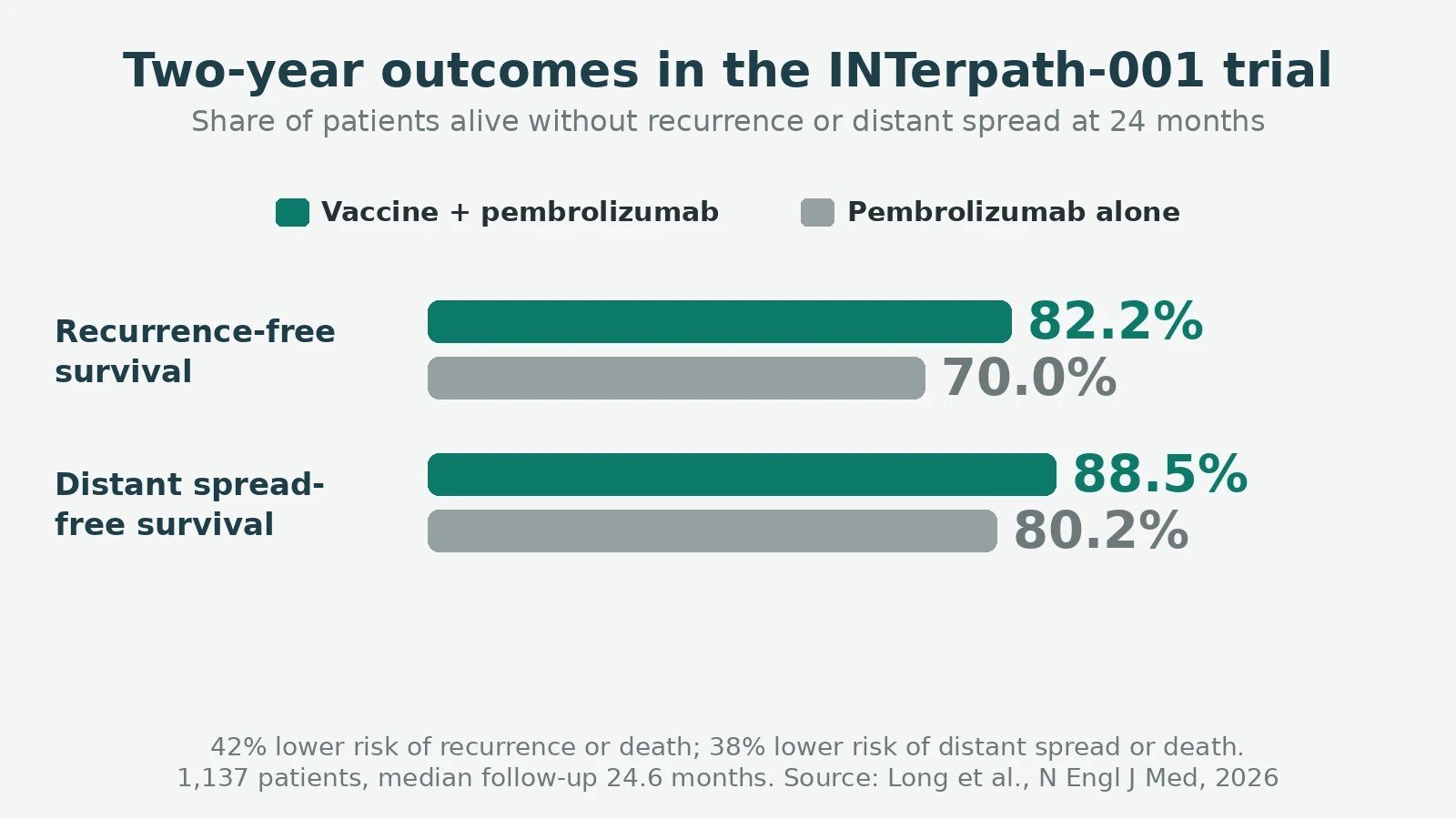
At two years, the headline results were:
- Recurrence-free survival: 82.2% of people who received the vaccine combination were alive without their melanoma returning, compared with 70.0% of those on pembrolizumab alone — a 42% lower risk of recurrence or death (hazard ratio 0.58, 95% CI 0.45–0.75, p < 0.001), as reported in the ASCO Post.
- Distant metastasis-free survival: 88.5% versus 80.2% were alive without the cancer spreading to distant parts of the body — a 38% lower risk of distant spread or death (hazard ratio 0.62, 95% CI 0.45–0.85, p = 0.002).
- The benefit was consistent across earlier and later stages of disease, and across other pre-specified patient groups, according to CancerNetwork.
One detail matters a great deal: the two groups looked almost identical for the first six months. The advantage only opened up after that point — beyond six months, the vaccine combination cut the risk of recurrence or death by 58%. That pattern fits how the treatment is supposed to work: it takes time for the immune system to learn its new targets and build a response.
The results build on an earlier, smaller phase 2b trial (KEYNOTE-942) in 157 people. After five years of follow-up, that study found the vaccine plus pembrolizumab lowered the risk of recurrence or death by 49% and the risk of distant spread or death by 59%, according to CURE Today.
What about side effects?
The most common side effects were fever (52.2% of people on the combination, versus 8.2% on pembrolizumab alone), pain where the injection was given (51.0% versus 9.5%) and fatigue (38.5% versus 29.7%). These were generally mild and short-lived. Serious (grade 3 or higher) side effects occurred in 23.6% of the vaccine group and 20.3% of the control group. Side effects led more people in the vaccine group to stop treatment (16.6% versus 9.5%). Eight people in the vaccine group (1.1%) died from a side effect, but none of those deaths was linked to intismeran itself, and five happened before the vaccine was even given, as the New England Journal of Medicine paper reports.
What the 42% figure does not prove
The headline number is real, but it is easy to over-read it. Here is what the trial has not shown:
- It has not shown that people live longer. Overall survival data are still immature, and the difference so far is not statistically significant (hazard ratio 0.77, 95% CI 0.45–1.31, p = 0.33). Longer follow-up is needed to find out whether keeping melanoma away for longer also extends life.
- It is not a cure, and it is not available. Intismeran autogene is investigational and not approved by any regulator. Merck and Moderna are working towards filing with the US Food and Drug Administration, with a possible approval in 2027, according to Nature Reviews Drug Discovery.
- It is not a vaccine for everyone with melanoma. The trial only included people whose high-risk melanoma had been completely removed by surgery and who had not had prior systemic treatment.
- It is not a preventive vaccine. It cannot stop melanoma developing in healthy people, and it is not a substitute for sun protection or skin checks.
- Key scientific questions remain open. As the ESMO discussant noted, detailed data on which neoantigens drove the immune response have not yet been published, and it is not yet clear how the vaccine compares with other approaches, such as giving two immunotherapy drugs before surgery.
Lead investigator Georgina Long of Melanoma Institute Australia put it plainly at ESMO: for a patient, more time free of melanoma is a meaningful benefit in its own right — but longer follow-up is needed to show an impact on survival and to learn which patients benefit most.
Who might the vaccine help?
If it is eventually approved, the vaccine would be aimed at people with high-risk melanoma that has been surgically removed — the group most at risk of the cancer coming back. Even with today’s standard immunotherapy after surgery, about three in ten people in the trial’s control group had their melanoma return or had died within two years. That gap is exactly what the vaccine is trying to close.
Beyond melanoma, the same personalised approach is being tested in other cancers. Merck and Moderna are running nine phase 2 and phase 3 trials in the INTerpath programme, including studies in non-small cell lung cancer, bladder cancer and kidney cancer, according to CancerNetwork. Similar vaccines are also being studied in pancreatic cancer and brain tumours.
For now, the only way to receive intismeran autogene is by joining a clinical trial. Anyone with melanoma who is interested can ask their care team whether a personalised vaccine trial is open to them, and can search for open trials on ClinicalTrials.gov — though eligibility is always decided by the trial team.
What happens next?
The full results were presented at ESMO Congress 2026 in Madrid on 24 October 2026 and published in the New England Journal of Medicine on 11 November 2026. The trial continues, with overall survival the key question still to be answered.
Regulators will now weigh the evidence. If the survival data mature in the vaccine’s favour, intismeran autogene could become the first personalised mRNA cancer vaccine to reach patients — and a template for the same approach in other cancers. But that decision is months away at the earliest, and the practical questions — how fast a bespoke vaccine can be made, what it will cost, and who benefits most — are still to be settled.
For people living with melanoma today, the practical message has not changed: attend follow-up appointments, report any new lump, changing mole or unexplained symptom promptly, and talk to your care team about whether a clinical trial could be right for you.
When to see a doctor
See a doctor promptly if you notice a new mole, a mole that changes shape, colour or size, a sore that does not heal, or a new lump under the skin — especially if you have had melanoma before. Also seek advice if you develop unexplained weight loss, persistent fatigue, or a new pain that does not settle. Early review matters: most skin changes turn out not to be cancer, but a doctor can check and arrange a referral if needed.
Do not wait for a routine appointment if a mole bleeds, itches persistently, or changes quickly. If you are already under follow-up for melanoma, contact your specialist team directly about any new symptom, and keep your scheduled scans and check-ups.
In an emergency call 911 (US), 999 (UK) or 112 (EU).
Frequently asked questions
What is the mRNA melanoma vaccine?
Intismeran autogene is a personalised mRNA vaccine made from each patient's own tumour. Scientists sequence the tumour's DNA, pick up to 34 unique markers called neoantigens, and write instructions for them into mRNA. Given with the immunotherapy pembrolizumab after surgery, it teaches the immune system to recognise and attack any melanoma cells left behind.
What did the phase 3 trial find?
In the INTerpath-001 trial of 1,137 people with high-risk melanoma removed by surgery, adding the vaccine to pembrolizumab cut the risk of recurrence or death by 42% over about two years. At two years, 82.2% of people on the combination were alive without recurrence, versus 70.0% on pembrolizumab alone. The risk of distant spread or death fell by 38%.
Does the vaccine help people live longer?
That is not yet known. Overall survival data from the trial are still immature, and the difference between the groups so far is not statistically significant. The trial will keep following participants to see whether keeping melanoma away for longer also extends life. For now, the proven benefit is more time free of recurrence, which the trial's lead investigator called meaningful in its own right.
Can I get the mRNA melanoma vaccine now?
No. Intismeran autogene is investigational and has not been approved by any regulator, so it cannot be prescribed outside a clinical trial. Merck and Moderna are working towards filing with the US Food and Drug Administration, with a possible approval in 2027. Anyone with melanoma who is interested should ask their care team whether a personalised vaccine trial is open to them.
What are the side effects of the mRNA melanoma vaccine?
The most common side effects were fever, pain at the injection site and fatigue, and these were usually mild and short-lived. Serious side effects occurred in 23.6% of people on the combination, compared with 20.3% on pembrolizumab alone. Side effects led 16.6% of people in the vaccine group to stop treatment. No death was linked to the vaccine itself.
Is this vaccine the same as a flu or COVID vaccine?
No. Flu and COVID vaccines prevent infection in healthy people. Intismeran autogene is a treatment vaccine given to people who already have cancer, after surgery, to stop it coming back. It is also personalised: each dose is made from one patient's own tumour, so no two doses are the same. It uses mRNA technology, but its purpose and design are completely different.
Sources
- The ASCO Post: High-Risk Melanoma — Personalized mRNA Vaccine Plus Immunotherapy ascopost.com
- CancerNetwork: Intismeran Plus Pembrolizumab Reduces Recurrence Risk in Resected Melanoma www.cancernetwork.com
- AACR Blog: Personalized Melanoma mRNA Vaccine Delivers Phase III Success www.aacr.org
- CURE Today: What Is a Personalized Cancer Vaccine? www.curetoday.com
- Nature Reviews Drug Discovery: Cancer vaccine development gets complicated www.nature.com
- Targeted Oncology: ESMO 2026 Presidential Symposium I Late-Breaking Recap www.targetedonc.com
- New England Journal of Medicine (via PubMed): Intismeran Autogene plus Pembrolizumab for Resected Stage IIB to IV Melanoma pubmed.ncbi.nlm.nih.gov

Try the tool
Not sure if it can wait?
Common causes and warning signs for 16 everyday symptoms.
Open the symptom guide