Menstrual Migraine: Why Your Period Triggers Headaches
If a pounding headache arrives like clockwork with your period, it may be menstrual migraine. Here is why the oestrogen drop triggers it, how to spot the pattern, and what can help.
- Written by
- Health Daily Advice
- Published
- Reading time
- 10 minutes
- Sources
- 7 cited

In this guide
Menstrual migraine is a migraine attack linked to your period, usually starting two days before bleeding begins and lasting into the first three days. It is triggered mainly by the sharp fall in oestrogen just before your period. These attacks often last longer and feel worse than migraine at other times, but treatments timed around your cycle can help.
If a pounding headache arrives like clockwork each month, it is easy to dismiss it as “just part of having a period”. It is not. For many women, the days around menstruation are the most predictable — and the most punishing — time for migraine. The good news is that the very predictability of menstrual migraine makes it easier to plan for than attacks that strike out of the blue. Once you can see the pattern, you and your doctor can time treatment around it.
What is menstrual migraine?
Menstrual migraine is not a separate disease. It is the name for migraine attacks that are tied to the menstrual cycle. According to the Migraine Trust, these attacks tend to happen from around two days before your period starts up to the third day of your period, although the exact timing varies from person to person.
This is a common problem. The Migraine Trust reports that as many as two-thirds of women with migraine may have attacks related to their periods, and the American Migraine Foundation puts it similarly, noting that for nearly two out of three women with migraine, attacks occur around the same time as their period. It can begin with your first periods and continue until they stop at the menopause. A systematic review and network meta-analysis published in The Journal of Headache and Pain also reported that 18–25% of female migraine sufferers experience menstrual migraine without aura.
Doctors use the International Classification of Headache Disorders (ICHD-3) to define the pattern. An attack counts as menstrual migraine when it falls in the five-day window from two days before menstruation to the third day of bleeding, in at least two out of three menstrual cycles.
Why does your period trigger migraine?
The main culprit is oestrogen — or rather, the sudden loss of it. Oestrogen levels climb through the first half of your cycle, peak around ovulation, then fall sharply in the days before your period. That steep drop, known as oestrogen withdrawal, is a well-established migraine trigger. It is the fall that matters, not simply having low oestrogen: levels are at their lowest during your period itself, yet attacks cluster around the drop that precedes it.
Researchers believe falling oestrogen affects the brain’s pain pathways and the chemical messengers that regulate them, including serotonin, lowering the threshold at which a migraine attack starts. Hormone-like substances called prostaglandins play a part too. Your body releases more prostaglandins around the time of your period; they cause the womb to contract, which brings period pain, and they have also been linked to migraine, as the Migraine Trust explains.
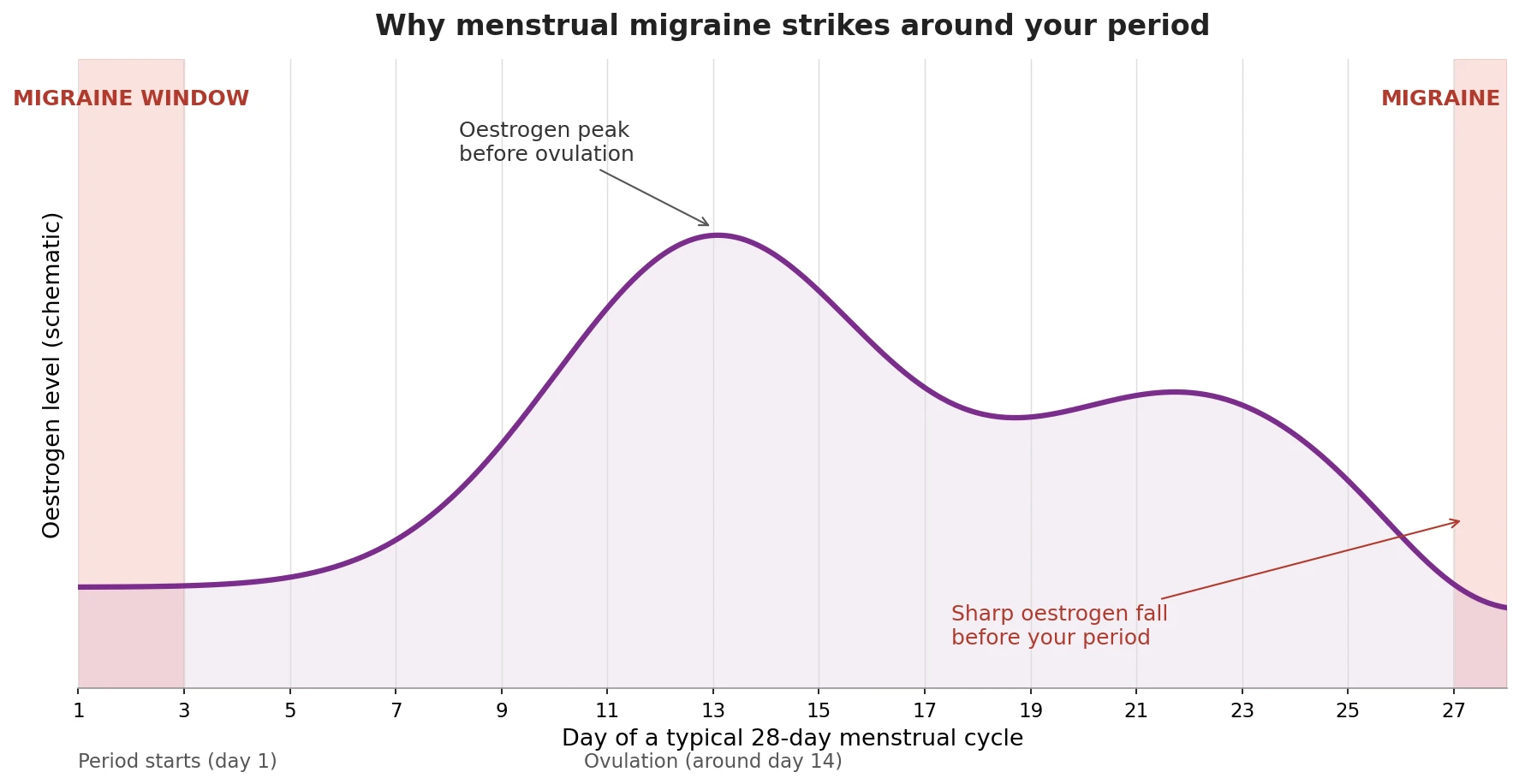
Other triggers often pile on at the same time. Poor sleep, missed meals, dehydration and stress are all common around a period, and each one can lower the migraine threshold further. That is why an attack that might not have happened on an ordinary week can break through in the days before your period.
What does menstrual migraine feel like?
The symptoms are the same as those of any migraine attack, but they often hit harder. The NHS describes the main features of a migraine attack as a throbbing headache, often on one side of the head and worse when you move around, feeling or being sick, and being very sensitive to light and sounds. Attacks usually last between 4 hours and 3 days.
With menstrual migraine, you may also notice:
- Head pain that ranges from dull to severe, usually on one side of the head and often around the forehead, according to Cleveland Clinic
- Nausea, vomiting, an upset stomach or abdominal pain
- Sensitivity to light, sound and smells
- A tender or sore scalp
- Blurred vision or dizziness
- Feeling very tired, and loss of appetite
- Feeling very warm and sweaty, or cold with chills
- Early warning signs hours or up to two days beforehand, such as yawning a lot, craving certain foods, mood changes or a stiff neck
Some people get aura — visual disturbances such as zigzag lines or flashing lights, tingling, or difficulty speaking — before the headache. However, menstrual migraine attacks are more likely to be without aura, even if you get migraine with aura at other times of the month, the Migraine Trust notes.
Pure menstrual migraine vs menstrually related migraine
There are two types, and the difference matters because it shapes treatment. In pure menstrual migraine, attacks happen only around your period. In menstrually related migraine, attacks also happen at other times of the month. The Migraine Trust says fewer than 1 in 100 women with migraine are thought to have the pure form — most women with menstrual migraine also get attacks at other times.
| Type | When attacks happen | How common it is |
|---|---|---|
| Pure menstrual migraine | Only in the window from two days before your period to the third day of bleeding, in at least two out of three cycles | Uncommon — fewer than 1 in 100 women with migraine, according to the Migraine Trust |
| Menstrually related migraine | In the same menstrual window, and also at other times of the month | Much more common — the pattern most women with menstrual migraine have |
How is menstrual migraine different from regular migraine?
Three differences stand out, and all three are backed by the major headache organisations. First, menstrual migraine attacks tend to last longer than attacks at other times — the NHS states plainly that attacks happening just before or during your period are often longer and more severe. Second, they tend to be more severe, with greater nausea and light sensitivity, as the American Migraine Foundation describes. Third, they can be harder to treat: the same medicines that work well on your other attacks may not work as well on a menstrual attack, and a systematic review in The Journal of Headache and Pain found menstrual migraine attacks tend to be more severe, longer-lasting and less responsive to treatment than non-menstrual attacks.
That does not mean nothing works. It means treatment often needs to be timed to the cycle rather than taken only once pain has started — which is where keeping a diary comes in.
How can you tell if your migraine is linked to your period?
There is no blood test or scan for menstrual migraine. Diagnosis is based on your history, and the most accurate way to confirm the link is to keep a diary for at least three months, recording both your migraine attacks and the days you are on your period. The Migraine Trust recommends exactly this, and your doctor will use the diary to see whether attacks fall in the menstrual window in at least two out of three periods.
When you keep the diary, note the day each attack starts, how long it lasts, how severe it is, what medicine you took and whether it helped, and anything else that might have contributed, such as poor sleep or a missed meal. A clear pattern in the diary is often a relief in itself: it turns something that felt random into something with a timetable you can work around.
What treatments help menstrual migraine?
Standard migraine medicines can be used for menstrual migraine, but the timing is often different. There are three broad approaches, as set out by the American Migraine Foundation: acute treatment to stop an attack, mini-prevention taken for a few days around your period, and continuous prevention taken every day. Which one suits you depends on how regular your periods are, whether you also get migraine at other times, and your overall health — so talk to a doctor or pharmacist about the right option for you.
Acute treatment: stopping an attack once it starts
Painkillers such as paracetamol and ibuprofen can help, and the NHS advises taking them as soon as the headache starts. If you also get painful periods, a stronger anti-inflammatory may help more — ask a pharmacist. Medicines called triptans are often used for migraine attacks; they come as tablets, nasal sprays and injections, and a doctor may suggest a triptan combined with an anti-inflammatory medicine. Medicines that stop you feeling sick can be added if nausea is a problem.
One warning applies to all of these: try not to take painkillers for more than two days a week, as the NHS advises, because using them too often can cause medication overuse headache and make migraine harder to treat. The days you use painkillers or triptans for menstrual migraine count towards this, so mention your total use to your doctor.
Mini-prevention: treatment timed around your period
Because menstrual migraine is predictable, some women take preventive treatment for just a few days around their period, usually starting a couple of days before the expected attack and continuing for several days. The Migraine Trust describes this as perimenstrual prevention, and options a doctor may consider include a short course of an anti-inflammatory medicine, a long-acting triptan on the days attacks are expected, or oestrogen supplements such as a patch or gel to smooth out the hormone drop. The American Migraine Foundation also notes magnesium as a mini-prevention option studied in a controlled trial. These approaches are only suitable when your periods are regular enough to predict, and some are used without a formal licence for this purpose, so they need a doctor’s guidance.
Continuous prevention and hormonal options
If you get migraine often, or at other times of the month as well, daily preventive treatment may be the better route. The NHS lists preventive medicines, acupuncture, relaxation techniques and cognitive behavioural therapy (CBT) among the options a GP may consider, and a GP may also suggest lifestyle changes such as eating at regular times and drinking less caffeine.
Hormonal approaches aim to remove the oestrogen drop itself. Combined hormonal contraception can help, and taking the combined pill continuously without a break avoids the sharp hormone fall of the pill-free week. However, combined hormonal contraception is not suitable for everyone: the Migraine Trust warns that you cannot take it if you have migraine with aura or other risk factors for stroke, so tell your doctor if you have aura. For women with aura, a progestogen-only pill may be an option. A doctor can talk through the choices, including whether a hormonal coil might help by stopping periods altogether.
What can you do at home around your period?
Medicine is only part of the picture. Because attacks usually come from a combination of triggers, the Migraine Trust suggests taking extra care with the other triggers in the days around your period:
- Keep a regular sleep pattern, and avoid too much or too little sleep
- Eat small, regular meals and do not skip breakfast — missing meals can trigger attacks
- Stay well hydrated, and limit caffeine and alcohol
- Keep stress down where you can, with regular exercise and relaxation strategies
- Rest in a dark, quiet room during an attack — the NHS recommends lying down in a darkened room
- Have a small snack before bed if you tend to wake with a headache
It also helps to plan ahead. If you know your period is due, keep your usual migraine medicine with you, and avoid booking demanding commitments for the days when attacks are most likely.
Menstrual migraine, contraception and the menopause
Hormones shape migraine across a lifetime, not just month to month. Migraine often improves during pregnancy, especially in the second and third trimesters, when oestrogen and progesterone rise steadily. Attacks can get worse as you approach the menopause, when oestrogen levels fluctuate, and they may improve after the menopause once periods have stopped and oestrogen levels stabilise — although the Migraine Trust notes this is not the case for everyone.
Hormonal contraception can change the pattern in either direction. Some women find their migraine improves on it; others find attacks become more frequent or more severe, as Cleveland Clinic notes. If your headaches change after starting a hormonal medicine, talk to a doctor or pharmacist — a different type, a lower oestrogen dose, or a continuous regimen may suit you better. And if you develop aura for the first time while taking the combined pill, let your doctor know straight away.
When to see a doctor
See your GP if your migraine attacks are severe or getting worse, lasting longer than usual, happening more than once a week, difficult to control, or if you regularly get migraine before or during your period — that is the NHS advice. A GP can confirm the pattern from your diary, review your medicines, and refer you to a specialist migraine clinic if treatment is not working.
Ask for an urgent GP appointment or get help from NHS 111 if an attack has lasted longer than 72 hours, aura symptoms last longer than an hour at a time, or you are pregnant or have just had a baby.
Get emergency help straight away if you have a headache that came on suddenly and is extremely painful, problems speaking or remembering things, loss of vision or blurred or double vision, drowsiness or confusion, a seizure, a very high temperature with symptoms of meningitis, weakness on one side of your body or face, or you have recently had a head injury.
In an emergency call 911 (US), 999 (UK) or 112 (EU).
Menstrual migraine is common, it is often more severe than other migraine, and it is not something you simply have to put up with. The pattern is predictable, the trigger is understood, and there are treatments — acute, short-term preventive and hormonal — that can be timed to your cycle. If your period reliably brings a migraine, keep a diary for three months and take it to your doctor: that diary is the first step towards fewer lost days each month.
Frequently asked questions
What is menstrual migraine?
Menstrual migraine is a migraine attack linked to your menstrual cycle. Attacks usually start from two days before your period begins and last into the first three days of bleeding. They are triggered mainly by the sharp fall in oestrogen just before your period, and they often last longer and feel worse than migraine at other times.
Why does my period trigger migraines?
Oestrogen levels fall sharply in the days before your period, and that sudden drop — known as oestrogen withdrawal — is a well-established migraine trigger. Hormone-like substances called prostaglandins, which rise around your period and cause period pain, have also been linked to these attacks.
How long does menstrual migraine last?
Migraine attacks usually last between 4 hours and 3 days, according to the NHS, and menstrual migraine attacks tend to be on the longer end of that range. They often start two days before bleeding begins and can continue into the first three days of your period.
What is the difference between pure menstrual migraine and menstrually related migraine?
In pure menstrual migraine, attacks happen only around your period. In menstrually related migraine, attacks also happen at other times of the month. Pure menstrual migraine is uncommon — the Migraine Trust says fewer than 1 in 100 women with migraine are thought to have it.
What helps menstrual migraine?
Standard migraine medicines can help, often timed to your cycle: acute treatment to stop an attack, mini-prevention taken for a few days around your period, or daily prevention. Hormonal options that smooth out the oestrogen drop may also help. Talk to a doctor or pharmacist about which approach suits you.
When should I see a doctor about period migraines?
See your GP if attacks are severe or getting worse, last longer than usual, happen more than once a week, are hard to control, or regularly arrive with your period. Get urgent help if an attack lasts longer than 72 hours, aura lasts over an hour, or you have sudden severe headache, vision loss, confusion or weakness.
Sources
- The Migraine Trust: Menstrual migraine migrainetrust.org
- NHS: Migraine www.nhs.uk
- American Migraine Foundation: Menstrual Migraine Treatment and Prevention americanmigrainefoundation.org
- Cleveland Clinic: Period Headaches (Menstrual Migraines) my.clevelandclinic.org
- Zhang et al.: Comparative efficacy of different treatments for menstrual migraine (J Headache Pain, 2023) pmc.ncbi.nlm.nih.gov

Try the tool
When is your next period and fertile window?
Six cycles ahead from your last period date.
Open the calculator