What Causes Heavy Periods? Symptoms, Causes and When to Worry
Soaking through pads every hour, clots bigger than a 10p coin, periods that drag past a week? Heavy periods affect about 1 in 5 women. Here are the causes, the anaemia risk and when to see a GP.
- Written by
- Health Daily Advice
- Published
- Reading time
- 6 minutes
- Sources
- 5 cited

In this guide
Heavy periods, also called menorrhagia, mean losing much more blood than usual or bleeding for more than seven days. About 1 in 5 women of reproductive age has them. Common causes include hormone imbalance, fibroids, polyps and adenomyosis, but often no cause is found. Heavy bleeding can cause iron-deficiency anaemia, so it is worth getting checked.
Periods vary a lot from person to person, which makes it hard to know what counts as heavy. Some women lose a little blood over three days; others soak through protection every hour and dread leaving the house. If your periods regularly disrupt your life, they are heavy enough to deserve attention, whatever anyone else’s periods look like. This guide explains how to tell, what causes heavy bleeding, what it can do to your iron levels, and when to see a GP.
What counts as a heavy period?
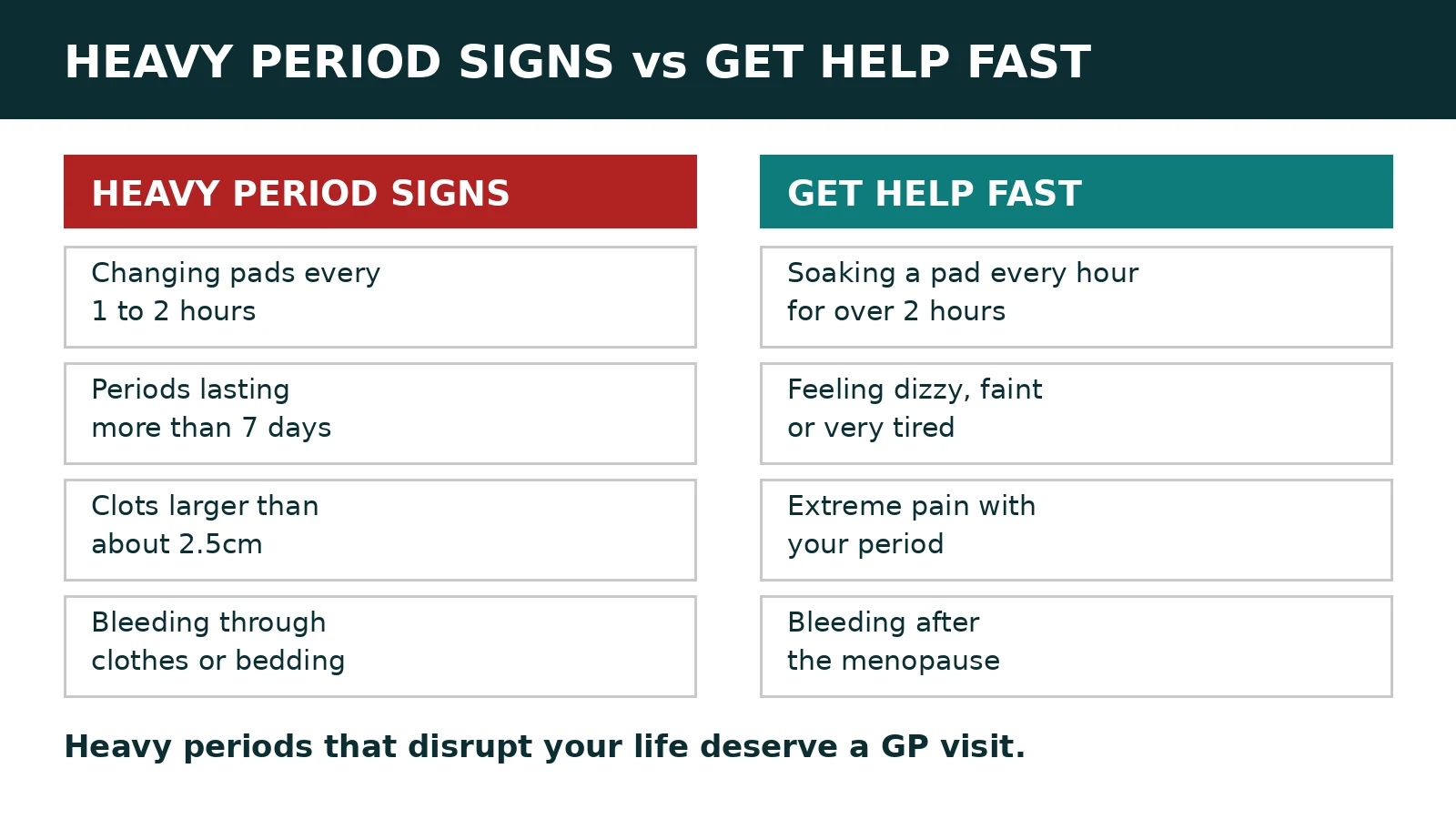
In a normal period, most people lose about 30 to 40 millilitres of blood, roughly two to three tablespoons, over three to seven days. Doctors consider a period heavy if you regularly lose more than 80 millilitres. That is hard to measure at home, so the NHS uses practical signs instead. You may have heavy periods if you:
- need to change your pad or tampon every 1 to 2 hours, or empty your menstrual cup more often than recommended
- need to use two types of period product together, such as a pad and a tampon
- have periods lasting more than 7 days
- pass blood clots larger than about 2.5cm, roughly the size of a 10p coin
- bleed through to your clothes or bedding
- need to get up at night to change protection
- avoid daily activities, like exercise, or take time off work because of your periods
- feel tired or short of breath a lot
Heavy periods are common. They affect about 1 in 5 women of reproductive age, and about 10 in 100 women have very heavy periods. Menstrual bleeding is clearly too heavy if it affects your daily life or if the blood loss leads to iron deficiency and anaemia. Our guide to period blood clots explains when clots are normal and when they are a reason to see a doctor.
What causes heavy periods?
Sometimes heavy periods are simply normal for you, and they can be heavier at certain times of life, such as when periods first start, after pregnancy, or approaching menopause. When a cause can be found, it is usually one of these.
Hormone imbalance
In a typical cycle, the hormones oestrogen and progesterone stay in balance and control how the lining of the womb builds up. When they fall out of balance, the lining grows too thick and sheds as heavy bleeding. Conditions that disturb this balance include polycystic ovary syndrome, obesity, insulin resistance and thyroid problems. If the ovaries do not release an egg in a cycle, known as anovulation, the body does not make progesterone as usual, which can also lead to heavy bleeding.
Growths in the womb
Benign growths are the most common physical cause of very heavy periods. Fibroids are non-cancerous tumours that grow in the muscle wall of the womb and can cause heavier or longer bleeding. Polyps are small growths on the lining of the womb that can cause heavy or prolonged bleeding, and sometimes bleeding between periods. Adenomyosis is a condition where glands from the womb lining grow into the muscle wall, causing heavy and painful periods.
Other causes
- Bleeding disorders. Conditions such as von Willebrand disease, where the blood does not clot properly, can make periods heavy. Heavy periods can be one of the first signs of a bleeding disorder.
- Medicines. Blood thinners such as warfarin and some anti-inflammatory medicines can increase bleeding, and a hormone-free coil (IUD) is a well-known cause of heavier periods.
- Infections. Pelvic inflammatory disease and other infections of the reproductive organs can cause heavy bleeding.
- Other conditions. Liver, kidney and thyroid disease can all contribute, and endometriosis is sometimes involved.
- Pregnancy complications. A single, very heavy, late period can be due to a miscarriage.
- Cancer. Rarely, heavy periods can be a sign of womb or cervical cancer, which is why bleeding after menopause always needs checking.
In many cases, no cause is found at all. That does not mean the bleeding is not real, and treatment can still help.
Can heavy periods cause anaemia?
Yes. Losing a lot of blood month after month drains iron from the body, and without enough iron the body cannot make enough red blood cells. This is iron-deficiency anaemia. It can leave you feeling tired, dizzy, weak and short of breath, with pale skin and cold hands and feet. More severe anaemia can cause dizziness, breathing difficulties and a racing heart, especially after physical activity.
A blood test can show whether heavy periods have caused anaemia, and your GP will usually check this when you first talk about heavy bleeding. Eating iron-rich foods such as spinach, red meat, beans and lentils can help replace lost iron, and your doctor may also suggest iron supplements. Do not take aspirin for period pain while your periods are heavy, as it reduces blood clotting and can make bleeding worse.
How are heavy periods diagnosed?
Your doctor will start by asking about your periods and how they affect your life: when your last period was, how long periods last, how often you change protection on your heaviest day, and whether bleeding stops you doing normal things. It helps to keep track for one or two months first, noting start and end dates and how heavy each day was, or counting how many pads or tampons you use.
Tests to find the cause may include blood tests to check iron levels, hormones and thyroid function, an ultrasound scan to look at the womb, and sometimes a hysteroscopy, where a tiny camera looks inside the womb, or a biopsy of the womb lining. Your doctor will also ask about illnesses in your family, medicines you take, and any stress that might be affecting you.
What treatments are available?
Treatment depends on what is causing the bleeding, how much it affects you, your age, and whether you want to have children. Heavy periods do not always need treatment, but there are good options when they are disrupting your life.
- Hormonal treatments. Some types of contraception, such as an intrauterine system (IUS) or the combined pill, can reduce bleeding by making the womb lining grow less.
- Medicines to reduce bleeding. Tranexamic acid helps blood to clot and can cut blood loss, and prescription anti-inflammatory painkillers such as mefenamic acid or naproxen can help with both pain and bleeding.
- Iron supplements. If blood tests show anaemia, iron supplements help rebuild your iron stores.
- Procedures. If medicines do not work, a specialist may suggest removing the lining of the womb (endometrial ablation) or removing fibroids or polyps.
- Hysterectomy. Removing the womb is a major operation and is only considered when periods are very heavy, other treatments have not worked, and you do not want to have any more children.
Talk to your doctor about what matters most to you, whether that is lighter periods, less pain, keeping your fertility, or avoiding surgery. The right choice depends on your own situation, and there is time to weigh the options.
When to see a doctor
See your GP if heavy periods are affecting your life, have gone on for some time, or come with severe period pain, bleeding between periods or after sex, or pain when passing urine, having a bowel movement or having sex. The NHS also advises seeing a GP if you feel constantly tired or short of breath, which can be a sign of anaemia.
Get medical help sooner if you soak through a pad or tampon every hour for more than two hours in a row, pass a blood clot larger than a quarter, feel dizzy, weak or extremely tired, or have extreme pain with your period. Seek care straight away if you are bleeding and are pregnant or think you may be pregnant, as bleeding in pregnancy can be an emergency.
In an emergency call 911 (US), 999 (UK) or 112 (EU).
Frequently asked questions
How do I know if my period is too heavy?
You may have heavy periods if you need to change a pad or tampon every one to two hours, bleed for more than seven days, pass clots larger than about 2.5cm, or bleed through clothes or bedding. Doctors consider a loss of more than 80ml in one period heavy, against a typical 30 to 40ml. If bleeding stops you doing normal things, it is too heavy whatever the amount.
What is the most common cause of heavy periods?
Often no single cause is found. When a cause is identified, it is usually a hormone imbalance, a fibroid or a polyp, or adenomyosis, where womb lining grows into the muscle wall. Heavy periods are also common when periods first start, after pregnancy and near menopause. Your doctor can check for these with blood tests and an ultrasound scan.
Can heavy periods cause anaemia?
Yes. Losing a lot of blood month after month uses up iron, and without enough iron the body cannot make enough red blood cells. Iron-deficiency anaemia can leave you tired, dizzy, weak and short of breath, with pale skin and cold hands and feet. A blood test can check your iron levels, and your GP may suggest iron supplements alongside treatment for the bleeding.
Do heavy periods need treatment?
Not always. Some women manage well without treatment, but help is available if bleeding affects your daily life or causes anaemia. Options include hormonal contraception or a hormonal coil, medicines that reduce bleeding, and painkillers. If these do not work, a specialist may suggest removing the womb lining or fibroids, and hysterectomy is only considered as a last resort.
When should I see a doctor about heavy periods?
See your GP if heavy periods affect your life, have gone on for some time, or come with severe pain, bleeding between periods or after sex, or constant tiredness and breathlessness. Seek help sooner if you soak a pad or tampon every hour for more than two hours, feel dizzy or faint, or pass very large clots. Bleeding after menopause always needs checking.
Sources
- NHS: Heavy periods www.nhs.uk
- Mayo Clinic: Menorrhagia (heavy menstrual bleeding) - Symptoms and causes www.mayoclinic.org
- St Jude Children's Research Hospital: Heavy Menstrual Bleeding (Menorrhagia) together.stjude.org
- InformedHealth.org (NCBI): Overview: Heavy periods www.ncbi.nlm.nih.gov

Try the tool
When is your next period and fertile window?
Six cycles ahead from your last period date.
Open the calculator