What Is Adenomyosis? Symptoms, Causes and Treatment
Heavy, painful periods that keep getting worse can have a cause many women have never heard of. Here is what adenomyosis is, how it differs from endometriosis, and the treatments that help.
- Written by
- Health Daily Advice
- Published
- Reading time
- 6 minutes
- Sources
- 7 cited

In this guide
Adenomyosis is a condition where the tissue that normally lines the uterus grows into the muscle wall of the womb. Each month that trapped tissue thickens, breaks down and bleeds, which can cause very heavy, painful periods and pelvic pain. About one in three people with it have no symptoms. Treatments range from pain relief and hormonal medicine to surgery.
What is adenomyosis?
Adenomyosis (pronounced add-en-o-my-OH-sis) affects the uterus, the hollow, pear-shaped organ where a baby grows during pregnancy. The Mayo Clinic explains that the tissue lining the inside of the uterus — called endometrial tissue — grows into the muscle wall of the uterus. During each menstrual cycle, that trapped tissue thickens, breaks down and bleeds, just like the lining of the uterus does. Because the blood has nowhere to go, the uterus can become enlarged and periods can become heavy and painful.
The condition is not cancer, and it does not lead to cancer. The Cleveland Clinic notes that the uterus can double or triple in size. How common it is exactly is unknown, because many people have no symptoms and never find out they have it.
Symptoms of adenomyosis
About one in three people with adenomyosis have no signs or symptoms at all. For others, symptoms can be severe enough to disrupt daily life. They include:
- Heavy or long-lasting periods, sometimes with blood clots
- Severe cramping or sharp pelvic pain during periods
- Pelvic pain that does not go away between periods
- Painful sex
- A larger uterus, which may cause tenderness or pressure in the lower stomach
- Bloating or a feeling of fullness in the belly
- Bleeding between periods
Symptoms vary through the cycle because they are linked to oestrogen, the hormone that drives the monthly shedding of the womb lining. The NHS describes heavy periods as needing to change a pad or tampon every 1 to 2 hours, periods lasting more than 7 days, or passing clots larger than about 2.5cm — and lists adenomyosis as one of the conditions that can cause them. Heavy bleeding can lead to anaemia — too few healthy red blood cells — which can make you feel tired, cold and short of breath. If your periods are so heavy or painful that they interfere with work, study or daily life, that is worth getting checked.
What causes adenomyosis?
Doctors do not know the exact cause. Several theories exist, and more than one may be involved:
- Invasive growth. Endometrial cells from the lining of the uterus invade the muscle wall, possibly through cuts made during surgery such as a caesarean section.
- Developmental origins. Endometrial tissue may be deposited in the uterine muscle while the uterus is first forming in the foetus.
- Inflammation after childbirth. Inflammation of the lining of the uterus after giving birth may play a part.
- Stem cells. Bone marrow stem cells may enter the uterine muscle and start behaving like endometrial cells.
- Retrograde menstruation. Period blood may flow backwards through the fallopian tubes into the pelvic cavity instead of leaving the body.
Whatever the cause, adenomyosis depends on oestrogen to grow. That is why symptoms often ease or disappear after the menopause, when oestrogen levels fall.
Who is more likely to get adenomyosis?
Adenomyosis most commonly occurs in women aged 40 to 50, and in women who have given birth or had surgery on the uterus, such as a caesarean section, fibroid removal, or dilation and curettage (D&C). It is also more common in women who have endometriosis. But it is not only a condition of midlife: doctors are diagnosing it more often in people in their 30s with abnormal bleeding or painful periods, and the Cleveland Clinic reports that about 2% to 5% of adolescents with severely painful cycles have adenomyosis. An analysis of 16 studies cited by Medical News Today found most women are diagnosed between the ages of 32 and 38.
Adenomyosis often occurs alongside other conditions of the womb, such as endometriosis and fibroids. When several conditions happen together, diagnosis can be harder because the symptoms are so similar.
Adenomyosis vs endometriosis
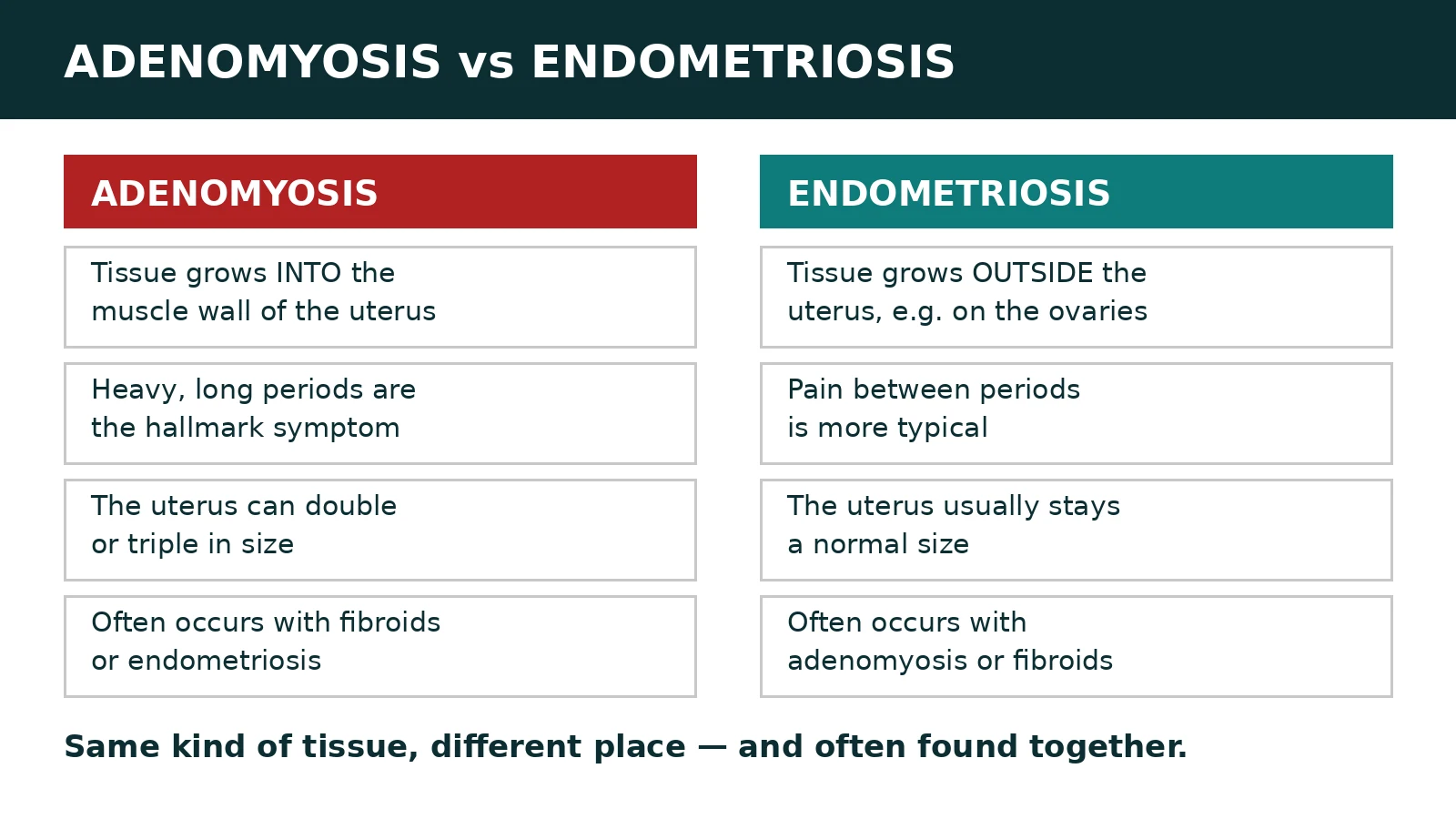
Adenomyosis is often confused with endometriosis, and the two conditions frequently occur together. The difference is where the tissue grows. In adenomyosis, endometrial-like tissue grows into the muscle of the uterus. In endometriosis, it grows outside the uterus — for example on the ovaries or fallopian tubes. Adenomyosis is more likely to cause heavy menstrual bleeding, while endometriosis is more often linked to pain outside of periods. If you have symptoms of either, a doctor can help work out which one is involved. You can read more in our guide to endometriosis symptoms.
How is adenomyosis diagnosed?
Diagnosis usually starts with a conversation about your symptoms and a pelvic examination, during which a doctor may notice that the uterus feels larger, softer or tender. A transvaginal ultrasound — an ultrasound probe placed inside the vagina — can sometimes show thickening of the uterine wall, and an MRI scan can show enlargement and thickening in more detail. A doctor may also take a sample of tissue to rule out more serious conditions.
It is worth knowing that adenomyosis can only be diagnosed with complete certainty by examining the uterus under a microscope after a hysterectomy. In practice, doctors diagnose it from symptoms and scans, and that is enough to start treatment.
How is adenomyosis treated?
Treatment is not always needed. If you have no symptoms, are not trying to get pregnant, or are close to the menopause, your doctor may simply keep an eye on things. When treatment is needed, the aim is to ease pain and heavy bleeding. Options include:
- Pain relief. Anti-inflammatory medicines such as ibuprofen can ease cramping. Your doctor or pharmacist can advise on what is suitable for you.
- Hormonal medicines. Birth control pills, a hormonal injection or a hormonal intrauterine device (IUD) can reduce bleeding and pain by controlling the menstrual cycle.
- Non-hormonal medicine. Medicines such as tranexamic acid can reduce the amount of bleeding during periods.
- Adenomyomectomy. Surgery to remove the adenomyosis from the uterine muscle, similar to removing fibroids.
- Hysterectomy. Surgery to remove the uterus. This cures adenomyosis, but it means you will no longer have periods or be able to get pregnant, so it is usually considered when other treatments have not worked and you do not plan to have children.
Because symptoms often go away after the menopause, the best treatment can depend on how close you are to that stage of life. Talk to your doctor about the options that fit your symptoms, your age and your plans for pregnancy.
Adenomyosis and fertility
Adenomyosis can make it harder to conceive, and it is linked to a higher risk of miscarriage, preterm birth and babies who are small for their gestational age. The Cleveland Clinic notes that left untreated, it can lead to infertility or miscarriage because the embryo may struggle to implant in the lining of the uterus. More research is still needed on the link with infertility. If you are trying to get pregnant and have heavy, painful periods, talk to your doctor sooner rather than later.
Living with adenomyosis
Heavy, painful periods can affect work, relationships and mood, and many people live with the symptoms for years before getting a diagnosis. Keeping a simple record of your periods — how heavy they are, how much pain you feel, and which days are worst — can help your doctor understand the pattern. Heat, rest and gentle movement can help on painful days, and planning around your cycle can make work and social life easier. If your periods are getting heavier or more painful over time, or if pain is affecting your daily life, do not put off getting help.
When to see a doctor
See a doctor if you have heavy periods that last a long time, severe cramping during your periods that gets in the way of daily activities, pain during sex, or a feeling of fullness or heaviness in your abdomen. Seek help sooner if you have heavy bleeding with dizziness, fainting or severe pain, or if you are trying to get pregnant and periods are very painful. Your GP can check for anaemia, arrange scans and refer you to a gynaecologist if needed.
In an emergency call 911 (US), 999 (UK) or 112 (EU).
Frequently asked questions
What is adenomyosis?
Adenomyosis is a condition where the tissue that lines the uterus grows into the muscle wall of the womb. Each month, that trapped tissue thickens, breaks down and bleeds, which can cause heavy, painful periods and pelvic pain. The uterus can also become enlarged. About one in three people with it have no symptoms at all.
What is the difference between adenomyosis and endometriosis?
Both involve endometrial-like tissue, but in different places. In adenomyosis, the tissue grows into the muscle wall of the uterus. In endometriosis, it grows outside the uterus, for example on the ovaries or fallopian tubes. Adenomyosis is more likely to cause heavy bleeding. The two conditions often occur together.
What causes adenomyosis?
The exact cause is unknown. Theories include endometrial cells invading the muscle wall, tissue deposited during foetal development, inflammation after childbirth, stem cells, and period blood flowing backwards. Its growth depends on oestrogen, which is why symptoms often ease after the menopause.
How is adenomyosis diagnosed?
A doctor will ask about your symptoms and do a pelvic examination. A transvaginal ultrasound or MRI scan can show thickening and enlargement of the uterus. A swab or tissue sample may be taken to rule out other conditions. The only certain diagnosis is examining the uterus after a hysterectomy.
Can adenomyosis affect fertility?
Yes, it can make it harder to conceive and is linked to a higher risk of miscarriage, preterm birth and babies who are small for their gestational age. Left untreated it can lead to infertility or miscarriage. If you are trying to get pregnant and have very heavy, painful periods, talk to your doctor.
Does adenomyosis go away?
Symptoms often ease or disappear after the menopause, when oestrogen levels fall. Before then, hormonal medicines, pain relief and other treatments can control symptoms. A hysterectomy cures adenomyosis, but it is usually only considered when other treatments have not worked and you do not plan to have children.
Sources
- Mayo Clinic: Adenomyosis — symptoms and causes www.mayoclinic.org
- Cleveland Clinic: Adenomyosis my.clevelandclinic.org
- Medical News Today: Adenomyosis www.medicalnewstoday.com
- NHS: Heavy periods www.nhs.uk

Try the tool
When is your next period and fertile window?
Six cycles ahead from your last period date.
Open the calculator