What Is Bacterial Vaginosis? Causes, Symptoms and Treatment
Bacterial vaginosis is the most common cause of unusual vaginal discharge, yet most women who have it notice nothing at all. Here is what causes it, how to tell it from thrush, and how it is treated.
- Written by
- Health Daily Advice
- Published
- Reading time
- 8 minutes
- Sources
- 9 cited

In this guide
Bacterial vaginosis (BV) is a common vaginal condition caused by an imbalance in the vagina’s natural bacteria. When protective lactobacilli fall and other bacteria multiply, discharge can turn thin and greyish-white with a strong fishy smell. Many women have no symptoms at all. It is treatable with antibiotics from a GP or sexual health clinic.
What causes bacterial vaginosis?
A healthy vagina is home to many kinds of bacteria, and most of the time one group — the lactobacilli — keeps the others in check. The CDC describes bacterial vaginosis as what happens when those lactic-acid-producing lactobacilli are replaced by high concentrations of other bacteria, including Gardnerella vaginalis and other anaerobic bacteria. The balance tips, the vagina becomes less acidic, and the new mix of bacteria produces the discharge and smell BV is known for.
Nobody fully knows what sets the change off. The NHS is clear that the exact cause is not fully understood. What is known is that some things make it more likely: being sexually active, a change of sexual partner, having an intrauterine device (IUD), and using perfumed products in or around the vagina. The CDC’s guidelines add douching, having more than one partner, and not using condoms to that list. Even so, women who have never had sex can still develop BV, so sex alone does not explain it.
What are the symptoms of bacterial vaginosis?
The best-known sign is discharge that looks and smells different from usual. The NHS lists an unusual discharge with a strong fishy smell — often worse after sex — and discharge that becomes greyish-white, thin and watery. Mayo Clinic adds that the discharge may be grey, white or green, and that some women notice itching or a burning feeling when they pass urine.
One thing that surprises many women is how often there are no symptoms at all. In the CDC’s nationally representative survey, 84% of women found to have BV reported no symptoms. The NHS puts it more simply: half of women with bacterial vaginosis have no symptoms. Because BV so often stays quiet, it is frequently picked up by chance — for example, during a routine smear test or a sexual health check.
It is also worth knowing what BV usually does not do. The NHS notes that it does not usually cause soreness or itching, which is one of the ways it differs from thrush. Pain, heavy bleeding or a fever are not typical BV symptoms, and they need a doctor’s attention for another reason.
How common is bacterial vaginosis?
Very common. The CDC calls bacterial vaginosis the most common cause of vaginal discharge worldwide. In the United States, a nationally representative survey (NHANES 2001–2004) found BV in 29.2% of women aged 14 to 49 — about 21.2 million women. The same survey found it in roughly one in five women who had never had vaginal, oral or anal sex, and in a quarter of pregnant women, which underlines that it is not simply a consequence of sex.
Rates are not the same everywhere. The survey found BV in about 51% of Black women, 32% of Mexican American women and 23% of white women in the US. Researchers are still working out how much of that gap comes from differences in biology, behaviour, income and access to care — and how much from the fact that some groups are simply tested more often.
Is bacterial vaginosis an STI?
No — bacterial vaginosis is not classed as a sexually transmitted infection (STI). The NHS is explicit about this, but adds the important nuance: sexual activity can trigger it or pass it on. BV can be passed to a woman, or to anyone with a vagina, during sex, and it is more common in sexually active people and in women with a new partner.
That distinction matters for two reasons. First, a male partner does not usually need treatment — Mayo Clinic notes that treatment is not usually needed for a partner whose sex is male, though a female partner with symptoms may need testing and treatment. Second, having BV does raise your risk of catching a genuine STI. The CDC explains that women with BV are at increased risk of HIV, chlamydia, gonorrhoea, trichomoniasis and herpes, probably because the changed bacterial balance weakens the vagina’s natural defences. That is one reason the CDC advises that everyone with BV is also tested for HIV and other STIs.
How is bacterial vaginosis diagnosed?
See a GP — your family doctor, called a primary care physician in the US — or go to a sexual health clinic if you think you have BV. Many sexual health clinics offer walk-in appointments and often return results faster than a GP surgery, according to the NHS.
At the appointment you will be asked about your symptoms, and a doctor or nurse may examine you and take a sample of the discharge with a cotton bud. The sample is checked for the bacteria linked to BV, and for other infections, so that an STI is not missed. Mayo Clinic explains that the doctor may also test the acidity of the vagina — a pH of 4.5 or higher points towards BV, since a healthy vagina is more acidic than that. Do not try to diagnose it yourself from symptoms alone: discharge changes can come from several different causes, and the treatments are not the same.
How is bacterial vaginosis treated?
Bacterial vaginosis is usually treated with antibiotics, prescribed by a GP or sexual health clinic. They come as tablets taken by mouth, or as a gel or cream used inside the vagina. The antibiotics most often used are metronidazole and clindamycin, and the choice between a tablet and a vaginal treatment depends on your situation, your preferences and any other medicines you take — talk to a doctor or pharmacist about which suits you.
Finish the full course, even if the smell and discharge clear up quickly. Mayo Clinic warns that stopping early makes it more likely BV will come straight back. During treatment, the CDC advises avoiding sex or using condoms consistently, and not douching, because douching may increase the risk of relapse. There is no over-the-counter cure: home remedies, probiotics and vaginal washes have not been shown to treat BV, and the CDC notes that probiotic products are not supported as a replacement or add-on treatment.
Why does bacterial vaginosis keep coming back?
Recurrence is the most frustrating part of BV, and it is common. The NHS says it often returns within a few months, and Mayo Clinic says it is common for BV to come back within 3 to 12 months even after proper treatment. If it keeps returning, you will usually be given another course of antibiotics, and if you get it more than four times in a year, the NHS says a GP or clinic may prescribe a vaginal antibiotic gel to use over a few months to help keep it away.
Part of the reason it returns is that antibiotics clear the overgrown bacteria but do not always restore the lactobacilli that keep the balance. Researchers are still studying why some women are prone to repeat episodes, and whether treating partners or using longer courses helps. If yours keeps coming back, a GP or sexual health clinic can also help work out whether something is triggering it, such as sex or your period.
Bacterial vaginosis vs thrush: how to tell the difference
BV and thrush (a yeast infection) are the two most common causes of unusual discharge, and they are easy to confuse — but they feel different and need different treatment. BV’s discharge is thin and greyish-white with a fishy smell and usually no itching; thrush’s is thick and white, often compared to cottage cheese, and usually comes with itching and soreness. The NHS uses exactly that contrast — fishy-smelling discharge points to BV, thick white discharge to thrush — to help women work out which one they may have.
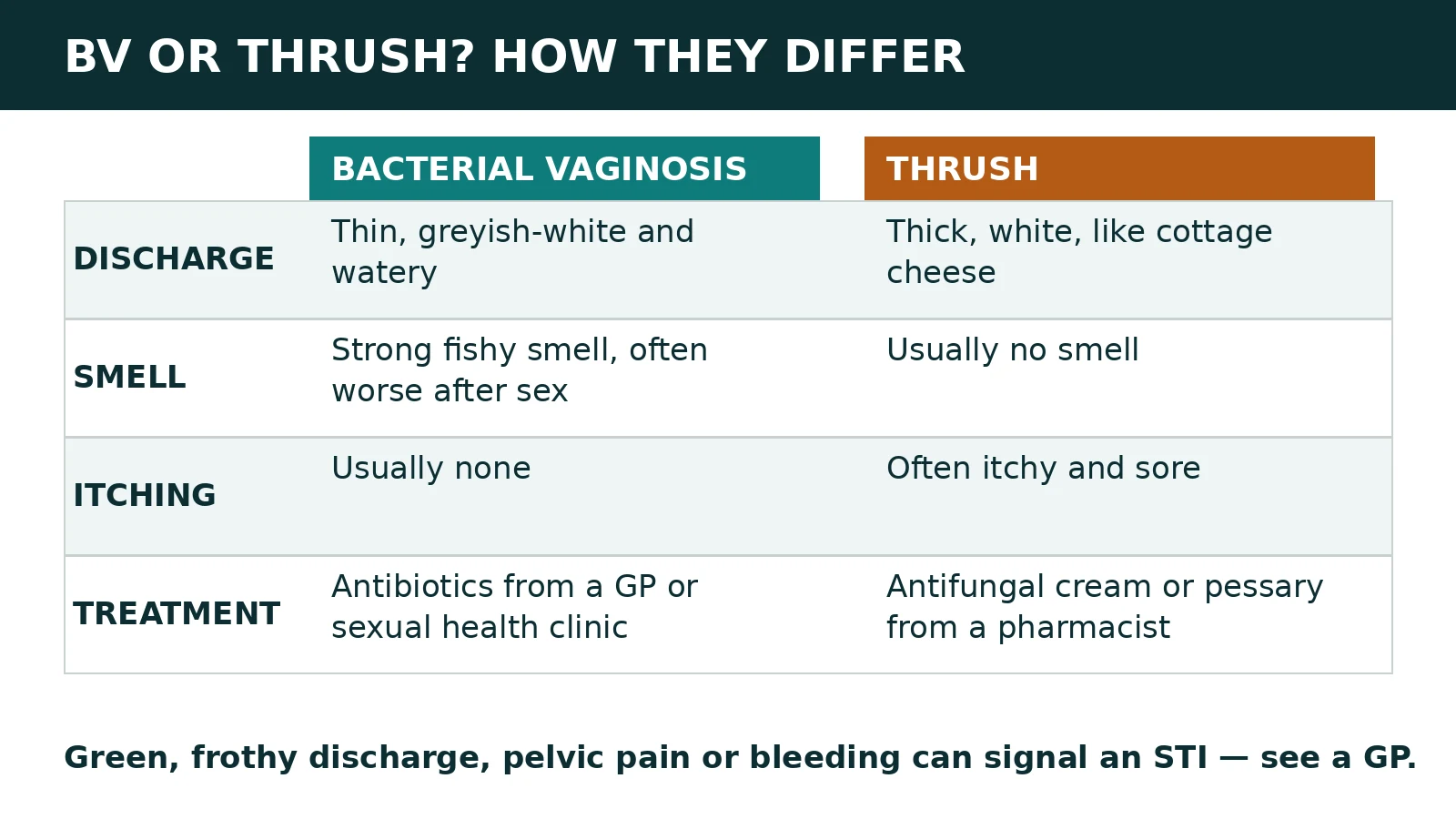
That difference is why getting the diagnosis right matters. Antifungal creams and pessaries treat thrush, but they do nothing for BV, which needs antibiotics. Mayo Clinic advises seeing a doctor if you thought you had a yeast infection but still have symptoms after treating it yourself. And if the discharge is green, yellow or frothy, or comes with pelvic pain or bleeding, the cause may be an STI such as trichomoniasis or chlamydia — see a GP or sexual health clinic rather than treating it at home.
Bacterial vaginosis in pregnancy
BV in pregnancy needs attention, even without symptoms. The NHS says there is a small chance of complications such as premature birth or miscarriage, though BV causes no problems in the majority of pregnancies. The CDC recommends treatment for all pregnant women with symptoms, because symptomatic BV has been linked to premature rupture of the membranes, preterm birth, infection inside the womb and infection after delivery.
If you are pregnant and your discharge changes, speak to a GP or your midwife. Antibiotics used for BV can be prescribed during pregnancy, and your clinician will choose the option considered safest for you and your baby. Routine screening of pregnant women without symptoms is not recommended, but any change in discharge is worth mentioning at your next appointment — or sooner.
How can I lower my risk of bacterial vaginosis?
There is no guaranteed way to prevent BV, because the exact trigger is not fully understood, but the NHS and Mayo Clinic agree on a few habits that help protect the vagina’s natural balance:
- Wash the skin around your vagina with water and plain, unscented soap, and have showers instead of baths.
- Do not douche, and do not use vaginal deodorants, washes or scented wipes — the vagina cleans itself.
- Do not put perfumed soaps, bubble bath or antiseptic liquids in the bath, and avoid strong detergents on underwear.
- Use condoms or dental dams, limit the number of sexual partners, and clean sex toys.
- Do not smoke — smoking is listed by the NHS among the things that make BV more likely.
It is worth remembering that BV is not caused by being unclean. Washing more, or washing inside the vagina, does the opposite of helping: it disturbs the bacteria you are trying to protect.
When to see a doctor
See a GP or go to a sexual health clinic if you think you have bacterial vaginosis, if your discharge changes in colour, smell or texture, if you produce more discharge than usual, or if you are pregnant and notice a change. Get help sooner if you have pelvic pain, bleeding between periods or after sex, pain when you pass urine, or a fever — those symptoms point to something other than BV.
BV itself is not usually serious, and it is very treatable. The reason to get it checked is that the right treatment clears it quickly, stops it coming back as often, and lowers the risk of the complications linked to untreated BV — including STIs and problems in pregnancy.
In an emergency call 911 (US), 999 (UK) or 112 (EU)
Frequently asked questions
Is bacterial vaginosis an STI?
No. Bacterial vaginosis is not classed as a sexually transmitted infection, though sexual activity can trigger it or pass it on, and it can be passed to a female partner during sex. It is an imbalance of the vagina's natural bacteria, not an infection caught from a partner. Having BV does raise your risk of catching a genuine STI, which is why the CDC advises testing for HIV and other STIs too.
Can bacterial vaginosis go away on its own?
Sometimes, but it is not something to wait out. BV can clear without treatment in some cases, yet symptoms often persist, and untreated BV raises the risk of STIs and, in pregnancy, of premature birth. Antibiotics from a GP or sexual health clinic clear it reliably. If you think you have BV, or your discharge changes, see a doctor or a sexual health clinic rather than hoping it settles.
How can I tell bacterial vaginosis from thrush?
BV usually causes thin, greyish-white discharge with a strong fishy smell, often worse after sex, and usually no itching. Thrush usually causes thick, white discharge like cottage cheese, with itching and soreness and usually no smell. The two need different treatments: antibiotics for BV, antifungals for thrush. If you treated yourself for thrush and still have symptoms, see a GP or sexual health clinic.
Why does my bacterial vaginosis keep coming back?
Recurrence is common: the NHS says BV often returns within a few months, and Mayo Clinic says it commonly comes back within 3 to 12 months even after proper treatment. Antibiotics clear the overgrown bacteria but do not always restore the lactobacilli that keep the balance. If it returns, you will usually be given another course, and frequent recurrence may be treated with a vaginal gel used over several months.
Is bacterial vaginosis dangerous in pregnancy?
Usually it causes no problems, but there is a small chance of complications such as premature birth or miscarriage, so the NHS advises telling a GP or midwife if your discharge changes while pregnant. The CDC recommends treatment for all pregnant women with symptoms, as symptomatic BV has been linked to premature rupture of the membranes and preterm birth. Antibiotics used for BV can be prescribed safely during pregnancy.
Can my partner catch bacterial vaginosis?
BV can be passed to a woman, or anyone with a vagina, during sex, and a female partner with symptoms may need testing and treatment. A male partner does not usually need treatment. To lower the risk of passing it on and of BV coming back, use condoms during treatment and avoid sex until the course is finished, as the CDC advises. If either partner has symptoms, both should be checked.
Sources
- NHS: Bacterial vaginosis www.nhs.uk
- CDC: Bacterial Vaginosis — STI Treatment Guidelines www.cdc.gov
- CDC: Bacterial Vaginosis Statistics (NHANES 2001–2004) webarchive.library.unt.edu
- Mayo Clinic: Bacterial vaginosis — symptoms and causes www.mayoclinic.org
- Mayo Clinic: Bacterial vaginosis — diagnosis and treatment www.mayoclinic.org
- NHS: Vaginal discharge www.nhs.uk

Try the tool
When is your next period and fertile window?
Six cycles ahead from your last period date.
Open the calculator