What Is Vaginismus? Causes, Symptoms and Treatment
- Written by
- Health Daily Advice
- Published
- Reading time
- 6 minutes
- Sources
- 9 cited

In this guide
Vaginismus is the involuntary tightening of the muscles around the vagina when penetration is attempted or expected, which can make sex, tampon use or a cervical screening painful, difficult or impossible. It is an automatic reaction you cannot control, and it is not your fault. The good news: it is treatable, with 4 in 5 women responding well to treatment.
What is vaginismus?
“Vaginismus is when the vagina suddenly tightens up when you try to insert something into it. It can be painful and upsetting, but it can be treated.” That is how the NHS describes it. The tightening is a spasm of the pelvic floor muscles — it happens automatically, not because you are choosing to tense up.
Since 2013, the DSM-5 has grouped vaginismus together with painful intercourse (dyspareunia) under the single diagnosis of genito-pelvic pain/penetration disorder. Clinicians still distinguish two types:
- Primary (lifelong) vaginismus — penetration has never been comfortable or possible. It is often first noticed when trying to use a tampon, during a first pelvic examination, or when first attempting sex.
- Secondary (acquired) vaginismus — it develops after a period of pain-free penetration, for example after childbirth, surgery, menopause, an infection or trauma. The Cleveland Clinic notes that some women develop the condition later in life after years of doing these things without any issues.
Vaginismus is most common in women in their late teens to early 30s, according to the NHS, although anyone with a vagina can develop it at any age.
How common is vaginismus?
Exact figures are hard to pin down, because stigma and shame keep many people from seeking help. A clinical review in the Australian Journal of General Practice (2024) estimates that vaginismus affects 1–6% of the general female population, while 5–17% of women who present with sexual concerns have the condition. The same review reports that around 14% of Australian women experience painful sex in the previous 12 months, and vaginismus is one of its leading causes. These figures come from the review published by the Royal Australian College of General Practitioners (RACGP).
Because so many people suffer in silence, the real numbers are likely higher. If you recognise yourself in this article, you are far from alone — and help is available.
What causes vaginismus?
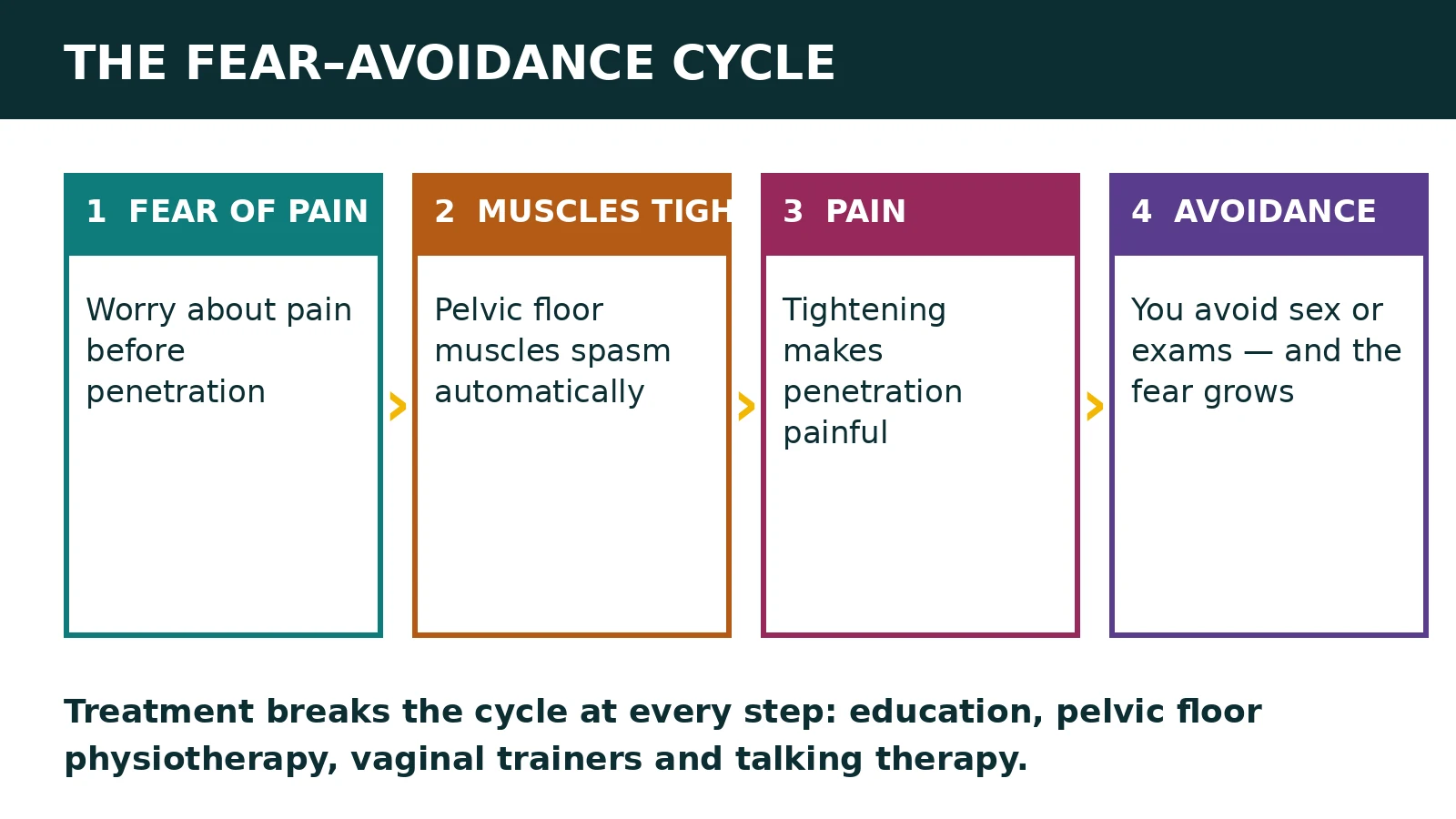
The exact cause is unknown, but the leading explanation is a fear–avoidance cycle. Fear of painful sex causes the pelvic floor muscles to tighten automatically; the tightening causes pain; the pain reinforces the fear, and the fear leads to avoiding penetration altogether. The RACGP review describes vaginismus as a psychophysiological problem involving cognitive, behavioural and physiological factors — in other words, thoughts, habits and the body’s responses all feed into each other.
Factors that can contribute, named by the NHS and the Cleveland Clinic, include:
- anxiety or fears about sex, or believing sex is shameful or wrong
- a painful sexual experience, or a previous painful pelvic examination or difficult birth
- sexual assault or abuse — a 2021 systematic review found a significant association between a history of abuse and a diagnosis of vaginismus
- a painful condition such as thrush, a yeast infection, endometriosis or pelvic inflammatory disease
- negative experiences with a vaginal delivery or pelvic surgery
None of these mean the condition is your fault. Vaginismus is a recognised medical condition, and the fear–tightening–pain cycle can be unlearned with the right support.
Symptoms of vaginismus
The main symptom is the involuntary tightening itself, often with burning or stinging pain when penetration is attempted. It can be triggered by:
- inserting a tampon
- vaginal penetration during sex, with a finger, a sex toy or a penis
- a cervical screening (smear test) or other pelvic examination
- even something being put near the vagina, because of fear of penetration
It can also cause fear of pain, loss of sexual desire when penetration is attempted, and difficulty with medical examinations. It does not necessarily affect arousal or enjoyment of other types of sexual contact. Over time it can strain a relationship, make it difficult to get pregnant, and increase stress, anxiety or depression, the Cleveland Clinic notes.
How is vaginismus diagnosed?
Diagnosis is based on a detailed medical, sexual and relationship history, plus an examination to rule out other causes of pain — such as infection, skin conditions, endometriosis, fibroids or sexually transmitted infections. A visual inspection of the vulva, swabs if needed, and a gentle cotton-tip test for pain at the vaginal entrance may be used.
Importantly, a speculum examination should not be attempted until therapeutic interventions have been tried if it is likely to be painful — and if it becomes painful, it should be stopped immediately, the RACGP review advises. Many people with vaginismus have felt unheard or dismissed in the past, so being believed is an important first step.
At a GP appointment, you can ask to be seen by a female doctor and bring someone trusted for support, and you can discuss ways to make the examination comfortable. In the US, a gynaecologist is the usual first port of call, according to MedlinePlus. Because many conditions cause vaginal pain, seeing a healthcare provider for an accurate diagnosis matters rather than trying to self-diagnose.
How is vaginismus treated?
Guidelines recommend an individualised, multidisciplinary approach — a combination of education, pelvic floor muscle relaxation, vaginal trainers and psychological therapy. Treatment usually starts under a specialist therapist and is then practised at home, and partners can be involved if you wish.
Education about your body
Learning about vulvovaginal and pelvic floor anatomy helps you understand what is happening and why. This sounds simple, but the RACGP review rates it as an important part of treatment.
Pelvic floor physiotherapy
A specialist physiotherapist teaches exercises to relax the pelvic floor muscles and reduce pain, using verbal instruction, biofeedback or vaginal trainers. The NHS lists pelvic floor exercises as a core part of treatment.
Vaginal trainers (dilators)
These are graduated sets of tampon-shaped plastic or silicone rods, used to apply gentle pressure at the vaginal entrance and gradually get used to penetration. Some practitioners teach using your own fingers instead.
Talking therapy and CBT
Talking therapy helps you understand and change feelings about your body and sex, the NHS explains. Cognitive behavioural therapy (CBT) uses graded exposure and cognitive restructuring to reduce avoidance — the RACGP review rates the evidence for CBT and for systematic desensitisation as level I, the strongest available. Relaxation techniques, mindfulness, breathing exercises and sensate focus exercises can also help.
What about medication?
Most medications have limited evidence and are not recommended by clinical practice guidelines. Botulinum toxin injections to the pelvic floor muscles are increasingly used but have limited supporting evidence and are not easily available in the UK.
How well does treatment work?
Very well, for most people. The Cleveland Clinic reports that about 4 out of 5 women (80%) respond well to treatment involving more than one therapy. A 2018 systematic review found around 80% of people with vaginismus responded to multimodal treatment. And the British Association for Sexual Health and HIV (BASHH) reports short-term treatment success rates of 72–100%, with treatment lasting from two to 15 sessions. Improvement may take several weeks to months — and the Cleveland Clinic notes that vaginismus does not go away on its own, so seeking help is the way forward.
When to see a doctor
See your GP or go to a sexual health clinic if you think you have vaginismus, the NHS advises. Seek help promptly if penetration is painful or impossible, if symptoms are affecting your relationship, mental health or fertility plans, or if a planned procedure such as cervical screening cannot happen because of pain or spasm.
Get prompt medical assessment if vaginal pain comes with unusual discharge, bleeding, fever or signs of infection, or if there could be a sexually transmitted infection or pelvic inflammatory disease. Anyone who has experienced sexual assault should be offered trauma-informed support.
One thing the experts are clear about: do not try to push through the pain. Forcing penetration worsens the fear–tightening–pain cycle. And if a treatment plan is not working, contact your provider to adjust it rather than giving up.
In an emergency call 911 (US), 999 (UK) or 112 (EU).
Frequently asked questions
What is vaginismus?
Vaginismus is when the vagina suddenly tightens up when you try to insert something into it, as the NHS puts it. The tightening is an involuntary spasm of the pelvic floor muscles, so it is an automatic reaction you cannot control. It can make sex, tampon use or a cervical screening painful, difficult or impossible, but it is very treatable.
What causes vaginismus?
The exact cause is unknown, but the leading explanation is a fear-avoidance cycle: fear of painful sex causes the pelvic floor muscles to tighten, the tightening causes pain, and the pain reinforces the fear. Contributing factors include anxiety about sex, a painful sexual experience, sexual assault or abuse, a difficult birth or painful examination, and painful conditions such as thrush or endometriosis.
Can vaginismus be cured?
It is very treatable, though doctors usually speak of successful treatment rather than a cure. The Cleveland Clinic reports that about 4 out of 5 women respond well to treatment involving more than one therapy. The British Association for Sexual Health and HIV reports short-term success rates of 72-100% with treatment lasting two to 15 sessions. Improvement may take several weeks to months.
How is vaginismus treated?
Guidelines recommend a combination of education about pelvic floor anatomy, pelvic floor physiotherapy to relax the muscles, vaginal trainers (dilators) used gradually at home, and talking therapy such as cognitive behavioural therapy. Relaxation techniques, mindfulness and sensate focus exercises can help too. Most medications have limited evidence and are not recommended.
What happens at a GP appointment for vaginismus?
The GP asks about your symptoms, medical history and sexual history, and may examine the vagina to rule out other causes such as infection or skin conditions. You can ask to be seen by a female doctor and bring someone trusted for support. A speculum examination should not be attempted until treatment has been tried if it is likely to be painful, and it should be stopped immediately if it hurts.
Is vaginismus the same as painful sex?
Not exactly, although they overlap. Since 2013 the DSM-5 has grouped vaginismus with painful intercourse under genito-pelvic pain/penetration disorder, but clinicians still distinguish them: vaginismus is specifically the involuntary muscle tightening, while painful sex can have many other causes, including infections, endometriosis, pelvic inflammatory disease and skin conditions. That is why seeing a doctor for an accurate diagnosis matters.
Sources
- NHS: Vaginismus 111.wales.nhs.uk
- Cleveland Clinic: Vaginismus my.clevelandclinic.org
- RACGP / Australian Journal of General Practice: Clinical assessment and management of vaginismus (2024) www1.racgp.org.au
- MedlinePlus: Vaginismus medlineplus.gov
- ACOG Practice Bulletin No. 213: Female Sexual Dysfunction (2019) pubmed.ncbi.nlm.nih.gov
- BASHH Special Interest Group for Sexual Dysfunction: Recommendations for the management of vaginismus (2006) www.academia.edu

Try the tool
When is your next period and fertile window?
Six cycles ahead from your last period date.
Open the calculator