Can Pepcid and Allegra Help PMDD? What We Know
Pepcid and Allegra are trending for PMDD online, but no trial has tested them. Here is what the histamine theory can — and cannot — explain.
- Written by
- Health Daily Advice
- Published
- Reading time
- 6 minutes
- Sources
- 10 cited

In this guide
No trial has tested Pepcid and Allegra for PMDD, so there is no proof the combination eases mood symptoms. The idea comes from allergy and mast-cell care, where blocking two histamine receptors can help hives. Guidelines instead recommend SSRIs, hormonal contraception and talking therapy. Anyone curious should talk to a doctor or pharmacist first.
If you spend time on health TikTok, you may have seen the claim: two ordinary pharmacy medicines, taken together, can calm the rage, anxiety and despair of PMDD. But enthusiasm is not evidence, and this combination has never been tested for PMDD.
What Is PMDD?
PMDD is a severe form of premenstrual syndrome. Symptoms begin in the one to two weeks before a period, ease a few days after bleeding starts, and return in most cycles. At least one mood symptom must dominate — irritability, low mood, anxiety or severe mood swings — plus physical symptoms such as bloating, joint pain and fatigue. The NHS and the Cleveland Clinic agree: this is not ordinary PMS.
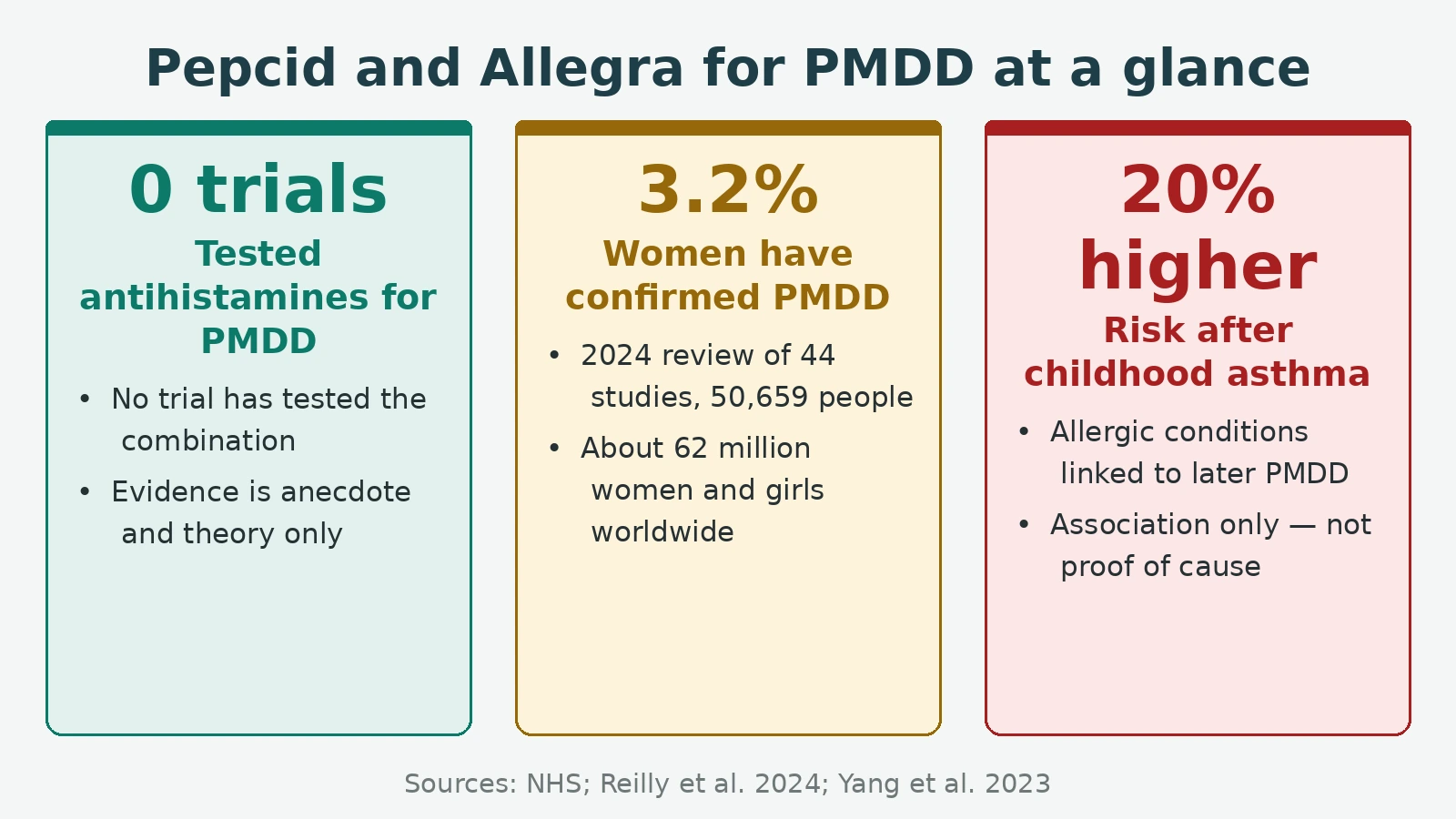
Diagnosis requires daily symptom ratings over at least two cycles. A 2024 meta-analysis by Reilly and colleagues, covering 44 studies and 50,659 participants, found a confirmed diagnosis in 3.2% of people, but only 1.6% in community samples — and 7.7% when diagnosis was provisional.
The exact cause is not known. The leading explanation is an unusual brain sensitivity to normal hormonal changes, rather than abnormal hormone levels. Serotonin is also thought to play a role, and a 1998 study by Schmidt and colleagues, in the New England Journal of Medicine, supports that view.
The stakes are high. A 2021 meta-analysis by Prasad and colleagues found women with PMDD had almost seven times the odds of a suicide attempt and almost four times the odds of suicidal ideation.
Why Is Pepcid and Allegra Trending for PMDD?
The trend did not start in a clinic or a journal. It started on social media in 2026, where people — including some doctors speaking online — described the Pepcid and Allegra pairing as a way to ease cyclical symptoms. Search interest followed, with the combination becoming a breakout trending search in November 2026.
The story travels because it feels accessible: both drugs are familiar and cheap compared with months of specialist care. But reports of benefit are still anecdote, and PMDD symptoms naturally fluctuate, so a good month proves very little on its own.
What Are Pepcid and Allegra?
Pepcid is the brand name for famotidine, a histamine H2-receptor blocker. Its licensed use is reducing stomach acid — heartburn, acid reflux and ulcers. It is cleared mainly by the kidneys, and it does not usually cause drowsiness.
Allegra is the brand name for fexofenadine, a second-generation H1 antihistamine, licensed for hay fever and chronic urticaria (hives). It blocks H1 receptors in the nose, eyes, throat and skin. It barely crosses the blood–brain barrier, which is why it is classed as non-sedating — and why any direct effect on brain mood circuits is speculative.
The two are paired because H1 and H2 are different histamine receptor types in different tissues. Blocking both is meant to suppress histamine signalling more broadly than either drug alone. That logic is borrowed from allergy and mast cell care, where allergists have long added an H2 blocker when an H1 blocker alone is not enough. — not a PMDD treatment.
What Is the Histamine and Mast Cell Theory?
The theory goes like this: mast cells, which release histamine, become more reactive when oestrogen rises, and histamine may then promote further oestrogen production, creating a loop. Histamine is also a neurotransmitter in the brain, reaching mood centres including the amygdala.
Each step has some support, but far weaker than online explanations suggest. Zaitsu and colleagues (2007) found oestradiol increased degranulation in mast-cell lines and mouse mast cells. That is preclinical work — cell lines and animals, not people with PMDD. The proposed feedback loop has not been shown to operate as a self-sustaining cycle inside the human body.
The strongest human data point comes from a large cohort study. Yang and colleagues, in Nature Mental Health in 2023, followed 6,524 girls from 1996 to 2013. Childhood asthma was associated with a 20% higher risk of premenstrual disorders in adulthood, and food allergy with a 28% higher risk. That is an association study, not proof that histamine causes PMDD or that antihistamines treat it.
Does Pepcid and Allegra Actually Help PMDD?
On the evidence available, there is no honest way to say yes. No randomised controlled trial, no cohort study and no case series has tested antihistamines for PMDD mood outcomes. MDLinx, Niyora and Ditto Daily all agree: current evidence is anecdotal and hypothesis-generating rather than practice-changing.
The indirect evidence does not close the gap. The H1 plus H2 combination does beat H1 alone in refractory chronic urticaria, but the studies are small and old. A skin condition is not PMDD, and those numbers cannot be carried across to mood symptoms.
There are simpler explanations for why some people feel better: the combination may be treating a coexisting allergy rather than PMDD itself, or sedation may play a role, especially with cetirizine instead of fexofenadine. There is also no studied timeline for mood improvement and no tested amount or timing for PMDD. Anyone judging whether something helps should keep a daily symptom diary for at least two cycles and discuss it with a doctor.
What Do the Guidelines Recommend Instead?
Antihistamines do not appear in any major PMDD guideline. That absence is itself a finding. The American College of Obstetricians and Gynecologists, in its 2023 guideline, lists medicines, psychological counselling, exercise and nutritional therapies, patient education and surgery in selected cases. Antihistamines are not among the recommended treatments.
The Royal College of Obstetricians and Gynaecologists takes a stepped approach: first-line exercise, cognitive behavioural therapy (CBT), vitamin B6, a combined oral contraceptive, and low-dose SSRIs; then hormone treatments, and, as a last resort, surgery. The NHS lists SSRIs, painkillers, hormonal treatment and talking therapies. In the US, the Food and Drug Administration has approved three SSRIs for PMDD — sertraline, fluoxetine and paroxetine — plus one drospirenone contraceptive pill.
What Are the Risks and Side Effects?
Both drugs are generally well tolerated for their licensed uses, which is part of why the trend feels low-risk — but combining medicines adds side effects rather than cancelling them out.
Famotidine’s common side effects, each affecting up to 1 in 10 people, are headache, dizziness, constipation and diarrhoea. Rare but serious effects include confusion, hallucinations and seizures, with risk higher in older adults and people with kidney problems, plus heart rhythm and liver problems. The UK leaflet advises against use in pregnancy unless a doctor thinks the benefits outweigh the risks.
Fexofenadine’s common side effects, also affecting up to 1 in 10 people, are headache, drowsiness, nausea and dizziness. A serious allergic reaction with swelling of the face, lips, tongue or throat needs urgent care. Fruit juices and antacids reduce how much is absorbed, so it should be taken with water only, with antacids separated by about two hours.
Combined, the likeliest problems are more daytime sleepiness, dry mouth and eyes, mild stomach upset and headache in the first few days. The combined effect on heart rhythm with long-term everyday use has not been studied, and studies disagree on whether long-term use is linked to dementia — a reason to involve a clinician, not to self-treat indefinitely.
Who Should Check First?
Some people should not try this combination without medical advice: anyone with kidney or liver disease, heart disease or medicines that affect heart rhythm, and older adults. It also includes anyone who is pregnant, trying to conceive or breastfeeding, and anyone taking other medicines, because interactions can change how well the drugs work.
Most importantly, anyone considering stopping an existing PMDD treatment to try antihistamines should speak to their clinician first — and should not stop. An SSRI, a hormonal contraceptive or a course of CBT that is working is not something to trade for an untested idea.
When to see a doctor
See a GP if you think you might have PMDD. The NHS advises keeping a symptom diary for at least two menstrual cycles to share at the appointment. Seek prompt care if symptoms are severe, affect work, relationships or daily functioning, or do not improve with current treatment.
Get medical help quickly if you develop a fast or irregular heartbeat, severe dizziness, fainting or confusion, or swelling of the face or throat. If you have thoughts of harming yourself, treat that as urgent. In an emergency call 911 (US), 999 (UK) or 112 (EU). You can also find support at https://www.healthdailyadvice.com/get-help-now/. In the US, the Suicide and Crisis Lifeline is 988; in the UK, Samaritans is 116 123.
Frequently asked questions
Does Pepcid help PMDD mood symptoms?
There is no evidence that it does. No trial has tested famotidine, alone or with an antihistamine, for PMDD mood symptoms such as irritability, low mood or anxiety. Any benefit people report online is anecdote, not proof. It may help a separate allergy or stomach problem, but that is different from treating PMDD itself. Proven options remain SSRIs, hormonal contraception and talking therapy.
Can I take Pepcid and Allegra together?
The two drugs are sometimes combined in allergy and mast-cell care, so the pairing itself is not new. That does not make it a tested PMDD treatment, and combining medicines adds side effects. Fruit juice and some antacids can reduce how well fexofenadine works, and other medicines can interact. Talk to a doctor or pharmacist first, especially if you take other medicines or have kidney, liver or heart problems.
Is PMDD caused by histamine?
No. The established explanation is an unusual brain sensitivity to normal changes in oestrogen and progesterone, with serotonin also thought to play a role. Histamine may interact with hormones and inflammation, and childhood asthma and food allergy have been linked with a higher later risk of premenstrual disorders. That link is an association, not proof that histamine causes PMDD.
How long would it take to work?
Nobody knows, because no study has measured it. There is no tested timeline for mood improvement, and no tested dose or timing for PMDD. The only dosing evidence relates to the drugs' licensed uses for allergies and heartburn. Anyone judging whether something helps should track symptoms daily for at least two cycles and discuss the pattern with a doctor, rather than relying on a few good days.
Should I stop my PMDD treatment to try antihistamines?
No. Do not stop an SSRI, hormonal contraceptive or other treatment that is working in order to try an unproven combination. Stopping suddenly can bring symptoms back and may cause withdrawal effects, depending on the medicine. Trying an unproven idea can also delay care that is known to help. If you are curious about antihistamines, raise it with the clinician who manages your PMDD first.
Is Pepcid and Zyrtec better than Pepcid and Allegra?
There is no evidence comparing the two pairings for PMDD, because neither has been tested for the condition at all. Zyrtec is cetirizine, another H1 antihistamine, and it is more likely to cause drowsiness than fexofenadine. Some reports also describe rebound itching after stopping cetirizine. Neither combination is recommended by any PMDD guideline, so choosing between them misses the larger point.
Sources
- NHS — PMDD (premenstrual dysphoric disorder) www.nhs.uk
- Cleveland Clinic — Premenstrual Dysphoric Disorder (PMDD) my.clevelandclinic.org
- Reilly et al., Journal of Affective Disorders, 2024 — PubMed pubmed.ncbi.nlm.nih.gov
- MDLinx — The antihistamine drug combo for PMDD and menopause www.mdlinx.com
- Niyora — Pepcid for PMDD: Evidence, Dosing and Side Effects www.niyora.com
- Ditto Daily — Can Antihistamines Really Help PMDD? dittodaily.com
- ACOG — Management of Premenstrual Disorders, Clinical Practice Guideline No. 7 www.acog.org

Try the tool
When is your next period and fertile window?
Six cycles ahead from your last period date.
Open the calculator