Can Antihistamines Help PMDD? What the Evidence Says
TikTok says Pepcid AC and Allegra ease PMDD, but no clinical trial has ever tested the combination. Here is what the histamine theory gets right, what the experts say, and the treatments that actually work.
- Written by
- Health Daily Advice
- Published
- Reading time
- 8 minutes
- Sources
- 9 cited

In this guide
No — there is no good evidence that antihistamines help PMDD. No clinical trial has tested the viral Pepcid AC and Allegra combination for premenstrual dysphoric disorder, and experts say the idea rests on an unproven theory about histamine and oestrogen. Treatments with real evidence include SSRIs, the combined pill and talking therapy.
Scroll through the wellness side of TikTok and you will find women saying that two ordinary hay fever and heartburn medicines — Pepcid AC and Allegra — have eased their mood swings, anxiety and premenstrual symptoms. Searches for the combination have surged, and the posts are persuasive: real women, describing real relief, in the days before their period. It is easy to see why the idea has spread so fast. But a closer look at what doctors and researchers actually know tells a more cautious story.
What is PMDD?
Premenstrual dysphoric disorder, or PMDD, is a severe mood disorder linked to the menstrual cycle. It is not simply bad PMS. Around 5% of women who menstruate live with PMDD, and the condition can be deeply disruptive: one review estimated that women with PMDD cumulatively endure 3.8 years of disability across their reproductive years.
Symptoms usually begin one or two weeks before a period and improve a few days after it starts, according to the NHS. They can include feeling depressed, hopeless, anxious or overwhelmed, anger and irritability, losing interest in things you normally enjoy, and, for some people, thoughts of suicide. Physical symptoms include breast tenderness, joint and muscle pain, exhaustion, sleep problems and bloating.
The scale of the distress is striking. A survey published in 2024 found that 82% of people with PMDD had experienced suicidal thoughts and 26% had attempted suicide. That is why PMDD deserves proper medical care — and why an unproven remedy circulating online is worth examining carefully rather than trying on trust.
Where did the Pepcid and Allegra trend come from?
The trend is simple to describe. Women are pairing an H1 antihistamine — usually fexofenadine, sold as Allegra, or sometimes cetirizine, sold as Zyrtec — with famotidine, sold as Pepcid AC, which is an H2 antihistamine. Both are available over the counter, and both are familiar medicines: Allegra is used for hay fever and allergies, while Pepcid is used for heartburn and acid reflux.
On social media, women report that the combination softens the worst of their premenstrual days — steadier moods, less anxiety, better sleep, fewer headaches and less bloating. Some describe it as life-changing. The posts have been picked up by larger accounts and by doctors with big online followings, which has given the trend a gloss of medical respectability. But as clinicians writing for MDLinx put it, TikTok has not discovered a new standard of care — the question is whether the trend points to a biological pathway worth investigating.
What is the histamine theory behind the trend?
The idea starts with histamine, a chemical the immune system releases in response to allergens. Antihistamines work by blocking histamine from acting on its receptors. Allegra blocks H1 receptors, which are found in the skin, airways and blood vessels. Pepcid blocks H2 receptors, which are mostly in the gut, where histamine triggers stomach acid. Taking the two together, the theory goes, shuts down histamine signalling more completely than either drug alone.
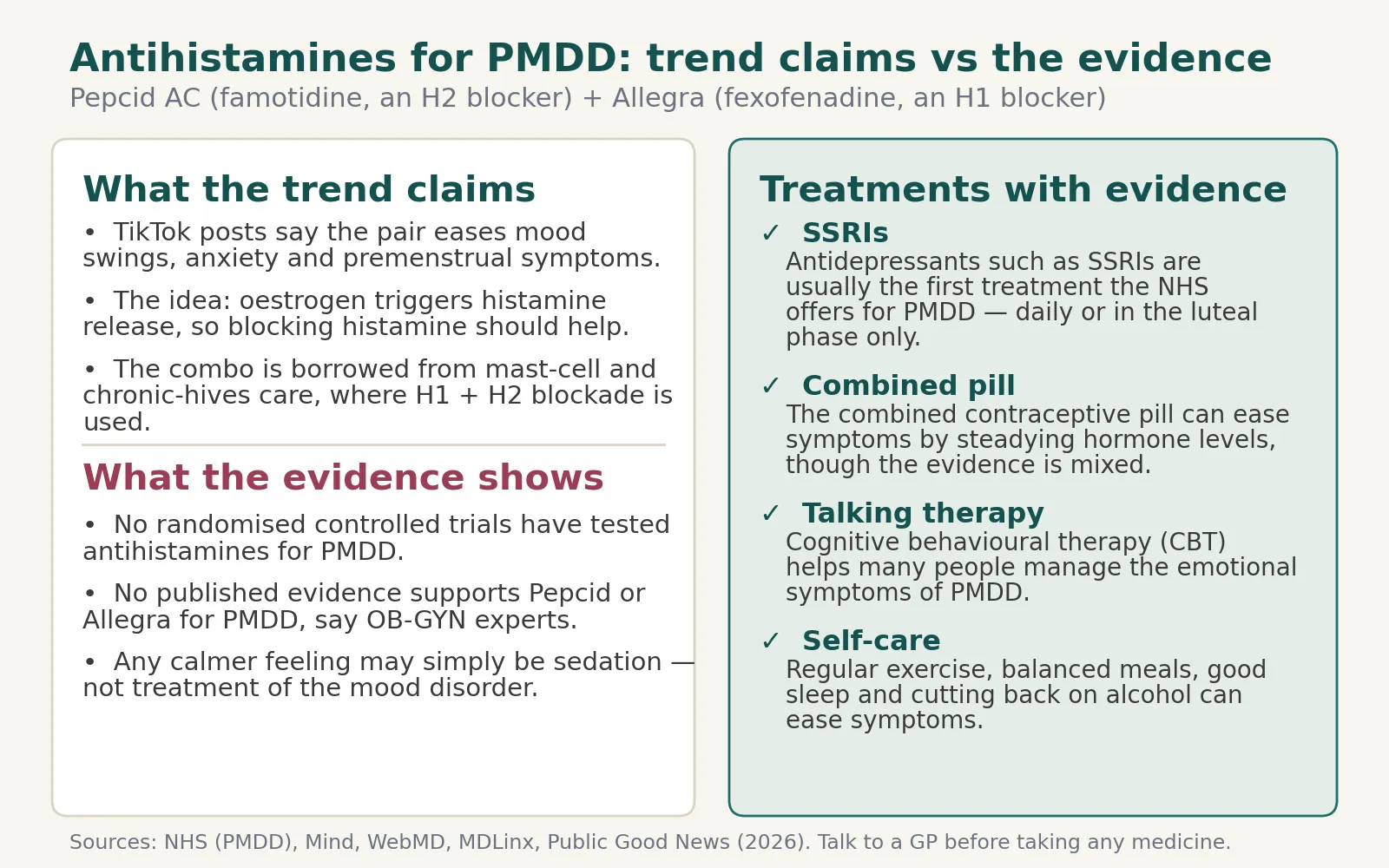
That combined approach is not new. Allergists have used H1 and H2 blockers together for decades to treat chronic hives, and the combination is also used in mast-cell conditions, where immune cells release too much histamine. The online trend simply borrows that logic and applies it to the menstrual cycle.
The hormonal link is this: oestrogen can prompt mast cells to release histamine, and histamine may in turn encourage the body to make more oestrogen — a possible feedback loop. Because oestrogen fluctuates sharply in the days before a period, some clinicians have suggested that histamine could be part of why PMDD symptoms flare in the luteal phase, the stretch between ovulation and menstruation. It is a plausible-sounding idea, and it fits neatly with symptoms such as bloating, headaches and low mood. But plausible is not the same as proven. As one psychiatrist told Public Good News, “this is all theoretical”.
Is there any evidence that antihistamines help PMDD?
The short answer is no — not in the sense that matters for medical treatment. There are no randomised controlled trials testing antihistamines for PMDD, and no peer-reviewed studies looking at whether they work for the condition. That is the position of psychiatrists and gynaecologists who have examined the trend in detail.
“There is currently no published evidence supporting the use of Pepcid or Allegra for PMDD,” New York OB-GYN Molly McBride told NewBeauty. Using the drugs this way would be considered off-label and without supporting evidence, she said. The same conclusion appears in WebMD’s review of the trend: there is no solid scientific evidence that combining the two drugs helps with PMDD, anxiety or depression, and most of what exists is anecdotal — people sharing their own experiences.
That does not mean the idea is worthless. Several doctors quoted in the coverage say the histamine pathway is genuinely interesting and deserves proper research. But enthusiasm is not evidence, and the gap between the two is exactly what matters when a treatment involves taking medicines every month.
Why do some women say they feel better?
If there is no evidence, why do so many women report feeling calmer and more stable? There are a few honest explanations, and none of them requires the histamine theory to be right.
First, some antihistamines are sedating. Histamine is not only an allergy chemical — it is also a brain chemical involved in wakefulness and alertness. A sedating antihistamine can make you feel drowsy and slowed down, which is easy to mistake for feeling less anxious. As allergist Saira Q. Zafar told NewBeauty, “what’s happening is usually sedation and cognitive slowing rather than treatment of anxiety or mood disorders”. Newer antihistamines such as Allegra are designed not to cross into the brain much, so they are not expected to change mood in a meaningful way.
Second, some women who feel better may have a separate, overlapping problem that antihistamines genuinely help — an allergy, a histamine sensitivity or a mast-cell condition — rather than PMDD itself. Treating that coexisting issue can make the premenstrual week feel easier without the drugs doing anything to PMDD.
Third, PMDD symptoms naturally rise and fall with the cycle. A treatment started in the worst week will often seem to work simply because the period arrives and symptoms lift on their own. That pattern makes personal stories unreliable, however sincere they are — which is why doctors rely on controlled trials rather than testimonials.
Are antihistamines safe to try for PMDD?
Both drugs are sold over the counter, and on their own they are generally considered safe for most people when used as directed for allergies or heartburn. But “over the counter” is not the same as “risk-free”, and taking them regularly, together, for a condition they are not licensed to treat is a different matter.
Allegra can cause drowsiness, headache, dry mouth, cough and an upset stomach. Pepcid can cause dizziness, headache, constipation and diarrhoea. WebMD notes that anyone with kidney or liver disease, anyone who is older, or anyone taking several medicines should ask a doctor before using the two together — especially if they plan to take them regularly. Older, sedating antihistamines carry extra concerns: they can add to daytime tiredness and fuzzy thinking, and frequent use can lead to tolerance or rebound symptoms.
There is also a subtler risk. Self-treating mood changes with antihistamines can delay a proper assessment, and with it the treatments that are known to work. Doctors writing for MDLinx warn that women may postpone proven therapies — such as SSRIs for PMDD — while experimenting with an unproven combination. And because PMDD can involve suicidal thoughts, anything that delays effective care carries real weight. If you are considering the combination, talk to a GP or pharmacist first, particularly if you take prescription medicines, hormone therapy or supplements, so that interactions can be checked.
What treatments for PMDD actually work?
The good news is that PMDD has treatments with solid evidence behind them. The NHS lists SSRIs — a type of antidepressant — as a main treatment, along with the combined contraceptive pill and talking therapies such as cognitive behavioural therapy (CBT). Painkillers or anti-inflammatory medicines can help with joint and muscle aches.
According to Mind, SSRIs are often the first treatment a doctor recommends for PMDD, and they can be taken every day or only during the luteal phase — the time between ovulation and the start of a period. Studies have shown that luteal-phase-only use can help, and withdrawal effects tend to be milder than with daily use. A doctor should review the treatment after two months to check it is working.
The combined pill may ease symptoms by steadying hormone levels, although Mind notes that the evidence is mixed: some people find it helps, others find it makes symptoms worse. Pills that stop ovulation tend to work better for PMDD, since the condition is tied to ovulation. If other treatments do not help, a GP may discuss further options, including medicines that temporarily bring on menopause — usually limited to around six months — and, only in very severe cases, surgery to stop periods altogether.
Everyday habits matter too. The NHS suggests regular exercise, balanced meals eaten little and often, plenty of sleep, mindfulness, cutting back on alcohol and stopping smoking. These steps will not replace medical treatment for moderate or severe PMDD, but they can take the edge off symptoms alongside it.
When to see a doctor
See a GP if you think you might have PMDD, if your symptoms are getting worse, or if they are interfering with work, relationships or daily life. It helps to keep a diary of your symptoms for at least two menstrual cycles, as the NHS advises, so your GP can see the pattern. If you have tried a treatment and it is not helping, go back — there are several options, and finding the right one can take time.
If you feel you might act on thoughts of harming yourself, get help straight away. In the UK, call Samaritans free on 116 123 at any time. You can also find support and crisis resources on our get help now page.
In an emergency call 911 (US), 999 (UK) or 112 (EU).
The Pepcid and Allegra trend is understandable: PMDD is under-researched, underfunded and often dismissed, and women are tired of waiting for answers. But the honest position today is that antihistamines are an interesting theory, not a treatment. Until proper trials are done, the safest path is the one with evidence behind it — and a GP who takes your symptoms seriously.
Frequently asked questions
Can antihistamines help PMDD?
There is no good evidence that they can. No randomised controlled trial has tested antihistamines for PMDD, and experts say there is no published evidence supporting Pepcid or Allegra for the condition. The idea rests on an unproven theory about histamine and oestrogen. Treatments with real evidence include SSRIs, the combined pill and cognitive behavioural therapy.
Why are women taking Pepcid AC and Allegra for PMDD?
Women on TikTok report that pairing the H1 antihistamine Allegra with the H2 blocker Pepcid AC eases mood swings, anxiety and premenstrual symptoms. The idea is that oestrogen triggers histamine release, so blocking histamine should help. The combination is borrowed from mast-cell and chronic-hives care, where H1 plus H2 blockade is an established approach.
What is the histamine theory of PMDD?
The theory is that oestrogen can prompt mast cells to release histamine, and histamine may encourage the body to make more oestrogen, creating a possible feedback loop. Because oestrogen fluctuates sharply before a period, histamine could in theory contribute to PMDD symptoms such as bloating, headaches and low mood. Researchers stress this is a hypothesis, not a proven cause.
Why do some women feel better on antihistamines?
Some antihistamines are sedating, and feeling drowsy can be mistaken for feeling less anxious — experts say this is usually sedation, not treatment of the mood disorder. Others may have a separate allergy or histamine-related problem that the drugs genuinely help. PMDD symptoms also lift naturally when a period starts, which can make any remedy tried that week seem to work.
Is it safe to take Pepcid and Allegra together for PMDD?
Both are sold over the counter and are generally safe when used as directed for allergies or heartburn, but taking them regularly together for PMDD is unproven and not without risk. Side effects include drowsiness, headache, dizziness and stomach upset. Anyone with kidney or liver disease, anyone older, or anyone on several medicines should ask a doctor or pharmacist first.
What treatments actually work for PMDD?
The NHS lists SSRIs, the combined contraceptive pill and talking therapy such as CBT as the main treatments. SSRIs are often recommended first and can be taken daily or only in the luteal phase. The pill can help by steadying hormone levels, though the evidence is mixed. Regular exercise, balanced meals, good sleep and cutting back on alcohol can ease symptoms alongside medical treatment.
Sources
- NHS: PMDD (premenstrual dysphoric disorder) www.nhs.uk
- Mind: Treatment for PMDD www.mind.org.uk
- WebMD: Allegra and Pepcid — What Does It Help With? www.webmd.com
- MDLinx: The antihistamine drug combo for PMDD and menopause www.mdlinx.com
- Public Good News: Can antihistamines treat PMDD? publicgoodnews.com
- NewBeauty: Why experts are urging caution around the Pepcid AC and Allegra trend www.newbeauty.com
- Pearlstein T, Steiner M. Premenstrual dysphoric disorder: burden of illness and treatment update. J Psychiatry Neurosci, 2008 pmc.ncbi.nlm.nih.gov

Try the tool
When is your next period and fertile window?
Six cycles ahead from your last period date.
Open the calculator