Cramps But No Period: Causes and When to Worry
Period-like cramps with no bleeding can be confusing. Here are the common causes, from ovulation pain to endometriosis, and the warning signs that need a doctor.
- Written by
- Health Daily Advice
- Published
- Reading time
- 7 minutes
- Sources
- 12 cited

In this guide
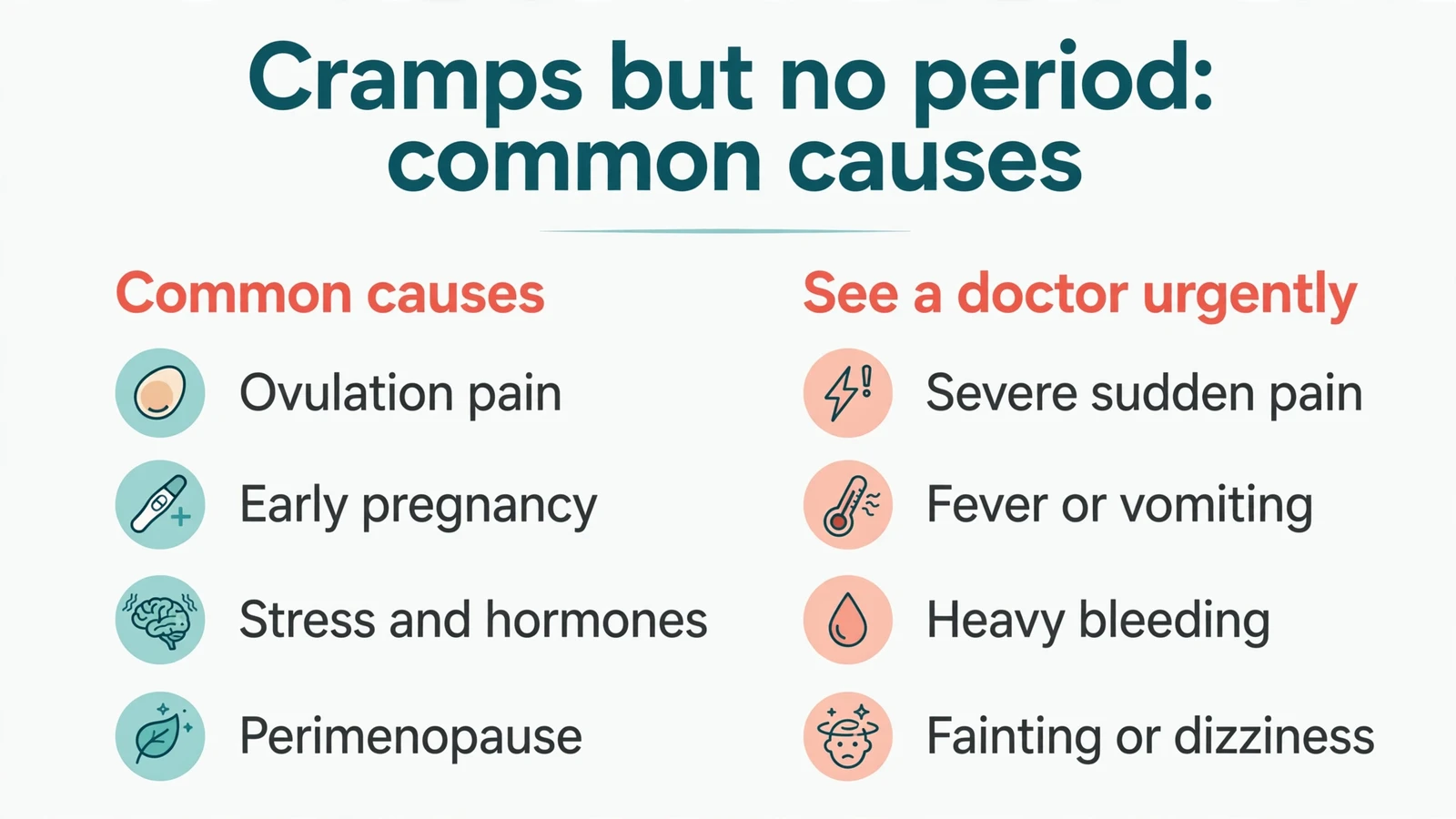
Cramps without a period are common and often harmless — ovulation pain, early pregnancy or a late period are frequent causes. But cramps can also signal conditions such as endometriosis, ovarian cysts or pelvic infection. Severe, sudden or persistent pain, especially with fever, heavy bleeding or fainting, needs prompt medical care.
Why you can have cramps without a period
Period pain happens when the muscular wall of the womb tightens, and the NHS explains that it usually lasts for up to 3 days. But the same cramping feeling can appear when you are not bleeding at all. The womb, ovaries and the tissues around them respond to hormones throughout the month, not only during a period, so pain can show up mid-cycle, before a late period or because of an underlying condition. Working out the pattern — when the cramps start, where they are felt and what comes with them — is the best first step.
Ovulation pain (mittelschmerz)
The most common cause of mid-cycle cramps is ovulation pain, known as mittelschmerz — German for “middle pain”. Mayo Clinic explains that it is one-sided lower abdominal pain linked to ovulation, occurring about 14 days before your next period. Cleveland Clinic notes that it may affect up to 40% of people who ovulate, and that the pain typically lasts a few hours but can continue for up to 48 hours.
Ovulation pain is usually felt on one side only — the side of the ovary releasing the egg — and feels like a dull ache or a sudden twinge, similar to menstrual cramps. It is typically harmless and does not require medical attention, but pain that is severe, lasts longer than a couple of days or comes with a fever should be checked by a doctor.
Early pregnancy
Mild cramping can be an early sign of pregnancy. As a fertilised egg implants in the lining of the womb and the womb begins to change, some people notice light cramps that feel much like period pain, sometimes with light spotting. Until you have a positive pregnancy test, there is no way to know whether cramps mean pregnancy or a period on its way, so if your period is late and you have cramps, take a pregnancy test and talk to a doctor or pharmacist if you are unsure.
Cramping in early pregnancy is not always harmless. A pregnancy that implants outside the womb — an ectopic pregnancy — is covered in more detail below, and it needs urgent care.
Stress and hormonal changes
Stress, illness, big changes in routine and hormonal contraception can all disturb your menstrual cycle. When ovulation is delayed, a period can arrive late while the usual pre-period cramps still appear on schedule, leaving you with cramps but no bleeding. Hormonal contraception can also change bleeding patterns: the NHS notes that some types, such as the progestogen-only pill, the implant and the injection, can make periods irregular or stop them completely.
If your cycles have suddenly become irregular, or periods have stopped unexpectedly, see your GP — the NHS lists these as reasons to get checked, especially if the change is new for you.
Perimenopause
In the years before menopause, fluctuating hormone levels make periods unpredictable. The NHS explains that one of the first signs of perimenopause is usually a change to your periods: they may happen more often or less often, and bleeding may get heavier or lighter. Cramps can still appear even when a period is skipped or very light. The NHS also notes that perimenopause symptoms usually last for 7 to 9 years, sometimes longer.
Any vaginal bleeding after 12 months without a period needs to be checked by a GP, even if it is only spotting.
Endometriosis
Endometriosis is a condition in which tissue similar to the lining of the womb grows outside the womb, most commonly in the pelvis. North Bristol NHS Trust explains that it affects as many as one in ten women of reproductive age, and that its symptoms include pelvic pain that can be cyclical or unrelated to the menstrual cycle, excessive pain before, during or after periods, pain during sex, persistent tiredness and abnormal bleeding.
Because endometriosis pain is not tied to bleeding, cramps can appear at any point in the cycle, including days when no period is due. The NHS lists endometriosis as one of the conditions that can cause painful periods, and it is worth raising with a GP if cramps regularly stop you doing daily activities or keep getting worse.
Ovarian cysts
Ovarian cysts are fluid-filled sacs that form on or in an ovary, often during ovulation. Most are harmless and cause no symptoms, but a large cyst can cause a dull ache or pressure in the lower abdomen, and a cyst that bursts can cause sudden, intense pain. Cleveland Clinic explains that symptoms of a ruptured cyst can include sudden intense pain in the lower abdomen, usually on one side, nausea and vomiting, fever, and bloating or a feeling of fullness. Cysts tend to rupture around ovulation or after strenuous physical activity and sex.
A ruptured cyst that causes a lot of bleeding can also cause shoulder pain or upper abdominal pain, and Cleveland Clinic describes this as a medical emergency. A twisted ovary (ovarian torsion) is also an emergency. Sudden, severe one-sided pelvic pain should never be waited out.
Pelvic inflammatory disease (PID)
Pelvic inflammatory disease is an infection of the womb, fallopian tubes and ovaries. The NHS explains that it is usually caused by sexually transmitted infections such as chlamydia and gonorrhoea, but it can also be caused by common bacteria that live in the vagina. Symptoms can include pain in the lower tummy or pelvis, pain felt deep inside during sex, heavy or painful periods that are unusual for you, bleeding between periods or after sex, and vaginal discharge that looks, smells or feels unusual.
PID does not always cause symptoms, and the pain can come and go. If it is diagnosed early it can usually be treated easily, but left untreated it can lead to long-term pelvic pain, fertility problems and a higher risk of ectopic pregnancy. The NHS advises asking for an urgent GP appointment or help from NHS 111 if you think you have symptoms of PID.
Ectopic pregnancy — a rare but urgent cause
An ectopic pregnancy is when a fertilised egg implants outside the womb, most often in a fallopian tube. Cleveland Clinic notes that ectopic pregnancies occur in about 2% of all pregnancies, and that most are discovered around eight weeks of pregnancy. Early symptoms can be very similar to a normal pregnancy, but may also include vaginal bleeding, pain in the lower abdomen, pelvis or lower back, and dizziness or weakness.
If a fallopian tube ruptures, the pain can become sudden and sharp, with fainting, low blood pressure, shoulder pain or rectal pressure. This is an emergency. If you have a positive pregnancy test — or a missed period — together with severe one-sided pelvic pain, bleeding or dizziness, get emergency help straight away.
Other possible causes
The NHS lists fibroids — non-cancerous growths in or around the womb — and adenomyosis, where womb-like tissue grows into the muscle of the womb, as conditions that can cause painful periods. An intrauterine device (IUD or coil) can also cause period-type pain, particularly during the first 3 to 6 months after it is fitted. Digestive problems such as constipation and irritable bowel syndrome can also cause cramping low in the abdomen that feels very like period pain.
What can help at home
For mild cramps with no worrying symptoms, the NHS suggests a warm bath or shower, a heat pad or hot water bottle wrapped in a tea towel on your tummy, massaging your tummy and back, and gentle exercise such as walking, swimming or yoga. Rest and keeping a simple note of when cramps happen in your cycle can also help you and your GP spot a pattern. Talk to a doctor or pharmacist about pain relief if you need it, and about whether your symptoms need a check-up.
Tracking your symptoms
Before your appointment, it helps to note a few things: the date your last period started, whether your periods are usually regular, where the pain is (one side or across the whole lower tummy), how long it lasts, and anything that comes with it — bleeding, discharge, fever, nausea or pain during sex. This is the information a GP will ask about, and it can make the difference between a quick reassurance and a referral for tests such as an ultrasound scan.
When to see a doctor
See your GP if your cramps keep coming back, are getting worse, stop you doing daily activities, or come with bleeding between periods, unusual discharge, pain during sex, or periods that have become more painful, heavier or irregular. The NHS advises asking for an urgent GP appointment or help from NHS 111 if your pelvic pain is severe or worse than usual and painkillers have not helped.
Get emergency help straight away — call 999 or go to A&E — if you have sudden, severe one-sided pelvic pain, fainting or dizziness, shoulder-tip pain, heavy vaginal bleeding, a very high temperature, or you are pregnant or think you might be pregnant and have severe pain or bleeding.
In an emergency call 911 (US), 999 (UK) or 112 (EU)
This article is general information only and is not a substitute for medical advice. Only a doctor who can examine you and, if needed, arrange tests can work out what is causing your cramps.
Frequently asked questions
Can you get period cramps but no period?
Yes. Cramps without bleeding are common and often harmless. The most frequent causes are ovulation pain, a late period, early pregnancy, stress or hormonal changes, and perimenopause. They can also be caused by conditions such as endometriosis, ovarian cysts or pelvic infection. If the cramps keep coming back, get worse or come with other symptoms, see a GP.
How long does ovulation pain last?
Ovulation pain, known as mittelschmerz, usually lasts a few minutes to a few hours. Cleveland Clinic notes that it can continue for up to 48 hours, and Mayo Clinic says it may last as long as a day or two. It is felt on one side of the lower abdomen, around the middle of your cycle, about 14 days before your next period. Pain lasting longer than a couple of days should be checked.
Can stress cause cramps without a period?
Stress can disturb your menstrual cycle and delay ovulation, so a period can arrive late while the usual pre-period cramps still appear on schedule. Illness, big routine changes and hormonal contraception can do the same. If your cycles have suddenly become irregular or periods have stopped unexpectedly, see a GP, as the NHS lists these as reasons to get checked.
Can cramps without a period mean pregnancy?
Yes, mild cramping can be an early sign of pregnancy, as a fertilised egg implants and the womb begins to change. Some people also notice light spotting. Until you have a positive pregnancy test, there is no way to know whether cramps mean pregnancy or a period on its way. If your period is late, take a test and talk to a doctor or pharmacist if unsure.
Can endometriosis cause cramps when I'm not on my period?
Yes. Endometriosis is tissue similar to the womb lining growing outside the womb, and it can cause pelvic pain at any point in the cycle, not only during bleeding. North Bristol NHS Trust notes it affects as many as one in ten women of reproductive age. See a GP if cramps regularly stop you doing daily activities, keep getting worse, or come with pain during sex or abnormal bleeding.
When should I worry about cramps with no period?
Get urgent help for sudden severe one-sided pelvic pain, fainting or dizziness, shoulder-tip pain, heavy vaginal bleeding, a very high temperature, or severe pain in pregnancy. See a GP sooner if cramps keep coming back, are getting worse, stop daily activities, or come with bleeding between periods, unusual discharge or pain during sex. In an emergency call 911 (US), 999 (UK) or 112 (EU).
Sources
- NHS: Period pain www.nhs.uk
- Mayo Clinic: Mittelschmerz www.mayoclinic.org
- Cleveland Clinic: Ovulation Pain (Mittelschmerz) my.clevelandclinic.org
- North Bristol NHS Trust: Endometriosis information for patients www.nbt.nhs.uk
- NHS: Pelvic inflammatory disease www.nhs.uk
- Cleveland Clinic: Ectopic Pregnancy my.clevelandclinic.org
- Cleveland Clinic: Ovarian Cyst Rupture my.clevelandclinic.org
- NHS: Symptoms of menopause and perimenopause www.nhs.uk

Try the tool
When is your next period and fertile window?
Six cycles ahead from your last period date.
Open the calculator