Period Blood Clots: When Are They Normal and When to Worry
Small blood clots on heavy days are usually a normal part of a period, but large or frequent clots can signal heavy bleeding. Here is how to tell the difference and when to see a doctor.
- Written by
- Health Daily Advice
- Published
- Reading time
- 7 minutes
- Sources
- 9 cited
In this guide
Small blood clots during your period are usually normal, especially on your heaviest days. They form when blood collects in the womb before it flows out. See a doctor if you often pass clots larger than about 2.5 cm, soak through a pad or tampon every hour, bleed for more than 7 days, or feel dizzy or faint.
What are period blood clots?
Period blood clots are small lumps of clotted blood and tissue that pass out of the womb during menstruation. They can look like jelly-like blobs or small dark lumps, and they often appear when you stand up after lying down or sitting for a while, or when you go to the toilet.
They form as part of the normal process of a period. During menstruation, hormones cause the lining of the womb to shed, and small blood vessels bleed as it does so. To stop you losing too much blood, plasma and platelets work together to form clots. As Cleveland Clinic explains, clots form whenever a certain amount of blood sits in one place, and when bleeding is heavy, blood collects inside the womb and clots as it sits there.
Large clots can be uncomfortable to pass. The cervix has to open wider to let a big clot through, which can cause strong cramping — one reason heavy flow often comes with more period pain.
What is normal?
Most menstrual blood clots are normal, and a few small ones on heavy days are nothing to worry about. Cleveland Clinic notes that clots the size of a dime or a quarter can be normal for some people. The key is what is normal for you, and whether the pattern is changing.
Clots often look bright red at the start and end of your period, when the flow is moving quickly and the blood has no time to darken. On the heaviest days, they may be dark red or maroon. This colour range is normal.
Clots are most likely on the days when your flow is heaviest. The NHS says a period usually lasts between 2 and 7 days, typically about 5 days, with the bleeding heaviest in the first 2 days, and that you lose about 20 to 90 ml of blood during a period (roughly 1 to 5 tablespoons). So small clots appearing on day 1 or 2, then fading as the flow lightens, fit the usual pattern.
In short, clots are usually normal when they are:
- small — well under 2.5 cm across
- occasional, rather than constant
- seen mainly on your heaviest days
- part of a period that lasts up to 7 days
- not accompanied by severe pain, dizziness or fainting
What is not normal? Signs of heavy bleeding
Large or frequent clots often go hand in hand with heavy menstrual bleeding. The NHS lists passing blood clots larger than about 2.5 cm — roughly the size of a 10p coin — as one of the signs of heavy periods, alongside needing to change a pad or tampon every 1 to 2 hours, needing to use two types of period product together, periods lasting more than 7 days, bleeding through to clothes or bedding, avoiding daily activities because of your periods, and feeling tired or short of breath a lot.
Mayo Clinic lists passing blood clots larger than a quarter among the symptoms of heavy menstrual bleeding, along with soaking through one or more pads or tampons every hour for several hours in a row, needing to get up at night to change protection, and symptoms of anaemia such as tiredness, fatigue or shortness of breath.
It is the pattern that matters most. As Cleveland Clinic points out, heavy bleeding that happens once in a single cycle and does not repeat is less concerning than a pattern that keeps happening. Look at how often large clots appear, how long the bleeding lasts, and whether it is getting worse over time.
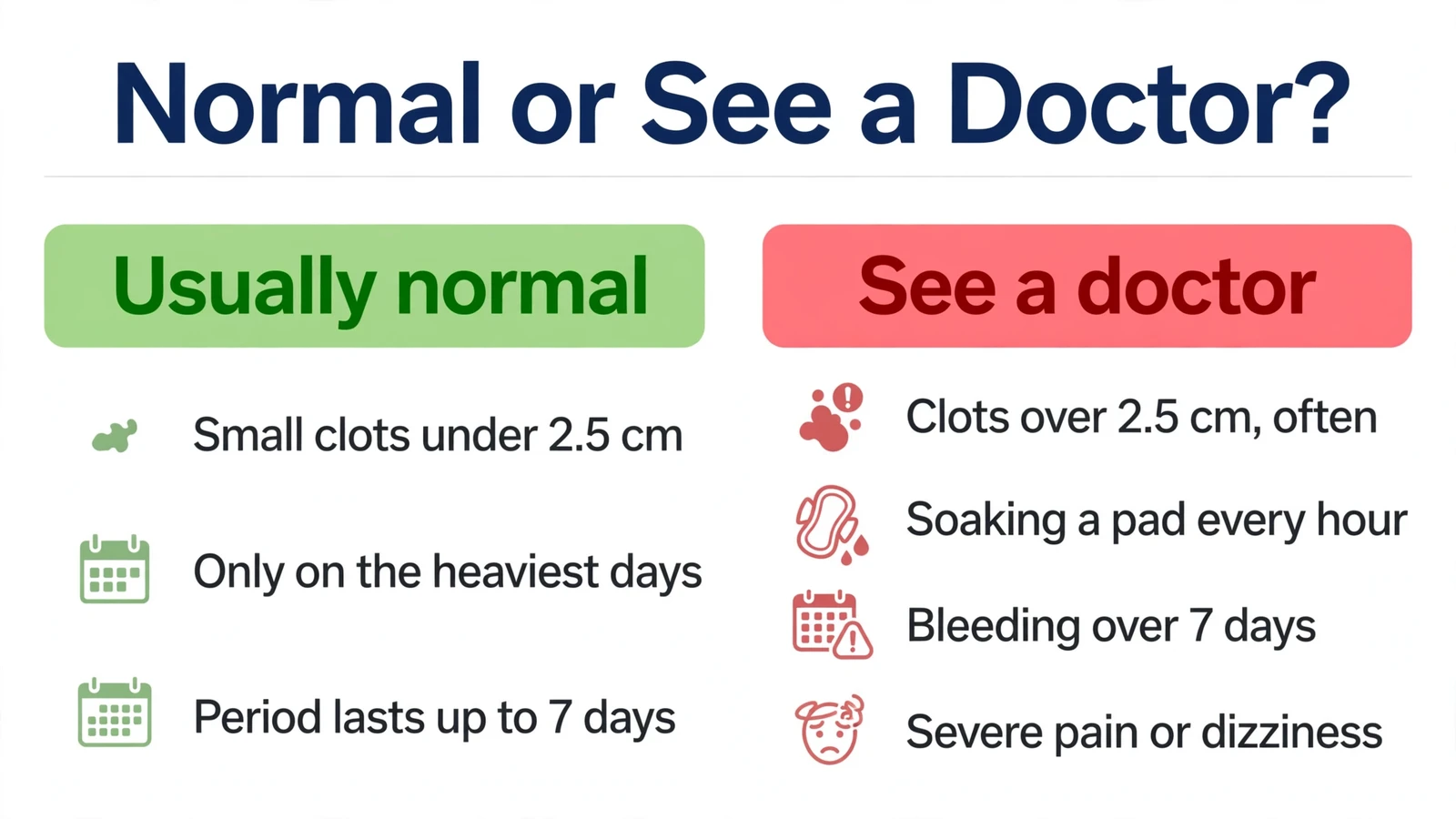
| Usually normal | See a doctor |
|---|---|
| Small clots, smaller than about 2.5 cm | Clots larger than about 2.5 cm, especially if they happen often |
| Clots only on your heaviest days | Large clots throughout your period, month after month |
| Period lasts 2 to 7 days | Bleeding lasts more than 7 days |
| Changing a pad or tampon every few hours | Soaking through a pad or tampon every hour for several hours |
| Usual cramps that ease with rest or simple pain relief | Severe pain, dizziness, fainting or breathlessness |
| No bleeding between periods | Bleeding between periods or after sex |
Possible causes of large or frequent clots
When clots are repeatedly large, it usually means the flow itself is heavy. The NHS lists several possible causes of heavy periods, including conditions affecting the womb or ovaries — such as fibroids, endometriosis, adenomyosis, polycystic ovary syndrome (PCOS) and pelvic inflammatory disease — bleeding disorders such as von Willebrand disease, and some medicines, including anticoagulants. Rarely, heavy periods can be a sign of womb cancer.
Mayo Clinic adds further detail. A hormone imbalance can make the lining of the womb grow too thick, so it sheds heavily; this can happen when you do not ovulate, which is common in the teenage years, around the menopause and with PCOS or thyroid problems. Uterine polyps — small, usually non-cancerous growths on the lining of the womb — can also cause heavy or prolonged bleeding, as can adenomyosis, where tissue from the lining of the womb grows into the muscle wall. A hormone-free intrauterine device (IUD) is another well-known cause of heavier bleeding.
Pregnancy is a special case. If you could be pregnant and you are passing blood clots or bleeding heavily, contact a doctor or go to the nearest emergency department. Cleveland Clinic warns this may be a miscarriage or an ectopic pregnancy, which can be life-threatening.
Sometimes no cause is found at all. Heavy periods can also be more common at certain stages of life, such as when periods first start, after pregnancy, or approaching the menopause.
What to track before seeing a doctor
If you book an appointment, a short record of your periods will help the doctor a great deal. Cleveland Clinic suggests being ready to share the following:
- how long your period usually lasts, and whether that has changed
- how heavy your usual flow is — roughly how often you change a pad, tampon or cup
- the size of the clots, compared with a 10p coin, and how often they appear
- whether you bleed between periods or after sex
- whether you have noticed changes over time
- whether you have pain, and how bad it is
- whether there is any chance you could be pregnant
- a list of medicines you take, including any blood thinners
- any other medical conditions, and whether heavy periods run in the family
Keeping a simple diary for two or three cycles — dates, flow, clot size and symptoms — is often enough. A period-tracking app can help, but a notebook works just as well.
What a doctor may do
Expect your doctor to ask about your cycle and your general health, and to do a pelvic examination. Cleveland Clinic notes that a doctor may also arrange a blood test, a cervical screening test or an ultrasound during the visit. The NHS says you may have blood tests to check for underlying conditions such as iron-deficiency anaemia.
Treatment depends on what is found, how severe the bleeding is and your other symptoms. Heavy periods do not always need treatment, but options a GP may discuss include some types of contraception, such as an intrauterine system or the combined contraceptive pill, and medicines to reduce bleeding, such as tranexamic acid or prescription anti-inflammatory painkillers. Cleveland Clinic lists contraceptives, nonsteroidal anti-inflammatory drugs, tranexamic acid, hormonal therapy and, in some cases, surgery among the treatments a doctor may consider after examination and testing.
If these treatments do not work, or a GP thinks a condition may be causing your heavy periods, they will usually refer you for tests or to a specialist. Specialist treatments can include removing the lining of the womb, removing fibroids, or, in some cases, removal of the womb. Do not start or stop any medicine on the basis of this article — talk to a doctor or pharmacist about what is right for you.
When to see a doctor
See a GP if your periods are affecting your life, you have had heavy periods for some time, you have severe pain during your periods, you bleed between periods or after sex, or you have heavy periods along with other symptoms such as pain when peeing, pooing or having sex. The American College of Obstetricians and Gynecologists (ACOG) defines heavy menstrual bleeding as blood loss that interferes with a woman’s physical, social, emotional or material quality of life — so if your periods are stopping you living normally, that alone is a good reason to be checked.
Get medical help promptly if you are soaking through a pad or tampon about every hour for several hours in a row, you feel dizzy, faint or very short of breath, or you look unusually pale. These can be signs of significant blood loss or anaemia.
Seek urgent care straight away if you could be pregnant and are passing blood clots or bleeding heavily.
In an emergency call 911 (US), 999 (UK) or 112 (EU).
Finally, remember that worrying about clots is common and nothing to be embarrassed about. Most of the time they are a normal part of a period — but if the pattern has changed or the signs above sound familiar, a quick conversation with a GP can give you reassurance, rule out a cause, and, if needed, start treatment. You do not have to put up with periods that disrupt your life.
This article is for general information only and is not medical advice. If you are concerned about your periods, speak to a GP or another qualified healthcare professional.
Frequently asked questions
Are blood clots normal during a period?
Yes, most of the time. Small clots are common, especially on your heaviest days, when blood collects in the womb and clots before it flows out. Cleveland Clinic notes that clots the size of a dime or a quarter can be normal for some people. They are usually bright red at the start and end of a period and dark red or maroon on heavy days. See a doctor if large clots keep happening or your pattern changes.
What size of period blood clot is normal?
Clots smaller than about 2.5 cm, roughly the size of a 10p coin, are usually normal, particularly on heavy days. The NHS lists clots larger than about 2.5 cm as one of the signs of heavy periods. Mayo Clinic similarly lists clots larger than a quarter as a symptom of heavy menstrual bleeding. Size matters most alongside frequency: one small clot is rarely a concern, but large clots that keep coming are worth checking.
When should I worry about period blood clots?
See a doctor if you often pass clots larger than about 2.5 cm, soak through a pad or tampon every hour for several hours, bleed for more than 7 days, bleed between periods, or have severe pain. Also seek care if you feel dizzy, faint, very tired or short of breath, as these can be signs of anaemia. If you could be pregnant and are passing clots or bleeding heavily, get urgent care.
What causes large blood clots during a period?
Large clots usually mean the flow itself is heavy. The NHS lists fibroids, endometriosis, adenomyosis, polycystic ovary syndrome (PCOS), pelvic inflammatory disease, bleeding disorders such as von Willebrand disease, and some medicines including anticoagulants. Mayo Clinic adds hormone imbalance, not ovulating, uterine polyps and a hormone-free IUD. Sometimes no cause is found, and heavy periods can also be common when periods first start or near the menopause.
Can period blood clots cause anaemia?
Yes, if the bleeding is heavy over time. The NHS lists feeling tired or short of breath a lot as a sign of heavy periods, and Mayo Clinic lists tiredness, fatigue and shortness of breath as symptoms of anaemia linked to heavy menstrual bleeding. Losing a lot of blood month after month can drain your iron stores. A doctor can check with a blood test and discuss treatment, so do not ignore ongoing tiredness alongside heavy periods.
What should I tell my doctor about period clots?
Keep a simple record for two or three cycles: how long each period lasts, how often you change a pad, tampon or cup, the size of clots compared with a 10p coin, and whether you bleed between periods. Also note any pain, dizziness, changes over time, medicines you take and whether you could be pregnant. Cleveland Clinic suggests sharing this information so your doctor can decide whether a pelvic exam, blood test or ultrasound is needed.
Sources
- Cleveland Clinic: Period Blood Clots: Should You Be Concerned? health.clevelandclinic.org
- NHS: Heavy periods www.nhs.uk
- NHS: Periods www.nhs.uk
- Mayo Clinic: Heavy menstrual bleeding – Symptoms and causes www.mayoclinic.org
- ACOG: Screening and Management of Bleeding Disorders in Adolescents With Heavy Menstrual Bleeding www.acog.org

Try the tool
When is your next period and fertile window?
Six cycles ahead from your last period date.
Open the calculator