What Is Trypophobia? Why Tiny Holes Make You Uneasy
- Written by
- Health Daily Advice
- Published
- Reading time
- 4 minutes
- Sources
- 9 cited
In this guide
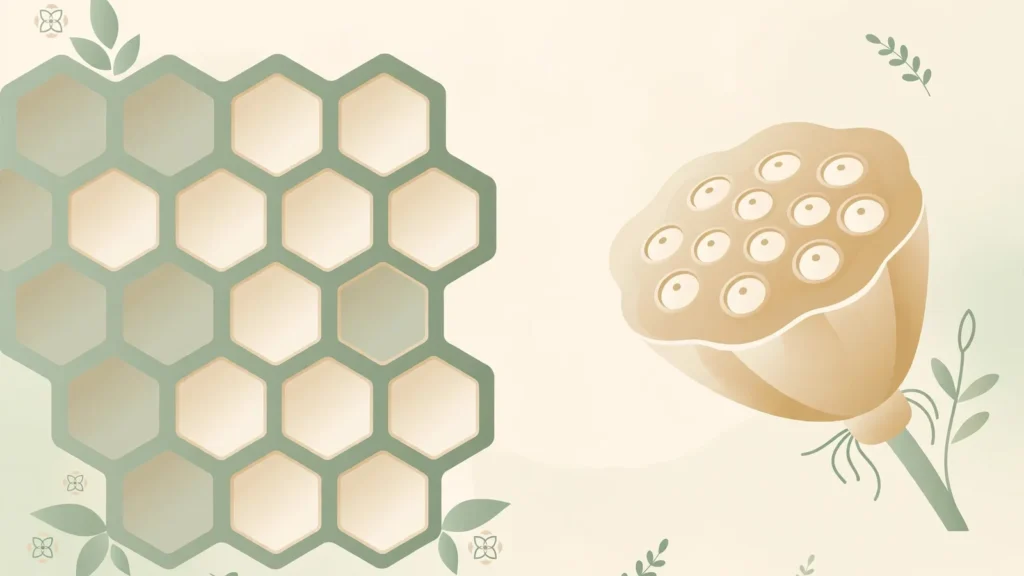
Trypophobia is an aversion to clusters of small holes or bumps, such as honeycombs, lotus seed pods and sponges. It is not a recognised medical diagnosis, but many people feel intense disgust, anxiety or skin-crawling when they see these patterns. Researchers think it may be an overgeneralised disease- or danger-avoidance response.
Why do tiny holes make some people uneasy?
Trypophobia only entered the scientific literature in 2013, when vision scientists Geoff Cole and Arnold Wilkins of the University of Essex published their study in the journal Psychological Science. They compared 76 images of hole clusters that trigger the reaction with 76 control images of ordinary holes, and found the triggering images had unusually high contrast energy at midrange spatial frequencies. In the same study, 16 per cent of participants reported trypophobic reactions.
Why would that visual feature bother the brain? Cole and Wilkins noticed the same visual signature in some of the most poisonous animals on earth, including the blue-ringed octopus, the deathstalker scorpion and the king cobra. As Cole put it, “there may be an ancient evolutionary part of the brain telling people that they are looking at a poisonous animal.” In other words, trypophobia could be an old survival instinct that misfires when it meets a harmless honeycomb.
There is a second, related theory. Hole clusters resemble the patterns caused by parasites and infectious diseases — the spotty rashes of measles and smallpox, or clusters of sores and insect bites. Research on this “disease avoidance” idea suggests trypophobia is an exaggerated, overgeneralised version of a healthy instinct to keep away from contamination. It is worth noting that not everyone is convinced: even people without trypophobia rate hole-cluster images as less comfortable than other images, which backs up the idea that the reaction is wired into how we see the world.
Is it fear or disgust?
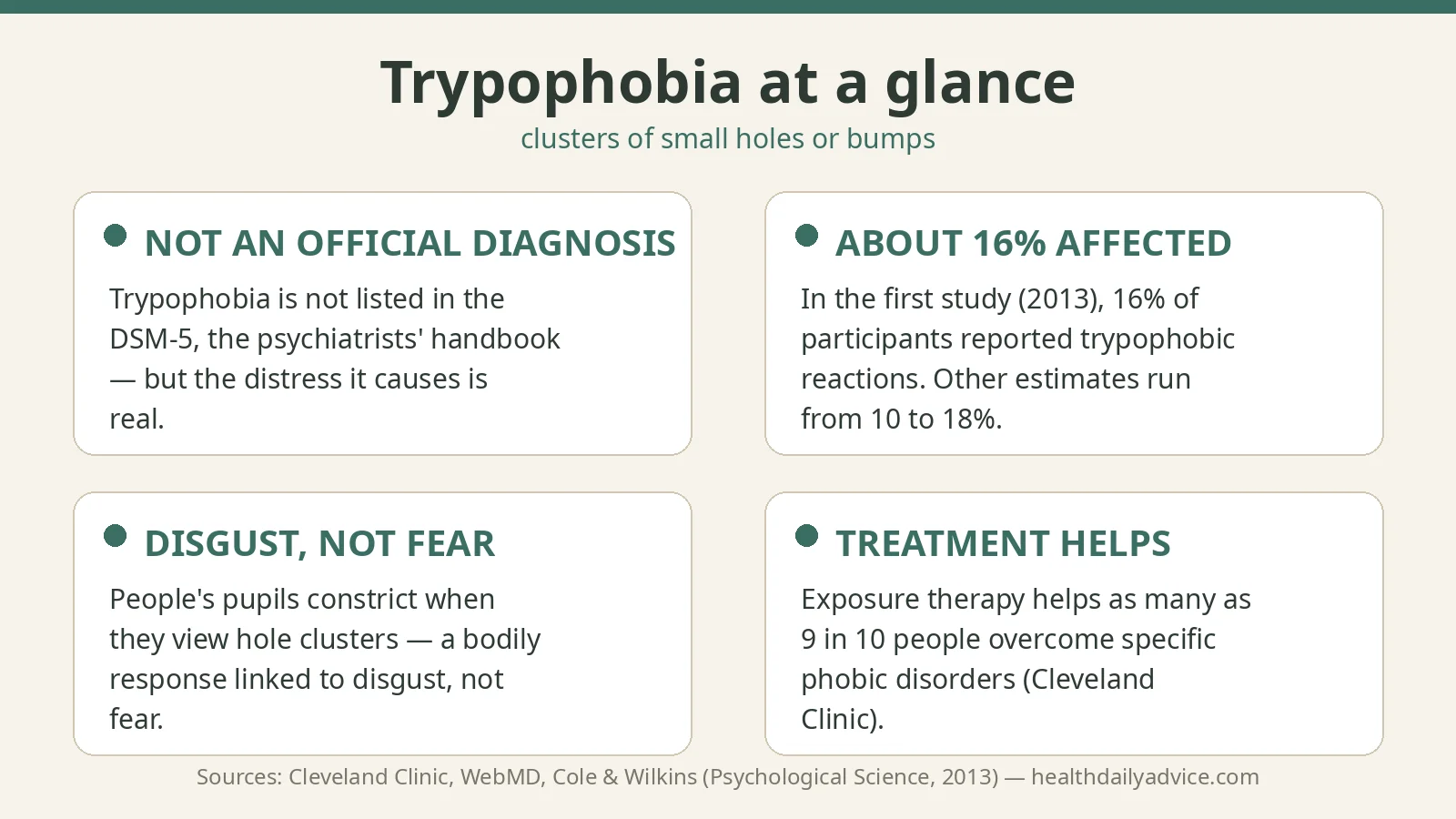
Despite the name — from the Greek trypa (hole) and phobos (fear), coined on a web forum in 2005 — trypophobia seems to be driven more by disgust than by fear. In one study, researchers tracked people’s pupils while they looked at hole clusters, threatening animals and neutral images. Pupils constrict when the parasympathetic (“rest and digest”) system takes over during disgust, and dilate during fear. The hole images caused constriction: a bodily response consistent with disgust, not fear.
That matches how people describe the feeling: “repulsive” and “gross” rather than scared. Alongside the emotional reaction, people report nausea, itchiness, goosebumps and a skin-crawling sensation.
Common trypophobia triggers
Almost anything with a tight cluster of holes or bumps can trigger a reaction. Common triggers include honeycombs, lotus seed pods, sea sponges, soap bubbles, strawberries, coral, Swiss cheese, pomegranates, shower heads, aerated chocolate, the air holes in a slice of bread and even pebbles in concrete. Patterns on skin — sores, scars or spots — can also trigger it, and most “trypophobia skin” pictures circulating online are fake.
Is trypophobia a real diagnosis?
Trypophobia is not listed as a standalone diagnosis in the Diagnostic and Statistical Manual of Mental Disorders (DSM-5), the handbook psychiatrists use to classify mental-health conditions. But the distress it causes is real, and a psychologist or GP can still assess it. Researchers have developed a Trypophobia Questionnaire — 17 questions asking people to rate their discomfort from 1 (“not at all”) to 5 (“extremely”) when viewing triggering images.
Estimates of how common it is vary: one study found that 18 per cent of adults had some degree of trypophobia, while other research puts the figure at 10 to 18 per cent of adults. The odds appear slightly higher in women than in men, and it runs in families — in one study, about 25 per cent of people with trypophobia had a close relative with the condition. Trypophobia can also travel with other conditions, including depression, anxiety and obsessive-compulsive disorder.
What helps with trypophobia?
Because trypophobia is not an official diagnosis, there is no dedicated treatment — but the same approaches used for other specific phobias apply. Exposure therapy is the main one: a therapist gradually exposes you to hole-cluster images or objects while teaching breathing and relaxation techniques. The Cleveland Clinic notes that this kind of talk therapy helps as many as nine in 10 people overcome specific phobic disorders. Interestingly, Dr Cole reports that he reduced his own reaction by looking at triggering images so often that he became desensitised to them.
Cognitive behavioural therapy (CBT) is also used: it helps you notice and change the thoughts and feelings the patterns trigger. The NHS says most phobias can be treated successfully, and that gradual exposure — also called desensitisation, or desensitization in the US — plus CBT are the main routes. Medication is not usually used for phobias; the Cleveland Clinic adds that anti-anxiety medicines generally do not help specific phobic disorders, though a doctor may prescribe them short-term in particular situations.
On your own, simple coping steps can take the edge off: look away from the trigger, slow your breathing, and give yourself time to settle. Regular sleep, exercise and cutting back on caffeine can reduce background anxiety, and talking to others who share the experience — through a support group or counselling — can help. What will not help is diagnosing or treating yourself; talk to a doctor if you want to work on it properly.
When to see a doctor
Talk to your GP if trypophobia is interfering with everyday life — for example, if you avoid places or activities because of it, if reactions feel like panic attacks, or if you notice related problems such as depression, constant stress or trouble sleeping. A GP can refer you to a specialist in behavioural therapy, such as a psychologist. In the UK you can also reach out to a mental-health support service directly; see Get help now for where to go.
In an emergency call 911 (US), 999 (UK) or 112 (EU)
Frequently asked questions
Is trypophobia a real phobia?
Trypophobia is not listed as a standalone diagnosis in the DSM-5, the handbook psychiatrists use, but the reactions it causes are real and measurable — disgust, anxiety, nausea and panic-like symptoms. A psychologist or GP can still assess it, for example with the 17-question Trypophobia Questionnaire. If it disrupts your daily life, it is worth discussing with a doctor, whether or not it carries an official label.
Why do holes make me feel sick or itchy?
The main feeling trypophobia produces is disgust, not fear. Pupil studies show the body responds to hole clusters the way it responds to contamination. One theory says the patterns remind the brain of poisonous animals or infectious diseases, an overgeneralised avoidance response. Itching and skin-crawling may be your body acting as if contamination is near, even though the pattern itself is harmless.
Can trypophobia be cured?
There is no dedicated cure because trypophobia is not an official diagnosis, but the treatments used for specific phobias work well. The Cleveland Clinic notes that exposure therapy helps as many as nine in 10 people overcome specific phobic disorders, and cognitive behavioural therapy is also effective. With professional help, most people learn to manage their reactions and regain control.
How common is trypophobia?
Estimates vary. In the first published study in 2013, 16 per cent of participants reported trypophobic reactions, and other research suggests 10 to 18 per cent of adults have trypophobia tendencies. The odds appear slightly higher in women than in men. In one study, about a quarter of people with trypophobia had a close relative with the condition.
What should I do if trypophobia triggers a panic attack?
In the moment, look away from the pattern and slow your breathing until the feeling passes. If panic attacks, avoidance or related problems keep happening — constant anxiety, low mood or poor sleep — talk to your GP. They can refer you to a specialist in behavioural therapy, such as a psychologist. If you ever feel you might harm yourself, seek urgent help right away.
Sources
- Cleveland Clinic: Trypophobia — what it is, triggers, symptoms, diagnosis and treatment my.clevelandclinic.org
- WebMD: Trypophobia — triggers, symptoms, diagnosis and treatment www.webmd.com
- ScienceDaily: Common phobia you have never heard of — fear of holes may stem from evolutionary survival response (Cole & Wilkins, University of Essex) www.sciencedaily.com
- NHS 111 Wales: Phobias — symptoms, diagnosis and treatment 111.wales.nhs.uk
- Yu P, et al. Emotional and visual responses to trypophobic images with object, animal, or human body backgrounds: an eye-tracking study. Front Psychol, 2024 pmc.ncbi.nlm.nih.gov
- Ayzenberg V, Hickey M, Lourenco S. Pupillometry reveals the physiological underpinnings of the aversion to holes. PeerJ, 2018 pmc.ncbi.nlm.nih.gov

Try the tool
Is it a fear, or a phobia?
Look up the name of 45 fears and take a 5-question check.
Open the phobia finder

