Measles in Pregnancy: Risks, Symptoms and What to Know
Measles in pregnancy is dangerous for mother and baby — but the risks are preventable. What a new US study of 112 pregnant women found, and what to do if you are exposed.
- Written by
- Health Daily Advice
- Published
- Reading time
- 9 minutes
- Sources
- 11 cited
In this guide
Measles in pregnancy raises the risk of pneumonia for the mother and of miscarriage, stillbirth, premature birth and low birth weight for the baby. The MMR vaccine cannot be given during pregnancy, so protection comes from being vaccinated beforehand. If you are pregnant and exposed, contact a clinician at once — immunoglobulin within six days can help.
Measles in the US in 2026: the numbers
Measles is back in the headlines because the United States is in the middle of its biggest outbreak in decades. The CDC reported 5,838 confirmed cases in 2026 as of 19 November, across 47 jurisdictions, with 43 outbreaks and 96% of cases linked to an outbreak. For comparison, the whole of 2025 saw 2,289 cases. Six measles deaths have been recorded in the US this year, and the CDC says the country has lost the elimination status it held since 2000 after sustained spread lasting at least 12 months.
On 20 November, the Virginia Department of Health announced the death of a young child aged 0 to 4 who tested positive for measles — Virginia’s first measles-associated death of 2026. The department gave no further details, to protect the family’s privacy.
Behind the case counts is a fall in vaccination. MMR coverage among US kindergarteners has dropped from 95.2% in the 2019–20 school year to 92.4% in 2025–26, below the 95% target and leaving about 280,000 kindergarteners at risk. Measles spreads so easily that a community needs around 92–95% immunity to stop it circulating, according to the American College of Obstetricians and Gynecologists (ACOG).
What the new study found: 112 pregnant women, 13 newborns
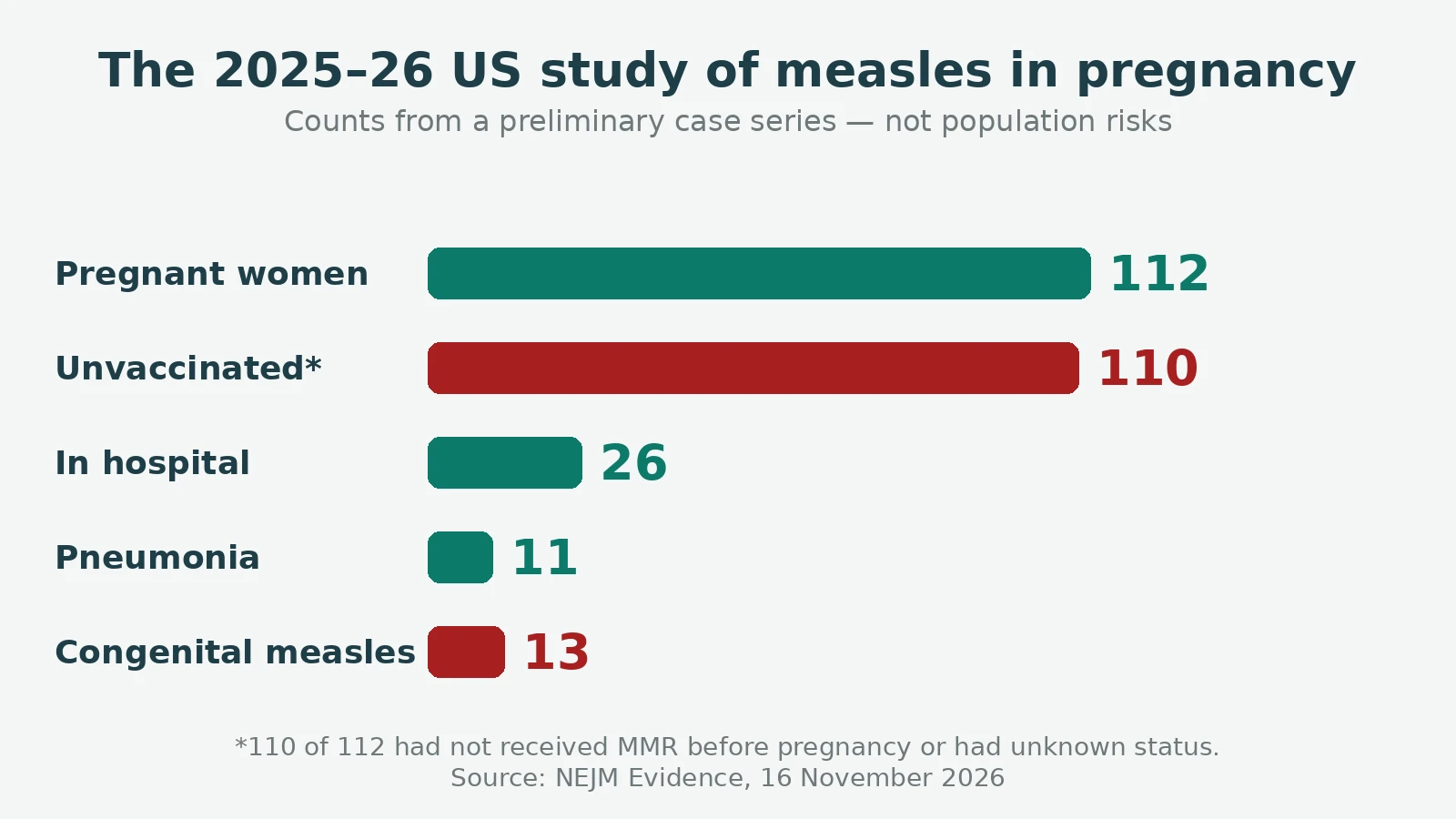
On 16 November 2026, a team of CDC scientists published the first detailed look at measles in pregnancy in the current outbreak in NEJM Evidence. The paper, a preliminary analysis of cases reported between 1 January 2025 and 28 September 2026, recorded 112 confirmed cases of measles during pregnancy, reported by 16 US jurisdictions, and 13 cases of congenital measles in newborns. These were the first documented measles cases among pregnant women in the US since 2019.
The figures make uncomfortable reading, but they need care in how they are read. Almost all of the women — 110 of 112 — had not received MMR vaccination before pregnancy or had unknown vaccination status. Twenty-six women (23%) were admitted to hospital for reasons other than labour; 11 developed pneumonia, two had respiratory failure and one was admitted to intensive care. No maternal deaths were reported in this group.
Of the 21 pregnancies with an outcome within 14 days of the mother’s rash, there were 19 live births and two losses — one miscarriage and one stillbirth. Of the 19 babies born in that window, eight were born prematurely, six of them before 34 weeks, and eight needed neonatal intensive care. Thirteen babies met the study’s definition of congenital measles, meaning they tested positive for the virus within 10 days of birth; six of them developed symptoms, including one with symptoms suggesting inflammation of the brain and its membranes.
These are counts from an incomplete case series, not general risk percentages. Only 37 of the 112 pregnancies had a reported outcome, 56 outcomes were unknown, and there was no comparison group. So the right way to read them is “among the women in this study”, not as the risk for any one pregnant woman who catches measles.
What is measles and how does it spread?
Measles is a highly contagious airborne disease caused by a virus. It first infects the respiratory tract and then spreads through the body, and there is no specific antiviral treatment — care is supportive, aimed at relieving symptoms and preventing complications.
It is one of the most infectious diseases known. The World Health Organization says one infected person can generate up to 18 secondary infections, and the virus can stay active and contagious in the air or on surfaces for up to two hours. The CDC says measles can spread to 9 out of 10 unvaccinated people who come into close contact with someone who has it. A person can pass it on from four days before the rash appears until four days after it erupts.
What are the symptoms of measles in pregnancy?
Symptoms usually begin 7 to 14 days after exposure. Early symptoms, lasting four to seven days, are a high fever, runny nose, cough and red, watery eyes, along with small white spots inside the cheeks. The rash appears three to five days after the first symptoms, usually on the face and upper neck, then spreads downward over about three days, and usually lasts four to eight days before fading.
Pregnant patients may also develop a fever and raised liver enzymes more often than people who are not pregnant, according to ACOG. Because the early symptoms look like many other illnesses, a clinician will ask about recent travel and vaccination history, and about whether you have been in contact with someone with measles.
How dangerous is measles in pregnancy?
For the mother, measles in pregnancy is linked to a higher risk of pneumonia, hospital admission and death, according to ACOG. The CDC lists the same risks and notes that pregnant people are among those at highest risk of severe complications, along with children under five and people with weakened immune systems.
For the pregnancy, measles is linked to a higher risk of miscarriage, stillbirth, premature birth and low birth weight. The WHO puts it plainly: catching measles during pregnancy can be dangerous for the mother and can result in miscarriage or a baby born prematurely with a low birth weight. The risk is greatest when infection happens close to delivery, because the baby is born before the mother has passed on protective antibodies.
Measles and birth defects: what the evidence says
No. Measles is not a known teratogen — it does not cause structural birth defects. The NEJM Evidence paper states this explicitly, and a 2015 review for obstetric providers concluded that while miscarriage, premature birth and low birth weight are linked to measles in pregnancy, the risk of congenital defects does not appear to be increased.
The confusion usually comes from rubella, also known as German measles. Rubella infection in the first 16 weeks of pregnancy carries a high risk of major birth defects, a condition called congenital rubella syndrome, which can affect sight, hearing, the heart and the brain. That risk belongs to rubella, not measles — and it is one reason the MMR vaccine, which protects against measles, mumps and rubella, matters so much before pregnancy.
What is congenital measles?
Congenital measles is not a birth-defect syndrome. It means a baby is born with an active measles infection because the virus passed from mother to baby before or around birth. In the NEJM Evidence study, a baby counted as having congenital measles if they tested positive for the virus within 10 days of birth.
It usually appears within the first 10 days of life and can present with fever, rash, hepatitis and pneumonia. In the study, six of the 13 babies with congenital measles developed symptoms. The rare long-term risk is subacute sclerosing panencephalitis (SSPE), a progressive brain disorder — a rare outcome, not a common one, and the authors call for linked mother-and-baby follow-up because data on long-term outcomes are limited.
Immunoglobulin given to the newborn at birth is recommended for babies exposed to measles in the womb, and may prevent infection or lessen complications. Fourteen of the 19 babies born within 14 days of their mother’s rash in the study received it.
Can you have the MMR vaccine while pregnant?
No. The MMR vaccine is a live vaccine and is not given during pregnancy. The best protection is to be vaccinated before becoming pregnant: one dose is about 93% effective against measles and two doses about 97% effective. If you are planning a pregnancy, check with your GP or healthcare provider whether you have had both doses — a surgery can check your vaccination record.
After an MMR dose, avoid becoming pregnant for 28 days — the NHS gives the same advice as one month. After pregnancy, MMR can be given in the postpartum period, even while breastfeeding and ideally before hospital discharge. Breastfeeding does not interfere with the vaccine, and the baby is not affected through breast milk.
If the MMR vaccine was given accidentally during pregnancy, there is no known risk. The UK Health Security Agency says women in this situation can be immediately reassured, and that it is not a reason to recommend ending a pregnancy. ACOG agrees.
One thing the vaccine cannot do is protect a pregnant woman who was never vaccinated — which is why the people around her matter too. If you are pregnant and not protected, make sure other children and household members are vaccinated, and keep sick family members away from you, infants and people with weakened immune systems.
What to do if you are exposed to measles while pregnant
Contact a healthcare provider right away — and call before going in person, so you are not sitting in a waiting room where the virus could spread. Your provider can check whether you are already protected, assess your risk and advise whether a visit is needed.
For pregnant women without documented MMR vaccination or other evidence of immunity, the recommended post-exposure protection is immunoglobulin — not the vaccine. The ACOG guidance is that intravenous immunoglobulin should be given within six days of exposure; the UK equivalent, human normal immunoglobulin, follows the same six-day window. Do not wait to see whether symptoms appear — the window is short.
If symptoms develop, contact your provider at once, especially with fever and a rash, and if you live in or recently travelled to an area where measles is spreading. In the UK, phone your GP or NHS 111 and do not attend the maternity department or any antenatal appointment until you have been assessed over the phone. If measles is diagnosed, stay home and away from other people until your provider says it is safe to be around others again.
A note on vitamin A: it does not prevent measles and is not a substitute for vaccination. Excess preformed vitamin A in pregnancy is dangerous — the CDC and ACOG warn against taking more than 10,000 IU a day, as excess in early pregnancy triples the risk of birth defects. The WHO’s vitamin A doses are for children under five with measles, not for pregnant women.
What happens to the baby after birth
If measles is diagnosed around the time of delivery, the baby will be watched closely and given immunoglobulin at birth. Measles is not spread through breast milk, so there is no contraindication to breastfeeding if a mother has measles — though she may be advised to avoid direct contact with her baby while infectious, with a caregiver feeding the baby her pumped breast milk.
Preterm labour can be a sign of infection in an exposed, susceptible pregnant person, so any signs of labour should be reported to your maternity team promptly, along with any fever or rash.
When to see a doctor
Contact your GP, midwife or obstetrician straight away if you are pregnant and you have been in contact with someone with measles, or if you develop a fever, cough, red eyes or a rash — especially if you live in or have travelled to an area where measles is spreading. Phone first and do not turn up at a clinic or maternity department without calling ahead.
Get urgent help if you develop difficulty breathing, chest pain, confusion, severe headache, a high fever that will not settle, or signs of labour before your due date. In an emergency call 911 (US), 999 (UK) or 112 (EU). If you are unsure whether you are protected against measles, ask your GP or healthcare provider to check your vaccination record — it is a quick check that can settle the question before an exposure happens.
Frequently asked questions
Can you get the MMR vaccine while pregnant?
No. MMR is a live vaccine and is not given during pregnancy. The best protection is to be vaccinated before becoming pregnant — one dose is about 93% effective against measles and two doses about 97%. After pregnancy, MMR can be given in the postpartum period, even while breastfeeding. If you are planning a pregnancy, ask your GP or healthcare provider to check your vaccination record.
Does measles cause birth defects?
No. Measles is not a known teratogen, and the risk of congenital defects does not appear to be increased, according to a review for obstetric providers and the NEJM Evidence study. The confusion comes from rubella, also called German measles, which can cause major birth defects if caught in the first 16 weeks of pregnancy. Congenital measles is different: it means a baby is born with an active measles infection.
What should I do if I am exposed to measles while pregnant?
Contact your healthcare provider right away and call before going in person. Your provider can check whether you are already protected and advise whether a visit is needed. If you have no documented MMR vaccination or other evidence of immunity, the recommended protection is immunoglobulin, given within six days of exposure. Do not wait to see whether symptoms appear, because the window is short.
Can measles pass to my baby?
Yes. Measles can pass from mother to baby before or around birth, and the risk is greatest when infection happens in the two weeks before delivery. A baby born with an active measles infection has what is called congenital measles. In the 2025–26 US study, 13 babies tested positive within 10 days of birth, and six developed symptoms. Immunoglobulin given to the newborn at birth may prevent infection or lessen complications.
Can I breastfeed if I have measles?
Yes. Measles is not spread through breast milk, and there is no contraindication to breastfeeding if a mother has measles. While she is infectious, she may be advised to avoid direct contact with her baby, and a caregiver without measles can feed the baby with her pumped breast milk. After pregnancy, the MMR vaccine can be given even while breastfeeding.
How common is measles in pregnancy right now?
Rare, but rising with the outbreak. The CDC reported 5,838 confirmed measles cases in the US in 2026 as of 19 November, and a study in NEJM Evidence recorded 112 confirmed cases in pregnancy between January 2025 and September 2026 — the first documented cases among pregnant women in the US since 2019. Almost all of the women, 110 of 112, had not been vaccinated before pregnancy.
Sources
- NEJM Evidence: Lewis et al. Outcomes among Pregnant Women with Measles and Their Infants in the United States, 2025–2026 www.cidrap.umn.edu
- CDC: Measles in Pregnancy www.cdc.gov
- CDC: Measles Cases and Outbreaks www.cdc.gov
- ACOG: MMR Vaccination and Management of Obstetric–Gynecologic Patients During a Measles Outbreak www.acog.org
- WHO: Measles fact sheet www.who.int
- UK Health Security Agency: MMR vaccine advice for pregnant women www.gov.uk
- Virginia Department of Health: First Measles-Associated Death in 2026 www.vdh.virginia.gov
- NHS Wye Valley: Measles in pregnancy advice www.wyevalley.NHS.uk

Try the tool
When is your next period and fertile window?
Six cycles ahead from your last period date.
Open the calculator

