What Is the Best Sleeping Position? Pros and Cons
Side sleeping wins for snoring, apnoea and heartburn; back sleeping suits the neck but crowds the airway; front sleeping strains the spine. Here is how each compares.
- Written by
- Health Daily Advice
- Published
- Reading time
- 4 minutes
- Sources
- 7 cited

In this guide
Side sleeping is the position most experts favour. Over 60% of adults sleep on their side, and it tends to reduce snoring and sleep apnoea, ease lower back pain and calm night-time heartburn — especially on the left. Back sleeping suits the neck but worsens snoring and apnoea, while front sleeping strains the neck and spine.
Side sleeping: the healthiest default
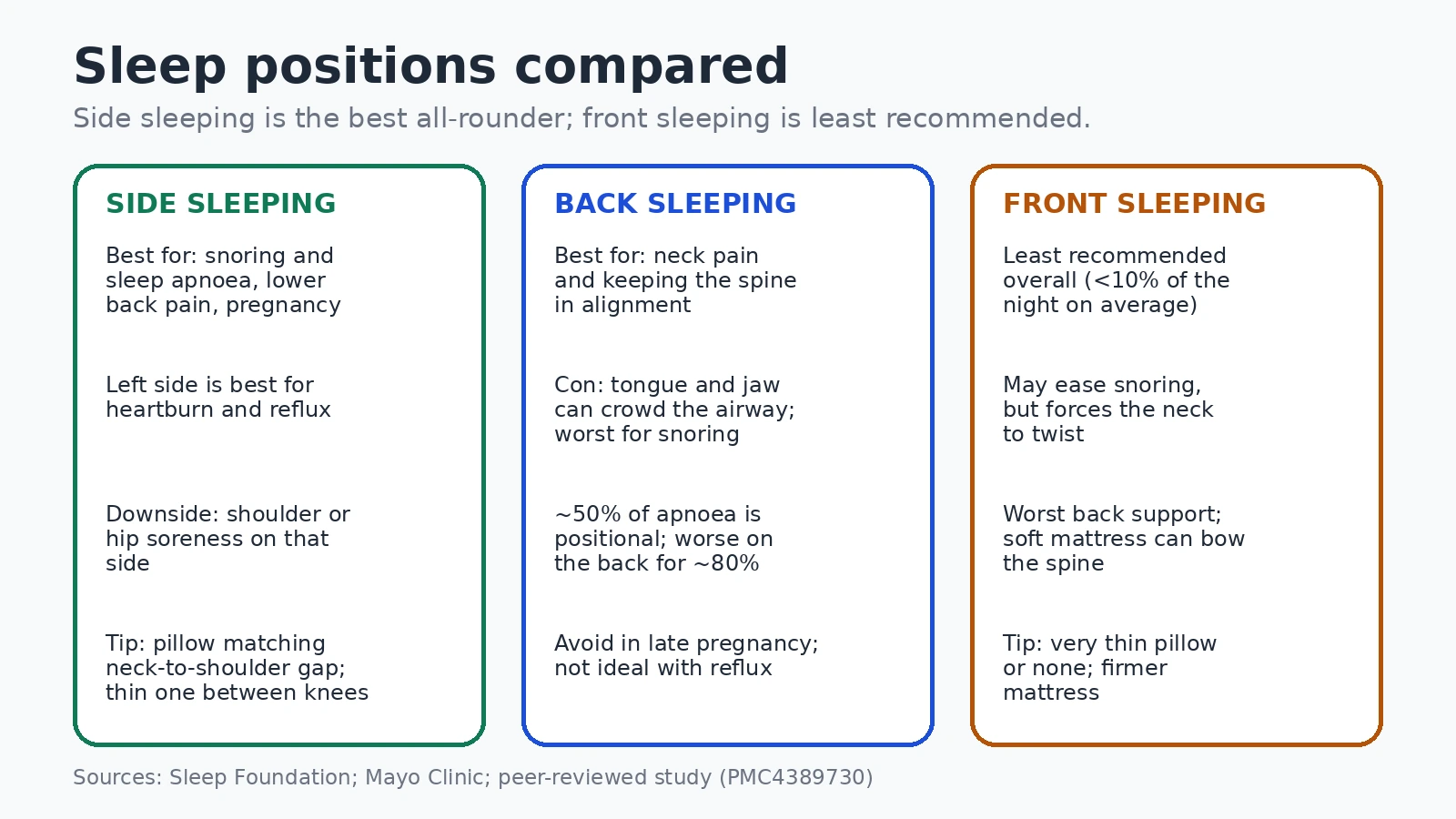
Side sleeping is the most common position — more than 60% of adults do it — and it is broadly considered the best all-rounder (Sleep Foundation). It opens the airways for steadier airflow and helps prevent the airway from collapsing, which reduces snoring; it is also often the best choice for lower back pain, especially with the knees slightly bent and a thin pillow between them (Mayo Clinic).
Left versus right: for heartburn, left usually wins. A 2023 meta-analysis found left-side lying was linked with less acid exposure time and faster acid clearance than right-side or back sleeping, and the American College of Gastroenterology’s 2022 reflux guideline advises avoiding sleeping on the right side (HealthPage UK). In one double-blind trial, 44% of people using a device that nudged them onto their left side halved their night-time reflux score, versus 24% of the sham group — helpful for many, but not everyone. If you have no reflux and sleep comfortably on your right, there is no strong reason to switch.
The main drawbacks: side sleeping can bring shoulder or hip soreness, so it is worth varying sides and using a pillow that fills the gap between neck and shoulder. It may also press the face into the pillow — though the evidence that this causes wrinkles is limited and mixed (Sleep Foundation).
Back sleeping: good for the neck, bad for snoring
Back sleeping makes it easiest to keep the spine aligned and spreads body weight evenly; it can be the best position for neck pain because the face points up and the neck muscles stay neutral (Sleep Foundation). But it is, in the words of Mayo Clinic sleep specialist Dr Lois Krahn, “actually the worst sleeping position, especially if you have sleep apnea”: the tongue and jaw fall back and crowd the airway (Mayo Clinic).
The numbers back this up. Around half of people with obstructive sleep apnoea have the “positional” type — their apnoea is at least twice as severe on their backs as in other positions — and about 80% have worse readings when supine than otherwise (Bidarian-Moniri et al., 2015). Back sleeping can also worsen acid reflux and is not recommended for pregnant people, heavier or older adults, or people with some types of back pain.
Front sleeping: the least recommended
Fewer than 10% of the night is spent on the front on average, and the Sleep Foundation does not recommend it for most people. It may ease snoring by keeping the airway open, but it offers the least back support, forces the head to turn to one side, and can pull the spine into a U-shape on a soft mattress (Sleep Foundation). Anyone with neck or back pain is best moving off their front. Front sleepers should use a very thin pillow or none at all, and a thin pillow under the hips helps the spine.
Sleep positions at a glance
| Position | Best for | Watch out for |
|---|---|---|
| Side (left) | Snoring and apnoea, lower back pain, heartburn, pregnancy | Shoulder and hip soreness; pillow must match neck-to-shoulder distance |
| Side (right) | Snoring and apnoea, back pain | Can worsen night-time reflux compared with the left |
| Back | Neck pain, spinal alignment, even weight distribution | Snoring and sleep apnoea, reflux; avoid in late pregnancy |
| Front | Occasionally eases snoring | Neck strain, spine pressure; least recommended overall |
Pregnancy: sleep on your side from 28 weeks
UK guidance from Tommy’s — reflected in NHS advice — is to go to sleep on your side (either side) from 28 weeks, for night sleep and naps. A pooled analysis of six studies linked falling asleep on the back with 2.6 times the risk of stillbirth, probably because the womb compresses major blood vessels (Tommy’s). To keep this in perspective, stillbirth in an uncomplicated pregnancy is rare — around 3 in 1,000 births in the UK — and side sleeping makes it lower still. You cannot control your position once asleep; if you wake on your back, simply settle back onto your side. There is no good evidence that the left side beats the right in pregnancy.
Pillows and mattresses matter too
Side sleepers need a pillow thick enough to keep the neck level with the spine, plus a thin pillow between the knees to protect the lower back. Back sleepers do best with a low-loft pillow that supports the neck’s natural curve — some people add a thin pillow under the knees. And for reflux, raising the head of the bed by around six inches with a wedge (not a stack of pillows, which bends the neck) works alongside left-side sleeping (Sleep Foundation).
What about wrinkles and acne?
Back sleeping is often claimed to prevent wrinkles because the face never presses the pillow, and side or front sleeping gets blamed for “sleep wrinkles”. The evidence, however, is limited and mixed — some studies found little difference between side and back sleepers, and sun exposure and genetics matter far more (Sleep Foundation). No reputable source linked sleeping position to acne, so position is not a credible acne treatment or cause.
When to see a doctor
Changing position can ease symptoms, but it is not treatment. Talk to a GP or pharmacist about loud snoring, gasping, pauses in breathing or daytime sleepiness (possible sleep apnoea), heartburn that keeps returning or needs regular over-the-counter medicine, and any persistent neck, shoulder or back pain. Pregnant women who are unsure about sleeping position should ask their midwife. In an emergency call 911 (US), 999 (UK) or 112 (EU).
Frequently asked questions
What is the healthiest sleeping position?
Side sleeping is the position most experts favour. More than 60% of adults already sleep on their side, and it is the best all-rounder: it opens the airways to reduce snoring and apnoea, eases lower back pain (a thin pillow between the knees helps), and left-side sleeping calms night-time heartburn. It is also the position UK guidance recommends in pregnancy from 28 weeks.
Is it better to sleep on your left or right side?
For heartburn, left is better. A 2023 meta-analysis found left-side lying was linked with less acid exposure and faster acid clearance than right-side or back sleeping, and the American College of Gastroenterology advises avoiding the right side for reflux. If you have no heartburn and sleep comfortably on your right, there is no strong reason to switch.
Is sleeping on your back bad?
It depends on you. Back sleeping is kind to the neck and keeps the spine aligned, but Mayo Clinic sleep experts call it the worst position for snoring and sleep apnoea, because the tongue and jaw fall back and crowd the airway. Around half of obstructive sleep apnoea is positional, at least twice as severe on the back. It is also not recommended in late pregnancy or for heavy snorers.
Why is stomach sleeping bad?
It is the least recommended position because it gives the spine the least support. Sleeping on the front often forces the head to one side, twisting the neck out of alignment, and on a soft mattress the hips sink and bow the spine. It can ease snoring, but the trade-off is not worth it for most people, especially anyone with neck or back pain.
What sleeping position is best in pregnancy?
Go to sleep on your side, either side, from 28 weeks - for night sleep and daytime naps. A pooled analysis of six studies linked back sleeping with 2.6 times the risk of stillbirth, probably because the womb compresses major blood vessels. Keep it in proportion: stillbirth in an uncomplicated pregnancy is rare, around 3 in 1,000 UK births. If you wake on your back, just settle back onto your side.
Sources
- Sleep Foundation: What Is the Best Sleeping Position? www.sleepfoundation.org
- Tommy's: Sleep position in pregnancy Q&A www.tommys.org
- Mayo Clinic News Network: What is the best sleeping position? newsnetwork.mayoclinic.org
- Bidarian-Moniri A. et al. 2015: Mattress and pillow for prone positioning in OSA (PMC4389730) pmc.ncbi.nlm.nih.gov
- HealthPage UK: Sleeping on Left Side for Acid Reflux healthpage.co.uk

Try the tool
Not sure if it can wait?
Common causes and warning signs for 16 everyday symptoms.
Open the symptom guide