Why Do I Wake Up With a Headache? Causes and Red Flags
Morning headaches are common — about 1 in 13 people get them. From sleep apnoea and teeth grinding to caffeine withdrawal and medication overuse, here are the causes, what may help and the red flags that need a GP.
- Written by
- Health Daily Advice
- Published
- Reading time
- 5 minutes
- Sources
- 7 cited

In this guide
Waking up with a headache is surprisingly common — about 1 in 13 people experience morning headaches, according to the Sleep Foundation. The usual culprits are sleep apnoea, teeth grinding, overnight caffeine withdrawal or dehydration. Migraine and medication overuse can also strike first thing. Most cases are not dangerous, but a few warning signs mean you should see a GP.
Morning headaches are more common in women than men, and peak in people aged 45 to 64, the Sleep Foundation reports. As you move from sleep to wakefulness, your brain becomes more responsive to changes in body position, touch and sound, so pain you would not have noticed asleep can hit you in the morning.
The 7 most common causes of morning headaches
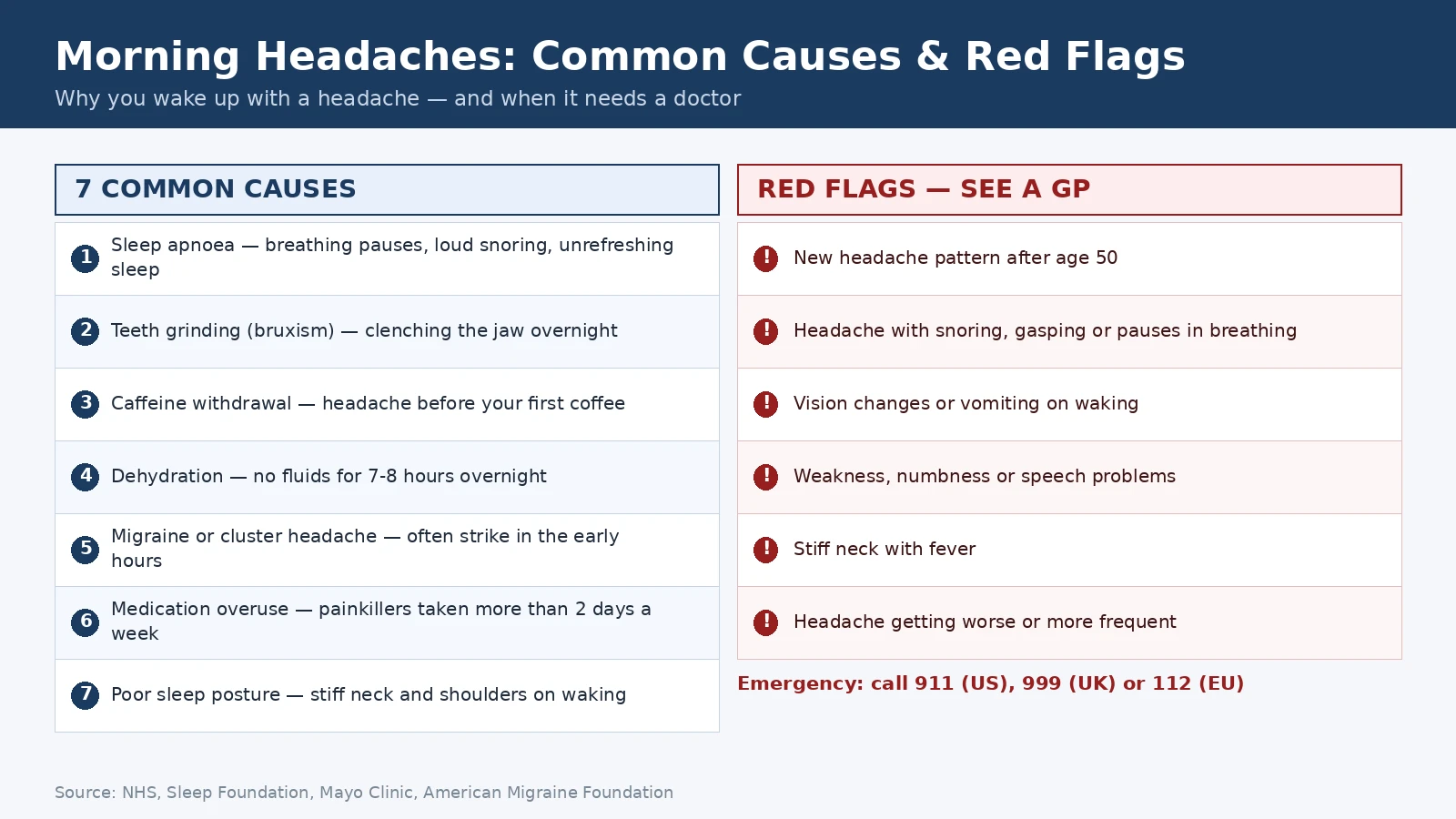
1. Sleep apnoea
Sleep apnoea is when your breathing stops and starts during sleep. The NHS lists “a headache when you wake up” as a daytime symptom of sleep apnoea, alongside gasping, snorting or choking noises and loud snoring at night (NHS: Sleep apnoea). In one study of people with obstructive sleep apnoea, 29% reported morning headaches. If your partner has noticed pauses in your breathing, or you wake unrefreshed despite a full night in bed, this is worth discussing with your GP — sleep apnoea can be serious if it is not diagnosed and treated.
2. Teeth grinding (bruxism)
Clenching or grinding your teeth overnight strains the jaw and temple muscles, which can leave you with a dull headache first thing. The NHS lists headaches as a symptom of teeth grinding, along with a painful jaw, worn-down or broken teeth, earache and disturbed sleep (NHS: Teeth grinding). Stress and anxiety are the most common cause, and grinding is also linked to snoring and sleep apnoea. A sore jaw in the morning, flattened or chipped teeth, or a partner who hears grinding at night are clues. A dentist can check and may recommend a mouth guard worn at night.
3. Caffeine withdrawal
If you drink coffee, tea or energy drinks every day, your body expects caffeine at roughly the same time. Caffeine narrows your blood vessels; when the dose wears off overnight, the vessels expand and blood flow increases, which can trigger a dull, throbbing headache before your first cup (Sleep Foundation). It often comes with fatigue, irritability or trouble concentrating. Shifting your wake-up time on weekends can make this worse.
4. Dehydration
You go 7–8 hours without fluids overnight, and mouth breathing, snoring or alcohol make the fluid loss worse. Dehydration reduces blood volume and the flow of oxygen to the brain, which can cause a dull pressure-like headache on waking (Sleep Foundation). Alcohol in the evening is a double hit: it disrupts your sleep and increases fluid loss. Drinking water through the day, and having some before bed if it will not wake you in the night, can help.
5. Migraine, cluster and hypnic headaches
Some headache disorders are wired to strike in the early hours. The early morning is one of the most common times for migraine attacks, and poor or fragmented sleep is a known trigger (Sleep Foundation). Cluster headaches — severe stabbing pain around one eye — often occur at the same time each day and can wake people from sleep. A rare type called hypnic headache, or “alarm clock headache”, only ever develops during sleep and wakes the sufferer; it usually starts after age 50, occurs on more than 10 days a month and lasts 15 minutes to 4 hours after waking, according to the American Migraine Foundation. New “alarm clock” headaches need a doctor’s assessment to rule out other causes.
6. Medication overuse
Taking painkillers for headaches too often can cause rebound headaches that wake you in the early morning — the pain eases with medication, then returns as it wears off (Mayo Clinic). The risk rises if you use pain relievers more than a couple of days a week, or combination painkillers, triptans or ergotamine on 10 or more days a month (simple painkillers on more than 15 days a month) for three or more months. If you need headache medication more than twice a week, talk to your doctor rather than increasing the dose yourself.
7. Poor sleep posture
An unsupportive pillow or an awkward sleep position can leave your neck and shoulder muscles strained overnight, triggering a dull tension-type headache on both sides of the head by morning. If the pain eases once you are up and moving, or it starts with a stiff neck, your set-up may be the problem. A pillow that keeps your neck aligned and a supportive mattress can reduce the strain (Sleep Foundation).
What may help
Because the causes need such different fixes, tracking your pattern for a week or two is the most useful first step: note the time you wake, the pain, whether you snored, ground your teeth, drank alcohol, had caffeine or took painkillers, and how you slept. A few general steps can help while you investigate:
- Keep a consistent sleep schedule — go to bed and wake up at the same time each day, including weekends.
- Drink water through the day and keep caffeine and alcohol away from bedtime.
- Wind down before bed: dim lights, put screens away and try reading or a warm bath.
- If you wake with a sore jaw or sensitive teeth, see a dentist about teeth grinding.
- Avoid taking painkillers for headaches more than a couple of days a week; if you need them more often, see your GP.
When to see a doctor
Occasional morning headaches are usually nothing to worry about, but see your GP if:
- you wake with headaches several times a week, or they are getting worse or more frequent
- your headache pattern has changed, or a new persistent headache starts after age 50
- you snore loudly, gasp, or someone has seen your breathing pause during sleep
- the headache comes with vision changes or vomiting on waking
- you need painkillers for headaches most days
Get urgent medical help for a headache that is sudden and severe, or that comes with a fever and stiff neck, confusion, double vision, weakness, numbness or difficulty speaking.
In an emergency call 911 (US), 999 (UK) or 112 (EU)
Frequently asked questions
Is it normal to wake up with a headache sometimes?
An occasional morning headache is usually nothing to worry about — about 1 in 13 people get morning headaches, most often from dehydration, poor sleep, caffeine withdrawal or teeth grinding. But if it happens several times a week, keeps getting worse, or comes with other symptoms like snoring, vision changes or vomiting, see your GP to find the cause.
Can sleep apnoea cause morning headaches?
Yes. The NHS lists a headache when you wake up as a daytime symptom of sleep apnoea, and in one study 29% of people with obstructive sleep apnoea reported morning headaches. Clues include loud snoring, gasping or choking sounds, pauses in breathing noticed by a partner, and waking unrefreshed. Sleep apnoea can be serious if untreated, so see your GP if these fit.
Can teeth grinding cause morning headaches?
Yes. The NHS lists headaches as a symptom of teeth grinding (bruxism), alongside a painful jaw, worn-down teeth, earache and disturbed sleep. Clenching or grinding overnight strains the jaw and temple muscles, causing a dull headache first thing. If you wake with a sore jaw or your partner hears grinding, a dentist can check and may fit a mouth guard for night-time wear.
Why do I get a headache before my morning coffee?
That is usually caffeine withdrawal. Caffeine narrows your blood vessels, and after 7 to 8 hours without it overnight they expand again, increasing blood flow and triggering a dull, throbbing headache. It often comes with fatigue, irritability or trouble concentrating and eases after your first caffeinated drink. Cutting back gradually, rather than suddenly, avoids this rebound.
Can taking painkillers every day cause morning headaches?
Yes — this is called medication overuse or rebound headache. Mayo Clinic says these headaches occur nearly every day, often waking you in the early morning, ease with pain relief and then return as it wears off. The risk rises with pain relievers more than a couple of days a week. If you need headache medication that often, see your doctor instead of increasing the dose.
When is a morning headache serious?
See a GP if morning headaches happen several times a week, are new after age 50, come with loud snoring, gasping or witnessed breathing pauses, vision changes or vomiting on waking, or if your pattern changes. Get urgent help for a sudden severe headache, or one with fever and stiff neck, confusion, double vision, weakness, numbness or difficulty speaking.
Sources
- Sleep Foundation: Why Do I Wake Up With a Headache? www.sleepfoundation.org
- NHS: Sleep apnoea www.nhs.uk
- NHS: Teeth grinding (bruxism) www.nhs.uk
- Mayo Clinic: Medication overuse headache — symptoms and causes dev.kcms.mayoclinic.org
- American Migraine Foundation: Hypnic Headache americanmigrainefoundation.org

Try the tool
Not sure if it can wait?
Common causes and warning signs for 16 everyday symptoms.
Open the symptom guide