Seasonal Affective Disorder: Symptoms, Causes and What Helps
Low mood that arrives with the dark evenings and lifts in spring has a name — seasonal affective disorder. Here is how to tell it from the winter blues, and what actually helps.
- Written by
- Health Daily Advice
- Published
- Reading time
- 5 minutes
- Sources
- 9 cited
In this guide
Seasonal affective disorder, or SAD, is a type of depression that returns at the same time each year, usually in late autumn and winter, and lifts in spring. Shorter days disrupt the body clock and the brain chemicals serotonin and melatonin. It is treatable: light therapy, talking therapy and antidepressants all help, and people benefit from daylight and exercise.
What is SAD?
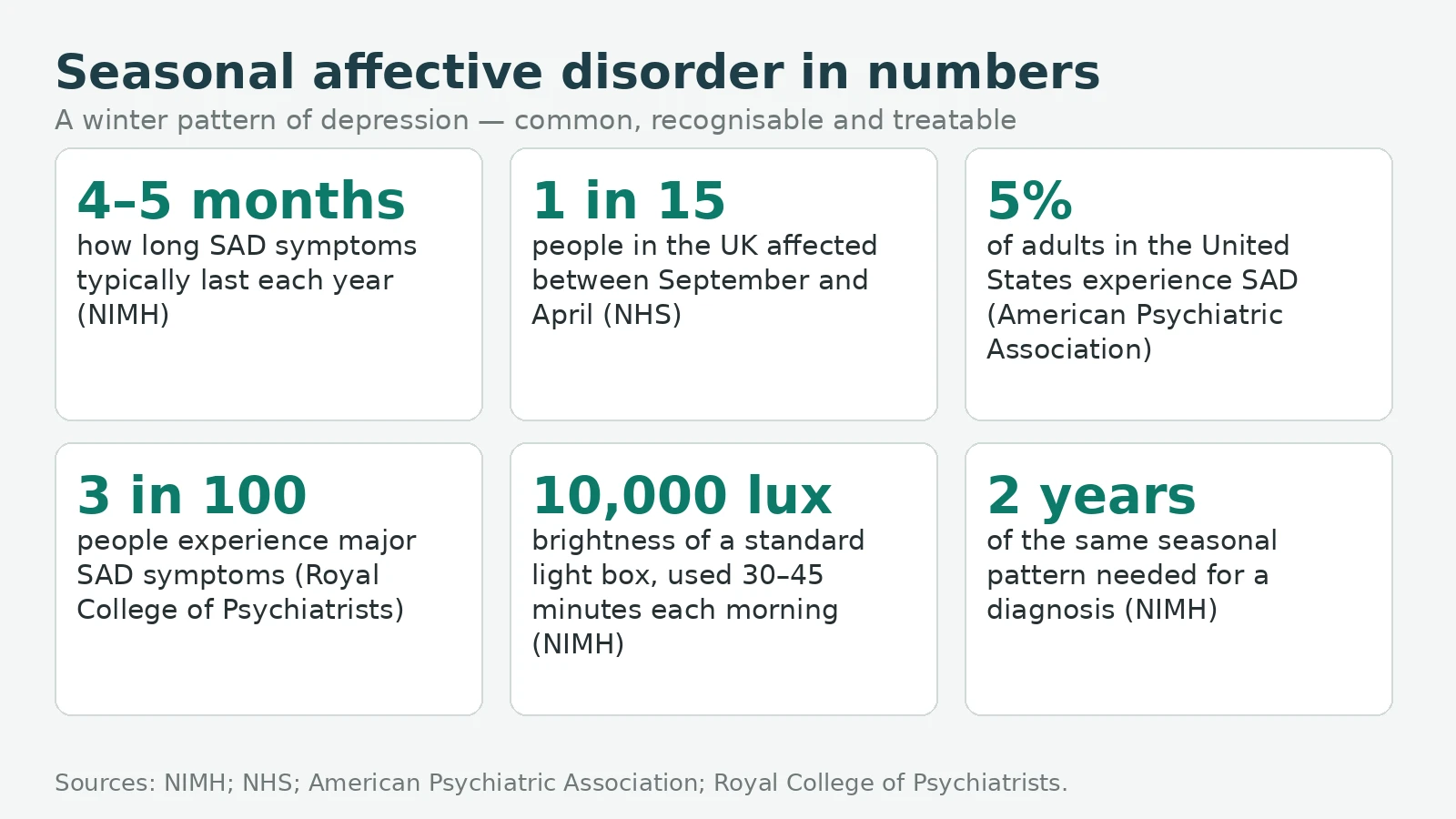
Seasonal affective disorder, usually shortened to SAD, is a type of depression that follows the calendar. Symptoms arrive at roughly the same time each year — most often in late autumn or early winter — and lift again in spring and summer. The US National Institute of Mental Health (NIMH) says an episode typically lasts about four to five months of the year. A smaller group of people has the reverse pattern, with low mood in spring and summer, but winter SAD is far more common.
It is more than feeling fed up with dark evenings. SAD is depression: low mood most of the day, nearly every day, that interferes with work, relationships and daily life. The NHS estimates it affects around one in 15 people in the UK between September and April, and the American Psychiatric Association puts the figure at about 5% of adults in the United States. Women are affected several times more often than men, and it usually begins in young adulthood.
What are the symptoms of SAD?
The core symptoms are the same as depression: a persistent low, sad or “empty” mood; losing interest in things you usually enjoy; feeling hopeless, guilty or worthless; difficulty concentrating; and feeling restless or irritable. On top of that, winter SAD has its own pattern. The NIMH lists oversleeping, overeating — especially craving carbohydrate-rich foods — weight gain, and social withdrawal, a feeling of wanting to hibernate. Thoughts of suicide or self-harm can also occur, and need to be taken seriously.
Summer-pattern SAD looks different: trouble sleeping, poor appetite and weight loss, restlessness and anxiety. If your low mood returns at the same time every year and lifts when the season changes, that pattern is the key clue.
SAD or the winter blues?
Most people feel a dip when the days shorten: the Cleveland Clinic estimates that 10–20% of people in the US get a milder form of the winter blues. SAD sits further along the same spectrum. The difference is severity and persistence: the winter blues come and go and do not stop you living your life, while SAD lasts for months, follows the same pattern year after year, and makes ordinary life hard. A diagnosis usually needs that seasonal pattern to have repeated for at least two years. If you are unsure which side of the line you fall on, a GP can help you work it out.
Why do shorter days affect mood?
The exact cause is not fully understood, but the NHS links SAD to reduced daylight in winter, which disturbs the brain chemicals that govern mood and sleep. Shorter days can lower serotonin, a brain chemical that helps regulate mood, and raise melatonin, the hormone that makes you sleepy — which fits the oversleeping and sluggishness many people describe. The same light shortage can disrupt the body’s internal clock, the circadian rhythm that keeps sleep and waking on schedule. Lower vitamin D may add to the problem, because the body makes vitamin D from sunlight on the skin and vitamin D is believed to support serotonin activity. SAD is also more common further from the equator, where winter days are shortest, and it can run in families.
How is SAD diagnosed?
A GP will usually ask about your moods and how they change through the year, and may ask you to fill in a questionnaire about your symptoms. You may be diagnosed with SAD if you have had depression symptoms at a particular time of year for two years or longer, and if the seasonal episodes happen more often than depressive episodes at other times of year. Keeping a simple note of your mood through the seasons can help the conversation.
What treatments help?
SAD is treatable, and most people need a combination of approaches. The main options, as set out by the NIMH, are light therapy, talking therapy, antidepressant medication and vitamin D.
Light therapy
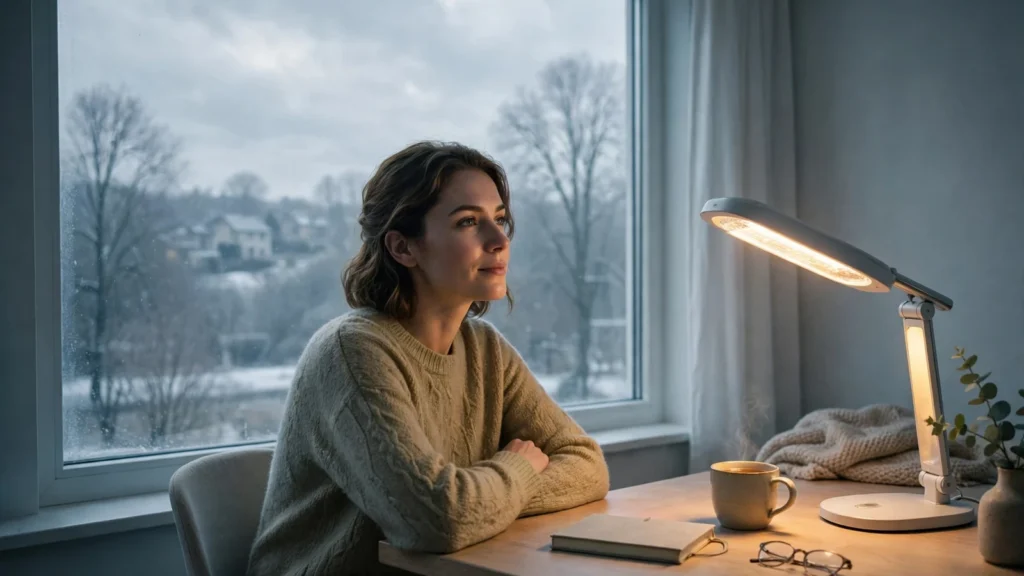
Light therapy has been a mainstay since the 1980s. It means sitting in front of a very bright light box — 10,000 lux, about twenty times brighter than ordinary indoor light — for 30 to 45 minutes a day, usually first thing in the morning, from autumn to spring. The boxes filter out ultraviolet light, and the treatment is safe for most people. Research quoted by the Mayo Clinic suggests around half of people who use a light box get good results. The NHS advises speaking to a GP before trying one, because very bright light may not suit people with certain eye conditions or those taking medicines that increase sensitivity to light. If you buy a light box, the NHS says to choose one that is bright enough (10,000 lux is standard), UV-free and carries a UKCA or CE mark.
Talking therapy
Cognitive behavioural therapy adapted for SAD (CBT-SAD) is usually delivered as two group sessions a week for six weeks. It works on the gloomy thoughts tied to winter — dreading the dark afternoons, for example — and on scheduling pleasant, engaging activities to counter the urge to withdraw. In head-to-head trials, CBT-SAD and light therapy eased symptoms about equally well, and a long-term study found the benefits of CBT seemed to last longer.
Antidepressants and vitamin D
Antidepressants can be used alone or alongside talking therapy. Because SAD is linked to serotonin, doctors sometimes prescribe selective serotonin reuptake inhibitors (SSRIs). In the US, the antidepressant bupropion in extended-release form is approved to prevent seasonal depressive episodes when taken daily from autumn through early spring. Vitamin D supplements are sometimes tried, but the evidence is mixed: some studies found them as effective as light therapy, others found no effect. Talk to a doctor or pharmacist before starting any medication or supplement.
Everyday steps that help
The NHS suggests getting as much natural daylight as you can — a walk outside in the daytime, even a brief one at lunchtime — exercising regularly, staying in contact with friends and family, keeping up your usual activities, and going to bed and waking up at the same time each day. Research quoted by the Seasonal Affective Disorder Association found a daily one-hour walk in the middle of the day could be as helpful as light treatment for coping with the winter blues.
When to see a doctor
See a GP if you think you might have seasonal affective disorder, or if treatment you are already receiving is not helping. In the UK, adults can also refer themselves directly to an NHS talking therapies service without a GP referral. If you are having thoughts of suicide or self-harm, get help straight away — contact your GP, call or text 988 in the US, or go to your nearest emergency department. You can also find support and crisis resources at https://www.healthdailyadvice.com/get-help-now/.
In an emergency call 911 (US), 999 (UK) or 112 (EU)
Frequently asked questions
What is seasonal affective disorder?
Seasonal affective disorder, or SAD, is a type of depression that follows the seasons. Symptoms usually start in late autumn or early winter, last about four to five months, and lift in spring and summer. It is linked to reduced daylight, which disturbs the brain chemicals serotonin and melatonin and the body's internal clock. A smaller group of people has the reverse pattern, with low mood in summer.
How is SAD different from the winter blues?
The winter blues are a milder, common dip in mood when the days shorten — the Cleveland Clinic estimates 10–20% of people in the US get them — and they do not stop you living your life. SAD is depression: symptoms last for months, return at the same time every year, and make work, relationships and daily life hard. A diagnosis usually needs the seasonal pattern to repeat for at least two years.
Does light therapy work for SAD?
For many people, yes. Light therapy means sitting in front of a bright light box — 10,000 lux is standard — for 30 to 45 minutes each morning, from autumn to spring. Research quoted by the Mayo Clinic suggests around half of users get good results. In trials it worked about as well as talking therapy, though it acted a little faster. Speak to a GP first if you have an eye condition or take medicines that increase light sensitivity.
Can SAD be prevented?
There is no guaranteed way to prevent it, but starting treatment early can help. Because SAD returns so predictably, people who have had it before may benefit from beginning light therapy or talking therapy in the autumn, before symptoms set in. Getting outside in daylight every day, exercising regularly, keeping a steady sleep routine and staying in touch with other people through the darker months also help protect your mood.
When should I see a doctor about SAD?
See a GP if your low mood returns at the same time each year, lasts for weeks, or makes daily life hard — or if treatment you are already receiving is not helping. In the UK, adults can also refer themselves directly to an NHS talking therapies service. Get help straight away if you have thoughts of suicide or self-harm: contact your GP, call or text 988 in the US, or go to an emergency department.
Sources
- NHS: Seasonal affective disorder (SAD) www.nhs.uk
- NIMH: Seasonal Affective Disorder www.nimh.nih.gov
- Mayo Clinic News Network: Seasonal affective disorder: More than feeling sad newsnetwork.mayoclinic.org
- Lancashire and South Cumbria NHS Foundation Trust: Understanding Seasonal Affective Disorder (SAD) www.lscft.nhs.uk
- Medical Xpress: Is shorter daylight dragging down your mood? What to know about seasonal affective disorder medicalxpress.com
- NHS 111 Wales: Seasonal affective disorder 111.wales.nhs.uk

Try the tool
How have you felt over the last 2 weeks?
The PHQ-9 and GAD-7 that GPs use. Private, about 3 minutes.
Start the self-check