Performance Anxiety in Bed: Causes and What Helps
Worry about performing can switch off arousal altogether. Here is why it happens, how the anxiety cycle works, and what genuinely helps.
- Written by
- Health Daily Advice
- Published
- Reading time
- 6 minutes
- Sources
- 6 cited

In this guide
Performance anxiety in bed is worry about how you will perform during sex, strong enough to interfere with arousal, erections or enjoyment. It is common: up to 25% of men and 16% of women are affected, studies suggest. Stress hormones narrow blood vessels and steal your attention. Talking, slowing down and professional help can break the cycle.
It often starts with one ordinary night: too much to drink, tiredness, a new partner, a distraction. The next time, you are already thinking about last time — and that worry makes it harder to relax and enjoy sex. Cleveland Clinic describes it as a vicious cycle: when you are in your head, worrying about pleasing your partner or keeping an erection, it is harder to enjoy sex, and that leads to a less fulfilling encounter — which feeds the worry next time.
What is performance anxiety in bed?
Sexual performance anxiety happens when feelings of anxiety — fear, embarrassment and worry — affect your sexual interest, performance or pleasure. It can happen to anyone, regardless of sex, and it is not a diagnosis in itself. Cleveland Clinic notes that it can be related to other anxiety disorders, such as social anxiety or generalised anxiety disorder.
It is a worry or fear that you will not be able to do something the way you would like it to happen. That worry can show up as difficulty getting or keeping an erection, arousal fading quickly, difficulty reaching orgasm, or simply not enjoying sex at all. Healthline notes it can also bring a faster heartbeat, sweating, and early or delayed ejaculation. Over time, some people start avoiding sex altogether, because it no longer feels worth the emotional toll.
How common is performance anxiety in bed?
More common than most people think. Cleveland Clinic reports that studies estimate up to 25% of men and 16% of women are affected. Because many people do not talk about it, the true figure is probably higher. It can affect people of any age, though in younger men it is one of the most common psychological causes of erection difficulties, because blood vessels and hormones are usually healthy at that age.
Why anxiety affects erections and arousal
Arousal needs a relaxed body, but anxiety does the opposite. When you are anxious, your body releases stress hormones such as cortisol and adrenaline. Healthline explains that anxiety raises cortisol, lowers testosterone and constricts blood vessels, making it harder for blood to flow where it is needed. Adrenaline narrows blood vessels and diverts blood towards the large muscles — the fight-or-flight response — which works directly against an erection.
Anxiety also steals your attention. Instead of noticing touch and pleasure, your mind is busy judging your body, counting the minutes, or wondering whether your partner is satisfied. That self-monitoring pulls you out of the moment, which makes arousal even harder. It is not a personal failing: it is how the stress response works.
The performance anxiety cycle
The pattern is self-reinforcing, and recognising it is the first step out of it:
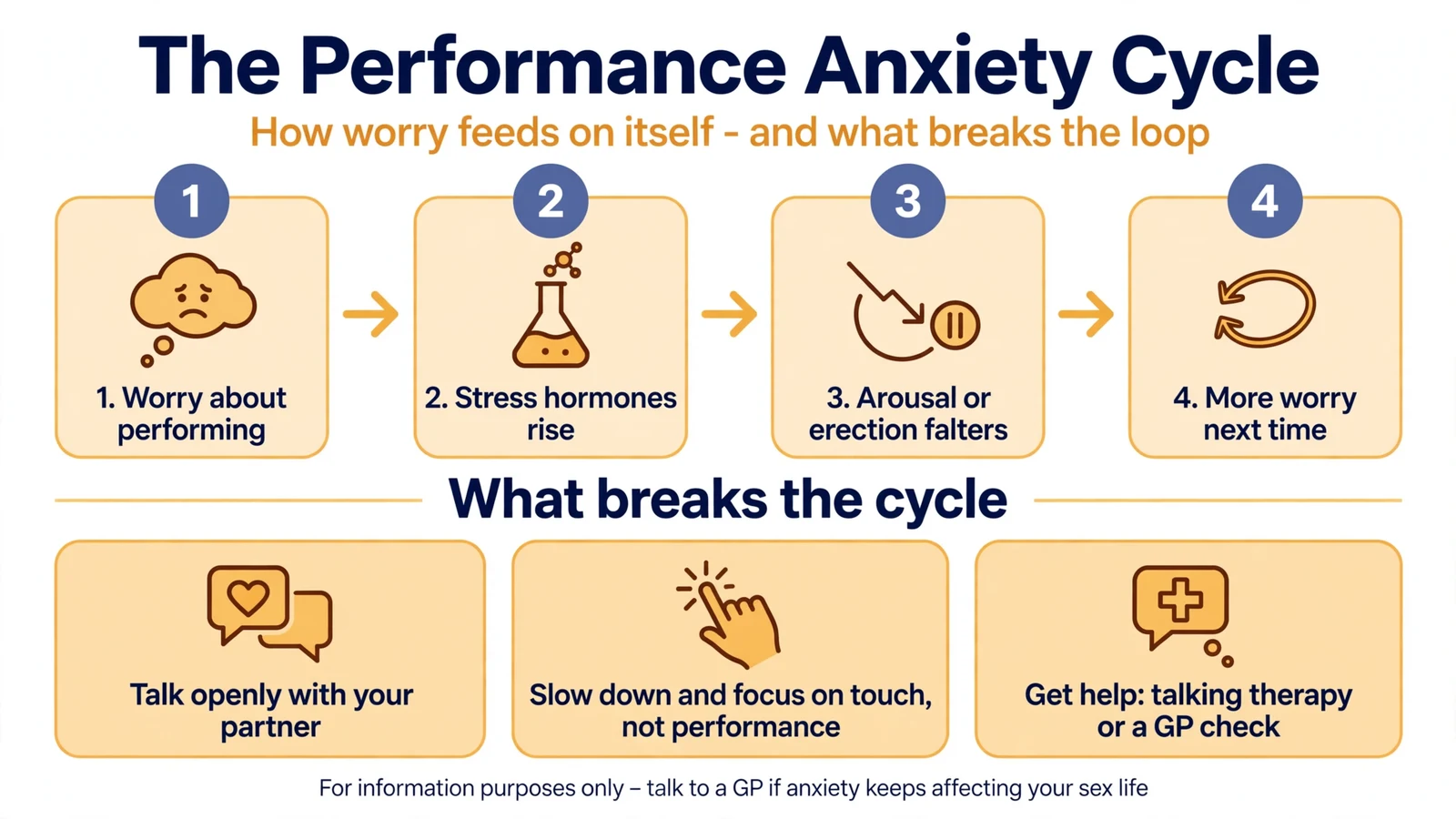
One disappointing occasion can start the loop, and each repeat makes the prediction of failure stronger. That is why the way out is usually to take pressure off, deliberately, rather than to push yourself harder.
Common causes
Performance anxiety rarely has one single cause. Cleveland Clinic lists the most common triggers:
- New encounters. A new partner, or a new situation, can make anyone self-conscious.
- Past sexual disappointments. A memory of a poor experience can make you dread a repeat.
- Concerns about body image. Worries about size, shape, weight or ageing can take over in a vulnerable moment.
- Worries about the relationship. Unresolved conflict, resentment or doubt about a partner can show up in bed.
- Past trauma. A history of trauma or abuse can significantly affect sexual interest and pleasure.
- Other stresses. Work pressure, money worries and tiredness leave little room for relaxation.
Unrealistic expectations add to the pressure. Healthline notes that many people compare themselves with porn, media portrayals or past partners, and that limited or misleading sex education leaves gaps that anxiety fills. Physical factors can play a part too: the NHS lists stress, tiredness, drinking too much alcohol, some medicines, and conditions such as high blood pressure, diabetes, depression and hormone problems among the causes of erection difficulties. Our guide to erectile dysfunction explains the physical side in more detail.
What helps with performance anxiety in bed?
There is no single fix, but several practical steps help most people. These are drawn from Cleveland Clinic and Healthline:
1. Talk openly with your partner
Your partner cannot read your mind, and silence often makes things worse: they may assume the problem is their fault, or that you no longer want them. Saying something simple — “I have been feeling anxious about sex lately and could use some patience” — is a good place to start. Clear, compassionate communication prevents misunderstandings and opens the way to new ways of connecting.
2. Redefine what sex means
Many people follow a narrow script: foreplay, penetration, climax. But you do not need to ejaculate or orgasm for sex to be meaningful. Massage, kissing, cuddling and other forms of touch can be just as intimate, and taking intercourse off the table for a while can remove the test altogether. Learning other ways to please a partner can also lessen the pressure.
3. Slow down and stay in the moment
Mindfulness helps. Tune into your breath, notice where you feel tension, and gently bring your attention back to what feels good when your mind wanders. Slow the pace: rushing keeps your body in a stress state and reduces arousal. Getting to know your own body, including through masturbation without a goal in mind, can build confidence and reduce anxiety.
4. Look after the basics
Regular movement, restful sleep, a healthy diet and moderating alcohol all support a calmer nervous system. The NHS advises trying to reduce stress and anxiety, exercising daily, and not drinking more than 14 units of alcohol a week. Alcohol may feel relaxing, but it impairs erections and makes failure more likely.
5. Get professional help
If anxiety keeps interfering, help is available. Talking therapies, including cognitive behavioural therapy and sex therapy, can address the thoughts and patterns driving the anxiety. In England, you can self-refer to NHS talking therapies without seeing a GP first. A doctor can also check for physical causes, review medicines that may affect sexual function, and discuss treatments for erection problems. The NHS notes that medicines that increase blood flow, such as sildenafil, can help with erection difficulties, and that counselling and therapy can help when problems are linked to emotional or mental health. If low desire is part of the picture, our guide to low libido in men may help.
When to see a doctor
See a GP or visit a sexual health clinic if erection problems keep happening, if performance anxiety has lasted more than a few months, or if it is affecting your relationship or mental health. The NHS advises this because persistent erection problems can be a sign of a health condition that can be treated. A GP will usually ask about your lifestyle and relationships, take basic health checks such as blood pressure, and may arrange blood tests. Sexual health clinics offer the same treatment as a GP, often with a walk-in service, and can test for infections that may be contributing.
Get urgent help if you have an erection lasting more than four hours, or chest pain during sex. Otherwise, remember that performance anxiety is one of the most treatable causes of sexual difficulty — and that asking for help is part of the treatment, not a failure.
In an emergency call 911 (US), 999 (UK) or 112 (EU).
Frequently asked questions
What is performance anxiety in bed?
Performance anxiety in bed is worry about how you will perform during sex, strong enough to interfere with arousal, erections or enjoyment. It can happen to anyone, regardless of sex. It is not a diagnosis in itself, but it can be related to other anxiety disorders, such as social anxiety or generalised anxiety disorder, and it can make you avoid sex altogether.
Can performance anxiety cause erectile dysfunction?
Yes. Anxiety releases stress hormones such as cortisol and adrenaline, which narrow blood vessels and make it harder for blood to flow where it is needed for an erection. Anxiety also pulls your attention away from the moment, which makes arousal harder. One poor experience can then start a cycle of worry and difficulty, but the cycle can be broken.
Is performance anxiety in bed common?
Yes, it is very common. Cleveland Clinic reports that studies estimate up to 25% of men and 16% of women are affected, and the true figure is probably higher because many people do not talk about it. It can affect people of any age, and in younger men it is one of the most common psychological causes of erection difficulties.
How can I stop performance anxiety during sex?
Talk openly with your partner about how you feel, slow down, and focus on touch and connection rather than performance. Redefining sex beyond intercourse, practising mindfulness, and looking after sleep, exercise and alcohol intake all help. If anxiety keeps interfering, talking therapies such as CBT or sex therapy can help, and a GP can check for physical causes.
When should I see a doctor about performance anxiety?
See a GP or visit a sexual health clinic if erection problems keep happening, if performance anxiety has lasted more than a few months, or if it is affecting your relationship or mental health. Persistent erection problems can be a sign of a treatable health condition. Get urgent help for an erection lasting more than four hours or chest pain during sex.
Sources
- Cleveland Clinic: How To Overcome Sexual Performance Anxiety health.clevelandclinic.org
- Healthline: How to Overcome Sexual Performance Anxiety www.healthline.com
- Healthline: The Link Between Sexual Performance Anxiety and Erectile Dysfunction www.healthline.com
- NHS: Erectile dysfunction (impotence) www.nhs.uk

Try the tool
Not sure if it can wait?
Common causes and warning signs for 16 everyday symptoms.
Open the symptom guide