What Is Nattokinase? Benefits, Risks and the Evidence
Nattokinase is an enzyme from natto, the Japanese fermented soybean food, sold as a heart-health supplement. Small trials show a modest blood pressure fall, but no large trial proves it prevents clots — and it carries real bleeding risks.
- Written by
- Health Daily Advice
- Published
- Reading time
- 8 minutes
- Sources
- 7 cited
In this guide
Nattokinase is an enzyme made when soybeans are fermented into natto, a Japanese food. Small trials suggest it can nudge blood pressure down and help the body break down fibrin, the protein in blood clots. But no large trial has shown it prevents clots, heart attacks or strokes, and it can raise bleeding risk, especially with blood thinners.
If you have seen nattokinase mentioned online lately, you are not alone. Searches for the supplement have surged this week, and the claims around it are bold: a natural blood thinner, a heart protector, a way to dissolve clots without a prescription. The truth is more modest — and, for some people, more worrying. The lab science is real, the human evidence is thin, and the risks are not hypothetical.
What exactly is nattokinase?
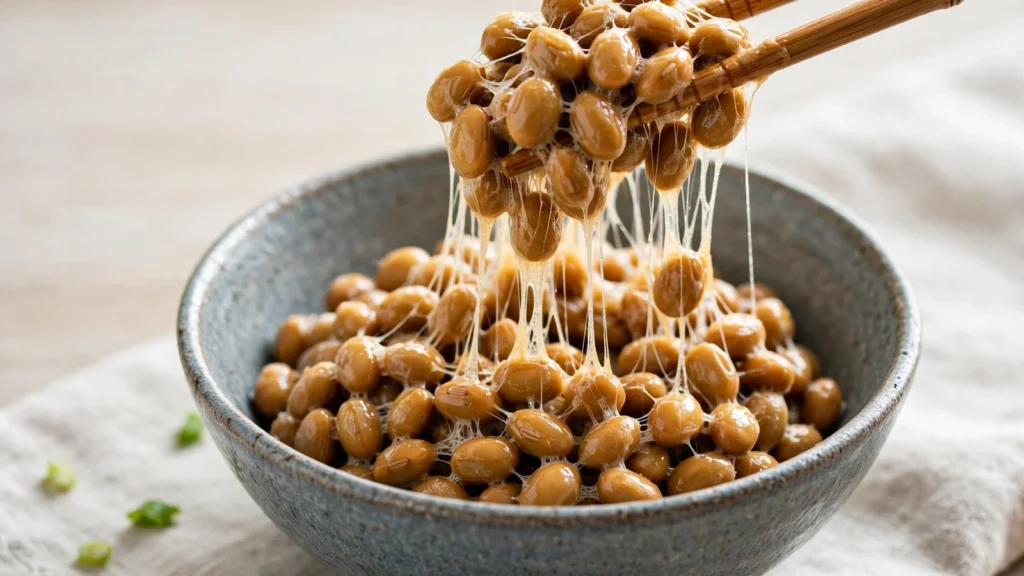
Nattokinase is an enzyme produced by the bacterium Bacillus subtilis as it ferments soybeans into natto, a sticky, strong-smelling food that has been eaten in Japan for centuries. It was identified in 1987 by Sumi and colleagues, who found it could dissolve fibrin, the tough protein mesh that holds a blood clot together.
Today nattokinase is sold as a supplement, usually in capsules, and marketed for heart health and circulation. Its strength is measured in fibrinolytic units (FU), a measure of enzyme activity rather than weight, so milligram figures on labels do not tell you much. Most products contain 2,000 FU per capsule, according to the evidence review by Evidentia Nutrition.
It is worth keeping two things separate from the start: natto the food, and nattokinase the isolated enzyme in a capsule. They are not the same, and the evidence for one does not automatically apply to the other.
How does nattokinase work?
Blood clots form when fibrin weaves itself into a mesh that traps platelets and blood cells. Nattokinase attacks that process in two ways. First, it breaks down fibrin directly. Second, it switches off a protein called PAI-1, which normally holds back tissue plasminogen activator (tPA) — the body’s own clot-dissolving enzyme. With PAI-1 out of the way, tPA can get on with dissolving clots more freely.
Memorial Sloan Kettering Cancer Center notes that nattokinase’s fibrin-dissolving activity in the lab is estimated at about four times that of plasmin, the body’s main fibrin-cutting enzyme. It also lowers levels of clotting factors such as fibrinogen, factor VII and factor VIII, and can reduce how readily platelets clump together.
That is an impressive mechanism on paper. The problem is that a mechanism is not an outcome. Showing that an enzyme can dissolve fibrin in a dish, or shift blood markers in a small study, is not the same as showing it stops people having heart attacks or strokes. That distinction runs through everything that follows.
What does the evidence actually show?
Human studies of nattokinase are few, small and short. Here is what they have — and have not — found.
Blood pressure
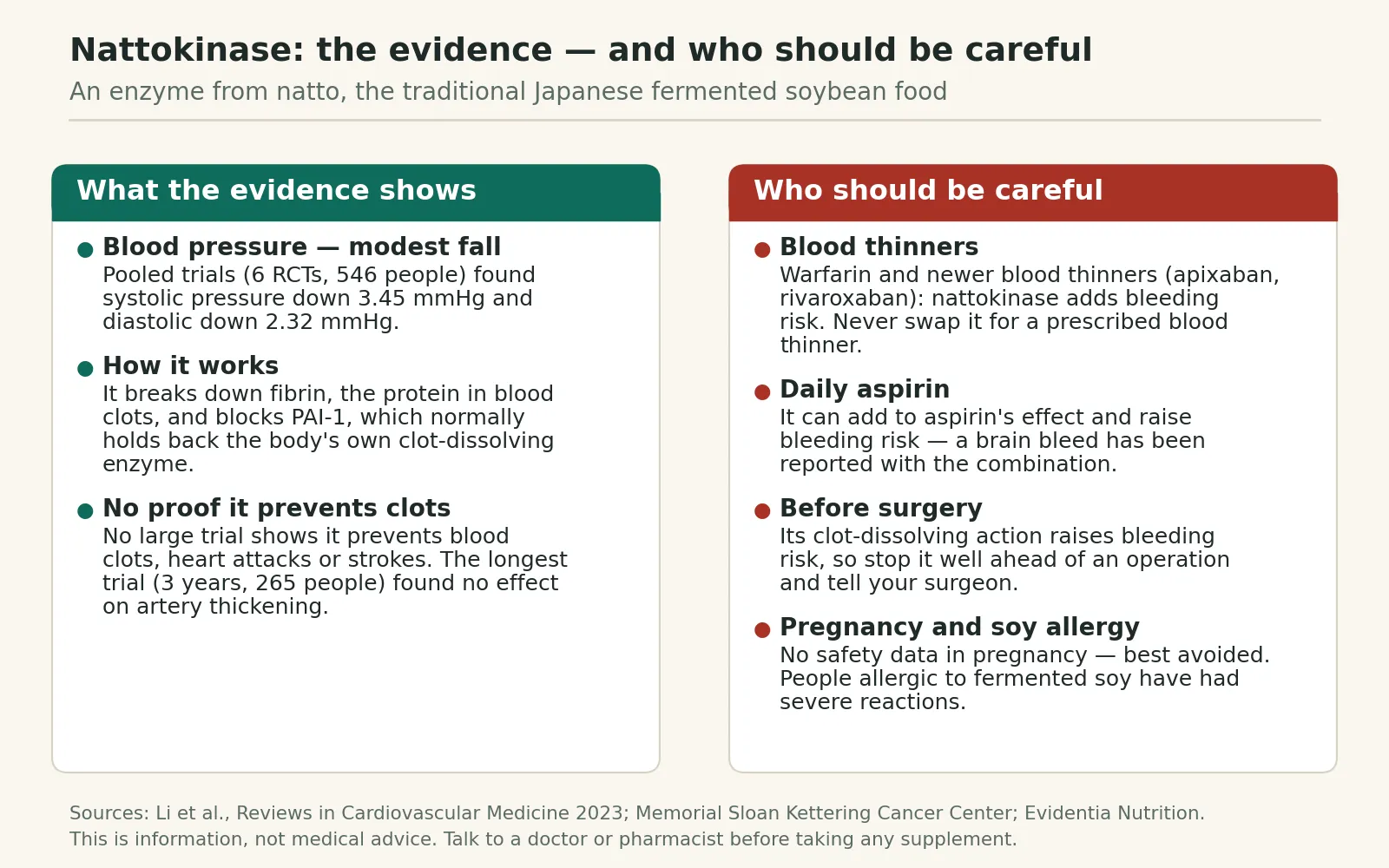
This is the one area where the evidence is reasonably consistent. A 2023 systematic review and meta-analysis in Reviews in Cardiovascular Medicine pooled six randomised controlled trials involving 546 people and found that nattokinase lowered systolic blood pressure by 3.45 mmHg and diastolic pressure by 2.32 mmHg compared with placebo. The authors rated the included trials as high quality, but the total number of people studied was small.
One of the better-known individual trials, by Kim and colleagues in 2008, studied 86 adults with pre-hypertension or stage 1 hypertension and found a net systolic fall of 5.55 mmHg over eight weeks, partly through lower renin activity — a mechanism similar in spirit to some blood pressure medicines.
A drop of a few mmHg is real, but modest. For comparison, regular exercise or cutting back on salt typically brings larger falls. And these trials measured blood pressure, not heart attacks or strokes, so they cannot say whether nattokinase protects the heart in the long run.
Blood clots and circulation
Several small studies show that nattokinase changes clotting markers in the blood: lower fibrinogen, lower PAI-1, and faster clot breakdown after a single dose. Memorial Sloan Kettering notes that early studies hint it may help prevent deep vein thrombosis, the kind of clot that usually forms in the leg.
But no large, long-term trial has tested whether nattokinase actually prevents clots, heart attacks or strokes. The longest study, the NAPS trial, followed 265 healthy adults for three years and found no effect on the progression of early artery thickening. As Evidentia Nutrition puts it, nattokinase is unusual among supplements in having a well-demonstrated biological effect in humans without matching evidence that the effect prevents disease.
Cholesterol
The cholesterol picture is unconvincing. The same 2023 meta-analysis found that lower total doses of nattokinase had no meaningful cholesterol-lowering effect, and were even linked to slightly higher total cholesterol in some analyses. One large non-randomised study using a much higher dose reported better cholesterol and artery results, but because it was not randomised, it cannot prove cause and effect — and the dose used was far above what ordinary products contain.
Is nattokinase the same as eating natto?
Not quite. Natto is a whole food: fermented soybeans rich in protein, fibre, vitamin K2 and probiotic bacteria, as well as nattokinase. Eating natto regularly is part of a traditional Japanese diet, and population studies link it with better heart health — though that may reflect the whole diet and lifestyle, not one enzyme.
A large Japanese cohort study that followed 79,648 adults aged 45 to 74 found that women who ate the most fermented soy foods, including natto, had a lower risk of cardiovascular disease than women who ate the least — a hazard ratio of 0.80, meaning about a fifth lower risk. No such link was found in men, and no link with total cancer in either sex. Observational studies like this cannot prove that natto itself caused the difference.
There is also a practical catch. Whole natto is very high in vitamin K, which can interfere with the blood thinner warfarin. Memorial Sloan Kettering points out that the bacteria in natto keep making vitamin K in the gut after you eat it, which can blunt warfarin’s effect. Nattokinase supplements are usually processed to remove most vitamin K, but that is worth checking on the label — and discussing with a doctor or pharmacist if you take warfarin.
Who should be careful with nattokinase?
The same clot-dissolving action that makes nattokinase interesting is what makes it risky for some people. The safety concerns are, frankly, better documented than the benefits.
- People on blood thinners. Nattokinase may add to the effect of warfarin and newer blood thinners such as apixaban and rivaroxaban, raising the risk of bleeding. It must never be used as a replacement for a prescribed blood thinner. One documented case involved a patient who stopped warfarin after a mechanical heart valve replacement and took nattokinase instead; nearly a year later he developed a clot on the valve and needed another operation.
- People who take aspirin daily. Memorial Sloan Kettering advises against combining nattokinase with daily aspirin, because it may increase aspirin’s effect and lead to excessive bleeding. A case of bleeding inside the brain has been reported in a patient who combined the two.
- Anyone planning surgery. Because it interferes with clotting, nattokinase raises bleeding risk around an operation. Evidence reviews recommend stopping it well ahead of elective surgery — at least two weeks beforehand — and telling your surgeon about it.
- People with a history of deep vein thrombosis. There is a theoretical concern that dissolving a clot too quickly could let a fragment break off and travel to the lungs or brain, so people with a history of DVT are advised to avoid it.
- People who are pregnant. There are no safety data for nattokinase in pregnancy, so avoiding it is the sensible course.
- People allergic to soy. Nattokinase comes from fermented soybeans, and severe allergic reactions, including anaphylaxis, have been reported in people allergic to natto.
Most clinical trials excluded people on blood thinners altogether, which means the safety picture in exactly the group most likely to be tempted by a “natural blood thinner” rests on case reports and reasoning rather than trial data.
What are the side effects of nattokinase?
In the small trials published so far, no notable side effects were reported. That sounds reassuring, but the trials were short, small, and mostly studied healthy people or people with mildly raised blood pressure — not the groups at highest risk.
Outside the trials, the case reports tell a different story. Memorial Sloan Kettering lists a case of internal bleeding that led to the death of an elderly woman who took over-the-counter nattokinase for an irregular rapid heartbeat — and she was not taking any other blood thinner. Other reports include severe allergic reactions and a clot forming on a mechanical heart valve after nattokinase was substituted for warfarin.
Possible side effects to be aware of include unusual bruising or bleeding, nosebleeds, blood in the urine or stools, and allergic symptoms such as a rash, swelling or difficulty breathing. WebMD also notes that doctors do not recommend nattokinase for children or for women who are pregnant or breastfeeding, because there is not enough evidence about its safety in those groups.
When to see a doctor
Talk to a doctor or pharmacist before taking nattokinase — especially if you take any blood thinner, aspirin or other medicine that affects clotting, if you have a bleeding disorder, a mechanical heart valve or a history of blood clots, or if you have surgery planned. Bring the product with you so they can see exactly what it contains.
Get urgent medical help if you notice signs of serious bleeding, such as vomiting blood, coughing up blood, black or bloody stools, blood in your urine, a severe headache, or a large unexplained bruise or swelling. Seek emergency help straight away for symptoms of a stroke — face drooping, arm weakness or slurred speech — or chest pain and breathlessness.
In an emergency call 911 (US), 999 (UK) or 112 (EU).
The bottom line
Nattokinase is a genuinely interesting enzyme with a real mechanism: it dissolves fibrin and frees up the body’s own clot-clearing system. The best human evidence, from six small trials, is a modest fall in blood pressure of around 3 to 4 mmHg. What is missing is the evidence that matters most — large, long-term trials showing it prevents clots, heart attacks or strokes.
Against that modest and uncertain benefit sits a concrete risk. Nattokinase can increase bleeding, particularly alongside blood thinners or aspirin, and there are documented cases of serious harm, including a death from internal bleeding. If you take medicines that affect clotting, or you have a heart valve, a clotting disorder or surgery coming up, this is one supplement to discuss with a doctor or pharmacist first — not to start on the strength of a trending search.
Frequently asked questions
What is nattokinase?
Nattokinase is an enzyme produced by the bacterium Bacillus subtilis as it ferments soybeans into natto, a traditional Japanese food. It was identified in 1987 and is known for dissolving fibrin, the protein that holds blood clots together. It is sold as a supplement for heart health and circulation, with its strength measured in fibrinolytic units (FU) rather than milligrams.
Does nattokinase lower blood pressure?
The evidence points to a modest fall. A 2023 meta-analysis pooled six randomised trials with 546 people and found systolic pressure down 3.45 mmHg and diastolic down 2.32 mmHg compared with placebo. One trial of 86 adults found a larger net fall of 5.55 mmHg over eight weeks. The effect is real but small, and the trials measured blood pressure, not heart attacks or strokes.
Can nattokinase prevent blood clots?
There is no proof that it can. Laboratory and small human studies show nattokinase breaks down fibrin and shifts clotting markers, but no large, long-term trial has shown it prevents blood clots, heart attacks or strokes. The longest trial, which followed 265 people for three years, found no effect on artery thickening. It should never replace a prescribed blood thinner.
Is nattokinase safe with blood thinners?
No, it needs care. Nattokinase can add to the effect of warfarin, apixaban, rivaroxaban and daily aspirin, raising the risk of bleeding. Case reports include a clot on a mechanical heart valve after nattokinase replaced warfarin, a brain bleed when it was combined with aspirin, and a fatal internal bleed in an elderly woman taking it on its own. Talk to a doctor or pharmacist first.
Who should not take nattokinase?
People on blood thinners or daily aspirin, anyone with a bleeding disorder or a mechanical heart valve, and people with a history of deep vein thrombosis should avoid it unless a doctor advises otherwise. It should be stopped well before surgery, and there are no safety data in pregnancy, so it is best avoided. People allergic to fermented soy have had severe allergic reactions.
Is eating natto the same as taking nattokinase?
No. Natto is a whole food containing nattokinase along with protein, fibre, vitamin K2 and probiotic bacteria. A large Japanese study of 79,648 adults found women who ate the most fermented soy foods had a lower risk of cardiovascular disease, but this was an observational finding, not proof that natto caused it. Whole natto is also very high in vitamin K, which can interfere with warfarin.
Sources
- Memorial Sloan Kettering Cancer Center: Nattokinase www.mskcc.org
- Evidentia Nutrition: Nattokinase — Evidence Review www.evidentianutrition.org
- Li X, et al. Nattokinase Supplementation and Cardiovascular Risk Factors: A Systematic Review and Meta-Analysis of Randomized Controlled Trials. Rev Cardiovasc Med, 2023 pmc.ncbi.nlm.nih.gov
- Nozue M, et al. Fermented soy products intake and risk of cardiovascular disease and total cancer incidence: The Japan Public Health Center-based Prospective study. Eur J Clin Nutr, 2021 pubmed.ncbi.nlm.nih.gov
- WebMD: Nattokinase — Uses, Health Benefits and Side Effects www.webmd.com

Try the tool
Not sure if it can wait?
Common causes and warning signs for 16 everyday symptoms.
Open the symptom guide