Is Skipping Breakfast Bad for You? What the Research Says
Long-term studies link regular breakfast skipping to higher heart disease and diabetes risk, but weight-loss trials find no advantage to eating breakfast. Here is what the evidence actually supports.
- Written by
- Health Daily Advice
- Published
- Reading time
- 8 minutes
- Sources
- 8 cited

In this guide
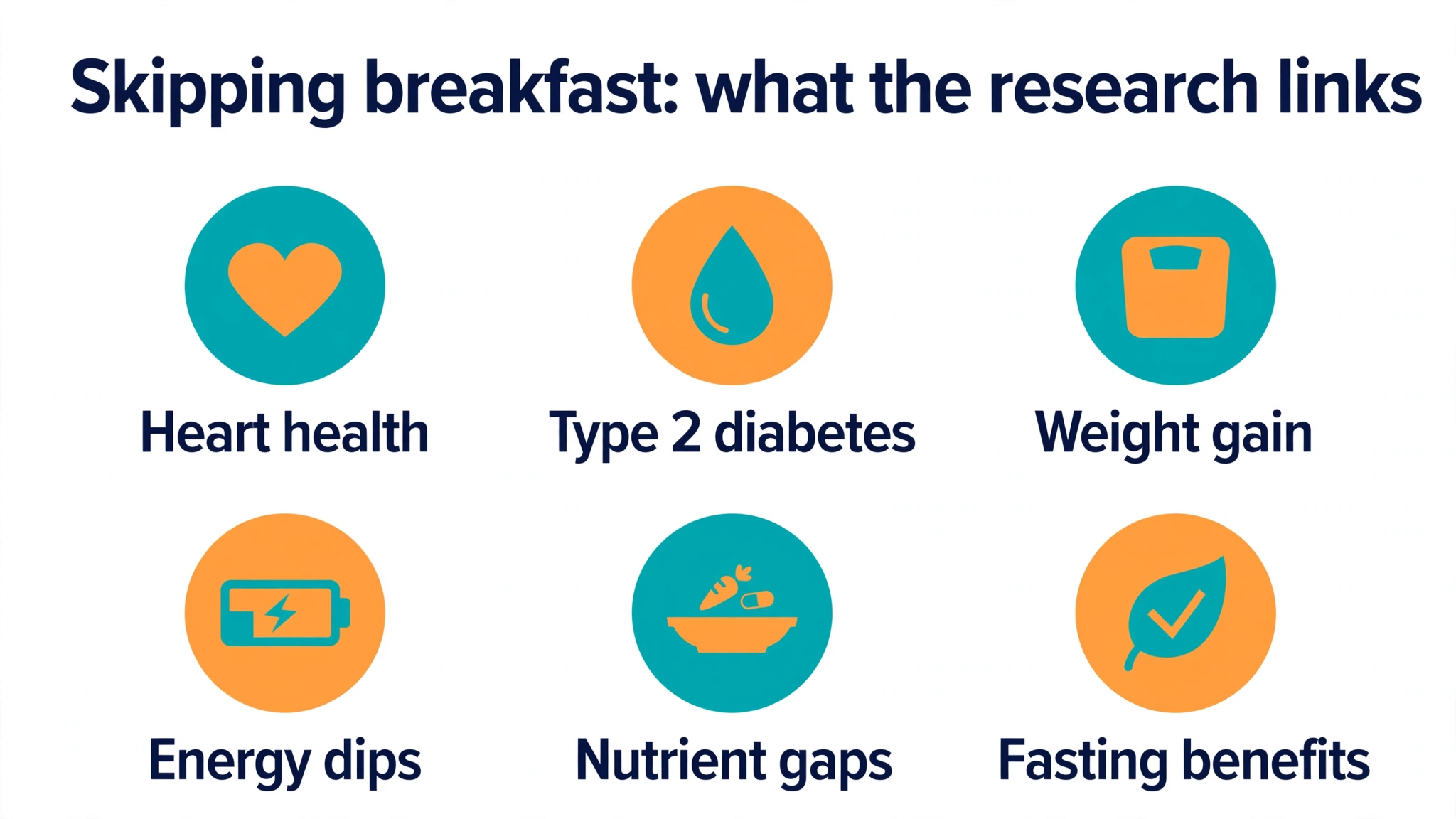
Skipping breakfast now and then is unlikely to harm a healthy adult, but making it a habit is linked to higher risks of heart disease and type 2 diabetes in long-term studies. Randomized trials, meanwhile, find no weight-loss advantage to eating breakfast. So the answer depends on your overall eating pattern, not on any single meal.
What long-term studies link to skipping breakfast
Most of what we know comes from observational studies, which follow large groups of people over many years and compare those who usually eat breakfast with those who usually skip it. A well-known one is a Harvard-led study published in Circulation: researchers tracked 26,902 American men aged 45 to 82 for 16 years and recorded 1,527 new cases of coronary heart disease. Men who reported skipping breakfast had a 27% higher risk of coronary heart disease than breakfast eaters (relative risk 1.27, 95% CI 1.06–1.53). Eating late at night was linked to an even larger 55% higher risk. The researchers found the breakfast link was partly explained by body weight, blood pressure, cholesterol and diabetes (Cahill et al., Circulation, 2013).
The pattern is similar for type 2 diabetes. A pooled analysis of six prospective cohorts, covering 96,175 participants and 4,935 cases of diabetes, found breakfast skippers were about a third more likely to develop type 2 diabetes (relative risk 1.33, 95% CI 1.22–1.46). After the researchers adjusted for body mass index, the excess risk fell to about a fifth (1.22), suggesting part of the link runs through skippers being heavier (reviewed in LiveWellNews).
For heart-related death, a nationally representative US cohort of 6,550 adults aged 40 to 75 was followed for about two decades. The small group who said they never ate breakfast — about 1 in 20 — died of cardiovascular causes at nearly twice the rate of daily breakfast eaters (hazard ratio 1.87, 95% CI 1.14–3.04) (LiveWellNews). A small meta-analysis of randomized trials also found LDL (“bad”) cholesterol was 9.24 mg/dL higher in breakfast skippers than in breakfast eaters (95% CI 2.18–16.30), though this was based on only three short trials.
Why the evidence is not settled
Observational studies cannot prove that skipping breakfast causes these problems. People who regularly skip breakfast differ from breakfast eaters in many other ways: they may work night shifts, sleep badly, smoke or drink more, and statistical adjustment can only partly allow for that. Someone who never eats breakfast may simply be someone whose whole routine is chaotic — and that chaos, not the missed meal, could be the real risk (LiveWellNews).
Randomized trials — where people are assigned to eat or skip breakfast — tell a more mixed story, at least for weight. A 2019 review in The BMJ pooled 13 trials and found that participants assigned to skip breakfast weighed 0.44 kg less on average than those assigned to eat it (95% CI 0.07–0.82). People told to eat breakfast consumed about 260 more calories per day in total (259.79 kcal, 95% CI 78.87–440.71) — in other words, skippers did not simply make up the missed calories later. The authors concluded there was no evidence that eating breakfast promotes weight loss or that skipping it causes weight gain (Sievert et al., The BMJ, 2019, via LiveWellNews). A two-day Cornell experiment found the same thing on a small scale: students who skipped breakfast ate fewer calories through the day than on the day they ate it (American Institute for Cancer Research).
On the other hand, long-term surveys point the other way. Four out of five participants in the National Weight Control Registry — people who have lost at least 30 pounds and kept it off for at least a year — report eating breakfast as one of their weight-maintenance strategies (American Institute for Cancer Research). Short trials can only show what happens over weeks, not what a habit does over decades.
What breakfast skippers tend to eat later
Skipping the morning meal does not happen in a vacuum. Cleveland Clinic dietitian Teresa Eury notes that skipping breakfast can leave you unable to fully concentrate, shaky, and more likely to overeat later in the day (Cleveland Clinic). Hunger by mid-morning plus constant food cues — the corner restaurant, the vending machine, a co-worker’s candy dish — can make it tough to limit what and how much you eat, especially when you are already hungry (American Institute for Cancer Research). If mid-morning hunger is a regular problem for you, it may help to read why you might always feel hungry.
Blood sugar is another concern. In the Bath Breakfast Project, a six-week experiment, blood sugar was more erratic in the afternoon and evening among people who fasted through the morning (LiveWellNews). Regular movement after eating can also help steady blood sugar, which is why some people take a short walk after meals.
Where the “most important meal of the day” slogan came from
“Breakfast is the most important meal of the day” sounds like a scientific finding, but it is closer to an advertising slogan. Reviewers who examined the trial evidence noted that breakfast has been promoted as the most important meal of the day in the media since 1917 — and the food industry, from cereal makers onward, has long had a stake in the question (LiveWellNews). The science behind the slogan turns out to be thin: the public health advice to eat breakfast for weight control was built on observational patterns, and trials have not confirmed it.
What the American Heart Association did conclude, in a 2017 scientific statement on meal timing, was more general: irregular eating patterns — skipping meals, erratic schedules — appear less favorable for achieving a healthy cardiometabolic profile than regular ones (LiveWellNews). Regularity may matter more than any single meal.
What a good breakfast looks like
If you do eat breakfast, what you eat matters more than whether you eat at 7 a.m. sharp. Harvard’s Teresa Fung, a dietitian and adjunct professor at the Harvard T.H. Chan School of Public Health, recommends building the meal around three elements: protein, fiber-rich carbohydrate, and fruits or vegetables (Harvard Health Publishing). Protein — eggs, Greek yogurt, cottage cheese, nuts, beans or tofu — digests slowly and keeps blood sugar on a more even keel. Fiber-rich carbs such as oats, whole-grain bread or brown rice provide sustained energy. She notes that breakfast is a good chance to get in nutrients often lacking in American diets, including calcium, fiber and folate.
Cleveland Clinic’s advice is similar: a balanced breakfast should include protein, fiber and heart-healthy fats — for example, an egg with whole-wheat toast and avocado. Eat something within two hours of waking if you can, and limit pastries and sugary cereals. As Eury puts it, a donut tastes good but leaves you hungry again within the hour, because foods high in refined sugar move through the body quickly without protein, fiber or healthy fats (Cleveland Clinic). Traditional breakfast foods like dairy, whole grains and fruit also contribute vitamin D, calcium, fiber and potassium (American Institute for Cancer Research).
Who should not skip breakfast
For most healthy adults, an occasional skipped breakfast is not a crisis. But some people should be cautious and talk to a doctor before regularly skipping meals:
- Children and teenagers. The 2010 Dietary Guidelines Advisory Committee found that children, especially adolescents, who skip breakfast are more at risk of overweight and obesity, and studies suggest children perform better in school after eating breakfast (American Institute for Cancer Research).
- People with diabetes or at risk of low blood sugar. For people who take medicines that lower blood sugar, when they eat interacts with their treatment, and that is a matter for their doctor (LiveWellNews). Skipping meals can raise the risk of hypoglycaemia (low blood sugar), so talk to a doctor or pharmacist before changing your meal pattern.
- People with a history of eating disorders. Deliberately skipping meals can reinforce disordered eating patterns; this is a decision to make with a clinician, not a diet trend.
- People who are pregnant or breastfeeding. Nutrient needs are higher, so talk to a doctor or pharmacist before restricting meals.
Skipping breakfast vs intermittent fasting
Not all meal-skipping is the same. Intermittent fasting usually means a deliberate, consistent eating window — for example, eating only between 11 a.m. and 7 p.m. — with attention to getting enough nutrients. Casual skipping is often chaotic: running on coffee until hunger strikes, then grabbing whatever is closest.
| Deliberate intermittent fasting | Chaotic skipping |
|---|---|
| Planned, consistent eating window | Irregular timing, driven by a busy schedule |
| Meals planned for protein, fiber and nutrients | First meal is often whatever is available |
| Total calories and diet quality tracked | Higher risk of overeating later in the day |
Intermittent fasting itself has mixed evidence. Short-term studies suggest time-restricted eating can improve blood pressure, blood glucose and cholesterol. But a preliminary analysis of more than 20,000 US adults, presented at the American Heart Association’s 2024 scientific sessions, found that people who ate all their food within less than 8 hours per day had a 91% higher risk of death from cardiovascular disease than those who ate across 12–16 hours. The researchers stressed this was an association, not proof of cause, and the findings have not yet been published in a peer-reviewed journal (American Heart Association Newsroom). Very tight eating windows deserve caution and medical advice, especially if you have heart disease or diabetes.
The bottom line
Habitually skipping breakfast is linked in long-term observational studies to a higher risk of heart disease and type 2 diabetes — but these studies cannot prove the missed meal is the cause, and randomized trials show no meaningful weight-loss advantage to eating breakfast either. Surveys suggest about 85% of US adults eat a morning meal on any given day, so skipping is the exception, not the norm (Harvard Health Publishing). If you skip breakfast and feel fine, eat balanced meals later and keep a regular pattern, there is little reason to force down a meal you do not want. If skipping leaves you shaky, foggy or raiding the vending machine by 11 a.m., a protein- and fiber-rich breakfast is probably worth the few minutes it takes.
When to see a doctor
Talk to a doctor (a GP in the UK) or pharmacist before changing your meal pattern if you have diabetes, take blood-sugar-lowering medicine, have a history of eating disorders, are pregnant or breastfeeding, or take any medicine that must be taken with food. Get medical advice promptly if skipping meals leaves you dizzy, faint or confused, or if you have chest pain, a racing heartbeat or severe headaches.
In an emergency call 911 (US), 999 (UK) or 112 (EU)
Frequently asked questions
Does skipping breakfast slow down your metabolism?
There is no solid evidence that skipping breakfast slows your metabolism in any meaningful way. In randomized trials, people told to eat breakfast actually consumed about 260 more calories per day than skippers, and skippers weighed about 0.44 kg less on average. Your body adapts to when you eat. What matters more for metabolism is overall calorie balance, diet quality, sleep and physical activity, not the timing of one meal.
Will skipping breakfast help me lose weight?
Possibly in the short term, but not reliably. A 2019 review of 13 randomized trials found breakfast skippers weighed 0.44 kg less on average than breakfast eaters, because skipping usually means eating about 260 fewer calories per day. However, the trials were short and low quality, and the authors found no meaningful evidence that either eating or skipping breakfast helps with weight loss. Sustainable weight control comes from total diet quality and calorie balance over time.
Does skipping breakfast increase diabetes risk?
In observational studies, yes. A pooled analysis of six long-term cohorts (96,175 people) found breakfast skippers were about 33% more likely to develop type 2 diabetes, falling to about 22% higher after accounting for body weight. This suggests part of the link runs through weight. These studies cannot prove cause, and a trial found skipping breakfast did not significantly raise blood sugar at lunch in healthy adults. If you take diabetes medicine, talk to a doctor before changing meal timing.
Is intermittent fasting the same as skipping breakfast?
Not exactly. Intermittent fasting usually means a deliberate, consistent eating window, for example eating only between 11 a.m. and 7 p.m., with attention to overall nutrition. Casual skipping is often chaotic: grabbing whatever is available when hunger hits. One preliminary analysis linked eating windows shorter than 8 hours to 91% higher cardiovascular death, so very tight windows deserve caution and medical advice, especially if you have heart disease or diabetes.
Should children skip breakfast?
No. The 2010 Dietary Guidelines Advisory Committee found children, especially adolescents, who skip breakfast are more at risk of overweight and obesity, and studies suggest children perform better in school after eating breakfast. Kids need steady energy and nutrients for growth, learning and play. If mornings are rushed, simple options like overnight oats, yogurt with fruit, or whole-grain toast with nut butter work well.
Is breakfast really the most important meal of the day?
The slogan has been promoted in the media since 1917, but it is not a scientific conclusion. What research supports is a pattern: people who eat regular, balanced meals tend to have better heart and metabolic health than people with chaotic eating patterns. Whether your first meal lands at 7 a.m. or 11 a.m. matters less than what you eat across the whole day: protein, fiber, whole grains, fruits and vegetables.
Sources
- Cleveland Clinic Newsroom: Do You Really Need to Eat Breakfast? newsroom.clevelandclinic.org
- Harvard Health Publishing: Healthy breakfast ideas to support energy and metabolism www.health.harvard.edu
- Cahill LE, et al. Prospective study of breakfast eating and incident coronary heart disease in a cohort of male US health professionals. Circulation, 2013 pubmed.ncbi.nlm.nih.gov
- LiveWellNews: Breakfast and weight: what trials show about eating or skipping the 'most important meal of the day' livewellnews.com
- American Institute for Cancer Research: The Studies: Is Breakfast the Most Important Meal? www.aicr.org
- American Heart Association Newsroom: 8-hour time-restricted eating linked to a 91% higher risk of cardiovascular death newsroom.heart.org

Try the tool
Not sure if it can wait?
Common causes and warning signs for 16 everyday symptoms.
Open the symptom guide

