Is Green Tea Good for You? What the Evidence Says
Green tea is a healthy habit for most adults, but the benefits are modest: slightly better cholesterol, small weight effects and only weak evidence beyond that. Here is what the science actually says.
- Written by
- Health Daily Advice
- Published
- Reading time
- 4 minutes
- Sources
- 12 cited
In this guide
Yes — for most healthy adults, drinking green tea is a good habit, but it is not a miracle drink. Research links its catechins, especially EGCG, to small improvements in cholesterol and weight, and some studies tie tea drinking to lower heart disease and dementia risk. Concentrated supplements carry real risks, though.
What is in your cup
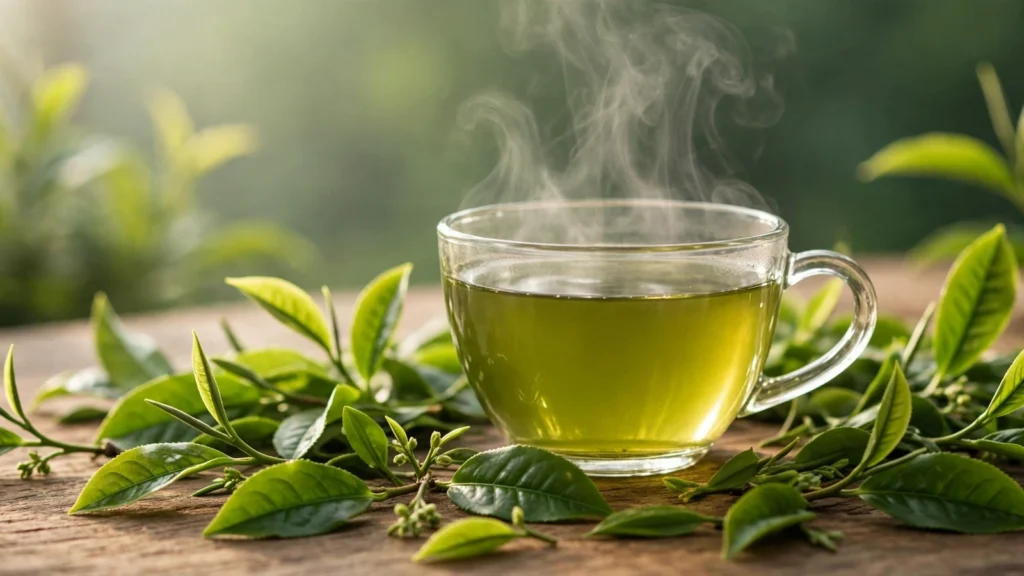
Green, black, and oolong teas all come from the same plant, Camellia sinensis. What makes green tea different is processing: the leaves are steamed or pan-fried and dried, but not fermented, which preserves its catechins — a type of antioxidant polyphenol. Catechins make up 25–35% of the dry weight of green tea, and the most studied one, epigallocatechin gallate (EGCG), accounts for 50–70% of those catechins (Wang et al., 2023; NCCIH).
Green tea also contains caffeine — about 22–46 mg per cup, according to Boston University (BU School of Medicine). That is less than half the caffeine in a cup of filter coffee, but enough to make you feel it.
What the research actually shows
Most trials have tested concentrated green tea extracts or catechin capsules rather than the brewed drink, so read every claim below with that in mind. Here is the evidence at a glance:
| Health area | What the reviews and trials found |
|---|---|
| Cholesterol | Small reduction in total and LDL cholesterol; no effect on HDL or triglycerides (NCCIH) |
| Weight | Small, statistically non-significant weight loss — not likely to be clinically important (Cochrane) |
| Blood pressure | No significant effect in overweight and obese adults (Wang et al., 2023) |
| Heart disease | Linked to lower coronary heart disease risk in Asian populations, but not in Western ones (NCCIH) |
| Brain health | Highest flavonoid intake (tea included) linked to ~40% lower dementia risk over 20 years — observational, not proof (Harvard Health) |
| Cancer | Studies inconsistent; no firm conclusions can be drawn (NCCIH) |
Heart and cholesterol
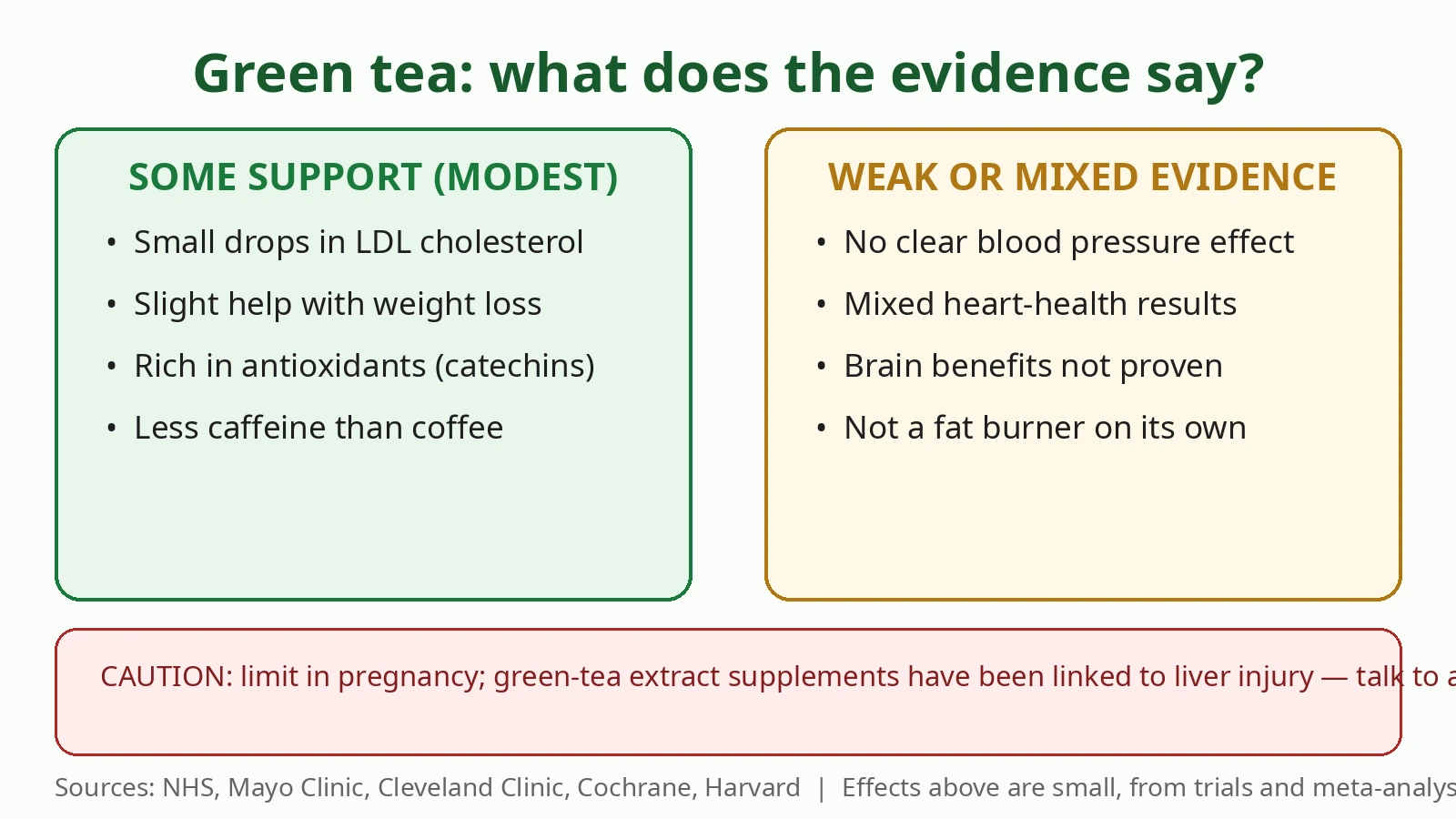
The most consistent finding is modest: green tea lowers total and LDL (“bad”) cholesterol to a small extent. It does not move HDL (“good”) cholesterol or triglycerides. That matters, because small cholesterol shifts alone rarely change heart disease risk — diet, activity, and blood pressure matter far more.
One 2023 meta-analysis of 11 trials in overweight and obese adults did find moderate lipid benefits: waist circumference fell by about 1.4 cm, triglycerides dropped by 0.18 mmol/L, and HDL rose slightly by 0.07 mmol/L — but there was no significant effect on blood pressure (Wang et al., 2023).
Weight
Forget the “fat-burning tea” marketing. A Cochrane review of 15 weight-loss studies and 3 weight-maintenance studies in 1,945 people found green tea preparations caused weight loss that was small, statistically non-significant, and not likely to be clinically important. They also showed no benefit for keeping weight off. As a calorie-free drink that replaces sugary beverages, green tea is a sensible choice — but it is not a weight-loss treatment.
Brain
The brain evidence is promising but weak. In a 20-year study of 2,800 adults, those with the highest intake of flavonoids — from tea, apples, pears, and berries — were about 40% less likely to develop dementia. But this was observational: it cannot prove tea itself protected anyone, and the tea drinkers may simply have had healthier habits overall (Harvard Health).
How much caffeine is in green tea — and how many cups is reasonable?
There is no official recommended amount of green tea itself. The useful yardstick is caffeine: the European Food Safety Authority considers total daily caffeine up to 400 mg safe for healthy adults, from all sources combined (EFSA). At roughly 22–50 mg of caffeine per cup, a few cups of green tea a day fit easily within that limit.
But remember the total: coffee, energy drinks, cola, chocolate, and some medications all contribute. If caffeine makes you jittery, anxious, or sleepless — classic caffeine side effects — cut back, and avoid green tea late in the day if your sleep suffers.
Who should be cautious
Pregnancy and breastfeeding
If you are pregnant, the NHS advises no more than 200 mg of caffeine a day from all sources — roughly two to three cups of green tea at about 75 mg a cup. Too much caffeine has been linked to a higher chance of miscarriage and stillbirth. The NCCIH adds that caffeine intake in pregnancy should not exceed moderate levels, and caffeine passes into breast milk, which can make infants fussy (NCCIH). If you are or might be pregnant, check with your health care provider about your caffeine intake.
Iron absorption
Tea can reduce how much iron your body absorbs from food. An NHS GP practice advises drinking tea and coffee between meals rather than with or just before/after food (Villa Medical Centre). If you are low in iron or take iron supplements, timing your tea matters.
Green tea extract supplements and the liver
There is an important split here. The NCCIH reports no safety concerns for green tea consumed as a beverage by adults. But concentrated green tea extracts — tablets, capsules, and powders often sold for weight loss — have been linked in uncommon cases to liver injury (NCCIH). People with a particular immune-system gene variant appear especially susceptible; an estimated 5–15% of Americans carry it. Extract supplements can also cause nausea, constipation, abdominal discomfort, and raised blood pressure.
Green tea can interact with some medicines — the NCCIH notes interactions with the blood pressure drug nadolol, the cholesterol drug atorvastatin, and the osteoporosis drug raloxifene. Talk to a doctor or pharmacist before using green tea extract supplements, especially if you take any medicine or have a liver condition.
When to see a doctor
See a doctor or pharmacist if you feel anxious, get palpitations, or cannot sleep after drinking green tea, or before starting any green tea extract supplement. Seek prompt medical help if you develop symptoms that could signal a problem — such as persistent abdominal pain or yellowing of the skin or eyes while using extract products. In an emergency call 911 (US), 999 (UK) or 112 (EU).
Frequently asked questions
How many cups of green tea can I drink a day?
There is no official daily amount for green tea itself. The yardstick is caffeine: a cup holds roughly 22-46 mg, and EFSA considers up to 400 mg of caffeine a day safe for healthy adults, from all sources combined. A few cups of green tea fit easily within that, but count coffee, energy drinks and other caffeine too, and cut back if sleep suffers.
Is green tea better for you than coffee?
Neither is clearly better - both contain caffeine and plant compounds linked to health benefits in observational studies. Green tea has less caffeine per cup, about 22-46 mg versus around 90 mg in filter coffee, so it disturbs sleep less. Choose by taste and how you react to caffeine.
Does green tea burn belly fat?
No - not in any meaningful way. A Cochrane review of trials in overweight or obese adults found green tea preparations caused a small, statistically non-significant weight loss that was not likely clinically important, and they did not help maintain weight loss. One meta-analysis found an average waist reduction of about 1.4 cm. Diet and activity remain what matter.
Is green tea safe to drink in pregnancy?
In moderation, yes, but it counts toward your caffeine limit. The NHS advises no more than 200 mg of caffeine a day in pregnancy - roughly two to three cups of green tea at about 75 mg a cup - because too much caffeine has been linked to miscarriage and stillbirth. Also, tea can reduce iron absorption, so drink it between meals, and ask your midwife if unsure.
Can green tea damage your liver?
Green tea as a beverage has no reported safety concerns for adults, according to the NCCIH. The liver problems seen were uncommon and linked mainly to concentrated green tea extracts in tablets or capsules, not brewed tea. People with a specific immune-system gene variant appear more susceptible. If you are considering an extract product, talk to a doctor or pharmacist first.
Does green tea help you lose weight without dieting?
There is no evidence for that. Trials found only small, statistically non-significant weight loss from green tea preparations, and no benefit for maintaining weight loss, per a Cochrane review. Green tea may have a modest effect on body weight through catechins and caffeine, but the effect is too small to replace dietary changes. Think of it as a healthy drink swap, not a shortcut.
Sources
- NCCIH: Green Tea: Usefulness and Safety www.nccih.nih.gov
- Cochrane: Green tea for weight loss and weight maintenance in overweight or obese adults www.cochrane.org
- NHS: Foods to avoid in pregnancy www.nhs.uk
- Wang Y, et al. Effects of green tea catechin on the blood pressure and lipids in overweight and obese population: a meta-analysis. Heliyon, 2023 pmc.ncbi.nlm.nih.gov
- Boston University School of Medicine: Green Tea www.bu.edu
- NHS GP: Iron deficiency anaemia villamedicalcentrewirral.nhs.uk
- EFSA: Scientific opinion on the safety of caffeine (EUFIC summary) www.eufic.org
- Harvard Health: High intake of berries, apples, and tea linked to lower dementia risk www.health.harvard.edu

Try the tool
Not sure if it can wait?
Common causes and warning signs for 16 everyday symptoms.
Open the symptom guide