Is Walking After Meals Good for You? What the Research Says
Even a five-minute stroll after dinner can steady your blood sugar and settle your stomach. Here is what studies show about post-meal walking, and how to time it.
- Written by
- Health Daily Advice
- Published
- Reading time
- 4 minutes
- Sources
- 10 cited

In this guide
Yes. Research shows that even a short, gentle walk after eating helps working muscles draw glucose from the blood, softening the blood sugar spike that follows a meal. It can also speed up how fast the stomach empties, easing fullness and reflux. Most studies used walks of two to fifteen minutes within an hour or so of eating.
Why a post-meal walk works
When your muscles contract, they need fuel, so they pull glucose out of the bloodstream. Crucially, this happens through a pathway that needs little insulin, the hormone that normally moves glucose into cells. UCLA Health explains that active muscles both demand more glucose and become more sensitive to insulin, which is why walking straight after eating directly blunts the post-meal rise.
That is also why standing helps a little: even small muscle contractions use glucose. But walking recruits the body’s largest muscle groups — the glutes, hamstrings and quadriceps — so the effect is bigger.
What the studies found
The strongest evidence comes from a 2022 systematic review and meta-analysis in Sports Medicine, which pooled seven one-day randomised crossover trials. Compared with staying seated, light-intensity walking breaks significantly reduced post-meal blood sugar (effect size −0.72, p<0.001) and insulin (−0.83, p<0.001). Walking also beat standing breaks, which lowered glucose only modestly and had no significant effect on insulin.
According to UCLA Health’s summary of that research, even a five-minute walk after eating had a measurable effect, seen during a 60- to 90-minute window after the meal. Walkers’ blood sugar rose and fell more gradually — a gentler curve than the sharp spike-and-crash of sitting. The benefit appeared in all participants, whether or not they had diabetes.
Smaller trials back this up. In a 2013 Diabetes Care study, ten inactive adults over 60 with impaired fasting glucose did three 15-minute post-meal walks on one day and a single 45-minute walk on another. Both improved 24-hour blood sugar control, but the post-meal walks were significantly more effective at lowering blood sugar in the three hours after the evening meal (p<0.01).
One caveat: the 2022 analysis found neither standing nor light walking had a significant effect on systolic blood pressure, so do not expect an immediate blood pressure benefit from a short stroll.
Digestion: fullness, reflux and wind
Blood sugar is not the only win. Cleveland Clinic gastroenterologist Dr Jessica Philpott says walking after a meal “can improve your gastric emptying” — the rate at which food leaves the stomach for the small intestine. Studies show walking immediately after eating shortens the time food sits in the stomach, which can improve feelings of excessive fullness, reflux and abdominal pain.
Her advice: walk within 15 to 30 minutes of eating, particularly after heavier meals, since that is when digestion slows down. You do not need to do it after every meal — what matters most is doing it at all. And if you cannot get outside, even standing up or walking around the house can help stomach emptying, according to Cleveland Clinic.
The habit went viral in the US under the nickname “fart walk”, but the benefits researchers actually measure are steadier blood sugar and faster stomach emptying.
What about sleep and mood?
An evening stroll may help you sleep too. In a 2016 crossover trial of 50 older adults, four weeks of evening walks (three 30-minute sessions a week) significantly improved sleep quality scores (p<0.05), with little difference between morning and evening walkers. Many people also find a gentle walk a pleasant way to wind down — a quiet break between dinner and bedtime.
How long, how fast, how soon
There is no single prescription, but the studies point to a simple formula:
- How long: two to five minutes is the minimum that showed an effect; ten to fifteen minutes after each meal worked even better in the small trials.
- How soon: within 60 to 90 minutes of eating for blood sugar; within 15 to 30 minutes for digestion.
- How fast: gentle to moderate. The NHS calls a brisk walk about 3 miles an hour — fast enough that you can talk but cannot sing. The post-meal studies used a light, comfortable pace.
- How often: after each main meal if you can. If you only manage one, make it after dinner, since the evening meal is followed by the most sitting.
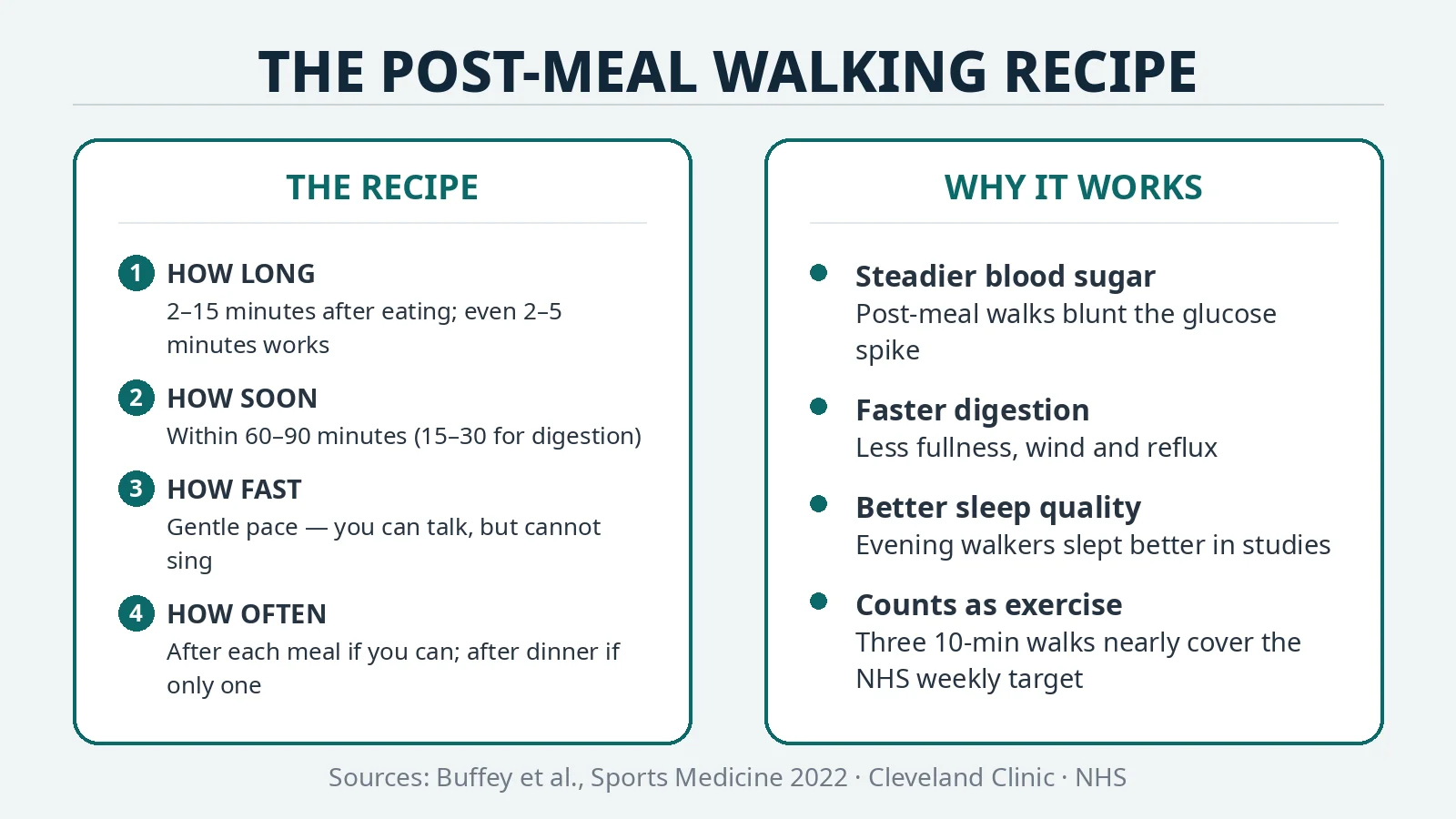
The NHS also notes that a brisk 10-minute daily walk counts towards the 150 minutes of weekly exercise recommended for adults aged 19 to 64 — three post-meal walks a day would get you most of the way there.
Who should take extra care
Walking after meals is safe for most people, but talk to your GP first if you have balance problems or a heart condition, or if you take insulin or medicines that can lower blood sugar, in case timing or checks need adjusting. If you walk outside at night, stick to well-lit routes.
When to see a doctor
See a GP if you regularly feel faint, dizzy or shaky after eating, have frequent reflux or abdominal pain that does not improve, or notice unexplained weight loss. In an emergency call 911 (US), 999 (UK) or 112 (EU).
Frequently asked questions
How long should you walk after a meal?
Start with what fits your day. In the 2022 meta-analysis, even 2 to 5 minute light walking breaks lowered post-meal blood sugar and insulin compared with sitting. Longer strolls of 10 to 15 minutes after each meal worked even better in smaller trials. The NHS also notes that a brisk 10-minute daily walk counts towards the 150 minutes of weekly exercise recommended for adults.
Is it better to walk before or after eating?
For blood sugar, after. When you walk after a meal, your working muscles take up glucose through a pathway that needs little insulin, directly blunting the post-meal rise. The 2022 Sports Medicine meta-analysis found light walking breaks significantly reduced postprandial glucose and insulin versus sitting. A walk beforehand still counts as exercise, but it does not catch the glucose surge that follows eating.
I have type 2 diabetes. Is walking after meals safe for me?
It is a useful habit for many people with diabetes, but check with your GP or diabetes team first. The 2022 meta-analysis found the blood-sugar benefit of short walks held regardless of whether participants had diabetes. If you take insulin or other medicines that can cause low blood sugar (hypoglycaemia), ask your doctor or pharmacist about timing and blood sugar checks before you start.
Does walking after dinner help you lose weight?
On its own, probably not much: a gentle stroll burns relatively few calories. What it does reliably is blunt blood sugar spikes and aid digestion, and steadier blood sugar may make it easier to avoid late-night snacking. The NHS says brisk walking helps burn excess calories and counts towards 150 minutes of weekly activity. For weight loss, walking works best alongside balanced eating.
Should I walk straight after eating, or wait a while?
You do not need to rush, but sooner is better. UCLA's summary of the research found the benefit was seen in the 60 to 90 minutes after a meal, with blood sugar rising and falling more gradually in walkers. Cleveland Clinic's gastroenterologist suggests walking within 15 to 30 minutes for digestion. Even getting up to stand or potter around the house helps if a walk is not possible.
Can walking after a meal cause indigestion or cramps?
A gentle stroll is unlikely to cause problems and may actually reduce bloating, fullness and reflux by speeding up stomach emptying, according to Cleveland Clinic. What tends to cause trouble is vigorous exercise straight after a big meal. Keep the pace comfortable, avoid large heavy meals before longer walks, and stop and rest if you feel unwell. See a GP if discomfort is frequent.
Sources
- Buffey AJ, et al. The acute effects of interrupting prolonged sitting time with standing and light-intensity walking: systematic review and meta-analysis. Sports Med, 2022 (PubMed) pubmed.ncbi.nlm.nih.gov
- UCLA Health: Taking a walk after eating can help with blood sugar control www.uclahealth.org
- DiPietro L, et al. Three 15-min bouts of moderate postmeal walking significantly improves 24-h glycemic control in older people at risk for impaired glucose tolerance. Diabetes Care, 2013 (PubMed) www.ncbi.nlm.nih.gov
- Cleveland Clinic Newsroom: Take a stroll — benefits of walking after eating newsroom.clevelandclinic.org
- NHS: Walking for health www.nhs.uk
- Taleghani E, et al. Comparison of the effects of morning and evening walks on nighttime sleep quality among elderly people. Mod Care J, 2016 brieflands.com

Try the tool
Not sure if it can wait?
Common causes and warning signs for 16 everyday symptoms.
Open the symptom guide