Is Dark Chocolate Good for You? Benefits and Downsides
Dark chocolate's flavanols support blood flow and modestly lower blood pressure, and studies link it to heart and blood-sugar benefits. But it is 170 calories per ounce and heavy metals are a real concern - here's the honest balance.
- Written by
- Health Daily Advice
- Published
- Reading time
- 3 minutes
- Sources
- 10 cited
In this guide
Dark chocolate can be good for you — in small amounts. Its cocoa flavanols support blood flow, modestly lower blood pressure and are linked to lower heart disease and type 2 diabetes risk. But it packs about 170 calories per ounce, heavy metals have been found in many bars, and eating extra for “health” wipes out the benefit.
What the research says dark chocolate does
Dark chocolate means 50–90% cocoa solids (milk chocolate is only 10–50%), and it’s the cocoa solids that carry the plant compounds — flavanols — behind the benefits, according to the Mayo Clinic Health System and the Cleveland Clinic.
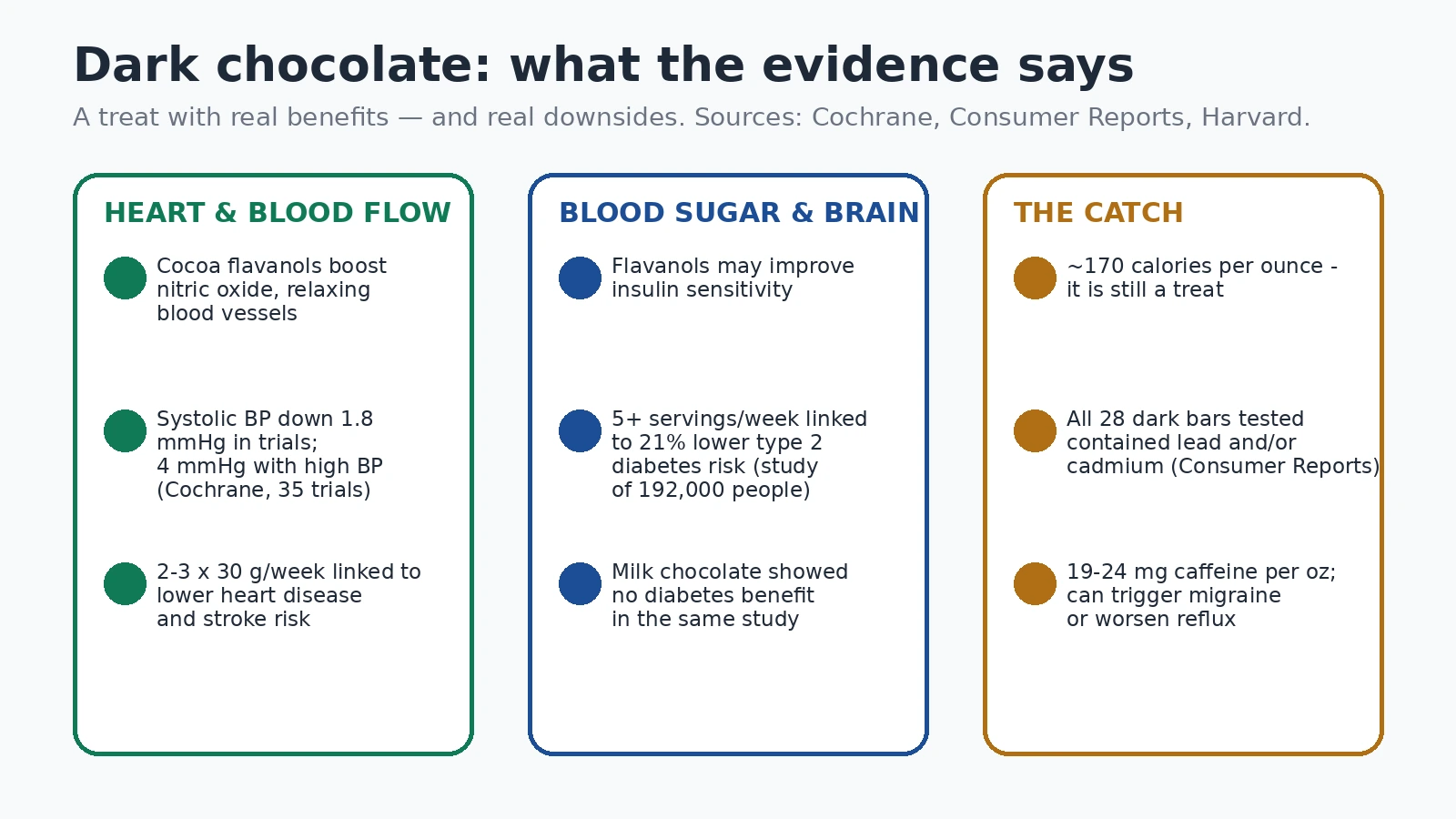
- Blood flow and blood pressure: flavanols support nitric oxide production, which relaxes blood vessels and improves circulation. A Cochrane review of 35 trials (1,804 people) found flavanol-rich cocoa lowered systolic blood pressure by 1.76 mmHg — and by 4 mmHg in people who already had high blood pressure.
- Heart disease: a meta-analysis of studies covering more than 500,000 people found those who ate dark chocolate regularly (two to three 30 g servings a week) had a lower risk of diabetes, heart disease and stroke, reports Harvard Health.
- Blood sugar: flavanols may improve insulin sensitivity. A Harvard-led observational study of more than 192,000 people linked at least five weekly servings of dark chocolate (about 28 g each) to a 21% lower risk of type 2 diabetes — but the effect vanished for milk chocolate, and observational studies can’t prove cause and effect.
- Brain and eyes: more blood flow to the brain may support short-term thinking (partly thanks to caffeine); one small trial found a 47 g bar of 72% chocolate improved visual sharpness two hours after eating.
- Mood and skin: daily 85% dark chocolate is linked to better overall mood, and flavanols may protect skin from UV damage, per the Cleveland Clinic.
One important caveat from the Harvard T.H. Chan School of Public Health: to match the flavanol dose used in the big COSMOS heart trial, you’d need around 700 calories of dark chocolate a day. As they put it, dark chocolate “can be part of a healthy diet, but it shouldn’t be considered a health food.”
The downsides: calories, heavy metals and caffeine
- Calories: one ounce (about three thin squares) of 70–85% dark chocolate has roughly 170 calories, 12 g of fat and 6.8 g of sugar, according to the Cleveland Clinic. That’s fine as a treat; it isn’t fine as medicine.
- Heavy metals: Consumer Reports’ 2022 lab test found detectable lead and/or cadmium in all 28 dark chocolate bars tested, with 23 of the 28 exceeding California’s safety thresholds per one-ounce serving (test data). A 2023 round found the same pattern across 48 cocoa products (summary). Cadmium comes from the soil; lead settles on beans as dust during drying. Organic labels don’t help — the metals come from the environment, not farming methods. Consumer Reports’ advice: enjoy chocolate as a treat, not a daily health ritual.
- Caffeine: two ounces of 70% dark chocolate contain about 50–60 mg of caffeine — roughly a quarter to a half of a coffee. That’s enough to matter if you’re sensitive: caffeine can worsen acid reflux and disturb sleep.
- Migraine: cocoa is a reported trigger for some migraine sufferers; if headaches follow chocolate, track it and talk to a doctor.
- Pregnancy: moderate amounts are considered possibly safe, but keep total caffeine from all sources low — some experts advise under 300 mg a day in pregnancy (cocoa safety monograph). If you’re pregnant or breastfeeding, talk to your midwife or doctor about what fits.
How to choose and how much to eat
- Go dark: pick bars with 70% cocoa or more — higher cocoa means more flavonoids and less sugar. The Cleveland Clinic also suggests under 8 g of sugar per serving, with cocoa as the first ingredient.
- Avoid Dutch/alkalised cocoa: alkali processing strips out much of the flavanols.
- Stick to 1–2 ounces (30–60 g) a day — about three to six thin squares. Harvard Health’s simple rule: “nibble on two squares of dark chocolate (the darker the better) daily.”
- Don’t chase the flavanol dose with extra bars — the calories and sugar will do more harm than the extra flavanols do good.
When to see a doctor
Chocolate isn’t a medicine, so there are no urgent warning signs — but talk to a doctor or pharmacist if you notice regular migraines after eating chocolate, if reflux or heartburn gets worse with it, or if you’re managing diabetes or high blood pressure and want to fit treats into your plan.
In an emergency call 911 (US), 999 (UK) or 112 (EU).
Frequently asked questions
How much dark chocolate should I eat a day?
The Cleveland Clinic suggests 1-2 ounces (30-60 g), which is about three to six thin squares, and Harvard Health's rule is simply two squares of dark chocolate (the darker the better) daily. One ounce of 70-85% dark chocolate has roughly 170 calories, 12 g of fat and 6.8 g of sugar, so it works as a treat, not a health food. Do not eat extra hoping for more benefit.
Does dark chocolate contain lead and cadmium?
Yes, according to Consumer Reports' lab testing: its 2022 test found detectable lead and/or cadmium in all 28 dark chocolate bars, with 23 of the 28 exceeding California's safety thresholds in a single one-ounce serving. A 2023 round across 48 cocoa products found the same pattern. Cadmium comes from the soil and lead settles on beans as dust, so organic labels do not make bars safer. Keep it a treat.
Is dark chocolate good for blood pressure?
Modestly. A Cochrane review of 35 trials with 1,804 people found that flavanol-rich cocoa lowered systolic blood pressure by 1.76 mmHg over 2-18 weeks - and by 4 mmHg in the 401 participants who already had high blood pressure. The effect was not seen in people with normal blood pressure. Chocolate can complement, never replace, prescribed blood pressure treatment.
Can diabetics eat dark chocolate?
In small amounts, usually, but talk to your doctor or dietitian first. Cocoa flavanols may improve insulin sensitivity, and a Harvard-led study of 192,000 people linked five or more weekly dark-chocolate servings to a 21% lower risk of type 2 diabetes - but that is observational, not proof. Dark chocolate still carries sugar and calories, and milk chocolate showed no benefit in the same study.
Is dark chocolate safe in pregnancy?
Moderate amounts are considered possibly safe, but the caffeine counts. Two ounces of 70% dark chocolate hold about 50-60 mg of caffeine, and some experts advise keeping total caffeine from all sources under 300 mg a day in pregnancy. Caffeine also crosses the placenta, so count tea, coffee and chocolate together. If you are pregnant or breastfeeding, ask your midwife or doctor what fits.
Which dark chocolate is healthiest?
The Cleveland Clinic advises choosing bars with at least 70% cocoa, under 8 g of sugar per serving, and cocoa listed as the first ingredient. Higher cocoa percentage means more flavonoids and less sugar. Avoid Dutch-processed or alkalised cocoa, because alkali treatment strips out much of the flavanols. Labels rarely state flavanol amounts, so use cocoa percentage and sugar as your guide.
Sources
- Mayo Clinic Health System: Choose dark chocolate for your heart www.mayoclinichealthsystem.org
- Cleveland Clinic: Is dark chocolate good for you? 6 benefits health.clevelandclinic.org
- Cochrane Library: Effect of cocoa on blood pressure www.cochranelibrary.com
- Harvard Health: Can dark chocolate improve vision? www.health.harvard.edu
- Harvard T.H. Chan School of Public Health: Dark chocolate and flavonoids hsph.harvard.edu
- Consumer Reports data (via PlasticDetox): Chocolate tested for lead and cadmium plasticdetox.org
- Food Revolution Network: Heavy metals in chocolate (CR 2023 data) foodrevolution.org
- Cocoa safety monograph: caffeine, migraine and pregnancy guidance www.skyclk.com

Try the tool
Not sure if it can wait?
Common causes and warning signs for 16 everyday symptoms.
Open the symptom guide