Is Honey Better Than Sugar? What the Evidence Shows
Honey has a small edge over white sugar — trace antioxidants, a lower glycaemic index and stronger sweetness — but it is still added sugar with more calories per spoon. Here is what the evidence says and how to use less.
- Written by
- Health Daily Advice
- Published
- Reading time
- 4 minutes
- Sources
- 8 cited
In this guide
Honey is slightly better than white sugar in some ways: it contains small amounts of antioxidants, has a lower glycaemic index and tastes sweeter, so you may need less of it. But it still counts as added sugar, has more calories per tablespoon, and Harvard notes that one type of sugar is not better than another overall.
Honey vs sugar: the numbers side by side
At a glance, the two sweeteners are closer than many people expect. Per tablespoon (about 21g), honey has around 64 calories, 17g of carbohydrate and 17g of sugar, compared with about 49 calories, 13g of carbohydrate and 13g of sugar for a tablespoon of white sugar.
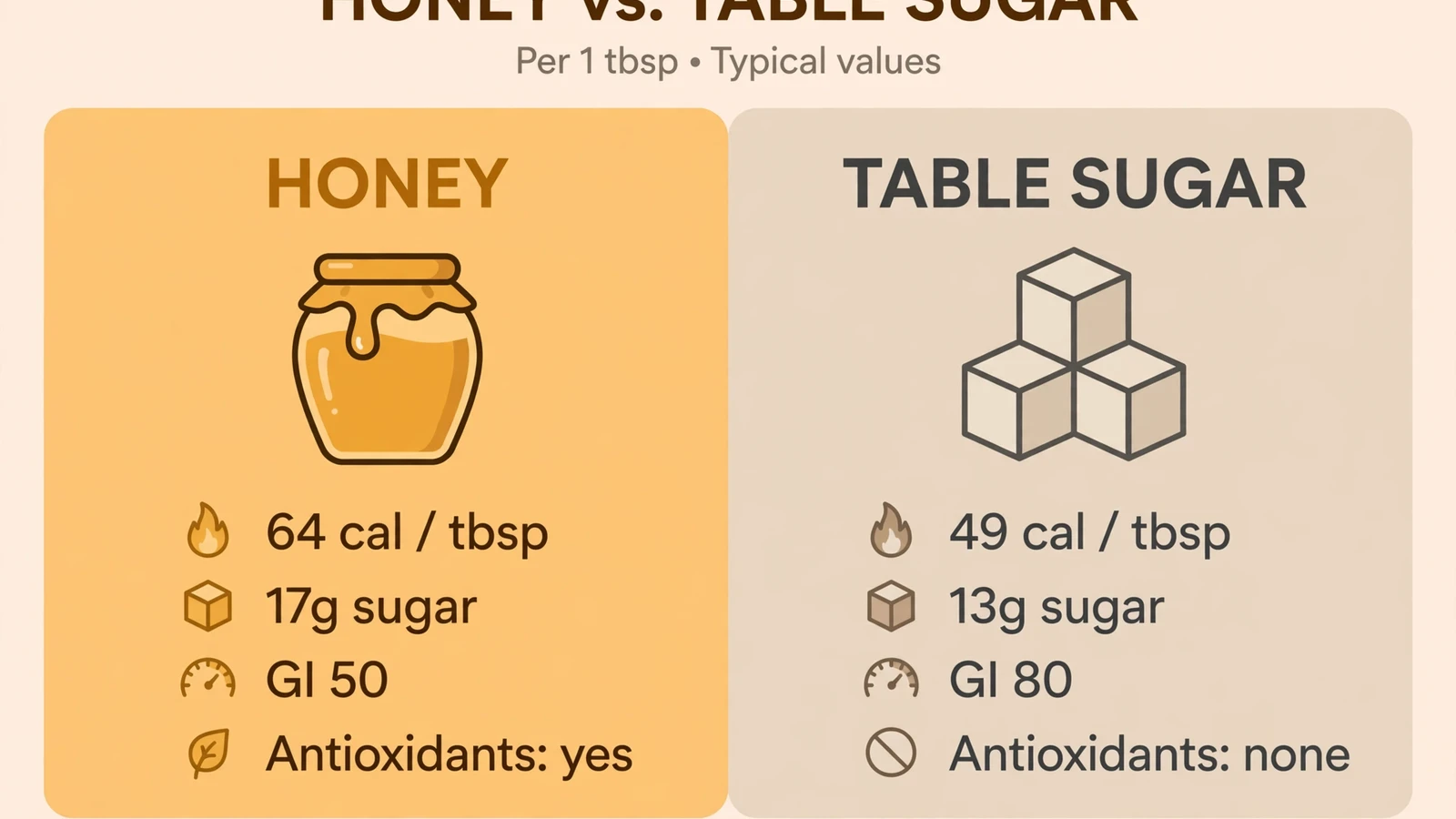
Honey also has a lower glycaemic index (GI): 50 for honey versus 80 for table sugar. That means honey raises blood sugar a little less sharply than white sugar does — though it still raises it quickly, like all carbohydrates. Dietitians note that GI responses vary with the type of honey, the amount eaten and individual factors such as insulin sensitivity.
What honey has that sugar doesn’t
Unlike refined white sugar, honey contains plant compounds called flavonoids and phenolic acids, which are types of antioxidants. It also has antibacterial properties and has been used for centuries on wounds, and the American Academy of Pediatrics recommends honey as a cough remedy for children older than 1 year.
These extras come with a caveat. Both WebMD and registered dietitians point out that honey’s vitamins and minerals occur in amounts too small to make a meaningful nutritional contribution — honey is a sweetener, not a multivitamin.
Raw vs processed honey: does it matter?
Raw, unpasteurised honey is often sold as the healthiest option because it is simply strained from the hive to the bottle. This preserves polyphenols and antioxidants that are usually killed during pasteurisation. Both raw and filtered honey are still about 95% carbohydrates, and some filtered honey may even contain added sugars — so raw is the purer choice, but the nutritional gap is modest.
Does the lower GI make honey better for blood sugar?
Only a little. A 2022 meta-analysis of 18 small studies found that some types of honey slightly lowered fasting blood sugar, but a 2021 systematic review found that too much honey can increase glucose levels in people with type 2 diabetes. WebMD’s conclusion: there is no likely benefit to swapping sugar for honey if you have diabetes, since both affect blood sugar in similar ways.
Harvard Health is even more direct: all added sugars are metabolised the same way, and while honey contains bioactive compounds, they have “little benefit when it comes to metabolic health.” For most people, they conclude, one type of sugar is not better than another.
Honey still counts as sugar — watch your total
However you slice it, honey is free sugar. The NHS counts the sugars in honey and syrups as free sugars, which should make up no more than 5% of the calories you get from food and drink each day — no more than 30g a day for adults, roughly seven sugar cubes. Eating too much sugar contributes to weight gain and tooth decay, and the NHS names honey among the free-sugar foods to limit at mealtimes.
In practice, honey’s extra sweetness can work in your favour: because you may need less of it to get the same sweetness, switching from sugar to honey may modestly cut your total sugar intake — but only if you actually use less.
Who should avoid honey?
Babies must never be given honey. Honey given to children younger than 12 months may cause a severe food poisoning called botulism, and the CDC says not to add it to food, water, formula or a dummy. This applies to raw and pasteurised honey alike, since either type can carry bacterial spores.
People with diabetes should count honey exactly as they would sugar and talk to a doctor or dietitian before adding it to their diet. Honey is also high in fructose, so people with digestive conditions such as IBS may find it hard to tolerate — talk to a doctor or pharmacist if that sounds like you.
The verdict: honey has a small edge, not a free pass
On balance, honey comes out marginally ahead of white sugar: it offers trace antioxidants, antibacterial properties, a lower GI and a stronger flavour that encourages smaller portions. But it is still a concentrated sugar with slightly more calories per spoon, and the evidence does not show a clear health advantage. The biggest win is simply using less sweetener overall — whichever jar it comes from.
- Use honey’s stronger sweetness to your advantage: start with a teaspoon and taste before adding more.
- Choose raw honey without added ingredients if you prefer the purer option.
- Count honey in your daily sugar limit, just as you would sugar.
- Never give honey to babies under 1.
When to see a doctor
Most people can use honey in normal amounts without issue, but see a GP if you notice unexpected symptoms after eating it, have an allergic reaction, or are unsure how it fits with diabetes, medication or a digestive condition. Talk to a doctor or pharmacist if honey seems to upset your stomach or your blood sugar readings change. In an emergency call 911 (US), 999 (UK) or 112 (EU)
Frequently asked questions
Is honey better than sugar for diabetes?
Not in any meaningful way. Honey has a lower glycaemic index than white sugar (50 versus 80), but WebMD notes there is no likely benefit to swapping one for the other since both affect blood sugar in similar ways. Research on honey and diabetes is mixed and mostly from small studies. If you have diabetes, count honey exactly as you would sugar and talk to your doctor or dietitian before adding it to your diet.
Is honey a free sugar?
Yes. The NHS counts the sugars naturally present in honey, syrups and nectars as free sugars, alongside sugars added to food and drink. UK guidance says free sugars should make up no more than 5% of the calories you get from food and drink each day — no more than 30g a day for adults, roughly seven sugar cubes. So honey should be counted in your daily sugar limit just like table sugar.
Does honey have fewer calories than sugar?
No — it has slightly more per spoon. A tablespoon of honey has around 64 calories and 17g of sugar, while a tablespoon of white sugar has about 49 calories and 13g of sugar. However, dietitians point out that honey tastes sweeter, so many people use less of it. Switching to honey only cuts your sugar intake if you actually use a smaller amount.
Can babies have honey?
No. The CDC warns that honey given to children younger than 12 months may cause infant botulism, a severe food poisoning, and says not to add honey to a baby's food, water, formula or dummy. The risk applies to raw and pasteurised honey alike, since either type can carry bacterial spores that produce a dangerous toxin in an infant's intestines. Honey becomes acceptable after a child's first birthday.
Is raw honey healthier than regular honey?
Slightly. Raw honey is simply strained from the hive, preserving polyphenols and antioxidants that are usually destroyed during pasteurisation. Both raw and processed honey are still about 95% carbohydrates, and some processed honey may even contain added sugars, so the nutritional gap is modest. If you buy honey, raw without added ingredients is the purer choice — but treat it as sugar either way.
Sources
- NHS: Sugar — the facts www.nhs.uk
- WebMD: Honey vs. Sugar for Diabetes: Glycemic Index & Safety www.webmd.com
- GoodRx: Is Honey Healthier Than Sugar? www.goodrx.com
- Harvard Health: Are certain types of sugars healthier than others? www.health.harvard.edu
- CDC: Foods and Drinks to Avoid or Limit (infant & toddler nutrition) www.cdc.gov
- Cleveland Clinic (via moneytalksnews): Think Honey Is Healthier Than Sugar? What to Know www.moneytalksnews.com

Try the tool
Not sure if it can wait?
Common causes and warning signs for 16 everyday symptoms.
Open the symptom guide

