Is Turmeric Good for Inflammation? What Science Says
Turmeric's active compound curcumin shows anti-inflammatory effects in lab studies, and small trials hint at joint pain relief — but the evidence is low quality, absorption is poor, and no guidelines recommend it as a treatment.
- Written by
- Health Daily Advice
- Published
- Reading time
- 4 minutes
- Sources
- 7 cited

In this guide
Yes, probably — but modestly. Turmeric’s active compound curcumin shows anti-inflammatory effects in laboratory studies, and some small trials found pain relief for knee osteoarthritis similar to anti-inflammatory drugs. Yet the evidence is low quality, the body absorbs curcumin poorly, and no clinical guidelines recommend turmeric as an inflammation treatment.
What is curcumin?
Turmeric is the bright yellow spice that gives curry its colour, made from the root of the Curcuma longa plant. Its main active ingredient is curcumin, a plant compound with antioxidant and anti-inflammatory properties in laboratory research, according to Cleveland Clinic. It is worth knowing that turmeric spice contains only a few per cent curcumin — most clinical trials used concentrated extracts, not the powder from the kitchen cupboard.
What the research shows on turmeric and inflammation
The strongest human evidence is for joint pain. A 2021 systematic review of 10 studies involving 1,287 participants found that, compared with placebo, turmeric may ease knee osteoarthritis pain and improve function to a degree similar to nonsteroidal anti-inflammatory drugs — but the reviewers stressed that optimal dosing, frequency and formulation remain unclear, reports the US National Center for Complementary and Integrative Health (NCCIH).
That caution is echoed elsewhere. A 2018 meta-analysis of 69 randomised trials in the British Journal of Sports Medicine found only three trials tested turmeric for osteoarthritis; turmeric showed a moderate effect on short-term pain and function scores (standardised mean differences of −1.19 and −1.13), summarised by a rheumatologist writing in The Rheumatologist.
For exercise-related muscle soreness, the picture is similar: a 2020 review of 11 studies found curcumin reduced the subjective intensity of muscle pain and exercise-induced muscle damage (measured by lower creatine kinase levels), while modulating pro-inflammatory signals such as TNF-α, IL-6 and IL-8, per the NCCIH. Beyond joints, trials have hinted at benefits in inflammatory bowel disease and oral or skin inflammation, but the same 2021 review concluded that “further high-quality studies are needed to firmly establish the clinical efficacy” of turmeric.
Crucially, in spite of its long history of use for inflammatory disorders, the NCCIH states there is still insufficient evidence to support turmeric supplementation for these conditions — and no clinical guidelines recommend it as a treatment.
The absorption problem: why black pepper matters
One of curcumin’s greatest downfalls is that the body absorbs it poorly: it is not very water-soluble and is rapidly broken down by the gut and liver. That is why turmeric products are so often paired with black pepper. The pepper compound piperine has been shown to boost curcumin absorption by up to 2,000% — in one study, adding 20 mg of piperine to 2 g of curcumin increased its absorption significantly, reports Healthline, citing the research. Piperine appears to ease curcumin’s passage through the intestinal wall and slow its breakdown by the liver.
Fat helps too: curcumin is fat-soluble, so eating it with oils, avocado, nuts or seeds can aid absorption — which is also why it is often cooked in hot, fatty food, notes Cleveland Clinic. However, even with these tricks, experts still debate how much active curcumin actually reaches inflamed tissues.
What is hype
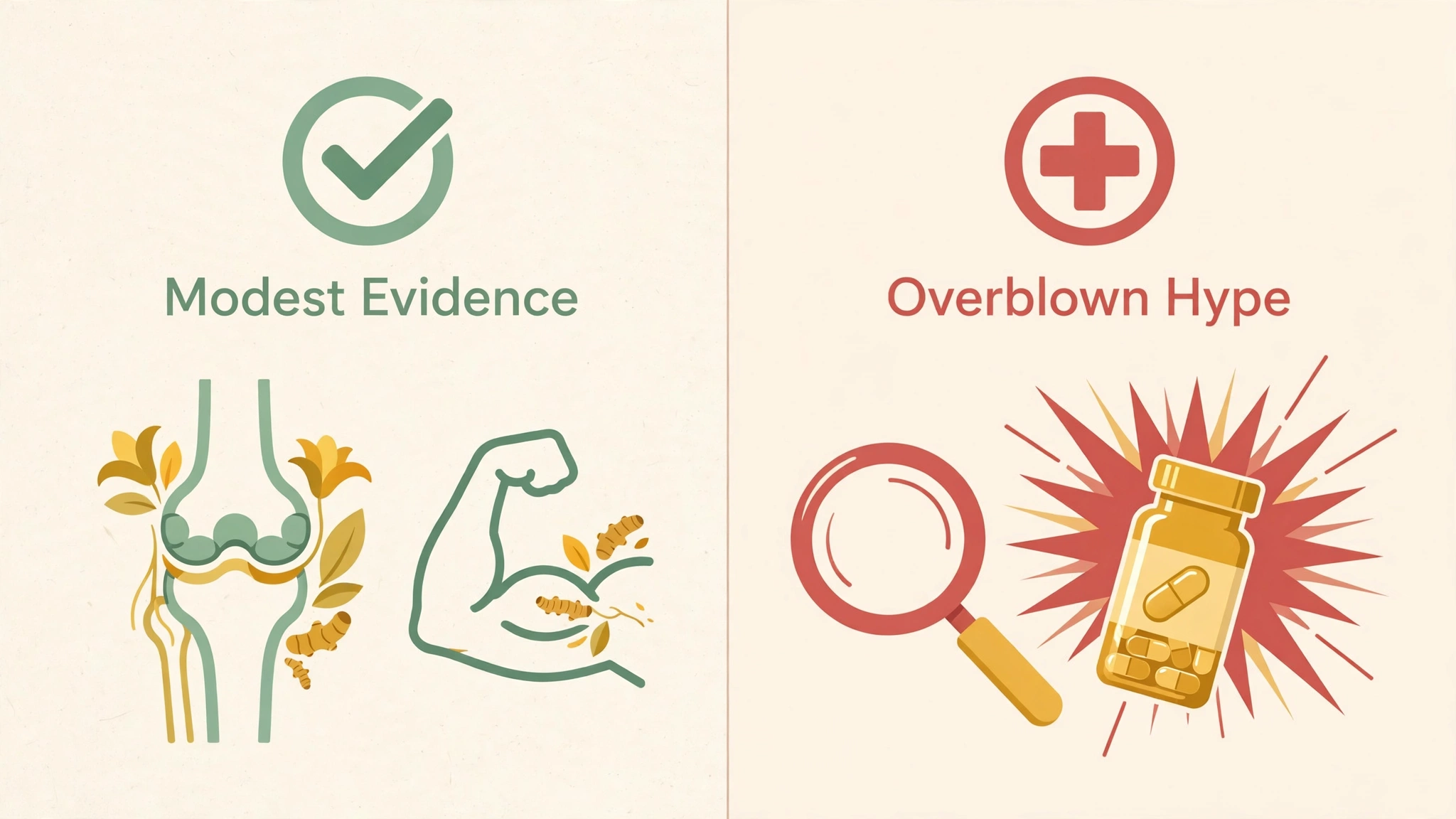
Some claims go far beyond the evidence. Claims that turmeric “cures cancer” or “detoxes” the body rest mainly on test-tube and animal studies — Healthline notes that test-tube studies suggest curcumin can affect cancer growth at the molecular level, but that is very different from a treatment that works in people. Similarly, social media posts claiming turmeric wipes out chronic inflammation are misleading: trials are small, short and low quality, and reviewers consistently call for larger, longer studies before firm conclusions can be drawn.
As one rheumatologist puts it, studies have demonstrated turmeric’s anti-inflammatory and antioxidative properties, but “we need more data to determine if it is truly effective for joint pain” — and it should be seen as, at most, an adjunctive therapy alongside proven treatments, writes Dr Samantha Shapiro in The Rheumatologist.
Who should talk to a doctor first
Turmeric as a food spice is fine for most people, but higher amounts deserve care. Very high doses — upward of 8,000 mg daily — may cause gastrointestinal upset or bleeding, especially in people taking blood thinners such as warfarin, warns The Rheumatologist. High doses or long-term use can also cause indigestion, nausea or diarrhoea, notes the NCCIH. Because curcumin can interact with medicines, talk to your GP or pharmacist before taking turmeric or curcumin supplements — especially if you take blood thinners or medicines for diabetes or blood pressure.
When to see a doctor
Turmeric will not diagnose or treat the cause of your inflammation, so get medical advice if joint pain, swelling or stiffness persists, keeps coming back, or stops you doing normal activities. Swelling, heat or redness in one joint, or joint pain with a fever, should be checked promptly.
In an emergency call 911 (US), 999 (UK) or 112 (EU).
Frequently asked questions
Does turmeric actually reduce inflammation?
Laboratory studies show curcumin, turmeric's main active compound, has anti-inflammatory effects, and some small human trials found it eased knee osteoarthritis pain similarly to common anti-inflammatory drugs. But the trials are small and low quality, dosing is unclear, and the NCCIH says evidence is still insufficient to support turmeric supplements for inflammatory disorders. It may help modestly as an add-on, not a proven treatment.
Can I take turmeric instead of ibuprofen for joint pain?
No — not without medical advice. One review found turmeric's effect on knee osteoarthritis pain similar to anti-inflammatory drugs, but trials were small, short and low quality, and no clinical guidelines recommend turmeric as a substitute for prescribed medicines. Never stop or replace prescribed treatment on the strength of supplement claims; talk to your GP or pharmacist first.
Why is turmeric always paired with black pepper?
Because curcumin is poorly absorbed. Black pepper contains piperine, which research shows can boost curcumin absorption by up to 2,000% — in one study, 20 mg of piperine added to 2 g of curcumin raised absorption significantly. Piperine seems to help curcumin pass through the intestinal wall and slows its breakdown by the liver. Fat with meals also helps, since curcumin is fat-soluble.
Is turmeric safe with blood thinners?
Check with your GP or pharmacist first. Turmeric as a food spice is generally fine, but very high doses (above 8,000 mg daily) may cause bleeding, especially in people on blood thinners such as warfarin, according to a rheumatologist's review. High doses can also cause gut upset. Mention all medicines and supplements to your prescriber before starting turmeric supplements.
Can turmeric cure cancer or detox the body?
No. Cancer claims come from test-tube and animal studies, where curcumin affected cancer cells at the molecular level — very different from a treatment that works in people. There is no clinical evidence that turmeric cures cancer or detoxifies the body. Cleveland Clinic frames cancer benefits as an area needing more research. Be sceptical of any product promising miracle results.
How much turmeric should I have each day?
There is no official recommended amount. Cooking amounts are safe for most people, and experts note a joint FAO/WHO committee set an acceptable intake of 3 mg of curcumin per kilogram of body weight per day. If you are considering supplements, talk to your GP or pharmacist first — especially if you take medicines or have a health condition — rather than guessing a dose yourself.
Sources
- NCCIH: Nutritional Approaches for Musculoskeletal Pain and Inflammation www.nccih.nih.gov
- The Rheumatologist: Turmeric — the evidence for therapeutic use for arthritis www.the-rheumatologist.org
- Cleveland Clinic: Turmeric health benefits and side effects health.clevelandclinic.org
- Healthline: Why turmeric and black pepper is a powerful combination www.healthline.com
- Nanavati K et al. Effect of curcumin supplementation on exercise-induced muscle damage: a narrative review (PMC) pmc.ncbi.nlm.nih.gov

Try the tool
Not sure if it can wait?
Common causes and warning signs for 16 everyday symptoms.
Open the symptom guide