How Long Do Thanksgiving Leftovers Last? The 3–4 Day Rule
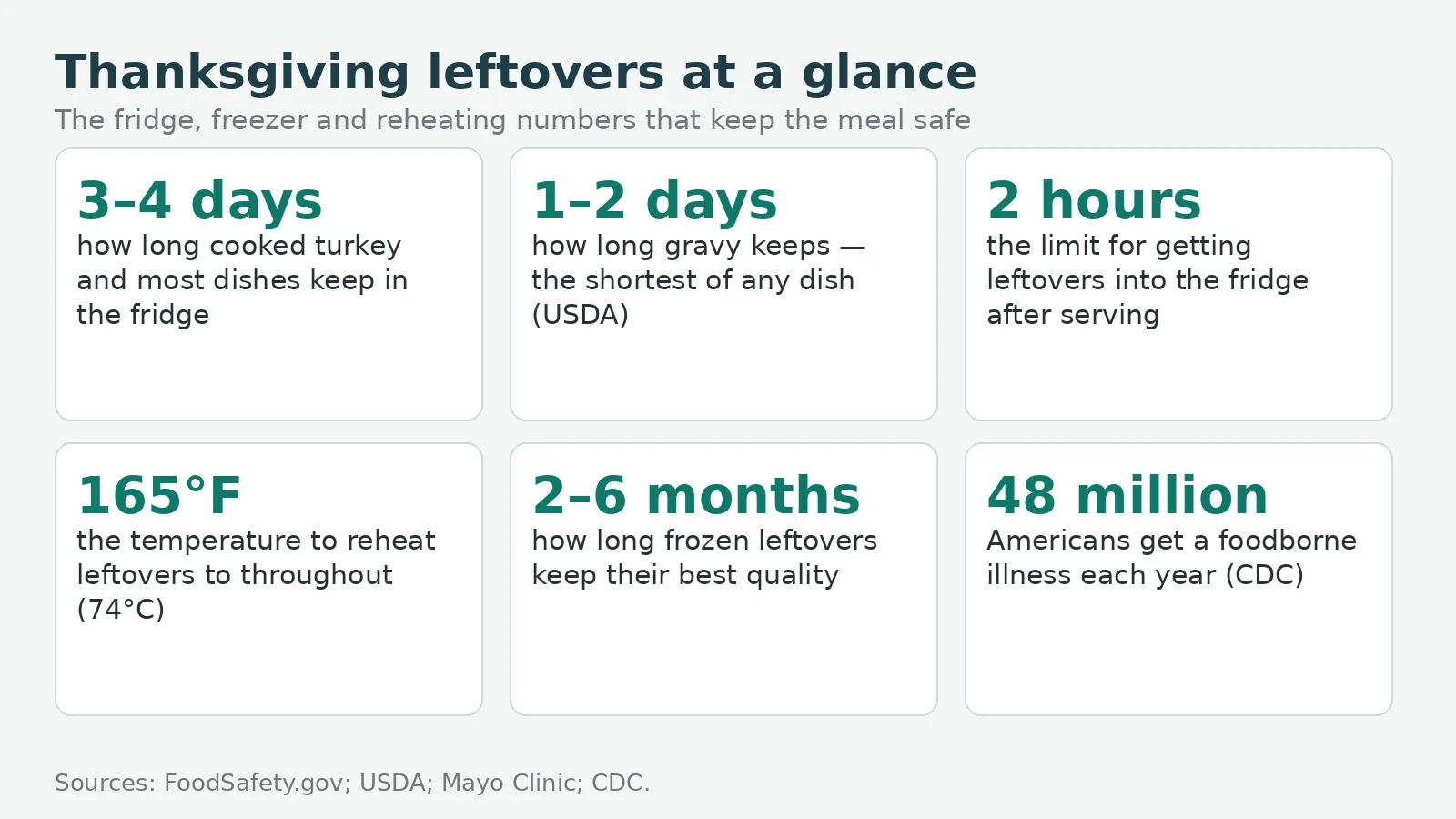
Cooked turkey and most Thanksgiving dishes keep 3–4 days in the fridge, so food from Thursday 26 November must be eaten or frozen by Monday 30 November. Gravy keeps only 1–2 days.
- Written by
- Health Daily Advice
- Published
- Reading time
- 5 minutes
- Sources
- 8 cited
In this guide
Thanksgiving leftovers keep for three to four days in the fridge, so food cooked on Thursday 26 November 2026 needs to be eaten or frozen by Monday 30 November. Gravy is the exception: use it within one to two days. The clock starts as soon as the meal ends, not when you finally get around to clearing the table.
How long does each Thanksgiving dish last?
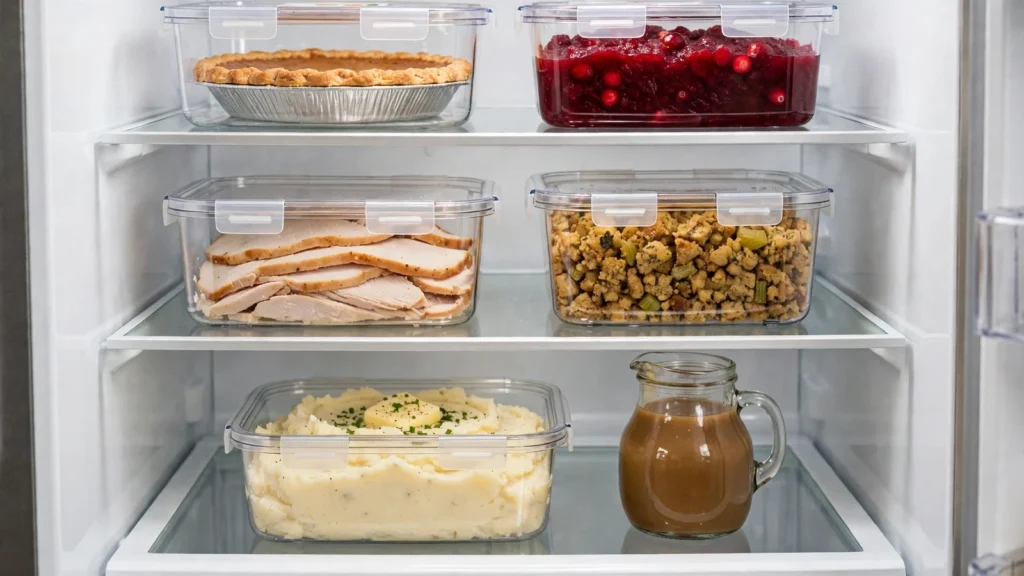
The United States Department of Agriculture (USDA) and FoodSafety.gov give the same headline rule for almost everything on the table: three to four days in the fridge. The table below pulls together the per-dish times from the USDA, FoodSafety.gov, Mayo Clinic and university extension services.
| Dish | In the fridge | In the freezer |
|---|---|---|
| Cooked turkey (sliced or in pieces) | 3–4 days | Best quality 2–6 months |
| Stuffing or dressing (stored separately) | 3–4 days | 4–6 months |
| Gravy | 1–2 days | 4–6 months |
| Mashed potatoes, sweet potatoes and casseroles | 3–4 days | 2–6 months |
| Pumpkin or pecan pie | 3 days | Not recommended |
| Fruit pie (no egg or dairy filling) | Up to 2 days at room temperature | Not recommended |
Gravy is the one dish where the guidance differs: the USDA and Rutgers University say to use it within one to two days, while Penn State Extension, citing USDA guidance, groups it with the three-to-four-day dishes. The safer one-to-two-day figure is the one to follow. Pumpkin pie sits in a similar grey area — FoodSafety.gov gives three to four days for custard-based pies, while Penn State says within three days — so plan on three. Cranberry sauce has no separate official window, so treat it under the general three-to-four-day rule like everything else.
The Monday rule: eat it or freeze it by 30 November
Thanksgiving 2026 falls on Thursday 26 November, which makes the deadline easy to remember: leftovers refrigerated on Thursday night must be eaten or frozen by Monday 30 November. FoodSafety.gov puts it the same way — “you have until the Monday after Thanksgiving.” Anything still in the fridge on Tuesday should go in the bin, even if it looks and smells fine.
The deadline is not about the food going stale. After four days, spoilage bacteria can make food smell or taste off, but the germs that cause food poisoning usually do not change how food looks, smells or tastes at all. That is why the USDA’s advice is blunt: when in doubt, throw it out. In USDA research, 31% of people said they would eat leftovers kept longer than four days — a habit worth breaking.
The two-hour rule and the danger zone
Leftovers should go into the fridge within two hours of cooking or serving — within one hour if the temperature is above 90°F (32°C), for example at an outdoor gathering. Bacteria grow fastest between 40°F (4°C) and 140°F (60°C), the range food-safety experts call the danger zone, so food left sitting on the table spends that time in exactly the conditions germs like best.
One common mistake is waiting for food to cool to room temperature before refrigerating it. In a recent USDA study, 76% of people said they would let leftovers cool first. That is not necessary and can make food unsafe: put leftovers in the fridge as soon as possible, even if they are still steaming. To help them cool quickly, divide them into small portions in shallow, airtight containers rather than putting a whole turkey or a deep pan straight into the fridge. And always take the stuffing out of the bird before refrigerating — its moisture and density help bacteria grow, and it cools too slowly inside the turkey.
Your fridge itself matters too. Keep it at 40°F (4°C) or below and the freezer at 0°F (−18°C) or below, and check with a thermometer rather than guessing: a fridge that runs warm can quietly cut the safe window short.
Freezing Thanksgiving leftovers
Freezing is the safety valve for anything you will not finish by Monday. Frozen leftovers keep their best quality for two to six months — plain turkey slices up to about four months, turkey covered in broth or gravy up to six. The important distinction is that freezer times are about quality, not safety: food kept continuously at 0°F stays safe indefinitely, though its flavour and texture fade over time. Mayo Clinic suggests eating frozen leftovers within three to four months for the best taste.
Label containers with the date before they go in, so a mystery tub in January does not become a guessing game. Thaw frozen leftovers in the fridge, in the microwave, or in a leakproof container in cold water — never on the kitchen counter. A whole frozen turkey needs about 24 hours per five pounds in the fridge, so a 20-pound bird takes four to five days to thaw.
How to reheat leftovers safely
Reheat leftovers until they reach 165°F (74°C) all the way through, checked with a food thermometer rather than by touch. Bring sauces, soups and gravy to a rolling boil. In the microwave, cover the food and stir or rotate it partway through, because microwaves leave cold spots where germs can survive — check the temperature in several places. It is safe to reheat frozen leftovers without thawing them first; it just takes longer. Never reheat leftovers in a slow cooker: the slow temperature rise can let bacteria multiply instead of killing them.
Why food poisoning is worth taking seriously
The stakes are higher than a ruined weekend. The Centers for Disease Control and Prevention (CDC) estimates that about 48 million Americans — roughly one in six — get sick from a foodborne illness each year, of whom 128,000 are hospitalised and 3,000 die. Norovirus causes the most illnesses, while non-typhoidal Salmonella is the deadliest foodborne germ. Food poisoning symptoms often include an upset stomach, loose stools, vomiting, stomach pain and fever, and usually start within hours or days of eating the food, according to Mayo Clinic.
Most healthy adults recover without treatment, but infants and children, pregnant people, older adults and anyone with a weakened immune system face a higher risk of serious illness. That is one more reason to treat the four-day rule as a hard deadline rather than a suggestion.
When to see a doctor
See a doctor or get emergency care if you have nervous-system symptoms such as blurry vision, muscle weakness or tingling skin, changes in how you think or act, a fever of 103°F (39.4°C) or higher, frequent vomiting, loose stools lasting more than three days, or signs of dehydration such as great thirst, a dry mouth, little or no urination, or feeling weak, dizzy or lightheaded, according to Mayo Clinic. Children dehydrate faster than adults, so seek care sooner for a child with vomiting and loose stools, especially with little or no urination, great thirst, weakness, dizziness, bloody stools or a fever.
In an emergency call 911 (US), 999 (UK) or 112 (EU). If you are unsure whether a food was stored safely, the USDA Meat and Poultry Hotline (1-888-674-6854) can answer questions on weekdays.
Frequently asked questions
How long does cooked turkey last in the fridge?
Cooked turkey keeps 3–4 days in the refrigerator, according to FoodSafety.gov and the USDA. That means turkey cooked on Thanksgiving Thursday 26 November 2026 should be eaten or frozen by Monday 30 November. Slice it and store it in shallow, airtight containers so it cools quickly, and keep the fridge at 40°F (4°C) or below.
Can you eat Thanksgiving leftovers after 4 days?
No — leftovers kept longer than 4 days in the fridge should be thrown away, even if they look and smell fine. The germs that cause food poisoning usually do not change how food looks, smells or tastes. If you will not finish them by day four, freeze them instead: frozen leftovers keep their best quality for 2–6 months.
How long does Thanksgiving gravy last?
Gravy keeps the shortest time of any Thanksgiving dish: the USDA and Rutgers University say to use it within 1–2 days. Some guidance groups gravy with the 3–4 day dishes, but the safer 1–2 day figure is the one to follow. In the freezer, gravy keeps for 4–6 months, and it should be brought to a rolling boil when reheated.
Can you freeze Thanksgiving leftovers?
Yes. Most Thanksgiving leftovers freeze well and keep their best quality for 2–6 months — plain turkey slices up to about 4 months, turkey in broth or gravy up to 6 months. Food kept continuously at 0°F stays safe indefinitely, so freezer times are about taste and texture rather than safety. Thaw frozen leftovers in the fridge, microwave or cold water, never on the counter.
How do you reheat Thanksgiving leftovers safely?
Reheat leftovers to 165°F (74°C) all the way through, checked with a food thermometer. Bring sauces, soups and gravy to a rolling boil. In the microwave, cover the food and stir or rotate it so there are no cold spots. Never reheat leftovers in a slow cooker, as the slow temperature rise can let bacteria grow. Frozen leftovers can be reheated without thawing first.
Can you tell if leftovers are bad by smelling them?
No. After about 4 days, spoilage bacteria can make food smell or taste off, but the bacteria that cause food poisoning usually do not change how food looks, smells or tastes. Mayo Clinic and Rutgers both warn not to trust your senses: if you are unsure whether a food was stored safely, throw it out. In USDA research, 31% of people said they would eat leftovers older than 4 days.
Sources
- FoodSafety.gov: Thanksgiving Leftovers for Safe Keeping, Weekend Grazing www.foodsafety.gov
- FoodSafety.gov: Cold Food Storage Chart www.foodsafety.gov
- USDA: Happy Leftovers Day! www.usda.gov
- CDC: Facts About Food Poisoning www.cdc.gov
- Mayo Clinic: Food poisoning: How long can you safely keep leftovers? www.mayoclinic.org
- Mayo Clinic: Food poisoning — symptoms and causes www.mayoclinic.org
- Penn State Extension: Holiday Leftovers extension.psu.edu
- Rutgers Cooperative Extension: Turkey Talk extension.rutgers.edu

Try the tool
Not sure if it can wait?
Common causes and warning signs for 16 everyday symptoms.
Open the symptom guide