Are Eggs Bad for Your Cholesterol? What the Science Says
One egg has 186 mg of cholesterol — so are eggs bad for it? The evidence says saturated fat matters far more, and up to one egg a day is fine for most people.
- Written by
- Health Daily Advice
- Published
- Reading time
- 6 minutes
- Sources
- 10 cited

In this guide
No — for most people, eggs are not bad for cholesterol. One large egg has 186 mg of cholesterol, but dietary cholesterol affects blood cholesterol far less than saturated fat does. Research finds up to one egg a day is not linked to higher heart disease risk, though people with diabetes or very high cholesterol should check with a doctor.
How much cholesterol is in an egg?
One large egg contains about 186 mg of cholesterol, according to figures from the US Department of Agriculture cited by the Mayo Clinic and the Cleveland Clinic. All of that cholesterol sits in the yolk — egg whites contain none at all. A medium egg has around 180 mg, the British Heart Foundation says.
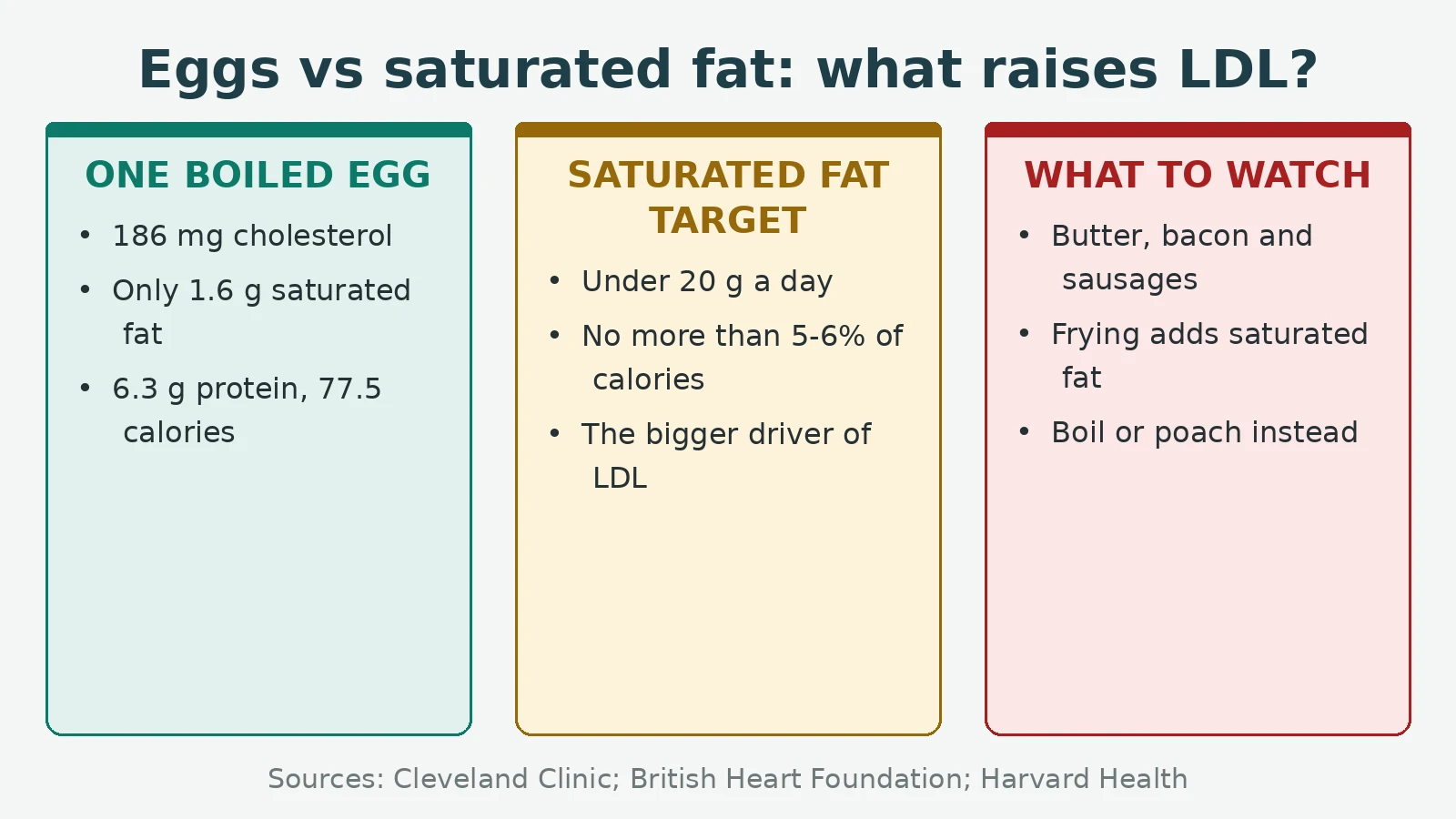
For comparison, a single boiled egg also delivers 6.3 g of protein, 77.5 calories and only about 1.6 g of saturated fat. It is one of the few foods that naturally contains vitamin D, and it provides choline, selenium, and lutein and zeaxanthin, which support eye health.
Do eggs raise your blood cholesterol?
Only a little, for most people. The liver makes most of the cholesterol in your blood itself — only about 10 to 20% comes from food — and when you eat more cholesterol, the liver usually cuts back its own production. That is why the old daily limit of 300 mg of dietary cholesterol was dropped from US dietary guidelines in 2015.
The bigger driver is saturated fat. The British Heart Foundation puts it plainly: saturated fat has “a much bigger impact” on blood cholesterol than dietary cholesterol. A Cleveland Clinic dietitian says the same — the total saturated fat you eat contributes more to LDL, the “bad” cholesterol, than the cholesterol in food does.
The effect of eggs is not zero, though. Evidence from randomised controlled trials shows that eating one to three eggs a day causes a mild increase in blood cholesterol in the general population, cardiologist Dr Janet Wei told Cedars-Sinai in September 2026. And some people are “hyper-responders” who react much more strongly to dietary cholesterol than others.
What the research says about eggs and heart disease
The strongest evidence comes from large, long-running studies. A 2020 analysis in the BMJ followed 215,618 people for up to 32 years and pooled data from 33 studies covering 1,720,108 participants. Eating at least one egg a day, compared with less than one a month, was not linked to higher cardiovascular risk — the hazard ratio was 0.93. For each extra egg a day, the pooled relative risk for cardiovascular disease was 0.98, for coronary heart disease 0.96 and for stroke 0.99 — all effectively no change.
Not every study agrees. A 2019 analysis in JAMA of 29,615 US adults found each extra half egg a day was linked to a 6% higher risk of cardiovascular disease and 8% higher all-cause mortality — but diet was measured only once, with outcomes tracked up to 30 years later, and the links weakened once red meat and other foods were accounted for. Harvard’s commentary said the findings would not change general healthy eating guidelines.
A 2025 umbrella review of 14 meta-analyses, published in Nutrition, Metabolism and Cardiovascular Diseases, found no association between high and low egg consumption and any cardiovascular outcome or all-cause mortality. It did find slightly higher LDL cholesterol with higher egg intake — up 7.39 mg/dL on average — but rated that evidence “very weak”. Its conclusion: there is insufficient evidence to discourage egg consumption, and eggs can be part of a healthy diet.
Perhaps the most telling recent evidence is a clinical trial published in The American Journal of Clinical Nutrition in July 2025. Sixty-one adults, average age 39 with average LDL of 135 mg/dL, each followed three five-week diets: two eggs a day with high cholesterol but low saturated fat; no eggs with low cholesterol but high saturated fat; and a control of one egg a day with both high cholesterol and high saturated fat. The two-eggs-a-day, low-saturated-fat diet resulted in lower LDL than the control — while the egg-free, high-saturated-fat diet did not. Harvard Health’s verdict: saturated fat, not dietary cholesterol, drives LDL up.
How many eggs can you eat?
There is no single number for everyone — it depends on your health. The main guidance is:
| Who you are | Guidance | Source |
|---|---|---|
| Healthy adult | 1–2 eggs a day is unlikely to be a problem; no set limit | British Heart Foundation |
| Healthy adult | Up to 7 eggs a week (one a day) without increasing heart disease risk | Mayo Clinic; American Heart Association |
| Heart disease or high cholesterol | Limit to about 4 yolks a week | Cleveland Clinic, based on AHA guidance |
| Diabetes | Some research links 7 eggs a week to higher heart disease risk; evidence is mixed — ask your doctor | Mayo Clinic |
| Familial hypercholesterolaemia | Be careful with dietary cholesterol; keep it to 300 mg a day, ideally nearer 200 mg — discuss with your GP or dietitian | British Heart Foundation |
Cedars-Sinai’s cardiology team sums it up the same way: one egg a day is unlikely to significantly raise cholesterol or heart disease risk for most people, and a healthy total cholesterol range is 140–200 mg/dL, with LDL under 100 mg/dL.
What matters more than the egg
How eggs are cooked, and what is served with them, makes the biggest difference, the British Heart Foundation says. Boiled or poached eggs, or eggs cooked in a small amount of vegetable oil, are healthy choices. Frying in butter or ghee, or adding cream, piles on saturated fat.
The classic fry-up is the real problem, not the egg: bacon, sausages, butter, fried bread and cheese add the saturated fat and salt that raise LDL. The Mayo Clinic notes that the foods typically eaten with eggs “might do more to boost heart disease risk than eggs do”. Dietary guidelines suggest aiming for under 20 g of saturated fat a day, and the American Heart Association advises no more than 5–6% of calories from saturated fat. Replacing 5% of saturated fat intake with unsaturated fat can cut heart disease risk by 15–25%, according to Harvard Health.
Overall diet pattern matters most: plenty of vegetables, fruit, wholegrains, beans, pulses, nuts and seeds, with less salt, sugar and saturated fat. An egg on wholegrain toast with spinach and tomato is a very different meal from eggs with bacon and buttered white bread.
Are eggs good for you?
Yes, in the context of a balanced diet. A large boiled egg provides 6.3 g of complete protein — all nine essential amino acids — plus vitamin D, B12, selenium and choline, a nutrient the body needs for brain and nervous system function. The Mayo Clinic notes some studies link up to seven eggs a week with a lower risk of certain types of stroke and of macular degeneration, the eye condition that affects central vision.
None of this means eggs are a health food to eat without limit. But the old idea that the cholesterol in an egg automatically becomes cholesterol in your blood has not survived the evidence. For most people, one egg a day, cooked simply and eaten as part of a balanced diet, is fine.
When to see a doctor
If you have high cholesterol, heart disease, diabetes or familial hypercholesterolaemia, ask your GP or dietitian how many eggs are right for you before settling on a daily habit. A cholesterol blood test is the only way to know your own numbers — total cholesterol, LDL and HDL — and your doctor can explain what they mean for you.
Seek urgent help for chest pain or pressure, breathlessness, or pain spreading to the arm, jaw or back. In an emergency call 911 (US), 999 (UK) or 112 (EU).
Frequently asked questions
How many eggs can I eat a day?
For most healthy adults, one egg a day is fine, and the British Heart Foundation says one to two a day is unlikely to be a problem. The American Heart Association and the Mayo Clinic put it at up to seven eggs a week. If you have heart disease or high cholesterol, aim for about four yolks a week, and if you have diabetes or familial high cholesterol, ask your GP or dietitian what is right for you.
Do eggs raise cholesterol?
A little, but far less than people once feared. One large egg has about 186 mg of cholesterol, yet dietary cholesterol has a much smaller effect on blood cholesterol than saturated fat does, because the liver makes most of your cholesterol and cuts back when you eat more. Trials show one to three eggs a day cause only a mild rise in blood cholesterol, and large studies find no link between up to one egg a day and heart disease.
Are egg whites better than whole eggs?
Egg whites have no cholesterol and no fat, so they suit people who need to limit yolks. But the yolk holds most of the egg's nutrients: vitamin D, B12, choline, selenium and the eye-protecting lutein and zeaxanthin. For most healthy people, whole eggs are the better choice, eaten in moderation. If your doctor has advised limiting yolks, use one whole egg plus extra whites to keep the protein without the extra cholesterol.
Can I eat eggs if I have high cholesterol?
Usually yes, but in smaller amounts. The Cleveland Clinic, following American Heart Association guidance, suggests people with heart disease or high cholesterol limit themselves to about four yolks a week, and egg whites can be eaten freely. How you cook them matters too: boil or poach rather than fry in butter, and skip the bacon and sausages. Your own cholesterol numbers and overall diet matter more than any single food, so check with your doctor.
Is it OK to eat eggs every day?
For most healthy adults, yes. Large studies following hundreds of thousands of people for decades found no higher heart disease risk from up to one egg a day, and a 2025 review of 14 meta-analyses reached the same conclusion. Keep the rest of your diet in mind, though: an egg with wholegrain toast and vegetables is a healthy meal, while eggs with bacon, butter and fried bread every day are not.
What is the healthiest way to cook eggs?
Boiled, poached or scrambled in a small amount of vegetable oil are the healthiest options, because they add almost no saturated fat. Frying in butter or ghee adds saturated fat, and serving eggs with bacon, sausages or cheese adds much more. What you eat with your eggs often matters more than the egg itself, so pair them with wholegrain toast, spinach, tomatoes or mushrooms rather than a full fry-up.
Sources
- British Heart Foundation: Are eggs high in cholesterol? www.bhf.org.uk
- Mayo Clinic: Eggs: Are they good or bad for my cholesterol? www.mayoclinic.org
- Cleveland Clinic: How Eggs Affect Cholesterol and Your Heart health.clevelandclinic.org
- Harvard Health: Enjoy eggs — just skip the bacon www.health.harvard.edu
- Cedars-Sinai: Are Eggs Bad for Cholesterol? What the Science Says www.cedars-sinai.org
- Medical News Today: How many eggs can you eat per week? www.medicalnewstoday.com
- Formisano et al. (2025) umbrella review, Nutrition, Metabolism and Cardiovascular Diseases doi.org
- Drouin-Chartier et al. (2020) Egg consumption and risk of cardiovascular disease, BMJ doi.org

Try the tool
Not sure if it can wait?
Common causes and warning signs for 16 everyday symptoms.
Open the symptom guide