What Is Astaxanthin? Benefits, Evidence and Safety
Astaxanthin is the pigment behind salmon's pink colour and one of the most searched supplements of November 2026. Here is what the human evidence actually supports — and where the claims run ahead of the science.
- Written by
- Health Daily Advice
- Published
- Reading time
- 5 minutes
- Sources
- 7 cited
In this guide
Astaxanthin is the red pigment that gives salmon, shrimp and lobster their colour, made by a tiny algae called Haematococcus pluvialis. Sold as a supplement, it is marketed for skin, eyes, heart and brain health. The human evidence is real but modest: a few small trials show benefits, while many bigger claims rest on lab studies and animal research.
The red pigment behind salmon’s pink colour
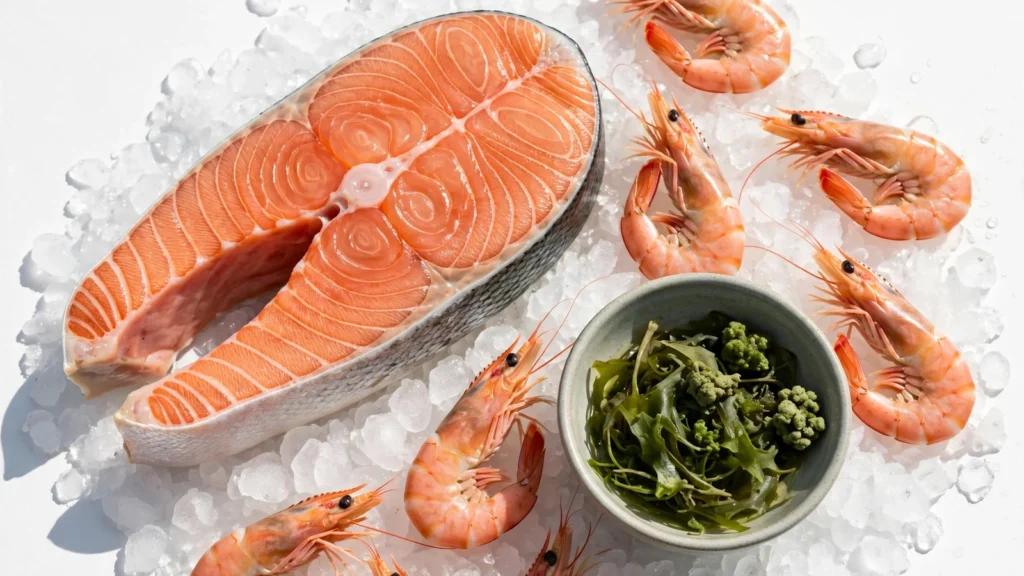
Astaxanthin is a carotenoid — a pigment in the same family as beta-carotene, lutein and lycopene — that gives salmon, shrimp, lobster and crayfish their reddish colour. It is made by tiny algae, above all the freshwater microalga Haematococcus pluvialis, which produces more of it than any other natural source and is the source used to make most supplements. Unlike beta-carotene, the body does not turn astaxanthin into vitamin A, and it is not an essential vitamin.
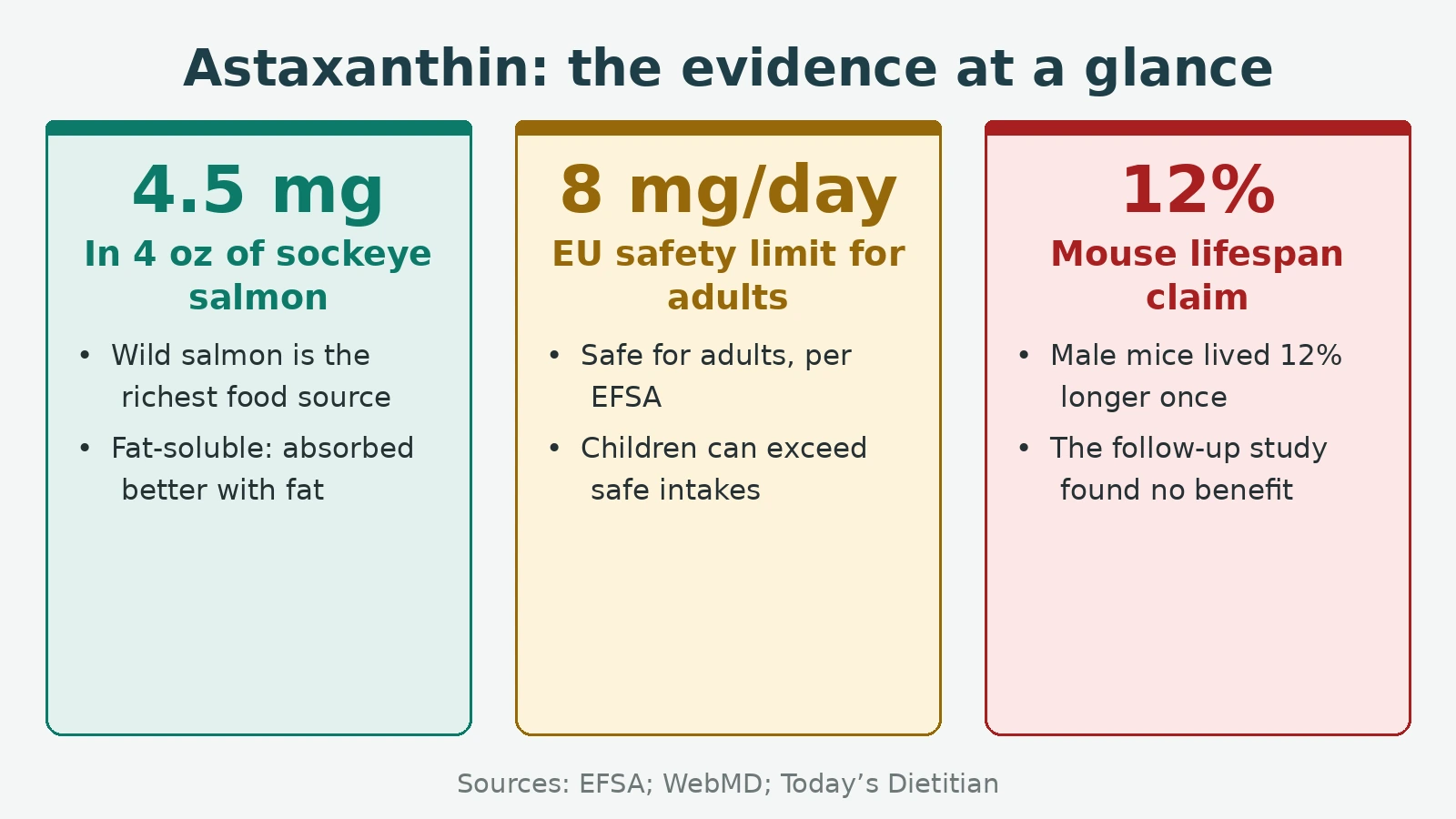
It is also the reason flamingos are pink: the birds pick it up from the algae and small creatures they eat. In food, the richest sources are pink seafood — wild salmon, rainbow trout, shrimp and lobster. A four-ounce serving of sockeye salmon contains about 4.5 milligrams. Astaxanthin is fat-soluble, so it is absorbed better when eaten with fat, such as olive oil, nuts or oily fish.
In the body it acts as an antioxidant, mopping up the unstable molecules known as free radicals, and it may damp down inflammation. That is the basis for most of the health claims made about it — but the leap from a strong antioxidant in a test tube to a proven benefit in people is exactly where the evidence gets thin.
What the human evidence actually shows
Skin: the best-supported area — and still small trials
The strongest human evidence is for skin. A 2021 systematic review and meta-analysis of 11 studies found that oral astaxanthin significantly improved skin moisture and elasticity compared with a placebo, but did not significantly reduce wrinkle depth. The trials were small, and more and larger studies are needed before the skin benefits can be stated with confidence.
Eyes: some promise for dry eye and screen strain
Some clinical trials have found that astaxanthin supplements help with mild-to-moderate dry eye, and other studies suggest it may ease eye strain from computer use. Reviews note improvements across several eye conditions, including diabetic retinopathy and age-related macular degeneration, but stress that longer trials are needed before any firm conclusions can be drawn.
Heart: one promising study, not proof
A 2023 study of people with prediabetes and abnormal blood fats found that astaxanthin was linked to significantly lower LDL and total cholesterol, along with other cardiovascular risk markers, compared with a placebo over 24 weeks. That is promising, but it is a single study measuring blood markers — not heart attacks or strokes — and experts say more systematic studies are needed before any heart benefit can be confirmed.
Brain and immunity: early days
Animal studies show astaxanthin can cross the blood-brain barrier, and it is being studied for its possible role in brain ageing and dementia — but human evidence is thin, and no trial has shown it prevents or treats any brain disease. For immunity, one small trial in young healthy women found an enhanced immune response at 8 milligrams a day over eight weeks. Both areas need much larger human trials before any claims can be made.
The longevity claim — and why it fell apart
Astaxanthin has been widely sold as an anti-ageing supplement, and the claim traces back to a study from the US National Institute on Aging’s Interventions Testing Program. In one group of mice, astaxanthin extended median lifespan in males by 12%. But when the same programme re-tested it in a later group of mice, at a different dose and starting age, there was no lifespan benefit at all — and in females, pooled data even pointed to shorter lifespans, though that effect disappeared when one test site was excluded. There is no human evidence that astaxanthin extends life, and the researchers themselves caution against reading too much into a single mouse study.
Safety: what we know
Astaxanthin is generally considered safe, and studies — including some in children — have not reported serious side effects. The most common complaints are stomach discomfort, more frequent bowel movements, reddish stools and mild stomach pain. European regulators have judged that 8 milligrams a day from supplements is safe for adults, even alongside astaxanthin from food. But at that level, teenagers aged 10 to 14 would exceed the acceptable daily intake, and children under 10 would exceed it by far — so supplements are not suitable for children unless a doctor advises it.
Some people should be cautious. Astaxanthin should be avoided in pregnancy, and there is no safety data for breastfeeding. People with bleeding disorders, diabetes, autoimmune conditions, low blood pressure or hormone problems should talk to a doctor first. The most serious warning comes from a published case report: a 69-year-old woman on the blood thinner warfarin developed bruising and a dangerous rise in her blood-clotting measure (INR, from 1.4 to 10.38) the day after she started taking astaxanthin. It is a single case, and she was also taking aspirin, but it is a reminder to tell your doctor about blood thinners or any other medicine before taking a supplement.
There is one more practical point: supplements are not regulated like medicines. In the US, the Food and Drug Administration treats them like food, and the quality of the active ingredient can vary widely between brands. No standard dose has been set for any condition, and most studies have used between 2 and 12 milligrams a day.
What astaxanthin is not
Astaxanthin is not a medicine, and it is not a substitute for medical treatment. It has not been shown to prevent or treat Alzheimer’s, Parkinson’s, heart disease, cancer or diabetes — those are areas where studies are early or animal-based. And despite the marketing, it is not a proven longevity supplement: the one striking mouse result did not replicate. The honest summary of the evidence is modest: a red pigment with real antioxidant power, some small human trials showing benefits for skin moisture and possibly dry eyes, and a long list of claims still waiting for proof.
When to see a doctor
Talk to a doctor or pharmacist before taking astaxanthin — or any supplement — especially if you take blood thinners such as warfarin, blood pressure or diabetes medicines, if you are pregnant or breastfeeding, or if you have liver disease or take medicines that affect the liver. Seek medical advice promptly if you notice unusual bruising or bleeding, an allergic reaction such as difficulty breathing, itching or a rash, or any new symptom after starting a supplement. In an emergency call 911 (US), 999 (UK) or 112 (EU).
Frequently asked questions
What is astaxanthin?
Astaxanthin is a red carotenoid pigment made by tiny algae, above all Haematococcus pluvialis, that gives salmon, shrimp and lobster their colour. It is fat-soluble, it is not turned into vitamin A in the body, and it acts as an antioxidant. Most supplements are made from the algae, and the pigment is also used to colour farmed salmon and shrimp feed.
What foods contain astaxanthin?
Pink seafood is the main source: wild salmon, rainbow trout, shrimp, lobster, crab and crayfish. A four-ounce serving of sockeye salmon contains about 4.5 milligrams. It is also what makes flamingos pink. Because astaxanthin is fat-soluble, it is absorbed better when eaten with fat, such as olive oil, nuts or oily fish.
Does astaxanthin help skin?
The evidence is modest but real. A 2021 systematic review and meta-analysis of 11 studies found that oral astaxanthin significantly improved skin moisture and elasticity compared with a placebo, but it did not significantly reduce wrinkle depth. The trials were small, and more and larger studies are needed before the skin benefits can be stated with confidence.
Is astaxanthin safe?
For most adults, astaxanthin is generally considered safe, and studies have not reported serious side effects. European regulators judge 8 milligrams a day from supplements safe for adults. Common side effects are mild stomach discomfort, more frequent bowel movements and reddish stools. It should be avoided in pregnancy, and children should not take it unless a doctor advises it. Tell your doctor about blood thinners before taking it.
Can astaxanthin help you live longer?
There is no human evidence that it can. The claim comes from a mouse study in which astaxanthin extended median lifespan in males by 12%. But when the same research programme re-tested it in a later group of mice, at a different dose and starting age, there was no lifespan benefit at all. The researchers caution against reading too much into a single mouse study.
Should I take astaxanthin supplements?
That is a decision for you and your doctor or pharmacist, not for an article. There is no standard dose for any condition, and supplements are not regulated like medicines, so quality varies between brands. It is especially important to ask first if you take blood thinners, blood pressure or diabetes medicines, or if you are pregnant, breastfeeding or have liver disease.
Sources
- WebMD: Astaxanthin — Health Benefits, Uses, Risks and Side Effects www.webmd.com
- Today's Dietitian: Ask the Expert — Astaxanthin www.todaysdietitian.com
- EFSA: Safety of astaxanthin for its use as a novel food in food supplements (2020) efsa.onlinelibrary.wiley.com
- Cleveland Clinic: Health Benefits of Shrimp health.clevelandclinic.org
- Zhou et al.: Systematic Review and Meta-Analysis on the Effects of Astaxanthin on Human Skin Ageing, Nutrients 2021 pubmed.ncbi.nlm.nih.gov
- Korstanje et al.: Astaxanthin and other compounds do not increase lifespan in UM-HET3 mice, Geroscience 2026 pubmed.ncbi.nlm.nih.gov
- Santiyanon & Yeephu: Interaction between warfarin and astaxanthin — a case report, J Cardiol Cases 2019 pubmed.ncbi.nlm.nih.gov

Try the tool
Not sure if it can wait?
Common causes and warning signs for 16 everyday symptoms.
Open the symptom guide