Is Beetroot Juice Good for You? Benefits and Downsides
Beet juice's nitrates can lower blood pressure and slightly boost endurance, but it can turn urine red and is not for everyone. Here is the honest evidence.
- Written by
- Health Daily Advice
- Published
- Reading time
- 4 minutes
- Sources
- 9 cited
In this guide
Yes, for many people: studies link beet juice’s natural nitrates to lower blood pressure and slightly better exercise endurance, because the body converts nitrates into nitric oxide, which relaxes blood vessels. But it can turn urine red, adds sugar without fiber, and may be risky with kidney disease or blood pressure drugs — so the evidence deserves an honest look.
First, a note on the name
In the United States the vegetable is usually called beets; in the United Kingdom it is known as beetroot. Either way, the deep-red juice sold in stores and made at home comes from the same vegetable, and this article uses the US wording from here on.
How beet juice works in the body
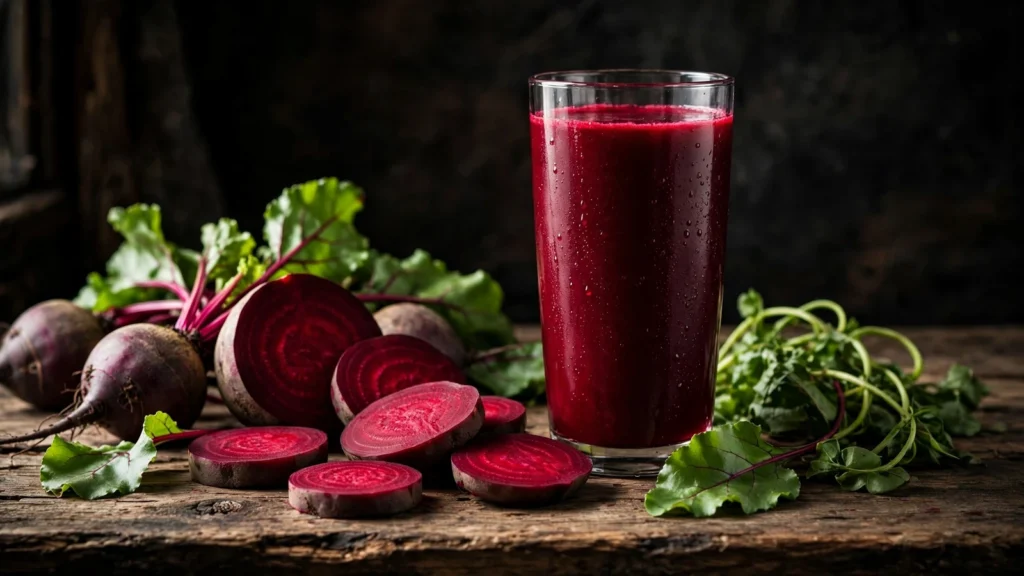
Beets are unusually rich in dietary nitrates. After you drink the juice, bacteria living on the tongue convert those nitrates to nitrite, and the nitrite is then converted in the stomach and tissues into nitric oxide — a signaling molecule that tells the smooth muscle around blood vessels to relax (Stanaway et al., 2019; Domínguez et al., 2017). That widening of blood vessels (vasodilation) is the mechanism behind most of beet juice’s claimed benefits: blood can flow more freely and pressure can fall.
Blood pressure: the strongest evidence
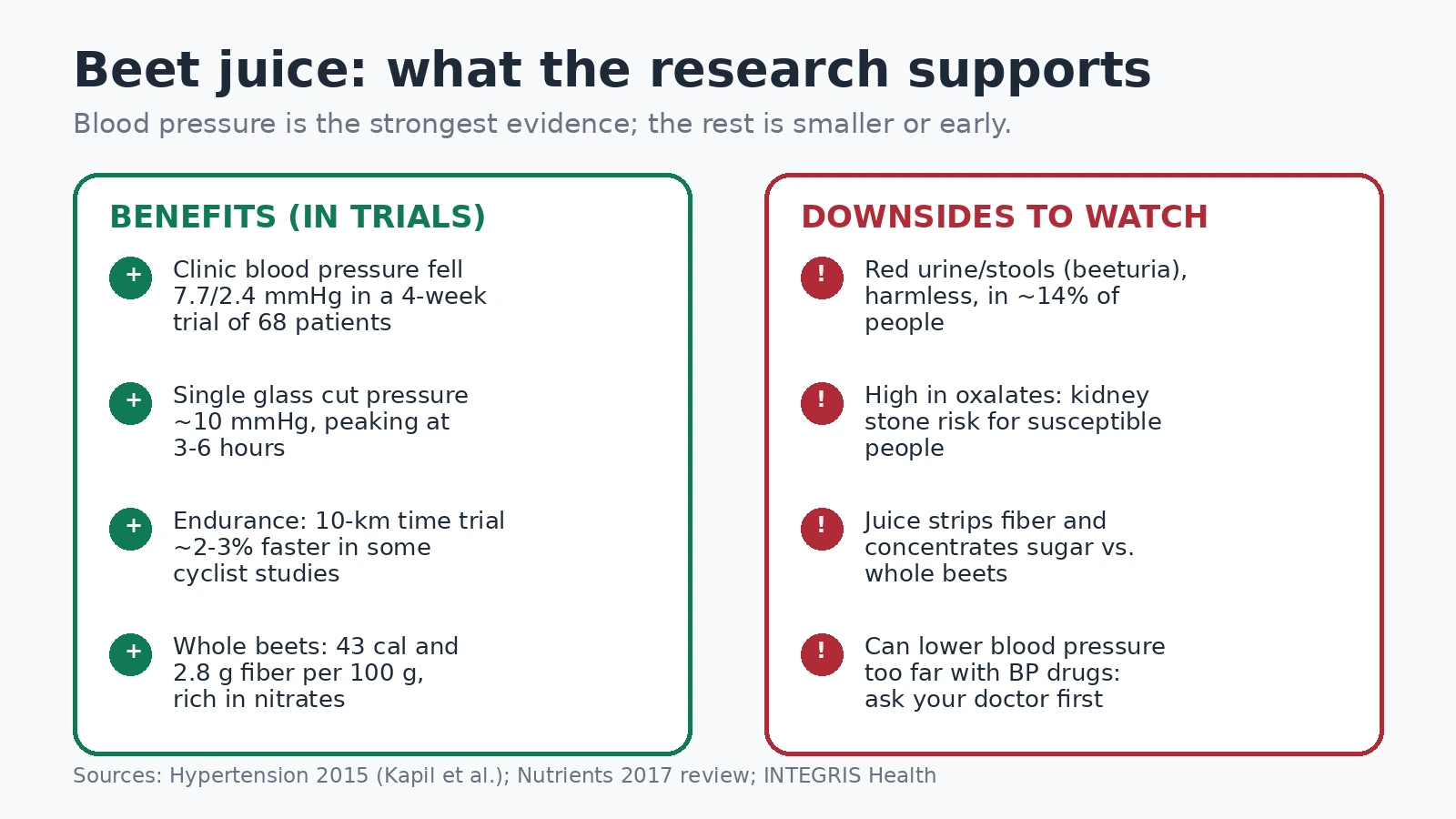
The blood-pressure research is the most convincing. In a 2015 British Heart Foundation-funded trial published in Hypertension, 68 adults aged 18 to 85 with high blood pressure drank 250 mL of beet juice daily for four weeks, against a nitrate-free placebo juice. Clinic blood pressure fell by 7.7/2.4 mmHg, 24-hour readings fell by 7.7/5.2 mmHg, and home readings by 8.1/3.8 mmHg; the lining of the blood vessels also worked about 20% better, and the treatment was well tolerated (Kapil et al., 2015). An earlier small trial found an average drop of about 10 mmHg peaking three to six hours after a single glass (Age UK summary of Webb et al., 2008). Notably, blood pressure crept back to its previous level within two weeks of stopping, so any effect depends on keeping the habit up — and the juice is not a replacement for prescribed medication.
Endurance and exercise: a smaller, mixed picture
A systematic review of 23 studies concluded that beet juice can improve cardiorespiratory endurance by making exercise more efficient — for example, trained cyclists finished a 10-km time trial in 953 seconds versus 965 on placebo, and time to exhaustion at 90% of maximum effort stretched from 160 to 185 seconds (Domínguez et al., 2017). The Australian Institute of Sport rates beet juice among supplements with strong supporting evidence. But the gains are modest (typically 2 to 3% in time trials), some studies find no benefit in elite athletes at all, and the effect can be weakened by caffeine taken alongside it.
Brain health: too early to claim
There is a plausible link — nitric oxide also boosts blood flow to the brain — and one small trial found slightly faster reaction times on a thinking test after a single dose, with a bigger blood-pressure drop in the over-50s than in younger adults (Stanaway et al., 2019). But reviews of older-adult trials describe the evidence as too small and inconsistent to claim real cognitive benefits. Treat brain-health claims as unproven for now.
Juice versus whole beets
Juicing concentrates the nitrates, but it also removes the fiber and leaves a sugar-heavy drink: “when you juice beets you lose the fiber and ingest more sugar than you would by eating a beet or two” (INTEGRIS Health). Whole beets carry about 43 calories, 9.56 g of carbohydrates and 2.8 g of fiber per 100 g — roughly 58 calories per cup — so eating the vegetable gives you fiber and a gentler sugar load alongside the same nitrates (USDA data via Medindia).
The downsides to know about
- Red urine and stools (beeturia). The betalain pigment can turn urine pink or red and darken stools. It is harmless and is estimated to affect around 14% of people — one study found 7 out of 8 regular beet-juice drinkers experienced it (INTEGRIS Health).
- Kidney stones. Beets are rich in oxalates, which can bind with calcium and form stones in people who are prone to them (INTEGRIS Health).
- Kidney disease. Beets contain substantial potassium, which matters if your kidneys cannot filter it properly — talk to a doctor or pharmacist if you have kidney disease.
- Stomach upset. The fermentable sugars (FODMAPs) in beets can cause gas, bloating and cramps, especially with irritable bowel syndrome; some people get mild diarrhea from concentrated juice (INTEGRIS Health; Ubie Health doctor’s note).
- Medication interactions. Because beet juice can lower blood pressure, combining it with blood pressure drugs, nitrate heart drugs or erectile-dysfunction drugs could push pressure too low — talk to your doctor or pharmacist first (Ubie Health doctor’s note).
- Rare allergy. People with a beet allergy can develop hives, throat tightness or, very rarely, anaphylaxis (INTEGRIS Health).
When to see a doctor
Talk to a doctor or pharmacist before adding beet juice if you have kidney disease, a history of kidney stones, or take blood pressure, heart or erectile-dysfunction medication. Get checked if red urine appears without having eaten or drunk beets, or if you develop severe stomach pain, swelling or signs of an allergic reaction. In an emergency call 911 (US), 999 (UK) or 112 (EU).
Frequently asked questions
Does beet juice lower blood pressure?
Evidence says yes, modestly. In a 2015 British Heart Foundation-funded trial of 68 adults with high blood pressure, daily beet juice cut clinic readings by 7.7/2.4 mmHg over four weeks, with effects reversing two weeks after stopping. An earlier small study found about 10 mmHg reduction peaking three to six hours after one glass. It complements, but never replaces, prescribed blood pressure treatment.
Can beet juice improve athletic performance?
Slightly, for most recreational athletes. A systematic review of 23 studies found beet juice improves exercise efficiency: in one trial, trained cyclists finished a 10-km time trial in 953 seconds versus 965 on placebo. The gains are small, typically 2 to 3%, and elite athletes often see no benefit at all. The effect can also be weakened by caffeine taken alongside the juice.
Why is my urine red after drinking beet juice?
It is called beeturia, and it is harmless. The betalain pigment that makes beets red passes into urine in an estimated 14% of people, and one study found 7 out of 8 regular beet-juice drinkers experienced it. Stools can look dark too. See a doctor if urine turns red when you have not eaten or drunk beets, since that needs checking.
Is beet juice bad for kidneys?
It can be for some people. Beets are rich in oxalates, which can form kidney stones in people prone to them, and they carry substantial potassium, which matters if your kidneys cannot filter it properly. People with a history of calcium oxalate stones or kidney disease should talk to a doctor or pharmacist before making beet juice a habit.
Can I drink beet juice if I take blood pressure medication?
Talk to your doctor or pharmacist first. Because beet juice can lower blood pressure, combining it with blood pressure drugs, nitrate heart drugs or erectile-dysfunction drugs could push pressure too low, causing lightheadedness or dizziness. The same caution applies to potassium-related risks with kidney disease. Do not change or skip prescribed medication for juice.
Sources
- INTEGRIS Health: Is Beet Juice Healthy? Benefits for Blood Pressure & Performance integrishealth.org
- Stanaway et al. 2019, Nutrients: Acute Supplementation with Nitrate-Rich Beetroot Juice (PMC6683255) pmc.ncbi.nlm.nih.gov
- Kapil et al. 2015, Hypertension: Dietary nitrate provides sustained blood pressure lowering (PMC4288952) pmc.ncbi.nlm.nih.gov
- Age UK: Beetroot link to lowering blood pressure www.ageuk.org.uk
- Medindia: Beets, raw - Nutrition Facts and Information (USDA-based) www.medindia.net
- Dominguez et al. 2017 systematic review: Beetroot Juice and Cardiorespiratory Endurance (PMC5295087) pmc.ncbi.nlm.nih.gov
- Nutra Business Review: Daily beet juice lowers blood pressure (Queen Mary University of London) nutraceuticalbusinessreview.com
- Ubie Doctor's Note: Beet Juice for ED - Harmless or Risky? ubiehealth.com

Try the tool
Not sure if it can wait?
Common causes and warning signs for 16 everyday symptoms.
Open the symptom guide