Tea and Heart Health: What a 486,000-Person Study Found
A study of nearly half a million adults links regular tea drinking with lower vascular disease risk — but how hot you drink it may matter as much as how much you drink.
- Written by
- Health Daily Advice
- Published
- Reading time
- 7 minutes
- Sources
- 9 cited

In this guide
Regular tea drinking was linked to an 11% lower risk of heart and blood vessel disease in a study of 486,000 adults followed for nine years. Black tea and moderate-strength brews showed the strongest links, while tea drunk “burning hot” was linked to a 16% higher risk. The study shows an association, not proof that tea protects the heart.
Tea is the most widely drunk beverage in the world after water, so even a small link between a daily cuppa and heart health matters at population level. A large new study from China, published in the Journal of Internal Medicine in October 2026, is the most detailed look yet at how the type, strength, temperature and amount of tea relate to vascular disease. Here is what it found, what it did not prove, and what it means for the way you drink your tea.
What did the new study actually find?
Researchers followed 485,934 adults aged 30 to 79 in the China Kadoorie Biobank for a median of 9.05 years. During that time, 14,863 people developed vascular disease — a broad group that includes heart disease, stroke and other conditions affecting the blood vessels, pulmonary heart disease and peripheral artery disease.
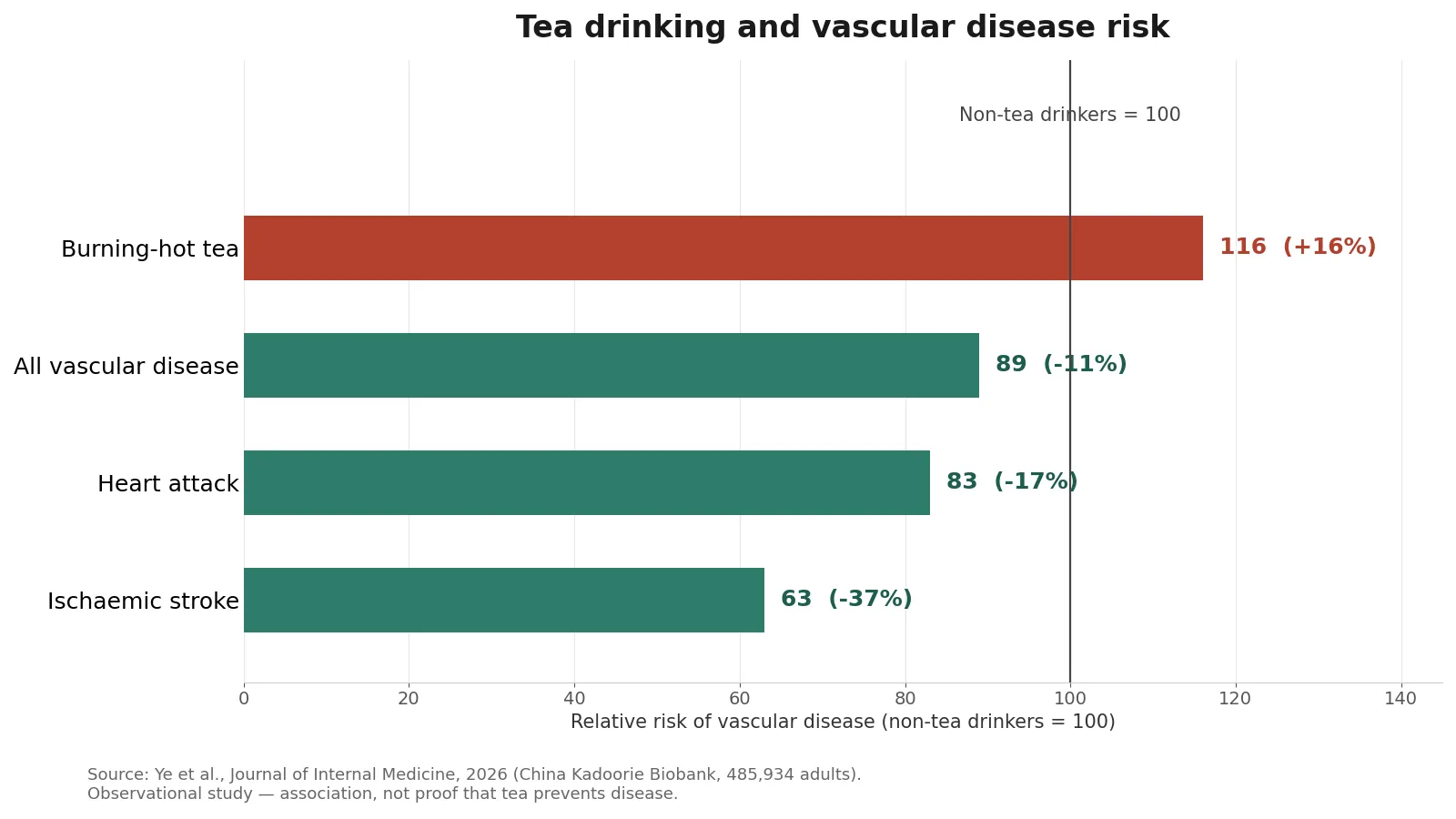
People who drank tea regularly had a lower risk of these conditions than people who did not drink tea regularly. The headline figure was a hazard ratio of 0.888, which works out at roughly 11% lower relative risk. The pattern held across several of the individual conditions the researchers tracked. Regular tea drinkers had about a 37% lower risk of ischaemic stroke — the kind caused by a blocked blood vessel in the brain — and about a 17% lower risk of heart attack, according to reporting of the study’s subtype results. There was no clear link for haemorrhagic stroke or for pulmonary heart disease.
It is worth pausing on what “11% lower” means. It is a relative figure: it compares the risk in tea drinkers with the risk in non-tea drinkers, and it says nothing about any one person’s absolute chance of developing heart disease. It also comes from an observational study. The researchers watched what people did and recorded what happened; they did not assign people to drink tea or not. That means tea itself may not be the cause — tea drinkers may simply differ from non-drinkers in other ways, such as diet, income or other habits, that the researchers could not fully account for.
How much tea was linked to the lowest risk?
Among people who drank tea at least weekly, the lowest estimated risk sat at around 6 to 8 cups a day. The relationship was not a straight line — risk fell as intake rose, then levelled off — so drinking more and more tea was not linked to ever-lower risk.
That 6 to 8 cup figure needs careful handling. The researchers and the experts commenting on the study were clear that it is not a recommended target. Tea intake was recorded once, at the start of the study, cup sizes were not standardised, and an observational study cannot show that drinking more tea caused the lower risk. Nobody should start forcing down eight cups a day in the hope of protecting their heart — and for many people, that much tea would mean a lot of caffeine and a lot of trips to the bathroom.
Does black tea beat green tea?
Surprisingly, yes — at least in this study. Black tea showed more consistent links with lower vascular disease risk than green tea did. That runs against the common assumption that green tea is always the healthier choice, and it is one of the findings the researchers themselves treat as exploratory, because they ran many comparisons and some patterns may have arisen by chance.
Both black and green tea come from the same plant, Camellia sinensis; they differ in how the leaves are processed. Black tea is heavily oxidised, green tea barely at all, and that changes the mix of plant compounds in the cup. Tea contains polyphenols, compounds that have attracted interest for their antioxidant effects and possible influence on blood vessel function, but the study does not show that polyphenols explain the difference between black and green tea. The practical message from independent experts is simpler: both are reasonable choices, and there is no reason to switch from a tea you enjoy to one you do not.
Strength mattered too. People who drank moderate-strength tea had the lowest associated risk — stronger tea was not linked to greater benefit. And, as with the type of tea, the study did not test whether changing the strength of your brew would change your risk.
Why does drinking tea “burning hot” matter?
This was the study’s most striking twist. People who said they drank their tea “burning hot” had a 16% higher risk of vascular disease (hazard ratio 1.160). The same habit that was linked to lower risk at a comfortable temperature was linked to higher risk when the tea was scalding.
The study did not identify a specific temperature that becomes harmful, and it did not establish how heat might affect blood vessels. So the finding should not be read as proof that hot tea damages your heart. But it fits with a wider body of evidence that very hot drinks are best avoided. The World Health Organization’s cancer agency classifies drinks above 65°C as “probably carcinogenic”, and a large Oxford study of almost 980,000 UK adults, published in September 2026, found that people who preferred their tea and coffee very hot had around three times the risk of one type of oesophageal cancer compared with people who preferred their drinks warm. Letting a freshly made cup cool for a few minutes is a simple, cost-free change.
What happened when tea was combined with exercise and not smoking?
The researchers also looked at tea drinking alongside other habits. The lowest risk of all was seen in people who drank tea habitually, did not smoke and were highly physically active — a combination linked to a hazard ratio of 0.548, or roughly 45% lower risk than the comparison group in that joint analysis. That is a much bigger difference than tea alone, and it underlines the study’s real message: tea is one small part of a pattern of habits, not a shortcut.
That pattern is consistent with what we already know about heart health. The NHS advice on preventing coronary heart disease centres on the familiar foundations: a healthy, balanced diet with plenty of fruit and vegetables, regular physical activity, a healthy weight, not smoking, keeping alcohol within 14 units a week and keeping blood pressure under control. Tea can sit comfortably inside that pattern — especially unsweetened tea, since adding sugar changes the picture — but it cannot stand in for any of it.
Does this match what earlier studies found?
Broadly, yes. A large UK Biobank study of 498,043 adults, published in the Annals of Internal Medicine in 2022, found that people who drank two or more cups of tea a day had a 9% to 13% lower risk of death from any cause than people who did not drink tea, with lower deaths from cardiovascular disease, ischaemic heart disease and stroke. That study, run by researchers at the US National Cancer Institute, found the pattern held regardless of whether people added milk or sugar, and regardless of genetic differences in how fast they metabolised caffeine. It was also observational, and its authors stressed that it did not show people should start drinking tea or change how much they drink.
Taken together, the two studies — one in China, one in the UK, both following around half a million people — point in the same direction. Regular tea drinking is consistently associated with modestly better cardiovascular outcomes. Neither study proves that tea causes the benefit, and neither supports a specific daily target.
What does this mean for your cuppa?
If you already enjoy tea, this study is reassuring: your habit is associated with better vascular health, not worse. A few sensible points follow from the evidence:
- Drink it at a comfortable temperature. Let a freshly poured cup cool for a few minutes rather than drinking it scalding hot.
- Keep it unsweetened where you can. The study’s findings should not automatically be extended to heavily sweetened tea drinks.
- Do not chase a number. Six to eight cups a day was where the lowest estimated risk appeared in this study, but it is not a target — and the amount that suits you depends on your caffeine tolerance, sleep and other health conditions.
- Remember the bigger picture. The largest differences in the study came from combining tea with not smoking and being active, not from tea alone.
Tea is a pleasant, low-calorie drink that fits well into a heart-healthy lifestyle. It is not a medicine, and it is not a substitute for the things that are proven to protect your heart: not smoking, moving regularly, eating well and keeping blood pressure, cholesterol and blood sugar in check. If you have heart disease, high blood pressure or another condition and you are unsure how much tea or caffeine suits you, talk to a doctor or pharmacist.
When to see a doctor
See a GP promptly if you notice chest pain or tightness, breathlessness, palpitations, fainting, or pain spreading to your arm, jaw or back — especially during exertion. Also get checked if you have risk factors such as high blood pressure, high cholesterol, diabetes or a family history of heart disease and have not had them reviewed recently. In an emergency call 911 (US), 999 (UK) or 112 (EU).
If you are worried about your heart, do not try to diagnose yourself from a study, however large. A GP can check your blood pressure and cholesterol, talk through your individual risk and advise on the steps that matter most for you.
Frequently asked questions
Does drinking tea lower your risk of heart disease?
It is linked to a lower risk, not proven to cause one. In a 2026 study of 485,934 adults, regular tea drinkers had about 11% lower risk of vascular disease than non-tea drinkers. The study was observational, so it cannot show that tea itself caused the difference. Tea can be part of a heart-healthy lifestyle, but it does not replace not smoking, exercise and a healthy diet.
How many cups of tea a day is best for heart health?
There is no recommended number. In the 2026 China Kadoorie Biobank study, the lowest estimated risk among weekly tea drinkers appeared at around 6 to 8 cups a day — but the researchers and independent experts stress this is not a target. Tea intake was recorded once, cup sizes were not standardised, and the study cannot prove that drinking more tea caused the lower risk.
Is black tea or green tea better for your heart?
In this study, black tea showed more consistent links with lower vascular disease risk than green tea, which surprised researchers because green tea is often assumed to be healthier. Both come from the same plant and both are reasonable choices. Independent experts say there is no reason to switch from a tea you enjoy, and the findings do not prove black tea is superior.
Is drinking very hot tea bad for you?
Possibly. In the 2026 study, people who drank their tea 'burning hot' had a 16% higher risk of vascular disease. The study did not identify a specific harmful temperature or explain the mechanism. Separately, the WHO's cancer agency classes drinks above 65°C as probably carcinogenic, and a large Oxford study linked very hot drinks to a higher risk of one type of oesophageal cancer. Letting tea cool for a few minutes is a simple precaution.
Does tea protect your heart if you smoke or never exercise?
Tea alone is unlikely to make much difference. In the study, the lowest risk was seen in people who drank tea habitually, did not smoke and were highly physically active. Tea was one part of a broader healthy pattern. The NHS advice on preventing heart disease centres on not smoking, regular activity, a healthy weight and a balanced diet, with blood pressure, cholesterol and blood sugar kept in check.
Sources
- Ye Z, et al. Habitual tea consumption is associated with lower cardiovascular disease risk. Journal of Internal Medicine, 2026 pubmed.ncbi.nlm.nih.gov
- Wiley press release: Can drinking tea help protect against cardiovascular disease? newsroom.wiley.com
- ScienceDaily: Drinking tea may help protect your heart, but there's a surprising catch sciencedaily.com
- Healthline: Heart Disease: 6 to 8 Cups of Tea Daily May Reduce Risk www.healthline.com
- National Cancer Institute: Tea Consumption Associated with Lower Risk of Death (UK Biobank) dceg.cancer.gov
- Oxford Population Health: Very hot drinks linked to threefold increase in oesophageal cancer risk www.ndph.ox.ac.uk
- NHS: Coronary heart disease — Prevention www.nhs.uk

Try the tool
Not sure if it can wait?
Common causes and warning signs for 16 everyday symptoms.
Open the symptom guide