Can You Really Rewire Your Brain? Neuroplasticity Explained
Yes, within limits: your brain can form new connections throughout life, but change is gradual and specific to what you practise. Here is what exercise, sleep, learning and therapy can actually change, and what brain-training hype cannot.
- Written by
- Health Daily Advice
- Published
- Reading time
- 7 minutes
- Sources
- 9 cited
In this guide
Yes, within limits. Your brain can form new connections and reorganise itself throughout life, a process called neuroplasticity, but change is gradual and specific to what you practise. Exercise, sleep, learning new skills and rehabilitation can support it, yet no app, supplement or short course can rewire your brain overnight.
It is no surprise that “brain health” and “neuroplasticity” are popular searches in October 2026. The idea that we can reshape our own brains is hopeful, but also easy to oversell. This guide separates what research actually supports from what it does not, so you can spend your effort where it counts.
What is neuroplasticity?
Neuroplasticity is your brain’s ability to absorb information and adapt to new challenges, forming new connections between its billions of neurons as you learn and experience new things. Cleveland Clinic describes it as an internal rewiring process that lets your mind grow and meet new demands, with real structural changes inside the brain as new synaptic connections form.
There are two broad kinds. Structural plasticity strengthens pathways as you learn and consolidate a skill. Functional plasticity builds pathways around damaged areas after an injury, helping other parts of the brain take over a job. That is why rehabilitation after a stroke or head injury is built around repeated, targeted practice rather than rest alone.
One spelling note: this article uses British spelling, so you will see “reorganise” (reorganize in US spelling) and “behaviour” rather than their American forms.
What research actually supports
Exercise
Regular movement is one of the best-supported brain habits. Cleveland Clinic notes that exercise brings benefits for the brain beyond neuroplasticity itself, and that trying a new exercise routine adds new movement experience for the brain to learn from. For a practical target, the NHS advises adults aged 19 to 64 to aim for at least 150 minutes of moderate intensity activity a week or 75 minutes of vigorous intensity activity a week, plus strengthening activities on at least 2 days a week. If you have not exercised for some time or you have a medical condition, talk to a doctor first about what is appropriate for you.
Sleep
Sleep is when the day’s learning is consolidated, in Cleveland Clinic’s words, and Mayo Clinic Press calls it one of the most important, yet often overlooked, strategies for brain health. Mayo Clinic Press reports that studies show people who do not sleep enough may be twice as likely to develop Alzheimer’s disease, alongside an increased risk of dementia. As a guide, an NHS community health service states that the average adult needs around seven to nine hours of sleep a night. Good sleep will not rewire your brain on its own, but poor sleep undermines almost every other brain habit.
Learning new skills
Learning something genuinely new — a language, an instrument, a sport — is a stronger driver of change than repeating something you already find easy. Mayo Clinic Press explains that moderately challenging activities such as reading, playing an instrument or learning a new skill can build cognitive reserve, which is how well your brain copes with change or decline, and that people who spend more time learning tend to have neural networks better equipped to adapt. Cleveland Clinic makes the same point in everyday terms: take a new route, try a new recipe, listen to new music, or sign up for a class. It is the new experience that counts, not how good you are at it.
Mindfulness and therapy
Mindfulness meditation is one of the few mental practices with brain-imaging evidence behind it. In a small Harvard study, 16 participants in an eight-week mindfulness course meditated for about half an hour a day, and MRI scans showed increased grey matter in the hippocampus, a region important for learning and memory, while the non-meditating control group showed no such changes. An earlier study of the same participants found reduced grey matter in the amygdala, a region linked to fear and stress, correlated with lower stress levels. Harvard Health itself cautions that the study was small, so this is promising evidence, not proof of a cure for anything.
Talking therapies work on a similar principle: practising new ways of responding to thoughts and situations, repeatedly, over time. If anxiety, low mood or trauma is affecting your daily life, talk to a doctor about therapy options rather than trying to “rewire” yourself alone.
Rehabilitation after injury
Neuroplasticity is also the basis of recovery after brain injury. Cleveland Clinic explains that after a stroke or traumatic head injury, new synaptic connections can create pathways that work around damaged areas, and that physical therapy and rehabilitation activities aim to use that regenerative force. Mayo Clinic Press adds that, over time and with a lot of practice, people can recover functions such as movement or speech because the brain functionally reorganises itself. Recovery is rarely complete or quick, and it needs professional rehabilitation — this is not something to attempt without medical guidance.
What neuroplasticity does NOT promise
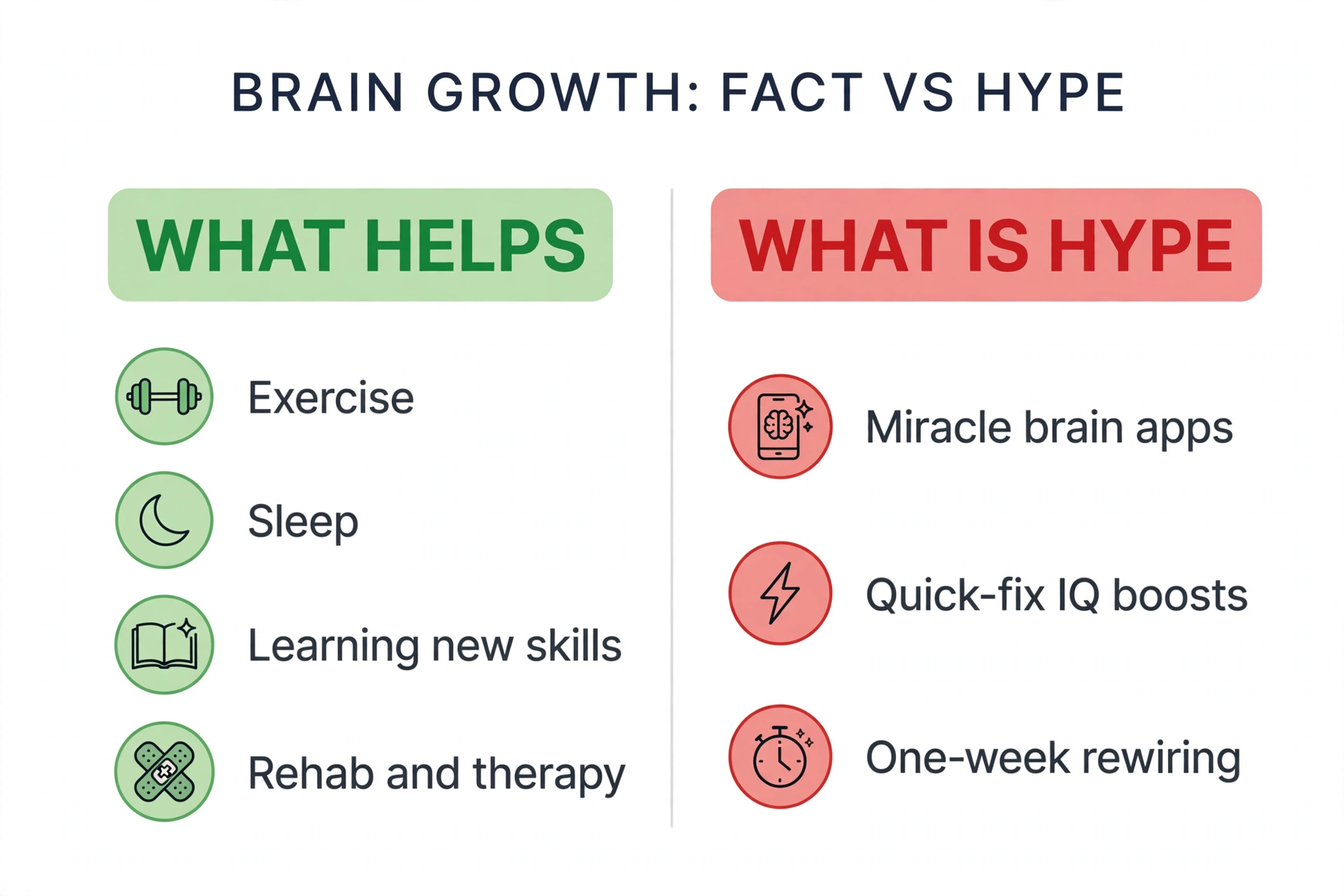
Brain-training games are the clearest example of oversold neuroplasticity. A systematic review that examined 132 journal articles cited by brain-training companies found no convincing evidence that computerised brain-training programs improve cognition in daily life, concluding that people improve on the specific tasks they practise, but that broader benefits are premature at best. In other words, a memory game mostly makes you better at that memory game.
Be sceptical of any product that promises to raise your IQ, reverse dementia, erase trauma in days, or rewire your brain in a week. Neuroplasticity is real, but it does not mean the brain can do anything, at any age, on any timescale. Age matters too: Cleveland Clinic notes that anybody at any age can benefit, but the process goes a bit easier when you are younger and may take more time and patience when you are older. Mayo Clinic Press likewise notes that brain development continues to mature into the mid-to-late 20s, and that the rate of brain shrinkage increases after 60 years of age — yet the brain retains its ability to adapt throughout life.
How long does change take?
There is no single timeline, because “change” can mean different things: feeling calmer after a few weeks of practice, performing a new skill more fluently after months of repetition, or regaining movement after injury over many months of rehabilitation. The Harvard mindfulness study found measurable brain changes after eight weeks of daily practice, which is a useful reality check — weeks, not days. Cleveland Clinic’s summary of neuroplasticity principles stresses repetition, intensity and salience: skills improve with repeated, focused, meaningful practice, and they weaken if you stop using them. Think in terms of a habit you can keep for months, not a challenge you finish in a weekend.
Mayo Clinic Press offers an encouraging example of a realistic timescale: an estimated 20% of people who catch COVID-19 experience a change in their sense of taste and smell, with another 20% experiencing prolonged changes, yet in an estimated 95% of people with these changes, neuroplasticity helps senses improve in less than a year, most effectively through smell retraining. Recovery happened, but it took months.
Practical, evidence-based habits
- Move regularly. Build towards the NHS activity target above, choosing movement you enjoy enough to repeat.
- Protect your sleep. Keep regular bed and wake times, and talk to a doctor if poor sleep is persistent rather than an occasional bad night.
- Learn one new thing properly. Pick a skill that challenges you — a language, an instrument, a new sport — and practise it in short, regular sessions.
- Break small routines. A new route, a new recipe or a new class gives your brain the novelty Cleveland Clinic recommends, without needing a grand overhaul.
- Stay socially connected. Conversation, group classes and shared activities combine learning, novelty and social engagement in one habit.
- Manage stress, don’t ignore it. Mindfulness, regular movement and talking to someone you trust are safer starting points than any “brain-boosting” product.
- Be patient and specific. Train the skill you actually want to improve, keep at it for weeks and months, and judge progress on real-life tasks, not on a game score.
You do not need expensive equipment or a special programme to support neuroplasticity. The strongest evidence points to ordinary habits, done consistently, over time.
When to see a doctor
Talk to a doctor if you notice persistent memory problems, confusion, changes in personality, difficulty with everyday tasks, weakness or numbness, speech problems, or a head injury — or if anxiety, low mood or poor sleep is affecting your daily life. These symptoms need proper assessment, not self-diagnosis, and a doctor can advise on therapy, rehabilitation or other appropriate support.
If you are struggling with your mental health, support is available at https://www.healthdailyadvice.com/get-help-now/.
In an emergency call 911 (US), 999 (UK) or 112 (EU)
Frequently asked questions
Can you really rewire your brain?
Yes, within limits. Neuroplasticity means your brain can form new connections and reorganise itself throughout life, but change is gradual and specific to what you practise. Exercise, sleep, learning a new skill and rehabilitation can support it. No app or short course can completely rewire your brain overnight, and some changes, especially after injury, may be partial.
How long does it take to rewire your brain?
There is no fixed timescale. In a small Harvard study, eight weeks of daily mindfulness practice produced measurable brain changes, while learning a new skill or recovering after injury usually takes months of repeated practice. Judge progress on real-life tasks over weeks and months, not on a single week of effort.
Do brain training apps actually work?
They mainly make you better at the games themselves. A systematic review of 132 journal articles cited by brain-training companies found no convincing evidence of broader benefits in daily life. If you enjoy them, treat them as entertainment, and spend most of your effort on exercise, sleep, social activity and learning a real skill.
What is the best exercise for neuroplasticity?
No single exercise has been proven best. The NHS advises adults aged 19 to 64 to aim for at least 150 minutes of moderate activity or 75 minutes of vigorous activity a week, plus strengthening work on two days. Choose movement you enjoy and can repeat, and talk to a doctor first if you have a medical condition.
Can neuroplasticity help after a stroke?
It is the basis of stroke rehabilitation: the brain can form new pathways that work around damaged areas, and repeated, targeted therapy can help recover movement or speech over time. Recovery is often partial and takes months. It needs professional rehabilitation, so talk to a doctor rather than attempting exercises unguided.
Does sleep really help rewire your brain?
Yes, sleep supports learning and brain health. Sleep is when the day's learning is consolidated, and Mayo Clinic Press reports that people who do not sleep enough may be twice as likely to develop Alzheimer's disease. Most adults need around seven to nine hours a night. Talk to a doctor if poor sleep persists.
Sources
- Cleveland Clinic: What Is Neuroplasticity? How It Works health.clevelandclinic.org
- Mayo Clinic Press: The power of neuroplasticity mcpress.mayoclinic.org
- Harvard Health: Mindfulness meditation practice changes the brain www.health.harvard.edu
- University of Illinois News Bureau: Review finds little evidence that brain-training games yield real-world benefits news.illinois.edu
- NHS: Physical activity guidelines for adults aged 19 to 64 www.nhs.uk
- Birmingham Community Healthcare NHS: Do you get enough sleep? www.bhamcommunity.nhs.uk

Try the tool
How have you felt over the last 2 weeks?
The PHQ-9 and GAD-7 that GPs use. Private, about 3 minutes.
Start the self-check