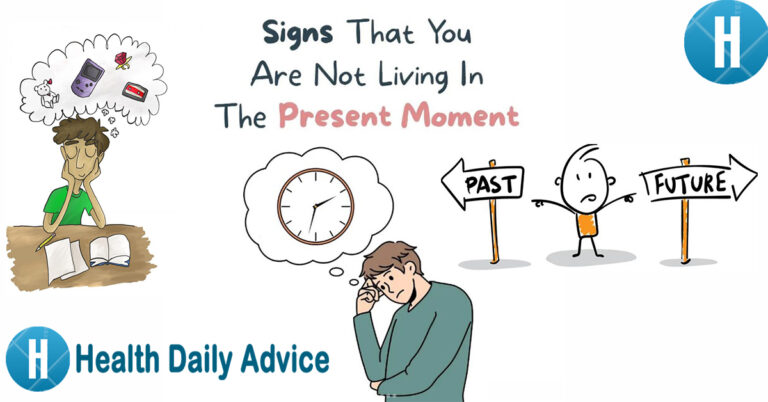
Why Do I Overthink Everything? Causes and Ways to Stop
Replays the same worries on a loop — called rumination — and can't switch it off? This guide explains why overthinking happens, how it harms anxiety and sleep, and evidence-based ways to quiet the loop.
- Written by
- Health Daily Advice
- Published
- Reading time
- 5 minutes
- Sources
- 7 cited

In this guide
You overthink because your brain confuses replaying worries with solving them. Psychologists call this loop rumination: dwelling on past mistakes or future “what ifs” without reaching a decision. It worsens anxiety, low mood and sleep. Techniques like scheduled worry time, thought challenging and mindfulness can quiet the loop.
What is overthinking, really?
The American Psychological Association defines rumination as obsessive thinking involving excessive, repetitive thoughts or themes that interfere with other mental activity. In plain terms: your mind replays the same worries, regrets and worst-case scenarios on a loop, hoping for a different ending.
It helps to separate two kinds of repetitive thinking. According to GetSelfHelp’s therapist-developed resources, worry is usually future-focused (“what if this goes wrong?”) and feeds anxiety, stress and fear; rumination is usually past-focused (“if only I had…”, “I should have…”) and feeds depression, sadness and shame. Most overthinkers do both, and the two patterns feed each other.
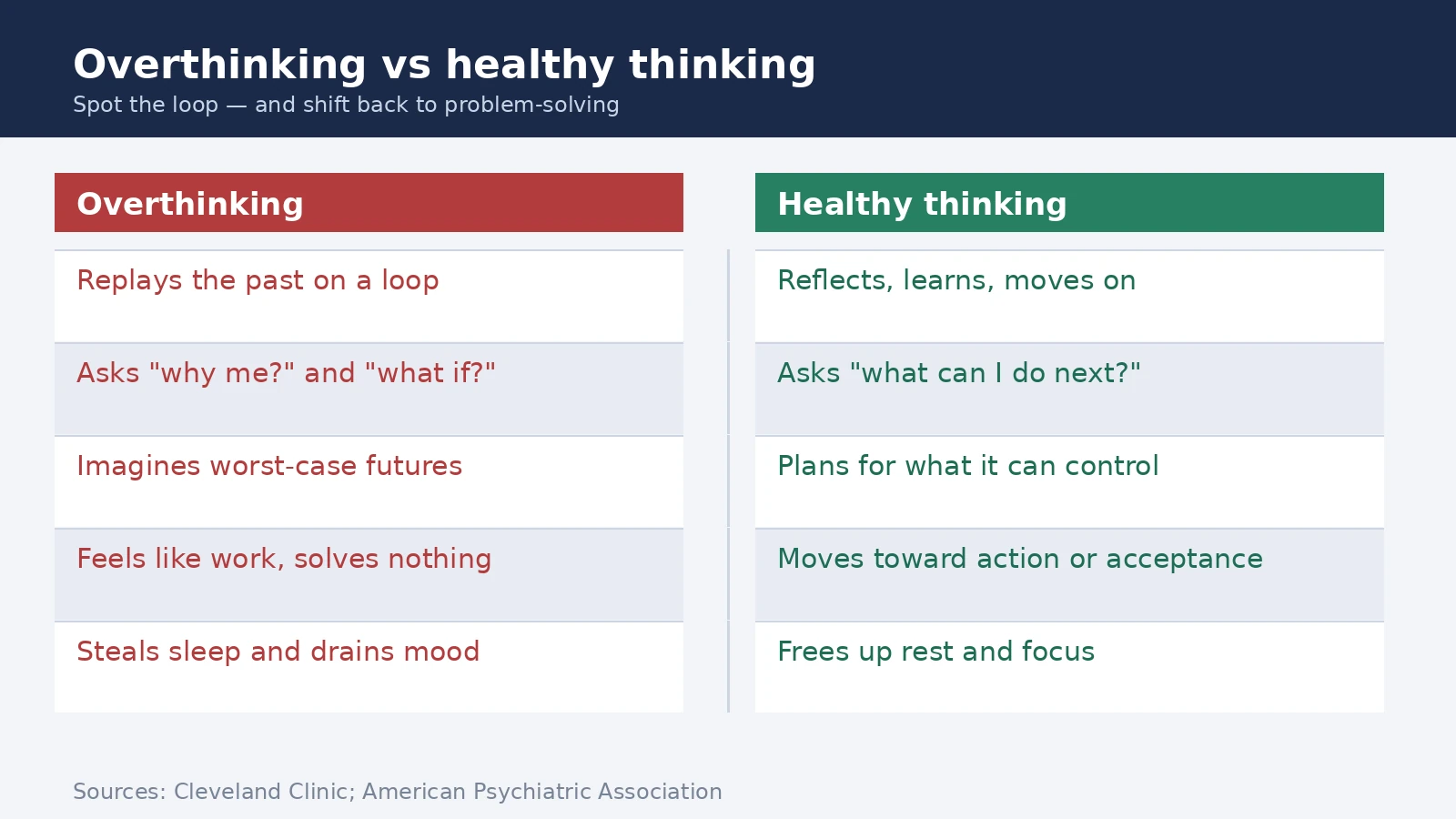
Both are a normal thinking style pushed into overdrive — like chewing the same mouthful over and over. And here is the trap: rumination feels like problem-solving. Cleveland Clinic psychologist Dr Susan Albers explains that healthy self-reflection tends to produce an “aha” moment that moves you forward, while rumination just goes round in circles with no feeling of relief.
Why do I overthink everything?
Your brain is built to solve problems, and that is useful most of the time. “When something feels unresolved or uncomfortable, your brain wants to figure it out,” says Dr Albers. “But not everything has a clear answer.” Instead of asking “what can I learn?”, the overthinking brain keeps asking “why did this happen?” and “how can I undo it?” — questions with no satisfying answer.
Healthline’s review of the research lists common reasons people ruminate: the belief that thinking it through will bring insight, a history of emotional or physical trauma, and facing ongoing stressors you cannot control. Personality traits matter too — perfectionism, anxiety and excessive concern about relationships make the loop more likely.
Research also shows that rumination is the key link between bad experiences and poor mental health. A University of Liverpool study found that past difficulties such as traumatic life events led to depression and anxiety mainly by leading people to ruminate and blame themselves, as reported by the American Psychiatric Association. The hopeful message from the study: while you cannot change your history, you can change the way you think and learn coping strategies that reduce stress.
How overthinking affects your health
Repetitive negative thinking is not harmless background noise. The American Psychiatric Association notes that the repetitive, negative aspect of rumination can contribute to the development of depression or anxiety and worsen existing conditions. Even in people without depression or anxiety, rumination fuels negative emotions — and the more you ruminate, the worse you feel, which triggers still more rumination.
The knock-on effects are physical as well as mental. Healthline’s review reports that the habit of rumination can make depression more intense or longer-lasting, impair your ability to think and process emotions, cause or worsen anxiety and sleep concerns, maintain and worsen stress responses into chronic stress, raise the risk of stress-related inflammation and physical health concerns, and increase the risk of substance use disorders.
Sleep is often the first casualty. As the NELFT NHS Foundation Trust puts it, “resting and having a good night’s sleep is hard when your head is full of worries.” If anxious thoughts keep you awake, the NHS suggests writing them down in a diary — and if sleep still will not come, getting up for a caffeine-free drink and returning to bed only when you feel tired.
7 ways to stop overthinking that actually work
1. Notice the loop and name it
You cannot stop a pattern you do not spot. When you catch yourself going round in circles, pause and tell yourself: “I don’t have to think about that right now — it can wait until I feel stronger.” The GetSelfHelp rumination guide reminds us that you cannot stop thoughts arriving, but you can choose not to focus on them.
2. Give worry a daily appointment
Instead of trying to banish worrying thoughts all day, give them a fixed time and place — for example, “I’ll think about this at 6 p.m. for 10 minutes.” Dr Albers reports that many people find their urge to ruminate fades before the appointment arrives. This scheduled “worry time” contains the loop instead of letting it bleed across the whole day.
3. Challenge the thought, like a scientist
Thought challenging is a core technique from cognitive behavioural therapy (CBT). Step back and examine the negative automatic thought: are you treating an assumption like a fact? The NHS suggests asking yourself: is what you’re worrying about likely to happen? Are you being realistic? Have you had similar thoughts before that never turned into reality? Writing the thought down makes it far easier to challenge than when it swirls in your head.
4. Write it down and park it
If certain thoughts keep returning, write them down — then physically put the paper away, in a drawer or an envelope. It sounds too simple to work, but Dr Albers emphasises that it creates distance between you and the thought. Keep an evening diary too: the NHS notes that recording what is happening and how it affects you helps you understand your triggers and prepare for them.
5. Come back to the present moment
Mindfulness is about being in the moment: instead of chasing a thought down a rabbit hole, observe it and let it pass. “Mindfulness helps you sit with an uncomfortable feeling without trying to change or judge it,” says Dr Albers. When anxious thoughts spike, the NHS recommends focusing on your breathing — for instance, the 4-7-8 technique: breathe in through your nose for 4 counts, hold for 7, breathe out through your mouth for 8, and repeat for four cycles.
6. Change gears: move your body, change the scene
Sometimes your brain needs a refresh. Do something that fully engages your mind or body — go for a walk, tidy a drawer, try something creative. “It’s much harder to ruminate when your hands and mind are busy in the present,” notes Dr Albers. The American Psychiatric Association likewise suggests physical activity and a change of environment, especially somewhere with positive associations, plus deliberately recalling times when things worked out well.
7. Shrink the worry into one small step
Rumination zeroes in on the problem; progress comes from zeroing in on the next step. Break a big worry into smaller parts, tackle one issue at a time, and make a step-by-step plan — write it down, be specific, then take one small step. For worries you cannot change at all, ask the NHS’s question: is it likely to happen, and is it realistic? What you cannot influence, you do not need to rehearse.
When to see a doctor
If overthinking is constant, distressing or starting to interfere with your daily life — your work, relationships or sleep — it may be time to talk to a doctor or therapist. “Therapy can be very effective,” says Dr Albers. “It can help you understand why you ruminate, identify triggers and develop healthier ways to respond.” If anxiety or depression are fuelling the cycle, treatment can quiet your brain enough to use these tools. You can find support options at healthdailyadvice.com/get-help-now.
In an emergency call 911 (US), 999 (UK) or 112 (EU)
Frequently asked questions
Why do I overthink at night more than during the day?
At night your mind has fewer distractions, so unfinished worries surface and replay on a loop. Research links rumination to poorer sleep, and the NHS notes that a head full of worries makes falling asleep hard. Writing worries down in a diary during the day — and giving them a fixed 'worry time' earlier — teaches your brain that 2 a.m. is not the time to problem-solve.
Is overthinking a sign of anxiety or depression?
It can be. Psychologists say rumination contributes to the development of anxiety and depression and can worsen both, but overthinking alone is not a diagnosis — it is a thinking habit. If looping thoughts come with constant worry, low mood, hopelessness or sleep problems most days, talk to a doctor or therapist, who can tell whether a condition is present.
What is the difference between overthinking and problem-solving?
Problem-solving moves toward action, acceptance or clarity — you identify options, decide and act. Overthinking circles the same questions, like 'why me?' or 'what if?', without reaching a decision or feeling relief. If your thinking has produced no new insight after several replays, you are ruminating, not solving.
How can I stop overthinking quickly?
Interrupt the loop fast: name it ('I'm ruminating again'), do something that fully occupies your hands and mind, such as a walk or a creative task, and try slow breathing — in for 4, hold for 7, out for 8. Writing the thought down and physically putting it away creates distance. For lasting change, practise scheduled worry time and thought challenging daily.
Does journaling help with overthinking?
Yes, when used actively rather than as a dumping ground. Writing worries down and challenging them — asking whether they are likely, realistic and backed by evidence — externalises the loop so it stops swirling. The NHS recommends keeping a diary of worries and triggers, while therapists use thought records for the same purpose in CBT.
When should I talk to a professional about overthinking?
If looping thoughts are constant or distressing, interfere with work, relationships or sleep, or come with anxiety, low mood or hopelessness that lasts weeks, talk to a doctor or therapist. Therapy — especially CBT — is effective for breaking rumination cycles, and support is available any time through a GP or helplines.
Sources
- Cleveland Clinic: Rumination — What It Is and How To Stop It health.clevelandclinic.org
- American Psychiatric Association: Rumination — A Cycle of Negative Thinking www.psychiatry.org
- NELFT NHS: How to cope with feelings of anxiety www.nelft.nhs.uk
- GetSelfHelp: Rumination & Worry www.getselfhelp.co.uk
- Healthline: How to Stop Ruminating www.healthline.com

Try the tool
How have you felt over the last 2 weeks?
The PHQ-9 and GAD-7 that GPs use. Private, about 3 minutes.
Start the self-check