Cannabis Use Disorder and Suicidal Thoughts: What the New Study Found
A study of 415,861 US adults found cannabis use disorder linked to 57% higher odds of suicidal thoughts — a link that stayed steady for a decade. Here is what it means, and where to get help.
- Written by
- Health Daily Advice
- Published
- Reading time
- 6 minutes
- Sources
- 8 cited

In this guide
A new decade-long study has found that US adults with cannabis use disorder had 57% higher odds of reporting suicidal thoughts in the past year than adults without the disorder. The link stayed steady from 2014 to 2023, and it held even after researchers accounted for depression and psychological distress.
The finding comes from a study published on 16 November 2026 in the Journal of Studies on Alcohol and Drugs, and it has been widely reported because cannabis is now far more available and more socially accepted than it was ten years ago. If you or someone close to you is struggling with cannabis use and low mood, the study is a reminder that both deserve attention — and that help is available. This article explains what the researchers found, what it does and does not mean, and where to turn for support.
What did the new study actually find?
Researchers at the University of California, Merced, led by doctoral student Tosin Philip Oyetunji, analysed survey answers from 415,861 adults in the United States. The data came from the National Survey on Drug Use and Health (NSDUH), a large annual survey run by the Substance Abuse and Mental Health Services Administration (SAMHSA) that asks a representative sample of Americans about drug use, mental health and treatment. The team looked at survey years 2014 to 2023 — a decade in which cannabis became legal for recreational use in more American states and cannabis products grew stronger.
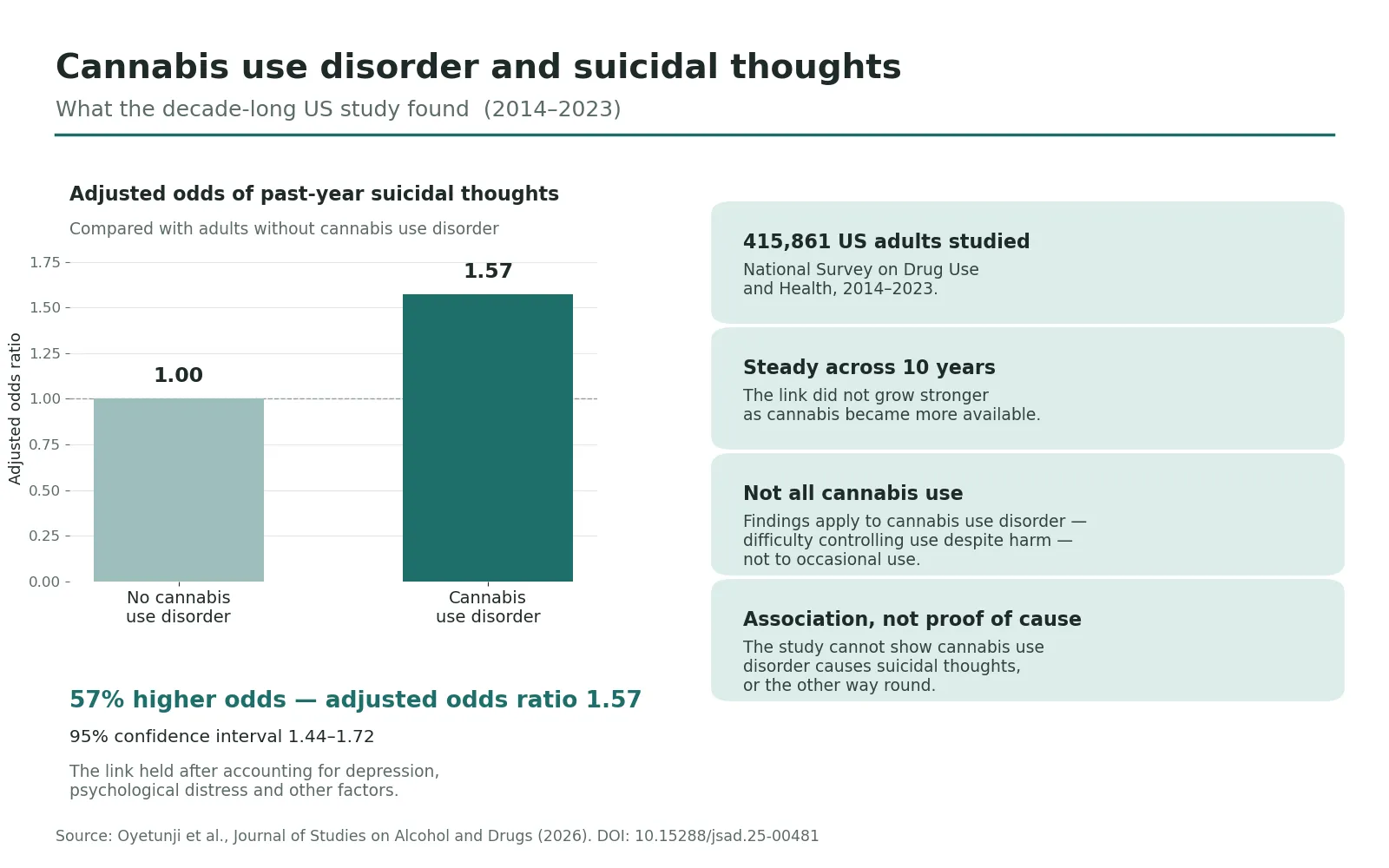
The headline result was clear. Adults with cannabis use disorder had 57% higher odds of reporting suicidal thoughts in the past year than adults without the disorder — an adjusted odds ratio of 1.57, with a 95% confidence interval of 1.44 to 1.72. In plain terms, suicidal thoughts were noticeably more common among people with the disorder, and the gap was too large to be put down to chance.
Two details make the finding more striking. First, the link stayed steady across the whole decade. The researchers had wondered whether wider legal access and stronger products might have made the association worse; it did not. As senior author Sidra Goldman-Mellor, a professor of public health at UC Merced, put it, suicidal thoughts do not seem to have increased among people with cannabis use disorder despite all the legal and social change. Second, the association held across age, sex and racial and ethnic groups, with women and younger adults showing higher risk. It also remained after the researchers accounted for depression, psychological distress and other factors that could have explained the link.
What is cannabis use disorder?
Cannabis use disorder is not the same as using cannabis. It describes a pattern in which someone finds it hard to control their cannabis use even when it causes problems in their life — for example, continuing to use it despite harm to their health, work or relationships, or after repeated attempts to cut back.
Cannabis can also affect mental health more broadly. NHS inform notes that cannabis can make some existing mental health symptoms worse and has been linked with the possible development of mental health issues, particularly with heavy use from a young age, over a long period, or with high-potency cannabis. People who use cannabis every day over a long period can develop tolerance and dependency, and stopping can bring withdrawal symptoms such as difficulty sleeping, vivid dreams, low mood, difficulty concentrating, irritability and cravings.
That distinction matters for this study. The researchers stress that the findings apply specifically to people with cannabis use disorder — not to everyone who uses cannabis. Occasional or non-problematic use was not what the study measured.
Does cannabis use disorder cause suicidal thoughts?
No — at least, this study cannot show that. It found an association: the two things occur together more often than would be expected by chance. Because the research used survey data collected at one point in time, it cannot tell us which came first, or whether something else explains the connection.
There are several plausible explanations, and more than one may be true at the same time. Problematic cannabis use could contribute to low mood and distress. Or an underlying mental health difficulty could contribute both to heavy cannabis use and to suicidal thoughts. Or other factors — such as stress, trauma, or other substance use — could be involved. The study’s design cannot separate these possibilities, and the authors are clear about that.
What the study can do is point to a group of people who may need more support than they are currently getting. The lead author noted that someone seeking help for cannabis use disorder may also be having suicidal thoughts that are not immediately apparent — and that the goal is not to assume everyone with the disorder is suicidal, but to identify those who need extra assessment, treatment or support.
Why didn’t the link get stronger as cannabis became more available?
That was the finding that surprised the researchers most. Recreational cannabis is now legal in half of US states, products have become more potent, and public attitudes have softened — many people now see cannabis as less risky than they once did. Public health experts had worried that easier access would worsen mental health at the population level.
On that particular question, the results are reassuring: the strength of the link between cannabis use disorder and suicidal thoughts did not grow over the ten years studied. But the researchers also stress the other side of the coin. The elevated odds were still substantial throughout the decade, and they remain so now. As Goldman-Mellor said, people with cannabis use disorder are still at a very substantially increased likelihood of experiencing serious suicidal thoughts, and that is not something widely understood.
So the picture is mixed rather than alarming in one direction. Wider availability does not appear to have made this particular risk worse — but the risk itself has not gone away either, and it deserves to be taken seriously by health services, policymakers and families.
What should you do if you are worried?
If you are finding it hard to control your cannabis use, or if you are having thoughts about harming yourself, the most important step is to tell someone. These feelings are more common than they can feel, and they are not a sign of weakness. Talking about them is the first step towards getting support.
A good starting point is your GP, who can talk through what you are experiencing and refer you to talking therapies or specialist services. The charity Mind explains that your GP can refer you to counselling or talking therapy, prescribe medication for a related mental health problem, or refer you to a community mental health team — and that it is common to worry about raising suicidal feelings with a doctor, but GPs are used to listening to people in this situation.
If you need to talk to someone right away, free helplines are available around the clock. In the UK, you can call Samaritans free on 116 123, any time of day or night, or call NHS 111. In the US, you can call or text 988 to reach the Suicide and Crisis Lifeline, or chat at 988lifeline.org. You can also find more support options on our get help now page.
For health professionals, the study carries a practical message too: when someone seeks help for cannabis use disorder, it is worth asking directly about suicidal thoughts as part of a broader mental health assessment, rather than only screening for depression. Some people in this group may be struggling in ways that are not obvious from the outside.
When to see a doctor
See a doctor promptly if you are finding it hard to control your cannabis use, if you feel low, anxious or unable to cope, or if you have had thoughts of harming yourself — even if the thoughts pass. A GP can listen without judgement and help you find the right support. If you are worried about someone else, encourage them to talk to their GP, and take their concerns seriously; just listening can make a real difference.
In an emergency call 911 (US), 999 (UK) or 112 (EU). If you feel you may act on thoughts of harming yourself, or you have already harmed yourself, call the emergency number for your country or go straight to your nearest emergency department. If you are in the UK, you can also call Samaritans on 116 123 or NHS 111, and in the US you can call or text 988. More support options are listed on our get help now page.
Frequently asked questions
Does cannabis use disorder cause suicidal thoughts?
The study does not show that. It found an association: adults with cannabis use disorder were more likely to report suicidal thoughts, but the research cannot tell us whether the disorder leads to those thoughts, whether an underlying mental health problem contributes to both, or whether other factors are involved. The link held even after researchers accounted for depression and psychological distress.
Does this mean everyone who uses cannabis is at higher risk?
No. The study looked specifically at cannabis use disorder — a pattern of struggling to control cannabis use despite harm to health, work or relationships. The researchers stress the findings do not apply to everyone who uses cannabis. Occasional or non-problematic use was not what the study measured, so these results should not be read as a risk that applies to all cannabis users.
How big was the study on cannabis use disorder and suicidal thoughts?
Very large. The researchers analysed survey answers from 415,861 adults in the United States, taken from the National Survey on Drug Use and Health between 2014 and 2023. That survey, run by the Substance Abuse and Mental Health Services Administration, interviews a nationally representative sample of Americans each year about drug use, mental health and treatment.
Did the risk rise as cannabis became legal in more states?
No. That was the finding that surprised the researchers most. Recreational cannabis is now legal in half of US states and products have become more potent, yet the strength of the link between cannabis use disorder and suicidal thoughts did not grow over the ten years studied. The elevated odds were substantial throughout the decade, but they did not get worse.
What is cannabis use disorder?
Cannabis use disorder is a pattern in which someone finds it hard to control their cannabis use even when it causes problems, such as harm to their health, work or relationships, or after repeated attempts to cut back. NHS inform notes that daily use over a long period can lead to tolerance and dependency, and stopping can bring symptoms including difficulty sleeping, vivid dreams, low mood, irritability and cravings.
Where can I get help if I have suicidal thoughts?
Tell someone — a friend, a family member or your GP — and ask for support. In the UK you can call Samaritans free on 116 123 at any time, or call NHS 111. In the US you can call or text 988 to reach the Suicide and Crisis Lifeline. If you feel you may act on these thoughts, or you have harmed yourself, call 999 in the UK, 911 in the US, or 112 in the EU.
Sources
- MedicalXpress: Cannabis use disorder linked to higher odds of suicidal thoughts medicalxpress.com
- ScienceDaily: Cannabis addiction linked to 57% higher odds of suicidal thoughts sciencedaily.com
- NHS: Help for suicidal thoughts www.nhs.uk
- NHS inform: Cannabis www.nhsinform.scot
- Mind: Treatment and support for suicidal thoughts www.mind.org.uk
- SAMHSA: Crisis help — 988 Suicide & Crisis Lifeline www.samhsa.gov
- SAMHSA: About NSDUH www.samhsa.gov

Try the tool
How have you felt over the last 2 weeks?
The PHQ-9 and GAD-7 that GPs use. Private, about 3 minutes.
Start the self-check