Weekly Park Visits May Boost Children’s Mental Health: Study
Children taken to a park at least once a week scored 16.5% better on mental-health assessments in a new UK study of 4,219 children. Here is what the research found — and its limits.
- Written by
- Health Daily Advice
- Published
- Reading time
- 5 minutes
- Sources
- 7 cited
In this guide
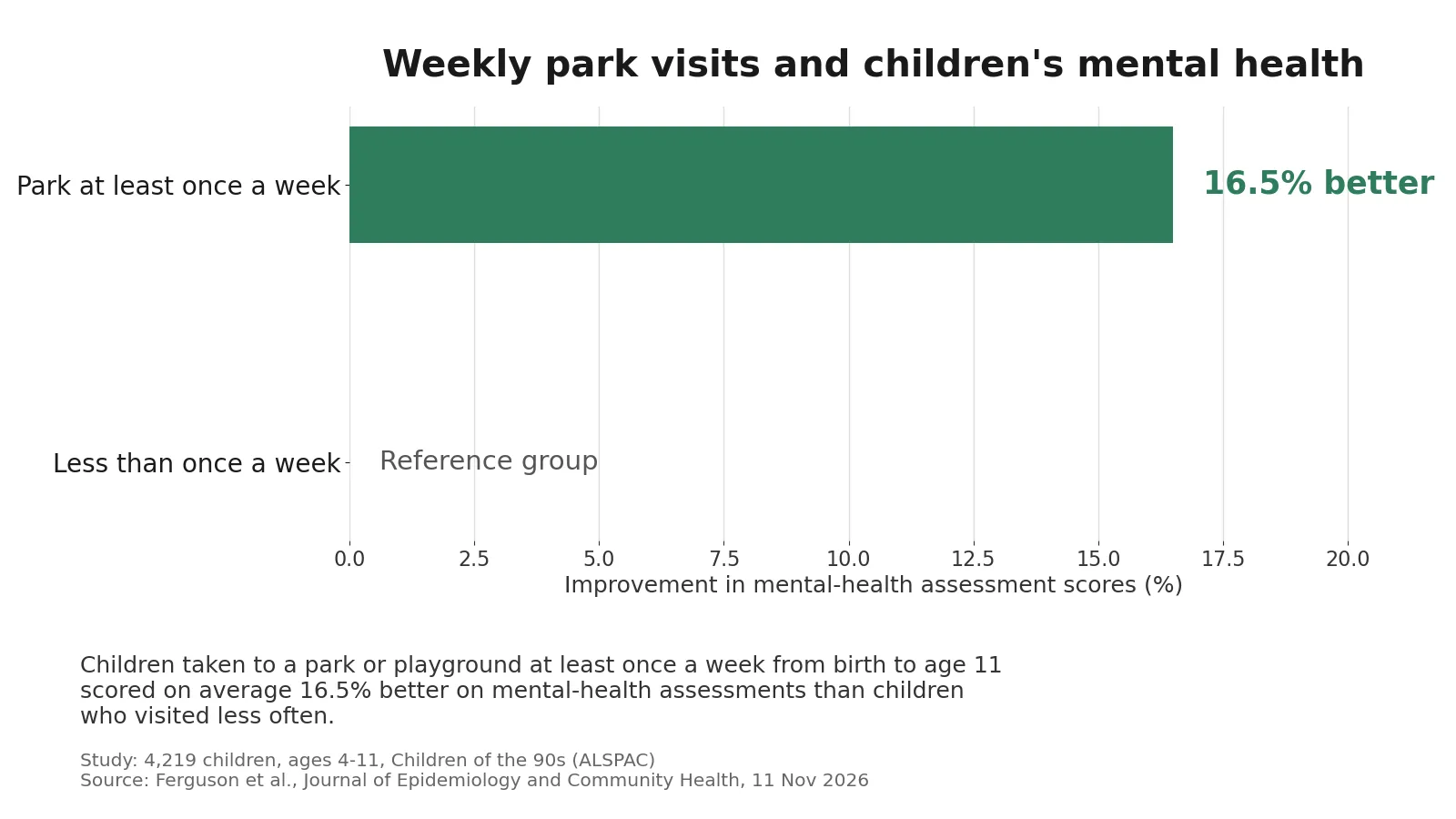
A new UK study suggests a simple weekly habit could support children’s mental health. Children taken to a park or playground at least once a week scored on average 16.5% better on mental-health assessments than children who went less often, in research following 4,219 children from ages 4 to 11.
What did the new study find?
Researchers from the Universities of Exeter and Bristol found that children taken to a park at least once a week from birth to age 11 scored, on average, 16.5% better on mental-health assessments than children who visited less than once a week. The link held after the team accounted for factors such as socioeconomic status and family adversity, which can also shape a child’s wellbeing.
The pattern showed up within individual children, too. The same child tended to show better social-emotional development during stretches of childhood when park visits were more frequent than during stretches when they were less frequent. That matters because it is stronger evidence than a simple comparison between different children, though it still does not prove that the park trips alone caused the difference.
How was the study carried out?
The research, published on 11 November 2026 in the Journal of Epidemiology and Community Health, drew on the Children of the 90s study, also known as the Avon Longitudinal Study of Parents and Children (ALSPAC), which has followed children born in and around Bristol since the early 1990s. The team analysed data from 4,219 children, looking at park visits and social-emotional development at five points between the ages of 4 and 11. Development was measured with the Strengths and Difficulties Questionnaire, a widely used parent-completed questionnaire that asks about emotions, behaviour, friendships and attention. The work was funded by the UK Medical Research Council and the National Institute for Health and Care Research (NIHR).
Why might park visits help children’s mental health?
Parks pack a lot into one free outing. Lead researcher Mark Ferguson, of the University of Exeter, explained that parks give children room to run around and be physically active, which is already known to support mental and physical health. They also make room for the kind of bold, make-believe play that helps children test themselves, build confidence and grow more independent — and for meeting other children and learning to get along with them.
Time in green, natural surroundings may help in another way, too. Earlier research suggests that being in nature can have a calming, restorative effect on children and the adults with them, easing stress for the whole family. None of this makes a park trip a treatment, but it helps explain why a regular visit might show up in a child’s development over time.
What is social-emotional development?
Social-emotional development is the set of skills children need to understand and manage their feelings, get along with others, build relationships, behave appropriately and cope with everyday challenges. It is a foundation for good mental health in childhood and later life, and difficulties in this area can be an early sign that a child may need extra support.
That is one reason the findings have drawn attention. The paper notes that an estimated 40% of children in England may experience difficulties with their mental health. NHS England’s 2023 survey found that about 1 in 5 children and young people aged 8 to 25 in England had a probable mental disorder, including 20.3% of 8- to 16-year-olds. Against that background, a free, local habit that supports development is worth taking seriously.
Does this prove that park visits cause better mental health?
No — and the researchers are open about that. This was an observational study, so it shows a link rather than proving cause and effect. Families who visit parks often may differ from other families in ways the study could not fully capture, even though the team adjusted for a wide range of background factors. The within-child pattern — the same children doing better when they visited more — makes the case stronger, but it does not settle it.
There are other limits to keep in mind. The data come from one long-running UK study of children born around Bristol in the early 1990s, and the researchers say more work is needed to see whether the findings apply in other areas and more diverse communities. The study also looked at how often families went to parks, not how long they stayed or what they did there, so it cannot say which parts of a park visit matter most.
Fairness is part of the story, too. Children from more advantaged families tended to visit parks more often when they were younger, though that pattern shifted as they grew older. As Mark Ferguson put it, the benefit can only be shared fairly if communities have good-quality parks that are safe, accessible and welcoming to families from all backgrounds.
How can families build in a weekly park visit?
A weekly visit does not need to be a big expedition. Many families find it easiest to pick a regular slot — a Saturday morning, or the walk home from school on a particular day — and treat it as a fixture rather than something to squeeze in. A local playground, a patch of green with room to run, or a walk that ends at the swings all count.
It can help to go with friends or other families, so children get the social side of play as well as the fresh air. And if the weather turns, a shorter visit in the right clothing still beats none at all. The study’s message is not that every outing must be long or perfect, only that going regularly seems to be what counts. If getting to a park is difficult where you live, it is worth raising with your local council or community groups, since safe, welcoming green space benefits the whole neighbourhood.
When to see a doctor
A weekly park visit is a healthy habit, not a substitute for professional help. If you are worried about your child’s mood, behaviour, friendships or development — for example, if they seem persistently sad, anxious or withdrawn, are struggling at school, or their behaviour has changed noticeably — talk to your GP or your child’s school. You can also find support and helplines at Health Daily Advice: Get Help Now.
Seek urgent help if a child talks about harming themselves, or if you feel they may be at immediate risk. In an emergency call 911 (US), 999 (UK) or 112 (EU).
Frequently asked questions
How often should children visit a park for their mental health?
The new study found a link at once a week or more: children taken to a park or playground at least weekly from birth to age 11 scored on average 16.5% better on mental-health assessments. That is not a prescription, and the study cannot say weekly visits are the ideal amount. But a regular weekly visit is a simple, practical aim for most families, and it costs little or nothing.
What did the park visits study actually measure?
The study followed 4,219 children in the Children of the 90s study (ALSPAC), looking at ages 4 to 11. Parents reported how often their child visited a park or playground, and social-emotional development was measured at five time points using the Strengths and Difficulties Questionnaire, a widely used questionnaire covering emotions, behaviour, friendships and attention.
Does going to the park really improve children's mental health?
The study shows a link, not proof of cause. Children who visited parks weekly scored better, and the same children tended to do better during periods when they visited more often, which strengthens the case. But families who visit parks may differ in other ways, and the data come from one UK study. The researchers say replication in other areas and more diverse communities is needed.
Why are parks thought to help children's mental health?
Parks give children space to be physically active, which supports mental and physical health, and room for adventurous and imaginative play that builds confidence and independence. They also bring children together, helping friendships and social skills. Time in green, natural surroundings may also have a calming, stress-reducing effect on children and the adults with them.
What is social-emotional development?
Social-emotional development is the set of skills children need to understand and manage their feelings, get along with others, build relationships, behave appropriately and cope with everyday challenges. It is a foundation for good mental health in childhood and later life. Difficulties in this area can be an early sign that a child may need extra support.
What should I do if I am worried about my child's mental health?
Talk to your GP or your child's school, and describe what you have noticed and for how long. They can advise on next steps and local support. If a child talks about harming themselves, or you feel they may be at immediate risk, seek urgent help. In an emergency call 911 (US), 999 (UK) or 112 (EU).
Sources
- University of Bristol: Going to the park at least once a week can improve children's mental health (11 Nov 2026) www.bristol.ac.uk
- University of Exeter: Going to the park at least once a week could improve children's mental health (11 Nov 2026) news.exeter.ac.uk
- Ferguson M et al. Park visits and social-emotional development throughout childhood: a longitudinal analysis of ALSPAC. J Epidemiol Community Health, 2026 doi.org
- NHS England: Mental Health of Children and Young People in England, 2023 digital.nhs.uk
- University of Exeter / The Conversation: Going to the park once a week or more has a measurable impact on a child's mental health news.exeter.ac.uk

Try the tool
How have you felt over the last 2 weeks?
The PHQ-9 and GAD-7 that GPs use. Private, about 3 minutes.
Start the self-check