What Is Overthinking? Signs, Causes and How to Stop It
Overthinking feels like problem-solving, but it is usually the opposite: the same thoughts, the same worry, no further forward. Here is what it is, why it happens and the proven ways to stop it.
- Written by
- Health Daily Advice
- Published
- Reading time
- 9 minutes
- Sources
- 9 cited

In this guide
Overthinking is the habit of going over the same thoughts again and again without reaching a decision — replaying past mistakes or worrying about what might happen next. It is not a mental health diagnosis in itself, but it is a common sign of anxiety or depression. It raises stress and spoils sleep, but it can be unlearned.
What is overthinking?
Overthinking means getting stuck in a loop of repetitive thoughts that go nowhere useful. Psychologists usually describe it in two forms. The first is rumination: turning past events over in your mind, such as a conversation that went badly or a decision you regret. The second is worry: scanning the future for problems that have not happened yet, usually in the form of “what if” questions.
Everyone does this sometimes. It becomes overthinking when the loop takes over — when you spend far more time thinking about a problem than solving it, and the thinking leaves you more stressed, not less. As the Cleveland Clinic puts it, with overthinking you go over and over a problem again and again, but there is no real resolution: you end up where you started, and sometimes with more worry than before.
It helps to know that overthinking is not a recognised mental health condition on its own. It is, however, a common symptom of depression and anxiety, and it is closely linked to generalised anxiety disorder (GAD), in which worry becomes excessive and hard to control. That distinction matters, because it means the loop is a habit and a symptom — not a flaw in who you are — and habits can be changed.
What are the signs of overthinking?
You may be overthinking if you recognise several of these patterns:
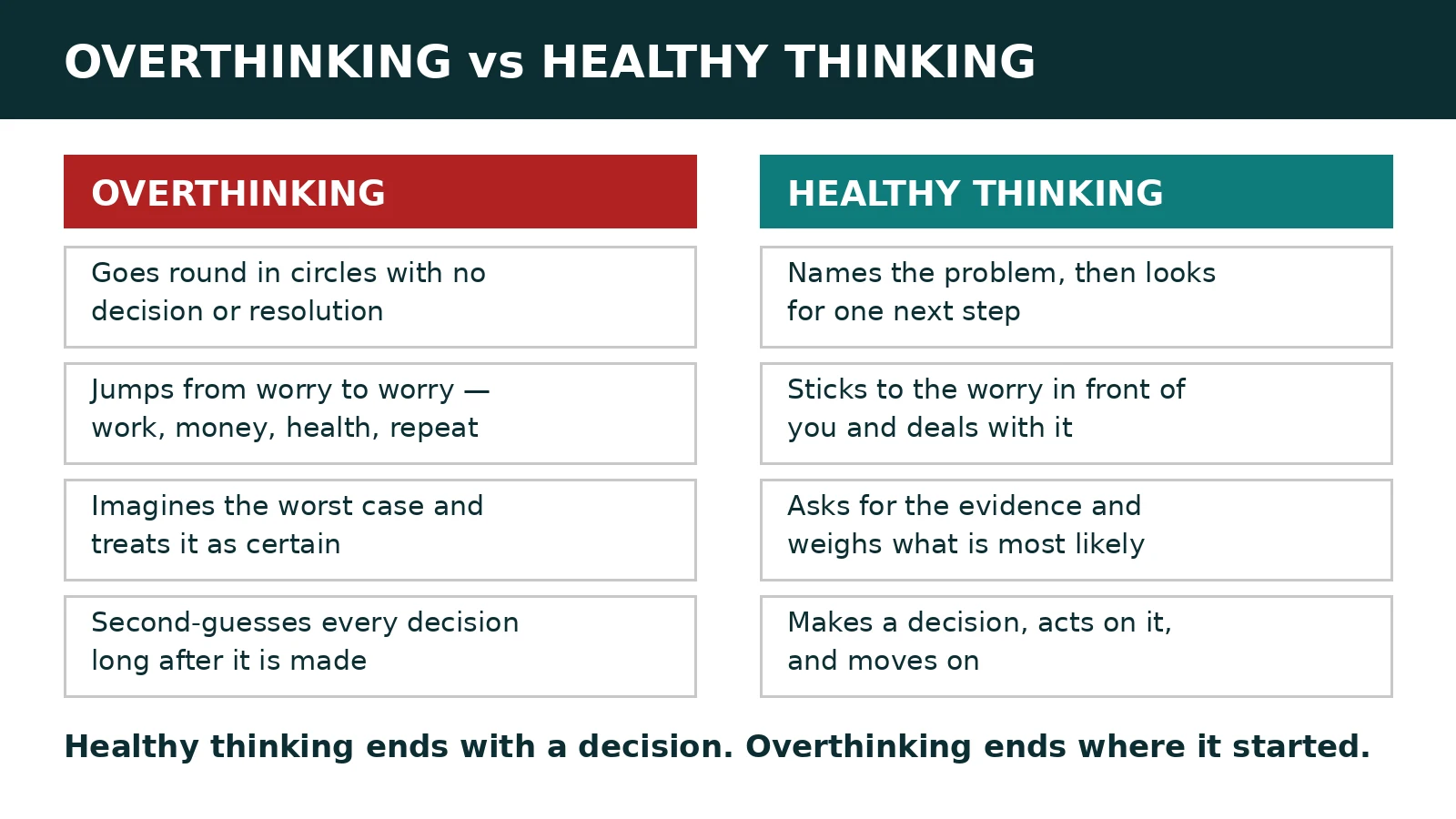
- Your worries jump from topic to topic. One minute it is a deadline, the next it is money, then your health, then a text you sent last week.
- You always picture the worst case. A late reply becomes proof someone is angry; a small mistake at work becomes a lost job.
- You struggle to make decisions. Even small choices take ages, and you second-guess them long afterwards.
- You cannot concentrate. The same thoughts keep pulling your attention away from what you are doing.
- You feel on edge. Restlessness, tension and a mind that will not switch off, especially at night.
- You keep asking others for reassurance. You need to hear, again and again, that everything is fine — and it never quite settles the worry.
These signs rarely arrive one at a time. A psychotherapist at the Cleveland Clinic describes a “chain effect”: you start worrying about work, that leads to worrying about money, and that leads to worrying about losing your job — each link feeding the next. Spotting the chain is the first step to breaking it, because a chain you can see is one you can interrupt.
Why do I overthink?
There is no single cause. According to the Cleveland Clinic, overthinking usually comes from a mix of three things: your genes, your personality and your life experiences. Some people are simply wired to find uncertainty harder to tolerate, so an unanswered question feels unbearable and the mind keeps circling it in search of certainty that never comes.
Stressful periods make it worse. The NHS lists common triggers for anxiety and worry, including pressure at work, money problems, relationship difficulties, illness, bereavement and difficult past experiences — and even big positive changes such as buying a house or having a baby. When your body is under stress it releases hormones such as adrenaline and cortisol, which sharpen your alertness and make the mind scan harder for threats. That is useful in a real emergency, but unhelpful at 2am when the “threat” is an email you cannot answer until morning.
Two thinking traps keep the loop spinning. The first is the belief that more thinking will eventually crack the problem — that if you just go over it once more, you will find the answer. The second is trying to fight the thoughts directly: the harder you push a worry away, the more it tends to bounce back. As the charity Mind explains, the more we try to be certain our worries are not true, the more time we spend thinking about our doubts — and the more anxious and uncertain we end up feeling.
Is overthinking bad for your health?
Yes — not because thinking is harmful, but because the loop has real knock-on effects. Overthinking is extremely common: in survey research by University of Michigan psychologist Susan Nolen-Hoeksema, 73% of adults aged 25 to 35 described themselves as overthinkers, compared with 52% of 45- to 55-year-olds and only 20% of 65- to 75-year-olds. Women were more likely to overthink than men — 57% compared with 43% — and the same research found overthinking contributes to depression and anxiety and interferes with good problem-solving.
The costs show up in everyday life first. Sleep is usually the first casualty: a mind full of worries makes it hard to drift off, and poor sleep makes the worrying worse the next day, a cycle the NHS describes in its anxiety guidance. Over time, the strain spreads. The Cleveland Clinic notes that people who cannot control their worrying often develop irritability, fatigue, concentration and memory problems, and insomnia — and that excessive worry can also intensify digestive problems and cause tension in the shoulders and neck.
The link to mood runs deeper still. Rumination is a recognised risk factor for depression: dwelling on distress without moving into problem-solving keeps low mood going and makes it harder to recover. Nolen-Hoeksema’s research also found that overthinkers were significantly more likely to turn to alcohol to quiet their thoughts, and that men who used alcohol to cope with stress were more likely to develop new alcohol-related problems over time.
There is encouraging evidence on the other side, too. A 2021 meta-analysis published in Health Psychology pooled 36 randomised trials and found that psychological interventions produced a medium-sized reduction in rumination and a smaller reduction in worry, along with small improvements in health behaviours and physical health. In other words, the loop is not fixed — structured techniques can genuinely quieten it.
How to stop overthinking
You cannot switch the loop off by force of will, and trying usually makes it louder. What works is giving the thinking structure, limits and an exit. These strategies are drawn from cognitive behavioural therapy (CBT) and the self-help guidance of the NHS and Mind.
1. Name the loop when it starts
The first skill is simply noticing. When the same thought has circled for the third time, say to yourself — silently or out loud — “this is overthinking.” Naming it creates a small gap between you and the thought, and that gap is where choice lives. With practice, you start to catch the spiral earlier, before it has gathered speed.
2. Set a daily worry period
Instead of worrying all day, give worry a fixed slot — about 30 minutes at a set time, as the Cleveland Clinic recommends. During that time, write down every worry, then highlight the ones you can actually do something about and brainstorm solutions for those. For the rest, practise letting them go until tomorrow’s slot. It sounds odd, but containing worry to one part of the day trains your brain to postpone it rather than obey it.
3. Turn “what if” into “if then”
For every worst-case “what if”, write an “if then” plan: if that did happen, what would I actually do? “What if I lose my job?” becomes “If I lost my job, then I would update my CV, contact two recruiters and cut back on non-essential spending for a month.” A concrete plan, even for a bad outcome, is far calmer than an open-ended fear.
4. Challenge the thought like a scientist
This is the core technique of CBT. Ask yourself: what is the evidence this thought is true? Is there another explanation? Am I treating a guess as a fact? The NHS suggests a similar check — is what you are worrying about likely to happen, and are you being realistic? Most overthinking rests on thoughts that sound certain but collapse under one honest question.
5. Write it down and park it
Getting worries out of your head and onto paper is one of the simplest circuit-breakers. Mind suggests writing worries down and keeping them in a particular place, such as a notebook or envelope, and making a list of what you can change and what you cannot — then focusing your energy on the first list only. A short diary also helps you spot patterns: the same worries, at the same times, triggered by the same situations.
6. Come back to the present moment
Mindfulness — paying full attention to the present moment — works against overthinking because the loop lives in the past and the future. Slow breathing, a short walk, or simply noticing five things you can see and hear can pull your attention back to now. The NHS recommends calming breathing exercises and regular movement such as walking, running, swimming or yoga, which help you relax and lower your baseline stress.
7. Look after the basics — and talk to someone
Overthinking thrives when you are tired, hungry, wired on caffeine or scrolling late at night. The Cleveland Clinic advises watching how much caffeine and alcohol you take in, since both can increase anxiety, and cutting back on heavy social media and news consumption, which feed the loop. Regular meals, movement and sleep are not extras — they are the foundation the rest sits on. And do not keep it all inside: talking to a friend, family member or therapist often shrinks a worry that felt enormous in your head. If the loop will not loosen, a therapist trained in CBT can teach you the full toolkit — the Cleveland Clinic calls CBT the most effective treatment for overthinking.
Is overthinking the same as anxiety?
Not quite, but they overlap heavily. Anxiety is a broader feeling of unease, fear or dread, with physical symptoms such as a racing heart, sweating and breathlessness. Overthinking is one of the ways anxiety shows itself — the mental habit of replaying and rehearsing. You can overthink without having an anxiety disorder, and you can feel anxious without overthinking, but in practice the two often travel together.
The line worth watching is duration and control. In generalised anxiety disorder, worry is excessive, difficult to control and spread across many areas of life on most days for at least six months, and it interferes with daily functioning. If your worrying looks like that — constant, uncontrollable and getting in the way of work, sleep or relationships — it is worth talking to a doctor, because GAD is treatable and you do not have to wait six months to ask for help.
When to see a doctor
See your GP if overthinking is constant, distressing or starting to interfere with your daily life — your work, relationships or sleep — and the things you have tried yourself are not helping. In the UK, adults can also refer themselves directly to an NHS talking therapies service without seeing a GP first, and a GP can make the referral for you if you prefer.
Get help straight away if you feel you might act on thoughts of harming yourself, or if you feel unable to keep yourself safe. In the UK and Ireland, call Samaritans free on 116 123 at any time, day or night. For more support options, see our get help now page.
In an emergency call 911 (US), 999 (UK) or 112 (EU)
Overthinking feels like problem-solving, but it is usually the opposite: the same thoughts, the same worry, no further forward. The way out is not to think harder — it is to think differently. Name the loop, give worry a time and a place, test the thought against the evidence, and take one small step. Most people find the loop loosens faster than they expect, and if it does not, help is available and it works.
Frequently asked questions
What is overthinking?
Overthinking is the habit of replaying the same thoughts without reaching a decision — going over past mistakes (rumination) or worrying about future 'what ifs'. It is not a mental health diagnosis on its own, but it is a common sign of anxiety or depression. It becomes a problem when it raises stress, spoils sleep or makes decisions harder.
Is overthinking a mental illness?
No. Overthinking is not a recognised mental health condition, but it can be a symptom of depression or anxiety, and it is closely linked to generalised anxiety disorder. That is good news in a way: it is a thinking habit, not a fixed part of who you are, and habits can be changed with techniques such as CBT, worry periods and journaling.
Why do I overthink everything?
Overthinking usually comes from a mix of genes, personality and life experiences. People who find uncertainty hard to tolerate are more likely to loop, and stress — work pressure, money worries, relationship problems or illness — makes it worse. The habit sticks because it feels like problem-solving, even though it rarely produces a decision.
How can I stop overthinking at night?
Write your worries down before bed and give them a fixed 'worry period' earlier in the day — about 30 minutes — so your brain learns to postpone them. Keep the bedroom screen-free, cut back on caffeine after midday and try slow breathing. If racing thoughts still keep you awake most nights, talk to a GP.
What is the difference between overthinking and anxiety?
Anxiety is a broader feeling of unease, fear or dread, often with physical symptoms such as a racing heart or sweating. Overthinking is one of the ways anxiety shows itself: the mental habit of replaying and rehearsing. The two often travel together, but you can overthink without having an anxiety disorder.
When should I get help for overthinking?
See a GP if overthinking is constant or distressing, or if it is interfering with your work, relationships or sleep and self-help is not working. In the UK you can also refer yourself directly to NHS Talking Therapies. If you feel you might act on thoughts of harming yourself, call Samaritans on 116 123 or 999 in an emergency.
Sources
- Cleveland Clinic: Is Overthinking a Mental Illness? health.clevelandclinic.org
- Cleveland Clinic: How to Stop Overthinking health.clevelandclinic.org
- NHS: Get help with anxiety, fear or panic www.nhs.uk
- Mind: How to manage anxiety and worry www.mind.org.uk
- McCarrick D, et al. Health effects of psychological interventions for worry and rumination: a meta-analysis. Health Psychology, 2021 psycnet.apa.org
- University of Michigan News: Most women think too much, overthinkers often drink too much news.umich.edu

Try the tool
How have you felt over the last 2 weeks?
The PHQ-9 and GAD-7 that GPs use. Private, about 3 minutes.
Start the self-check