What Is Rumination? Why Your Mind Replays Negative Thoughts
Rumination is repetitive negative thinking that loops without solving anything. Here is what it is, why the mind gets stuck, and practical ways to break the cycle.
- Written by
- Health Daily Advice
- Published
- Reading time
- 4 minutes
- Sources
- 5 cited
In this guide
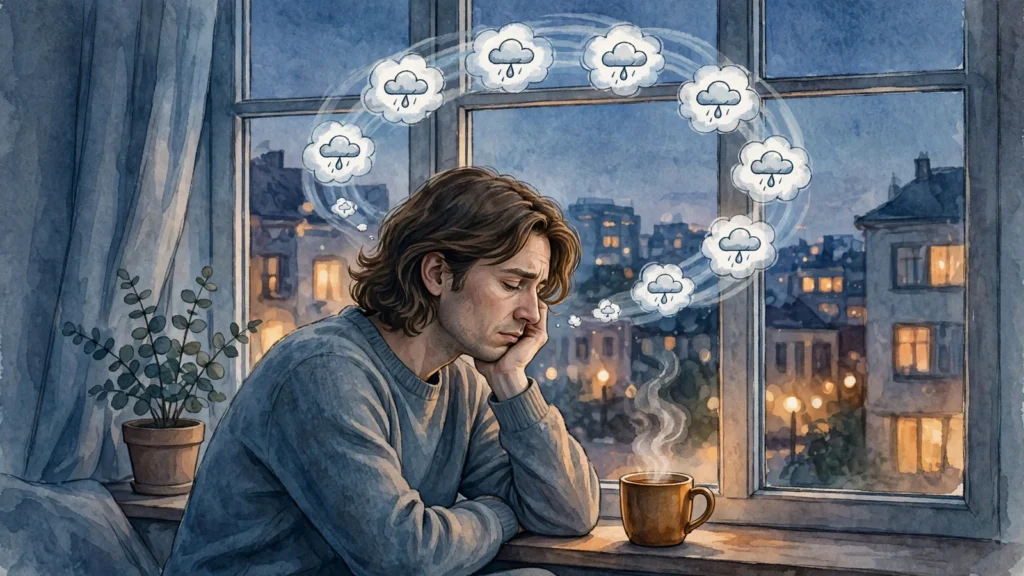
Rumination is repetitive, negative thinking that goes round and round without reaching a solution. Instead of working through a problem, the mind replays what went wrong, why it happened and what it might mean, which usually leaves you feeling worse. The good news is that rumination is a habit of thinking, and habits can be interrupted with practice.
What is rumination?
The American Psychiatric Association describes rumination as repetitive thinking or dwelling on negative feelings and distress, and on their causes and consequences. It is not the same as thinking a problem through. Healthy reflection is purposeful: it asks what happened, what you could do next and how you might handle it differently. Rumination stays vague and evaluative, asking questions such as “Why am I like this?” that have no concrete answer, so the loop never closes.
Rumination can take several forms. You might replay an awkward conversation, worry over a decision you have already made, or run through worst-case scenarios about the future. It often starts outside conscious awareness, especially when you are tired, stressed or alone with unstructured time. Research reviewed by Watkins and Roberts (2020) found that rumination magnifies and prolongs low mood, interferes with problem-solving and can maintain physiological stress responses.
Why does the mind ruminate?
There is rarely a single cause. The same review describes rumination as developing from dwelling on problematic goals until it becomes a learnt habit, combined with a tendency to process negative information in an abstract way. Life events, low mood and poor sleep can all make the habit more likely, and once the loop starts, feeling worse tends to feed further rumination.
Common triggers include:
- Stressful events, such as conflict at work or in a relationship, or a significant life change.
- Low mood or anxiety, which make negative memories easier to recall and harder to set aside.
- Unstructured, inactive time, when the mind defaults to internal chatter.
- Perfectionism or self-criticism, which turn a single mistake into a judgement about yourself as a whole.
- Poor sleep, which leaves less mental energy for redirecting attention.
The NHS notes that anxiety can bring worrying about the past or future, difficulty concentrating and trouble sleeping, all of which overlap with rumination and can keep it going.
Rumination vs reflection: how to tell them apart
| Rumination | Reflection |
|---|---|
| Repetitive and passive; the same thoughts circle without progress | Active and purposeful; it moves towards a decision or action |
| Abstract questions: “Why did this happen to me?” | Concrete questions: “What exactly happened, and what can I try next?” |
| Leaves you feeling worse and less motivated | May feel uncomfortable but leads somewhere useful |
| Focuses on faults, blame and worst cases | Considers facts, context and what is within your control |
If thinking about a problem for a while leaves you with a plan, however small, it was probably reflection. If it leaves you exhausted and no further forward, it was probably rumination.
How to break the cycle
You cannot simply order your mind to stop, and trying to suppress thoughts often backfires. The strategies below work by interrupting the loop or changing how you relate to it.
1. Set a daily worry time
The NHS Every Mind Matters programme suggests setting a daily “worry time” to go through your concerns at a set time each day. Outside that window, when a ruminative thought surfaces, acknowledge it and postpone it: “I will think about that at worry time.” Writing worries down during the window, and trying to find solutions there, helps the rest of the day stay clearer.
2. Switch from “why” to “how”
When you catch an abstract loop, reframe it as a concrete question. Instead of “Why do I always mess things up?”, try “What exactly went wrong in that meeting, and what is one thing I could do differently next time?” Shifting to specific, practical detail is the core move in rumination-focused cognitive behavioural therapy, and it restores the problem-solving ability that rumination blocks.
3. Break the problem into one small step
The American Psychiatric Association suggests separating out different problems, breaking larger ones into smaller parts and tackling one issue at a time with a specific, written plan. A small, doable step, such as sending one email or making one phone call, gives the mind something concrete to work with instead of a vague worry.
4. Move your body and change the scene
Physical activity and a change of environment can interrupt a loop, especially somewhere with positive associations. The NHS also recommends regular exercise, such as walking, running, swimming or yoga, to help you relax, and talking about your feelings with a friend, family member or health professional.
5. Recall times things worked out
Deliberately recalling times when things turned out well, even with challenges, can shift thinking down a different path. Asking family or friends to help you remember positive experiences can help, since rumination tends to make negative memories easier to recall than positive ones.
When to see a doctor
See a GP if repetitive negative thinking is distressing or disruptive, is affecting your sleep, work or relationships, or is not improving despite the strategies above. A GP can talk through what is going on and, if appropriate, refer you to an NHS talking therapies service; in many areas you can also refer yourself directly. Talking therapies such as cognitive behavioural therapy are designed to target exactly these patterns of thinking.
If you feel unable to cope or keep yourself safe, get urgent support right away. You can find immediate help at Health Daily Advice: Get Help Now, or call Samaritans on 116 123 at any time, day or night.
In an emergency call 911 (US), 999 (UK) or 112 (EU).
This article is for information only and is not a diagnosis. Only a health professional who can talk to you directly can assess what you are experiencing.
Frequently asked questions
What is rumination in simple terms?
Rumination is when your mind replays the same negative thoughts over and over without reaching a solution. You might go over a mistake, an awkward conversation or a worry about the future, asking why it happened or what it means about you. Unlike thinking a problem through, rumination stays vague and self-critical, so it tends to leave you feeling worse rather than giving you a plan.
Is rumination the same as overthinking?
They overlap, but they are not identical. Overthinking is a broad term for thinking too much about something, including analysing decisions endlessly. Rumination is a specific pattern: repetitive, passive focus on distress, its causes and its consequences. Overthinking can sometimes lead to a decision, whereas rumination typically circles the same negative material without moving towards an answer or an action.
Why can't I stop ruminating at night?
Night-time is prime time for rumination because there are fewer distractions, you are tired, and the day's events are fresh. Tiredness reduces your ability to redirect attention, and lying quietly gives the mind unstructured space to replay worries. A regular wind-down routine, writing worries down earlier in the evening, and a set daily worry time can help keep night-time loops shorter.
Does rumination cause depression?
Rumination does not cause depression on its own, but research shows it is a strong risk factor: it magnifies and prolongs low mood, interferes with problem-solving and makes negative memories easier to recall. People who ruminate more tend to experience depression more often and for longer. That is why therapies that target rumination directly, such as rumination-focused cognitive behavioural therapy, can be helpful.
When should I get help for rumination?
Get help if repetitive negative thinking is distressing or disruptive, affects your sleep, work or relationships, or is not improving despite self-help strategies. A GP can discuss what is going on and refer you to a talking therapies service, which you can often refer yourself to directly. If you feel unable to cope or keep yourself safe, seek urgent support right away rather than waiting.
Sources
- American Psychiatric Association: Rumination: A Cycle of Negative Thinking www.psychiatry.org
- Watkins ER, Roberts H: Reflecting on rumination (Behaviour Research and Therapy, 2020) www.medscape.com
- NHS: Get help with anxiety, fear or panic www.nhs.uk
- NHS Every Mind Matters: Anxiety www.nhs.uk

Try the tool
How have you felt over the last 2 weeks?
The PHQ-9 and GAD-7 that GPs use. Private, about 3 minutes.
Start the self-check