What Is Doomscrolling? Why It Hooks You and How to Stop
Doomscrolling is compulsively scrolling through negative news even though it leaves you feeling worse. Here is why your brain does it, what it does to your mood and sleep, and how to break the loop.
- Written by
- Health Daily Advice
- Published
- Reading time
- 7 minutes
- Sources
- 9 cited
In this guide
Doomscrolling is scrolling through negative news and social media for far longer than you meant to, even though it leaves you feeling worse. Research links it to higher anxiety, lower mood and poorer sleep — 38% of US adults in a 2025 survey said bedtime scrolling worsened their rest. A habit, not a diagnosis, and it can be broken.
What is doomscrolling?
Doomscrolling means compulsively consuming news and content on social media, even when you know it is damaging your mood, sleep and relationships. That is how Mayo Clinic psychologist Craig Sawchuk describes it — the key point is the compulsion and the way it interferes with daily life, not simply the amount of time you spend online.
The word rose to prominence during the COVID-19 pandemic and was one of the Oxford English Dictionary’s words of the year in 2020, according to Harvard Health. It is not a formal diagnosis: there is no recognised disorder or set of diagnostic criteria for doomscrolling, as the American Psychological Association (APA) notes. That matters, because it means the behaviour can usually be changed with practical steps rather than medical treatment — although the anxiety or low mood underneath it may still deserve professional support.
Doomscrolling is not the same as keeping up with the news. Reading a couple of trusted sources at set times is a normal, useful habit. Doomscrolling is what happens when the checking becomes automatic, stretches for hours, and leaves you tense, drained or unable to sleep.
Why doomscrolling hooks your brain
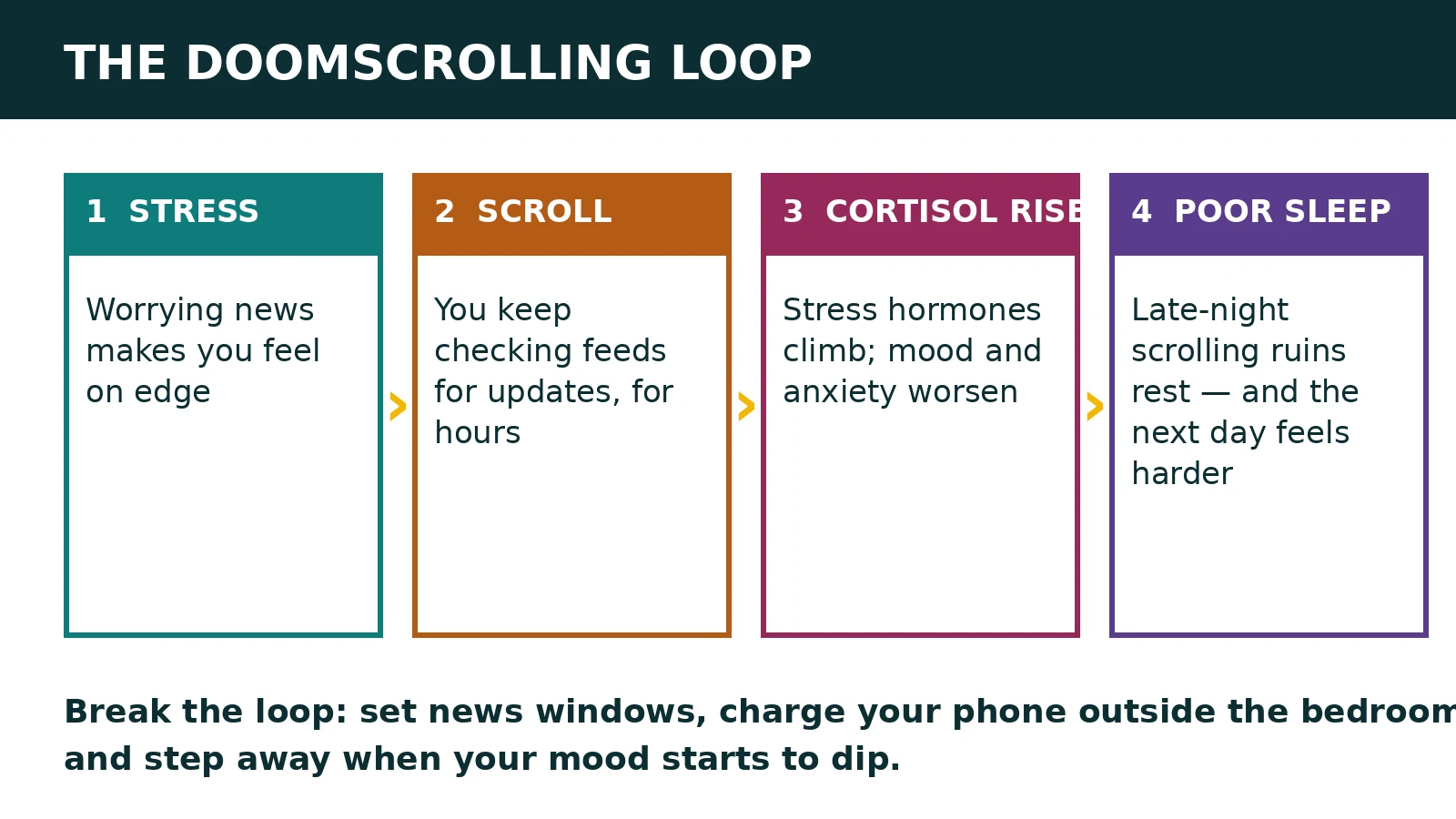
Your brain is wired to notice threats. Harvard Health explains that the amygdala, the part of the brain that scans for danger, drives hypervigilance — so stress makes you want to keep scrolling, and scrolling keeps you stressed. As one expert puts it, “the more you scroll, the more you feel you need to.”
This is the negativity bias at work: alarming headlines grab attention more strongly than reassuring ones, and social media feeds are designed to keep serving you the next post before you have finished processing the last. Psychologist Susan Albers of the Cleveland Clinic points out that doomscrolling also feeds the brain a steady stream of cortisol, the stress hormone — and over time, high cortisol levels can contribute to a range of mental and physical health problems.
There is also a false sense of control. Checking the news can feel like doing something about a worrying situation, even when it changes nothing. That feeling keeps you scrolling long after the information has stopped being useful.
Signs you are doomscrolling
Most people recognise at least one of these. You may be doomscrolling if you:
- check news or social media first thing in the morning or late at night, and lose track of time while doing it
- refresh feeds repeatedly for updates, feeling a strong urge to stay informed “just in case”
- feel anxious, sad or angry while you scroll — but keep going anyway
- put off bedtime to stay online, then feel tired and foggy the next day
- find it hard to concentrate on work, conversations or anything else afterwards
- notice tension in your neck and shoulders, a racing heart, or intrusive thoughts about headlines during the day
- have had friends or family comment on how much time you spend on your phone
At its worst, the APA notes, heavy news consumption can be linked to learned helplessness, drinking more, and losing interest in activities outside the news.
How doomscrolling affects your mental health
The research is mostly based on surveys, so it shows associations rather than proving that doomscrolling alone causes these outcomes. Even so, the pattern is consistent.
A review published in Applied Research in Quality of Life in April 2023 analysed three studies involving about 1,200 adults and found doomscrolling was linked to worse mental wellbeing and life satisfaction, Harvard Health reports. A 2024 study of 800 adults published in Computers in Human Behavior Reports found doomscrolling was linked to higher levels of existential anxiety — a feeling of dread when confronting the limits of existence.
The scale of news-related stress is striking. In the APA’s Stress in America survey of March 2022, 73% of Americans said they were overwhelmed by the number of crises facing the world, and 87% said it felt like there had been a constant stream of crises over the previous two years. By June 2020, 83% of Americans reported stress over the nation’s future.
For some people the pattern becomes severe. A Texas Tech University study of 1,100 US adults, published in Health Communication in 2022, found 16.5% showed signs of “severely problematic” news consumption — they focused less on school, work and family, and struggled to sleep. Just over 73% of that group said they experienced mental health issues “quite a bit” or “very much”, and 61% said their physical health had suffered.
Physical effects are part of the picture too. Harvard Health lists headaches, muscle tension, neck and shoulder pain, low appetite, difficulty sleeping and even raised blood pressure — alongside the long sedentary stretches that hours of scrolling involve.
Doomscrolling and sleep
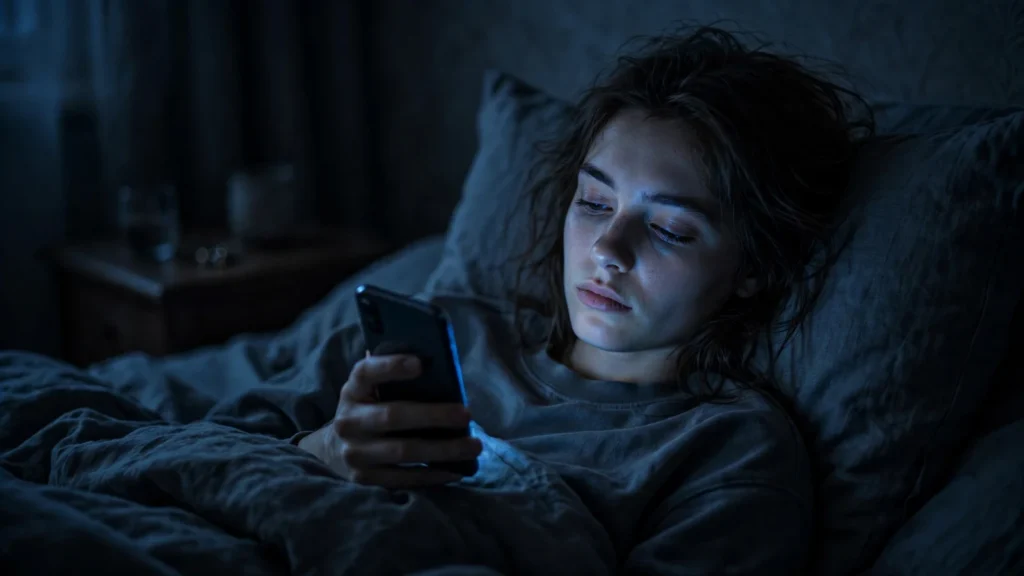
Bedtime is when doomscrolling does some of its worst damage. In an American Academy of Sleep Medicine survey of 2,007 US adults in June 2025, 38% said using a phone or tablet before bed to view news and current events made their sleep slightly or significantly worse — rising to 46% among 18- to 24-year-olds. More than a quarter (26%) said they prioritised screen time over getting the recommended amount of sleep, and half (50%) said they used a screen while in bed every day. The survey is reported by the AASM.
It is a double hit: the blue light and the mental stimulation delay sleep, while the upsetting content keeps the stress system switched on. The result is often “sleep procrastination” — delaying bedtime to stay online, then paying for it the next day.
How to stop doomscrolling
Breaking the habit works best when you change the environment around your phone, not just your willpower. These strategies are recommended by the Cleveland Clinic, Harvard Health, the Mayo Clinic and the APA.
Set news windows
Decide in advance when you will check the news — for example, one or two planned check-ins of 10 to 15 minutes, morning and evening — instead of checking reactively all day. Outside those windows, the apps stay closed.
Keep your phone out of reach
Harvard Health calls this potentially “the biggest game changer”. Charge your phone outside the bedroom and use a separate alarm clock. During the day, put it in another room or a desk drawer, or at least 10 feet away while you work.
Turn off notifications
Opt out of news and social media alerts so your phone is not pulling you back in. Do not bring it to the dinner table.
Curate what you see
Unfollow accounts and news sources that leave you feeling anxious, and cap the number of sites you read in one sitting. Read one useful article or a short reliable explainer instead of diving into an endless feed.
Use screen-time tools
Set app limits or an alarm. Switching your phone to grayscale makes scrolling less enticing — Harvard notes early data suggests this reduces screen time.
Pause before you pick it up
Ask yourself why you are reaching for the phone. A 30-second pause before opening an app, or picturing a red stop sign, can be enough to break the automatic impulse. Check your mood before you start scrolling and again after 10 to 15 minutes — if it is getting worse, step away.
Power down before bed
Switch off electronics 30 to 60 minutes before bed and build a wind-down routine instead: reading, journaling, a warm shower. Keep a regular wake time, even at weekends.
Replace the habit, don’t just remove it
Fill the gap with something that gives your nervous system a sense of closure: a short walk, stretching, slow breathing, meeting a friend, or volunteering. If a particular issue worries you, taking action on it — joining a local project or advocacy group — counters the helplessness that passive scrolling feeds.
When to see a doctor
Talk to your GP if you cannot stop doomscrolling even though it is making you extremely upset, anxious or low, or if it is interfering with work, relationships, sleep or daily life. The same applies if you notice persistent anxiety, depression or PTSD-type symptoms linked to news exposure, intrusive thoughts about headlines, or increased drinking. Harvard Health advises that a small percentage of people really need professional help, and the best place to start is by talking to your primary care doctor. The Cleveland Clinic suggests considering a therapist who specialises in cognitive behavioural therapy (CBT) to get to the root of the habit.
If you are struggling with your mental health right now, support is available — visit Health Daily Advice: Get Help Now for helplines and resources.
In an emergency call 911 (US), 999 (UK) or 112 (EU).
Frequently asked questions
What is doomscrolling?
Doomscrolling is the habit of endlessly scrolling through upsetting or negative news and social media, even when it makes you feel worse. Mayo Clinic psychologist Craig Sawchuk defines it as compulsive consumption of news despite knowing it damages your mood, sleep and relationships. The key issue is compulsion and interference with daily life, not just time spent online.
Why can't I stop doomscrolling?
Your brain is wired to scan for threats, so alarming headlines grab attention more strongly than reassuring ones, and stress makes the urge to scroll stronger. Psychologist Susan Albers of the Cleveland Clinic explains that doomscrolling also feeds the brain a steady stream of cortisol, the stress hormone. Checking the news can feel like doing something about a worry, even when it changes nothing.
Is doomscrolling bad for your mental health?
Research links it to worse mental health. A 2023 review of three studies involving about 1,200 adults found doomscrolling was linked to worse mental wellbeing and life satisfaction. A 2024 study of 800 adults linked it to higher existential anxiety. A 2022 study found 16.5% of adults showed severely problematic news consumption, with most of that group reporting mental health issues. These studies show associations, not proof of cause.
Does doomscrolling affect sleep?
Yes. In an American Academy of Sleep Medicine survey of 2,007 US adults in June 2025, 38% said using a phone or tablet before bed to view news made their sleep slightly or significantly worse, rising to 46% among 18- to 24-year-olds. Half said they used a screen while in bed every day. Blue light, mental stimulation and upsetting content all work against falling asleep.
How do I stop doomscrolling?
Set one or two planned news check-ins of 10 to 15 minutes a day instead of checking all day. Charge your phone outside the bedroom, turn off news notifications, unfollow anxiety-provoking sources, and use app limits or grayscale mode. Pause for 30 seconds before opening an app and check your mood after 10 to 15 minutes. Replace scrolling with a walk, a friend or a wind-down routine before bed.
When should I get help for doomscrolling?
Talk to your GP if you cannot stop even though it is making you extremely upset, anxious or low, or if it interferes with work, relationships, sleep or daily life. The same applies if you notice persistent anxiety, depression or PTSD-type symptoms linked to news exposure. Harvard Health advises starting with your primary care doctor, and the Cleveland Clinic suggests a therapist specialising in cognitive behavioural therapy.
Sources
- Cleveland Clinic: The Dangers of Doomscrolling and How To Stop health.clevelandclinic.org
- Harvard Health: Doomscrolling dangers www.health.harvard.edu
- American Psychological Association: Media overload is hurting our mental health www.apa.org
- American Psychological Association: Stress in America, March 2022 www.apa.org
- American Academy of Sleep Medicine: Americans are doomscrolling at bedtime aasm.org
- Arizona State University: News addiction can cause stress, anxiety, study says usenate.asu.edu
- Mayo Clinic psychologist Craig N. Sawchuk on doomscrolling (Gulf Business) gulfbusiness.com

Try the tool
How have you felt over the last 2 weeks?
The PHQ-9 and GAD-7 that GPs use. Private, about 3 minutes.
Start the self-check