What Is Gaslighting? Signs, Examples and How to Respond
Gaslighting is a form of psychological manipulation that makes you doubt your own memory, feelings and judgement. This guide explains the signs, the phrases to watch for, and how to respond and protect yourself.
- Written by
- Health Daily Advice
- Published
- Reading time
- 13 minutes
- Sources
- 5 cited

In this guide
Gaslighting is a form of psychological manipulation in which someone repeatedly denies, twists or dismisses your experience until you start doubting your own memory, feelings and judgement. It is a pattern of behaviour, not a single disagreement, and it can happen in romantic relationships, families, friendships and workplaces. Recognising the pattern is the first step towards protecting yourself.
If you have ever left a conversation feeling confused, apologetic and unsure of what actually happened — even though you were certain a few minutes earlier — you are not alone. That foggy, unsettled feeling is one of the most commonly described effects of gaslighting. This guide explains what gaslighting is, where the term comes from, the signs and tactics to watch for, how it differs from ordinary disagreement, how it can affect your mental health, and what you can do about it.
What is gaslighting?
Gaslighting is a form of emotional abuse and mental manipulation that disrupts your ability to trust others and yourself. The person doing it uses specific patterns of behaviour to get you to question your sanity and your ability to make decisions. As Cleveland Clinic psychologist Dr Chivonna Childs explains, gaslighting is “a form of emotional manipulation to make you feel as if your feelings aren’t valid, or that what you think is happening isn’t really happening.” Over time, you may start to question your self-worth, self-esteem and mental capacity.
WebMD describes it in similar terms: gaslighting is an emotionally abusive strategy that causes someone to question their feelings, thoughts and sanity, with the aim of convincing them that they cannot trust their own thoughts or instincts. The gaslighter may try to convince you that your memories are incorrect, that you overreact, or that something is “all in your head” — and then present their version of events as the truth.
Women’s Aid, the UK domestic abuse charity, describes gaslighting as a form of psychological abuse which makes someone question their perception of reality, and notes that it is a form of coercive control, which has been a criminal offence in England and Wales since 2015.
Gaslighting does not have to be deliberate in every case. As Dr Childs notes, the person doing it “may or may not realise they’re doing it,” but either way, being on the receiving end can feel confusing and be very damaging. Some people gaslight as a learned behaviour, as a defence mechanism when they feel challenged, or as a way to gain power and control. Others may have grown up with it and absorbed it as normal. None of that makes the effect on you any less real.
Where does the term gaslighting come from?
The term comes from Patrick Hamilton’s 1938 British play Gas Light, later made into the 1944 film Gaslight, starring Ingrid Bergman and Charles Boyer. In the story, a husband secretly dims the gas lamps in the house and moves objects around, then insists nothing has changed when his wife notices. He tells her she is imagining things, until she begins to doubt her own mind.
The play captured the essence of the behaviour so vividly that the word entered everyday language. Psychology Today describes gaslighting as manipulation that, at the mild end, distorts reality, and at the extreme end amounts to emotional abuse or psychological warfare, slowly dismantling the other person’s self-trust. The term became widely used from the 1960s onwards, and its use surged again in the 2010s as awareness of emotional abuse grew. Robin Stern’s 2007 book The Gaslight Effect helped bring the concept to a wider audience.
Common signs and tactics of gaslighting
No single tactic on its own defines gaslighting. It is the pattern — the same behaviours repeated over and over — that matters. Cleveland Clinic stresses that “no standalone tactic or experience defines gaslighting. It’s a pattern of behaviour, multiple instances of manipulation that happen over and over again.” With that in mind, these are the tactics experts describe most often.
1. Denial
The gaslighter denies something they said or did, even when you have proof. Common phrases include “That never happened,” “I never said that,” and “You’re making things up.” Simply Psychology notes that even when the victim provides proof, the gaslighter may not back down, which can leave the victim feeling confused, unseen and unheard.
2. Countering your memory
Countering means challenging your version of events and adding details that never happened. You may hear “You’re wrong. You never remember things correctly,” or “You have a bad memory.” Over time, this can make you stop trusting your own recall and stop sharing what you remember for fear of being wrong.
3. Trivialising your feelings
Trivialising, or minimising, aims to make your thoughts and feelings seem unimportant. Phrases such as “You’re overreacting,” “You’re too sensitive,” and “I was only joking” are typical. If this happens often enough, you may start to believe your feelings are invalid or that you are being dramatic for having them at all.
4. Withholding
Withholding is when the other person refuses to listen, pretends not to understand, or shuts the conversation down. They may say “I don’t know what you are talking about” or accuse you of trying to confuse them. The result is that nothing gets resolved, and you are left feeling frustrated and misunderstood.
5. Diverting and blame-shifting
When challenged, the gaslighter may change the subject, bring up an unrelated fault of yours, or twist the conversation so that you end up apologising instead. Simply Psychology gives the example of a gaslighter saying, “If you behaved differently, then I wouldn’t need to treat you this way.” The blame lands on you, even when the original issue was their behaviour.
6. Discrediting you to others
Some gaslighters tell other people that you are unstable, irrational or “losing it,” so that when you do speak up, others are less likely to believe you. They may say, “Everyone thinks you are crazy,” using other people’s supposed opinions as evidence against you. This is sometimes called “tribe gaslighting” when friends, family or colleagues reinforce the doubt.
7. Using affection as a weapon
After being called out, a gaslighter may switch to loving words — “You know I love you” or “I would never hurt you on purpose” — to defuse the situation and make you feel guilty for raising it. If the same hurtful behaviour then continues, those words are unlikely to be sincere.
8. Rewriting history
The gaslighter retells events in a way that suits them, sometimes casting you as the aggressor. For example, after shouting at you all evening, they may later claim, “You were yelling at me for no reason.” Small changes to stories and memories are often how gaslighting starts, precisely because they are easy to dismiss at first.
For more real-life wording, see our guide to 8 examples of what gaslighting sounds like.
Signs you may be experiencing gaslighting
Because gaslighting often starts subtly, it can be hard to recognise from the inside. These are some of the signs described by Cleveland Clinic, WebMD and Simply Psychology. You do not need to experience every one of them for the pattern to be real.
- You constantly second-guess your decisions and mistrust your judgement.
- You feel confused, on edge or nervous around one particular person, even just thinking about seeing them.
- You apologise often, even when you do not think you have done anything wrong.
- You feel you cannot do anything right, or that you are “too sensitive.”
- You have lost confidence and find it hard to make even simple decisions.
- You feel isolated, as though no one would believe you or understand.
- You have lost interest in work, hobbies or activities you used to enjoy.
- Other people have noticed changes in your mood or personality around this person.
- You make excuses for the other person’s behaviour, or defend them to friends and family.
- You feel like a different person — less confident, less relaxed — than you used to be.
If several of these feel familiar, it is worth taking the pattern seriously rather than dismissing it as oversensitivity. Your feelings are information, not evidence that something is wrong with you.
Gaslighting vs healthy communication: how to tell the difference
Two people can remember the same conversation differently without anyone gaslighting anyone. Psychology Today makes this point clearly: not remembering things said in the heat of an argument is normal, as no one can remember all conversations word for word. The difference lies in the pattern, the intent and the effect.
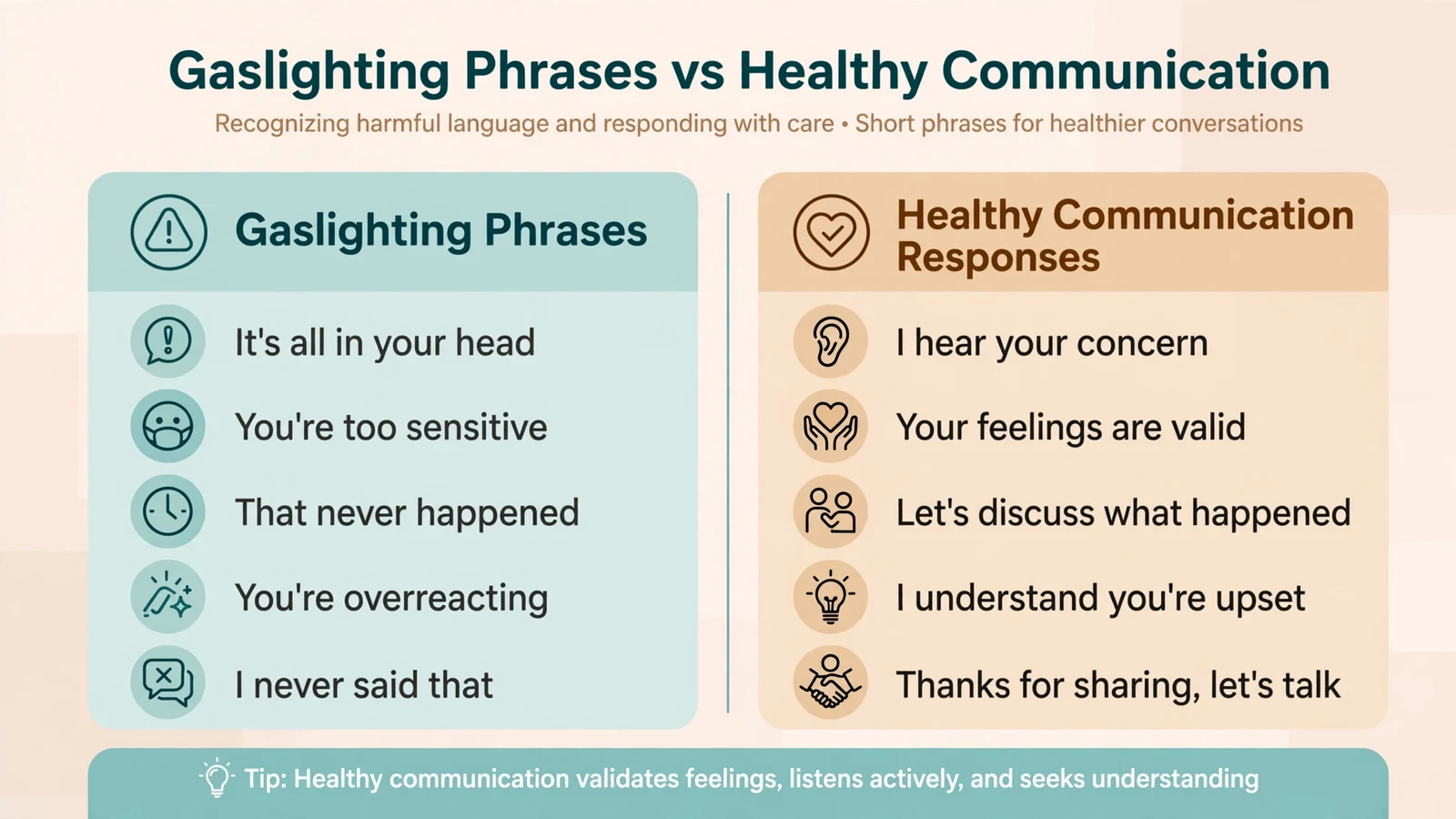
| Healthy disagreement | Gaslighting |
|---|---|
| “I remember it differently — let’s talk it through.” | “That never happened. You’re imagining things.” |
| “I didn’t mean it like that, and I’m sorry it hurt.” | “You’re too sensitive. You’re overreacting.” |
| “I hear how you feel, even if I see it differently.” | “Your feelings are wrong.” |
| “I got that wrong — let me put it right.” | “It’s your fault I acted that way.” |
| Stays on the issue being discussed. | Changes the subject or brings up unrelated faults. |
| You leave feeling heard, even if you disagree. | You leave feeling confused, apologetic and doubting yourself. |
In healthy communication, both people can hold different memories and still respect each other. In gaslighting, one person repeatedly insists their version is the only true one, dismisses the other’s feelings, and the other person’s confidence steadily shrinks. Ask yourself: does this happen again and again, and do I feel smaller and less sure of myself each time? A repeated pattern is the key warning sign.
Where gaslighting can happen
Gaslighting is most often discussed in romantic relationships, but it can happen anywhere there is an imbalance of power or trust. WebMD and Cleveland Clinic both note that it can occur in families, friendships and workplaces, and in medical settings too — sometimes called medical gaslighting — when a clinician dismisses or downplays a patient’s symptoms, for example by telling them their pain is “all in your head” or simply anxiety. A doctor telling a patient that pain from endometriosis is just normal period pain is one example WebMD gives. If a clinician makes you feel you cannot speak up about your own body, it may be worth seeking a second opinion or changing doctors.
It can also happen in groups. Political gaslighting, institutional gaslighting and racial gaslighting all involve powerful people or organisations denying a group’s experiences to maintain control. Whatever the setting, the mechanism is the same: repeated denial and distortion that makes the target doubt their own reality.
How gaslighting affects your mental health
Gaslighting targets your mental health by undermining your ability to think for yourself. Cleveland Clinic notes that questioning your perceptions and sanity can create or compound mental health issues such as anxiety and depression, which can lock you into a cycle of abuse. Simply Psychology reports that persistent gaslighting can wear away someone’s sense of identity, self-worth and self-confidence, and that some people may turn to substance use or experience suicidal thoughts as a result — which is why taking it seriously and getting support matters.
Over time, the effects can include:
- Anxiety, low mood and depression
- Loss of confidence and self-esteem
- Difficulty making decisions, even small ones
- Feeling confused, hopeless or worthless
- Withdrawing from friends, family and activities you enjoy
- Becoming dependent on the gaslighter for validation and decisions
- Hypervigilance — feeling constantly on edge around that person
- Lasting self-doubt, which can continue even after the relationship ends
These effects can build gradually, which is why gaslighting is so hard to spot early. As Women’s Aid explains, it usually happens gradually, so gradually that the behaviour seems harmless at first. Over time, a victim can become confused, anxious, isolated and depressed, and lose their sense of what is actually happening. If you recognise yourself in this description, it does not mean you are weak or at fault. It means you have been on the receiving end of a sustained pattern of manipulation, and support can help you rebuild trust in yourself.
How to respond to gaslighting and protect yourself
There is no single response that works in every situation, and what is safe depends on your relationship and circumstances. If you feel unsafe, your safety comes first — see the help section below. These steps, drawn from Cleveland Clinic, WebMD and Simply Psychology, can help you steady yourself and set boundaries.
Trust what you notice
Pay attention to how you feel during and after conversations with this person. If discussions regularly turn into blame sessions, or you leave feeling confused and apologetic, that pattern is worth noting. Your feelings are not proof on their own, but they are a useful signal.
Keep a private record
Writing down what happened, when, and what was said — dates, messages, screenshots kept somewhere safe — can help you sort truth from fiction when your memory is being challenged. Cleveland Clinic recommends documenting interactions for exactly this reason. Keep records somewhere the other person cannot access, and consider sending copies to a trusted friend.
Name the behaviour, if it is safe to do so
Calmly naming what is happening — “That is not how I remember it, and I am not going to argue about my memory” — can set a boundary and change the power dynamic. Dr Childs notes that calling out gaslighting behaviour helps set boundaries and puts the other person on notice that you will no longer accept that treatment. Only do this if you feel safe; if the person escalates, stepping away is the safer choice.
Do not get drawn into endless arguments
Trying to prove you are right rarely works with someone who is gaslighting you, and it can leave you exhausted. Simply Psychology advises avoiding arguments with the gaslighter, ending conversations that are no longer productive, and choosing not to engage when someone is making you question your reality. You can say, “I’m not going to continue this conversation while we’re both heated,” and walk away.
Stay connected to people you trust
Gaslighting thrives on isolation. Talking to a trusted friend, family member or therapist can help you check your reality against someone outside the situation. WebMD suggests imagining the situation from an outsider’s point of view, which can help you see the behaviour more clearly. If the other person is trying to turn people against you, a trusted outsider’s perspective is especially valuable.
Set clear boundaries
Decide what you will and will not accept, and state it plainly: “I will talk about this when we can both listen respectfully.” Boundaries protect your emotional energy. If the behaviour continues after you have named it and set limits, that tells you something important about the relationship.
Look after yourself and seek support
Cleveland Clinic recommends prioritising self-care after difficult interactions — grounding techniques, breathing exercises and time with supportive people can help you calm down and centre yourself. Talk therapy can also help you heal, rebuild confidence and make a plan. A therapist experienced in emotional abuse can help you untangle what happened and trust your own judgement again.
Know when to step back or leave
It is impossible to reason with someone who is gaslighting you on purpose. Dr Childs is direct about this: if you call out the behaviour and it does not stop, or it escalates, the only healthy response might be to leave the relationship. “A fire cannot burn if there’s no fuel,” she says. “They can’t fight if there’s no one to fight with.” If you are in an abusive relationship and need help leaving, support is available — see below.
When to see a doctor
Talk to a doctor if gaslighting is affecting your mental health — for example, if you have persistent anxiety, low mood, trouble sleeping, difficulty concentrating, or you feel unable to cope day to day. A doctor can listen, assess how you are doing, and refer you to a counsellor, therapist or other mental health support. You do not need to have a diagnosis, or to be in crisis, to ask for help.
Seek urgent help if you feel unsafe, if you are thinking of harming yourself, or if someone is threatening or hurting you. If you are in immediate danger, call the emergency services. In an emergency call 911 (US), 999 (UK) or 112 (EU). In the UK, you can also contact the National Domestic Abuse Helpline on 0808 2000 247, run by Refuge and Women’s Aid, for free, confidential advice. For more support and resources, visit our get help now page.
Recovery from gaslighting takes time, and that is normal. With distance from the behaviour, support from people you trust, and professional help where needed, most people do rebuild their confidence and their trust in their own judgement. If you are reading this and recognising your own experience, you have already taken the hardest step: naming what is happening.
“Gaslighting is a form of emotional manipulation to make you feel as if your feelings aren’t valid, or that what you think is happening isn’t really happening.” — Dr Chivonna Childs, Cleveland Clinic
Frequently asked questions
What is gaslighting in simple terms?
Gaslighting is when someone repeatedly denies, twists or dismisses your experience until you doubt your own memory, feelings and judgement. It is a pattern of psychological manipulation, not a one-off lie, and it is used to gain control by making you question what is real.
What are the signs of gaslighting?
Common signs include constantly second-guessing yourself, feeling confused or on edge around one person, apologising when you have done nothing wrong, losing confidence, and finding it hard to make decisions. Other people may also notice changes in your mood or personality around that person.
What are some examples of gaslighting phrases?
Typical phrases include “That never happened,” “You’re imagining things,” “You’re too sensitive,” “You’re overreacting,” “It’s all in your head,” and “Everyone thinks you’re crazy.” The wording varies, but the effect is the same: your memory or feelings are dismissed and your confidence is undermined.
Is gaslighting a form of abuse?
Yes. Gaslighting is recognised as a form of psychological and emotional abuse. Women’s Aid describes it as a form of coercive control, which has been a criminal offence in England and Wales since 2015. It can happen in romantic relationships, families, friendships and workplaces.
How do you respond to someone gaslighting you?
Trust what you notice, keep a private record of what happened, and name the behaviour calmly if it is safe to do so. Avoid endless arguments, stay connected to trusted people, and set clear boundaries. If the behaviour continues or escalates, consider stepping back from the relationship and seeking support from a therapist.
Can gaslighting affect your mental health?
Yes. Persistent gaslighting can contribute to anxiety, depression, low self-esteem and difficulty trusting your own judgement. It can also lead to isolation and lasting self-doubt. If it is affecting your daily life, talk to a doctor, who can refer you to a counsellor or therapist.
Sources
- WebMD: Gaslighting — signs to look for www.webmd.com
- Psychology Today: Bringing Gaslighting to Light www.psychologytoday.com
- Simply Psychology: What Is Gaslighting? www.simplypsychology.org
- Cleveland Clinic: Gaslighting health.clevelandclinic.org
- Women's Aid: Gaslighting and coercive control womensaid.org.uk

Try the tool
How have you felt over the last 2 weeks?
The PHQ-9 and GAD-7 that GPs use. Private, about 3 minutes.
Start the self-check