What Is Decision Fatigue? Signs, Causes and How to Cope
By evening, even small choices can feel impossible after a day of deciding. Here is what decision fatigue is, its eight common signs, and the routines that help it lift.
- Written by
- Health Daily Advice
- Published
- Reading time
- 8 minutes
- Sources
- 9 cited

In this guide
Decision fatigue is the mental exhaustion that builds after making many decisions in a day, leaving even small choices feeling hard. It is not a medical diagnosis, but a recognised pattern of tired thinking, poorer judgement and avoidance. Rest, routines and fewer choices usually help it lift within a day or so.
By the evening, choosing what to eat, what to watch or whether to reply to a message can feel oddly impossible — even though you made far bigger calls earlier without blinking. That end-of-day struggle is the classic picture of decision fatigue, and it is surprisingly common. Cleveland Clinic notes that we make hundreds, possibly thousands, of decisions every day, and the volume, complexity or impact of those choices can leave us physically, mentally and emotionally drained.
What is decision fatigue?
Decision fatigue describes what happens when a long run of choices wears down your ability to choose well. According to registered psychotherapist Natacha Duke, speaking to Cleveland Clinic, it is a phenomenon rather than a diagnosable medical condition: the more decisions a person makes over the course of a day, the more depleted they become, and their executive functioning — the brain’s ability to plan, focus and weigh options — starts to struggle. The result can be impaired judgement, slower thinking and a strong urge to avoid deciding anything at all.
It is usually short-lived. Cleveland Clinic stresses that true decision fatigue is acute: most people recover reasonably quickly, often feeling better after a day or so of rest. That is an important distinction. If you feel unable to decide things every single day, for weeks on end, something more lasting may be going on, such as anxiety, depression or burnout, and that deserves a proper conversation with a doctor or therapist.
Signs of decision fatigue
There is no test for decision fatigue, but Cleveland Clinic lists eight common signs. You may recognise several of them at the end of a demanding day:
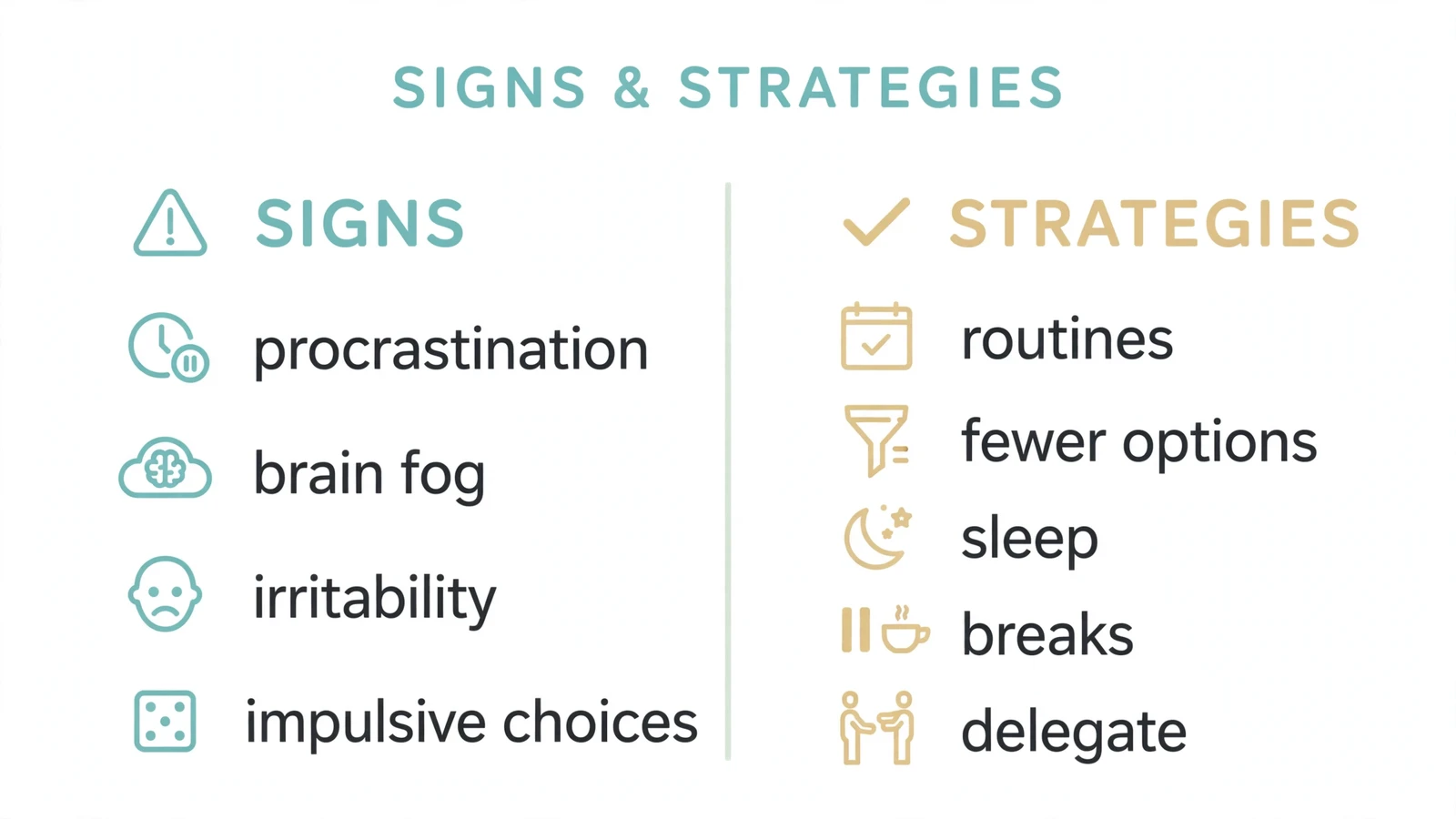
- Procrastination or decision avoidance. Putting choices off, or avoiding the people and situations that force a decision — sometimes without realising you are doing it.
- Impulsivity. After a day of careful choices, you become less careful: ordering takeaway you would normally skip, spending too much online, or saying yes to things you would usually turn down.
- Exhaustion. Feeling physically, mentally and emotionally drained, and desperate for a nap or a good cry.
- Brain fog. Losing your train of thought mid-sentence, forgetting names, or struggling to follow a conversation.
- Irritability. Snapping at someone for asking a simple question, such as where to go for lunch.
- Feeling overwhelmed. A sense that there is no room left in your head — let alone your schedule — for everything you are juggling.
- Regret or dissatisfaction. Ruminating for hours over a choice you already made, and second-guessing the call.
- Physical discomfort. The stress of deciding can bring tension headaches, eye twitching, nausea and other stomach troubles.
The NHS lists many of the same patterns among the mental symptoms of stress, including struggling to make decisions, feeling overwhelmed, difficulty concentrating and forgetfulness — which is one reason decision fatigue and stress so often arrive together.
Why does decision fatigue happen?
Anyone can experience it, but Cleveland Clinic says it is most likely when:
- You make a lot of decisions every day. Judges, surgeons and shift leaders are extreme examples, but many jobs and caring roles demand dozens of quick calls a day.
- Your decisions affect other people. Choices feel heavier when they touch your partner, children, employees or patients.
- You are in a difficult life situation. Picking flowers is easy; planning a funeral is not. Grief, illness and money worries all raise the stakes of ordinary choices.
- You face uncertainty. When you cannot know what the consequences of a choice will be, deciding takes far more effort.
- You have perfectionist tendencies. As Duke puts it, when the standard is perfection for everything, and you think everything through to the nth degree, that is exhausting and depleting for the brain.
- You are short of sleep. Cleveland Clinic psychologist Susan Albers calls being sleep deprived the number one cause of decision fatigue, noting that studies show we struggle to make decisions when we are overly tired. Cleveland Clinic also notes that sleep-deprived people have poorer impulse control and emotional regulation.
What the research says: ego depletion
The idea behind decision fatigue comes from a theory called ego depletion, developed by psychologist Roy Baumeister and colleagues. The American Psychological Association describes one of the earliest experiments, published in 1998: volunteers who resisted freshly baked cookies and ate radishes instead gave up on a difficult puzzle after about 8 minutes, while those who had eaten the cookies persevered for nearly 19 minutes. Drawing on willpower to resist the cookies, it seemed, had drained self-control for the next task.
Some experts liken willpower to a muscle that can get fatigued from overuse. But the theory is still debated: later studies have found smaller effects than the early experiments suggested, and the APA itself notes that further research is needed into how beliefs, mood and attitudes affect self-control. That debate does not make the everyday experience unreal — long stretches of effortful thinking, poor sleep and stress genuinely do make decisions harder. It simply means there is no single “willpower battery” that science has fully mapped, so practical strategies matter more than any one theory.
Decision fatigue vs burnout, stress and overthinking
Decision fatigue overlaps with several other experiences, and telling them apart helps you respond in the right way:
| Experience | What it feels like | What usually helps |
|---|---|---|
| Decision fatigue | Choices feel heavy late in a busy day; you avoid them or pick the easy option | Rest, fewer decisions, routines |
| Stress | Feeling under pressure or threatened; racing thoughts, irritability, trouble sleeping | Talking it through, planning ahead, breathing exercises, support from a GP if it persists |
| Burnout | Exhaustion and detachment that build over weeks or months, often tied to work | Real rest, boundaries, workload changes and professional support |
| Overthinking | Going over the same choice again and again, even when you have time and energy | Time limits, writing options down, deciding on “good enough” |
The key difference is time. Decision fatigue is usually tied to one heavy day and lifts with rest. The NHS Every Mind Matters service notes that long-term or severe stress can lead to physical, mental and emotional exhaustion often called burnout — so if the drained feeling never really lifts, it is worth looking at the bigger picture rather than blaming one busy day.
How to manage decision fatigue
You cannot always control how many decisions a day brings, but you can change how many of them demand your full attention. These strategies are drawn from Cleveland Clinic and the Cleveland Clinic Newsroom:
1. Automate the small stuff
Remove choice from the parts of life that do not need it. Wear a small rotation of outfits, keep a few go-to breakfasts, or set a weekly meal plan — meatless Mondays, for example. As Duke puts it, some things can be automated, and you can give yourself permission not to make perfection the standard for everything.
2. Make important decisions early
Research cited by Cleveland Clinic shows we take more time to deliberate — and make better decisions — early in the day. Where you can, put the big calls in the morning and leave routine matters for later.
3. Limit your options
When a choice has too many possibilities, narrow it first. Pick two or three options, compare only those, and set a time limit. If a trivial choice — a restaurant, a film, an inexpensive purchase — is still undecided after a few minutes, choose the first reasonable option and move on.
4. Delegate where you can
Not every decision has to be yours. Let a partner choose the takeaway, let a colleague pick the meeting time, or let a child old enough to choose pick their own clothes. Other people may occasionally get it wrong — so will you.
5. Protect your sleep
Sleep is the strongest defence. Cleveland Clinic’s advice is direct: if you are in a particularly decision-heavy phase of life, making the extra effort to get a good night’s sleep may help protect against decision fatigue. Keep regular sleep and wake times where possible, and avoid turning a big decision over at 3 a.m. — as Duke says, someone up at that hour Googling decision fatigue should be sleeping.
6. Move your body
Exercise supports the same executive functions that decision-making relies on. A study in the British Journal of Sports Medicine, cited by Cleveland Clinic, found that coupling 30 minutes of moderate-intensity exercise with a three-minute walking break every half hour can improve executive function. Any exercise is better than none, and even a short walk can help clear a foggy head.
7. Build in downtime
Schedule time when you do not have to decide, think or analyse anything — a walk, a favourite show, twenty minutes of quiet. Giving your brain a chance to go offline helps it stay charged for the decisions that matter.
8. Manage stress day to day
The NHS suggests talking about your feelings, using easy time-management techniques, planning ahead for stressful days, and trying breathing exercises for stress. It also advises not trying to do everything at once, and setting small targets you can actually achieve.
A decision-light day
Putting it together might look like this: the night before, lay out tomorrow’s clothes and decide breakfast. In the morning, tackle the one important decision first, before emails and messages pile up. Batch small decisions — answer messages in two windows rather than all day. Plan dinner in advance so the 6 p.m. “what shall we eat?” debate never happens. And in the evening, protect one hour with no decisions at all: no shopping, no planning, no “quick” choices that can wait until morning.
None of this removes decisions from life. The aim is smaller: spend your best thinking on the choices that deserve it, and let routines, defaults and other people carry the rest.
When to see a doctor
Decision fatigue on its own is not a medical problem, and a day of rest usually sorts it out. But see a GP if you struggle to make decisions most days, if the feeling does not lift after rest, or if it comes with low mood, constant worry, poor sleep or feeling unable to cope. The NHS advises seeing a GP if you are struggling to cope with stress or if the things you have tried yourself are not helping. In England, adults can also refer themselves directly to NHS talking therapies without seeing a GP first.
If you feel unable to cope or keep yourself safe, get urgent help now — call NHS 111, or Samaritans on 116 123. For more support, visit our get help now page.
In an emergency call 911 (US), 999 (UK) or 112 (EU).
Frequently asked questions
What is decision fatigue?
Decision fatigue is the mental exhaustion that builds after making many decisions in a day, leaving even small choices feeling hard. Cleveland Clinic describes it as a phenomenon, not a medical diagnosis: the more decisions you make, the more physically, mentally and emotionally depleted you become. It usually lifts after rest, routines and a lighter day of choices.
Is decision fatigue real?
Yes, the experience is real, even though the science behind it is still debated. The best-known theory, ego depletion, comes from a 1998 experiment in which people who resisted cookies gave up on a puzzle after about 8 minutes, while cookie-eaters lasted nearly 19. Later studies found smaller effects, but long days, poor sleep and stress clearly make deciding harder.
What causes decision fatigue?
It is most likely when you make many decisions in a day, when your choices affect other people, or when you face uncertainty and high stakes. Difficult life situations, perfectionist tendencies and being short of sleep all add to the load. Cleveland Clinic's psychologist calls sleep deprivation the number one cause, as tired people struggle to decide and control impulses.
How do you fix decision fatigue?
Cut the number of choices you have to make. Automate small ones with routines and meal plans, limit options to two or three, and make important decisions early in the day. Delegate what you can, protect your sleep, move your body — 30 minutes of moderate exercise helps executive function — and build in downtime when you decide nothing at all.
When should I see a doctor about decision fatigue?
See a GP if you struggle to make decisions most days, if the feeling does not lift after rest, or if it comes with low mood, constant worry, poor sleep or feeling unable to cope. In England, adults can refer themselves to NHS talking therapies without a GP. If you feel unable to cope or keep yourself safe, call NHS 111 or Samaritans on 116 123.
Sources
- Cleveland Clinic: 8 Decision Fatigue Signs and How To Cope health.clevelandclinic.org
- Cleveland Clinic Newsroom: Tips for Combating Decision Fatigue newsroom.clevelandclinic.org
- NHS: Get help with stress www.nhs.uk
- NHS Every Mind Matters: Stress www.nhs.uk
- American Psychological Association: Is Willpower a Limited Resource? www.apa.org

Try the tool
How have you felt over the last 2 weeks?
The PHQ-9 and GAD-7 that GPs use. Private, about 3 minutes.
Start the self-check